
How to Choose a Web Development Agency for AI in 2026
How to Choose a Web Development Agency for AI in 2026
The right web development agency for AI and automation isn’t the one with the flashiest portfolio. It’s the one that asks about your business goals before it talks about technology. Agencies that prioritize your strategic objectives over raw technical output consistently deliver better outcomes for digital transformation projects. Before you sign anything, run through this checklist:
- Does the agency ask about your business goals in the first meeting?
- Can they show portfolio work in SaaS platforms, intranets, or AI-enabled tools?
- Do they have developers, designers, SEO specialists, and project managers on staff?
- Can they explain how their architecture supports future feature expansion?
- Do they offer ongoing maintenance after launch?
Pro Tip: Ask any agency you’re evaluating to walk you through a past AI integration project, step by step. How they describe the process tells you more than any case study PDF.
Table of Contents
- What criteria matter most when evaluating a web development agency?
- Why customized AI solutions deliver results that off-the-shelf tools can’t
- How scalable architecture determines whether your AI investment holds up
- Botiqueai builds AI and automation into your digital platform from the ground up
- Key Takeaways
What criteria matter most when evaluating a web development agency?
The single biggest mistake businesses make is evaluating agencies on design aesthetics alone. A beautiful site that can’t scale or integrate with your existing tools is a liability, not an asset.
Team composition is the first real filter. An effective agency team includes developers, designers, project managers, and SEO experts working together, not siloed. When you’re building AI-enabled platforms, you also want someone on that team who understands API architecture and data flows, not just front-end design.
Portfolio relevance is the second. A strong track record in e-commerce or branding work doesn’t automatically translate to AI integration capability. Look specifically for similar project types: SaaS platforms, custom intranets, automation dashboards, or AI-powered customer tools. Ask to see the technical stack they used, not just the finished screenshots.
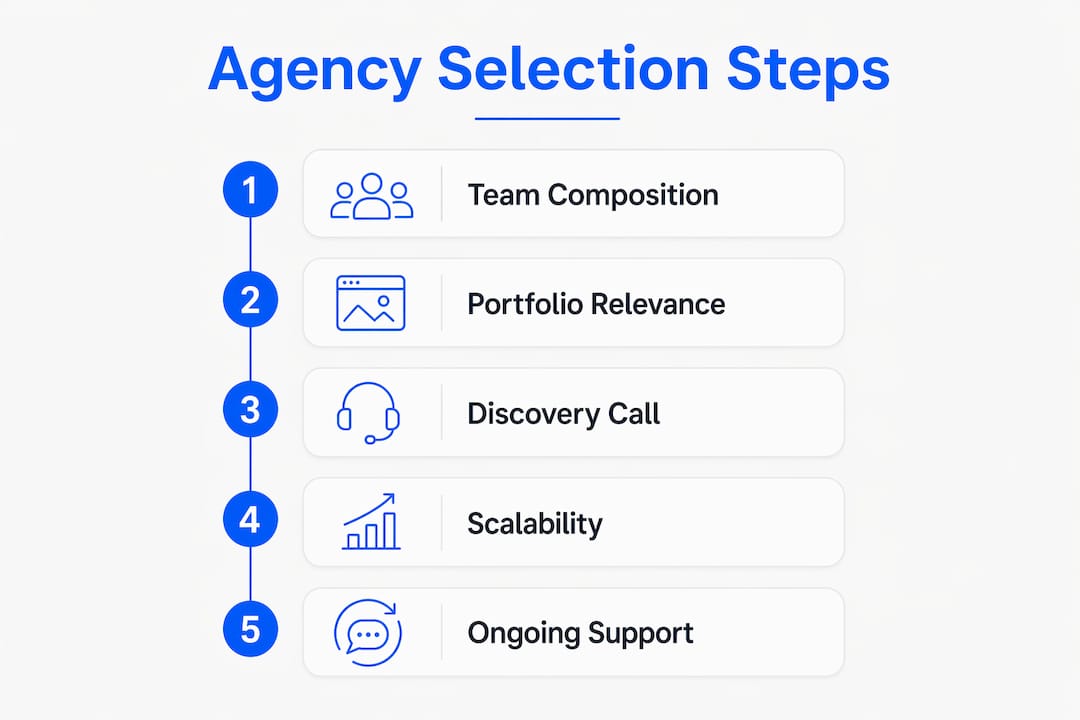
Pricing and timelines vary more than most agencies advertise upfront. Common pricing models include fixed project fees, hourly rates, and ongoing support agreements. A simple site might take a few weeks; a complex AI-enabled application typically runs a significantly longer time. Get a written timeline with milestones before you commit.
Red flags to watch for:
- No dedicated project manager assigned to your account
- Vague answers about post-launch support and maintenance
- Portfolio that shows only visual work with no technical detail
- No questions asked about your existing tech stack or integrations
- Pricing that seems fixed regardless of project complexity
Pro Tip: Request a discovery call focused entirely on your business objectives. If the agency jumps straight to design options, that’s a signal they’re selling a template, not a solution.
Why customized AI solutions deliver results that off-the-shelf tools can’t
Custom AI and automation solutions built into your web platform do something generic tools fundamentally cannot: they fit your actual workflows. An off-the-shelf chatbot answers FAQs. A custom AI agent, built around your product catalog, customer data, and internal processes, can qualify leads, route support tickets, and trigger follow-up sequences without human intervention.
The business outcomes are concrete. Customized AI integration leads directly to streamlined workflows, improved customer interactions, and sharper decision-making. That’s not a promise; it’s what happens when automation is built around real process maps instead of generic use cases.
Specialized agencies also bring something that general web shops typically don’t: the ability to blend AI with UX, SEO, and brand strategy into a single platform. Lounge Lizard describes this as building “conversion-focused digital platforms” where AI-driven search visibility and user experience work together rather than in parallel. That integration is what separates a functional site from one that actually grows revenue.
“The most successful agencies treat AI not as an add-on but as integral to the web development lifecycle for searchability and immediate end-user utility.” — Lounge Lizard
Ongoing adaptation matters just as much as the initial build. A specialized agency doesn’t hand you a finished product and disappear. They monitor performance, refine data sets, and update integrations as your business evolves. That continuous loop is where the real value compounds.
How scalable architecture determines whether your AI investment holds up
Scalability is the factor most businesses overlook until it costs them a full rebuild. Choosing an agency experienced in enterprise-ready technology means your platform can absorb growth, new features, and increased traffic without requiring a ground-up rewrite 18 months later.

In practice, enterprise-grade web architectures for AI solutions use modular coding, API-first designs, and containerized deployments. Each of those choices makes future updates faster and less risky. A monolithic codebase, by contrast, turns every new feature into a surgery.
Integrating AI with platforms like WordPress requires more than installing plugins. Custom development and API integrations are necessary to unlock full automation potential, particularly when connecting to CRMs, data pipelines, or third-party AI services. Ask any agency you’re considering how they handle API versioning and what happens when an upstream service changes its endpoints.
Signs an agency actually understands scalable AI architecture:
- They discuss load testing and performance benchmarks proactively
- They use version-controlled, modular codebases
- They can explain their containerization or cloud deployment approach
- They have a process for monitoring AI model performance over time
- They offer proactive maintenance covering security patches and data refinement
Pro Tip: Ask the agency to describe their most complex integration project. If they can’t explain the technical decisions they made and why, they probably didn’t make them intentionally.
Planning for maintenance from day one changes the economics of a project. Ongoing support contracts keep AI-enhanced platforms secure and performing as the underlying technology evolves. Treating web development as a one-time deliverable is how businesses end up with outdated, vulnerable platforms two years after launch. An AI agent on your website in 2026 needs continuous tuning to stay accurate and useful.
Botiqueai builds AI and automation into your digital platform from the ground up
Most web agencies add AI as an afterthought. Botiqueai builds it in from the start. The difference shows up in how the platform performs six months after launch, not just on demo day.
Botiqueai specializes in custom AI solutions for businesses undergoing digital transformation: custom chatbots, intelligent agents, and workflow automations built on platforms like n8n and Make. These aren’t plug-and-play tools. They’re purpose-built systems designed around your specific processes, customer interactions, and data environment.
For businesses running WordPress sites, Botiqueai brings the API integration expertise that generic developers lack. The Aria AI chatbot is a concrete example: a client-facing assistant built for websites and e-commerce that handles real customer interactions, not scripted FAQ responses. Every project includes a dedicated project manager and ongoing support, so your AI tools stay current as your business grows.
If you’re ready to move from evaluating agencies to actually building something, explore Botiqueai’s AI solutions and request a discovery call to map your automation opportunities.
Key Takeaways
Choosing the right web development agency for AI integration comes down to one thing: finding a partner that builds for where your business is going, not just where it is today.
| Point | Details |
|---|---|
| Business objectives first | Agencies that ask about your goals before proposing technology consistently deliver better AI outcomes. |
| Multi-disciplinary teams | Look for developers, designers, SEO specialists, and project managers working together on every project. |
| Portfolio specificity | Prioritize agencies with proven work in SaaS, intranets, or AI-enabled tools, not just visual design. |
| Scalable architecture | Enterprise-ready, API-first, modular builds prevent costly rewrites as your platform grows. |
| Botiqueai’s approach | Botiqueai builds custom chatbots, intelligent agents, and workflow automations into your platform from day one, with ongoing support included. |