
Agent skills: the manager's guide in 2026
Agent skills: the manager's guide in 2026
Agent skills are no longer a topic reserved for developers. In 2026, every manager who supervises agents, whether human or AI, must understand how these skills are built, evaluated, and optimized. The market is evolving fast: 52,000 skills hosted on a single platform in four months illustrates the scale of the phenomenon. This article gives you the keys to understanding the technical nature of AI agent skills, identifying the essential qualities of human agents, and deploying concrete training strategies for your organization.
Table of contents
- Key takeaways
- Understanding agent skills: definition and architecture
- Key human skills for agents in 2026
- Training and development strategies for agents
- Challenges and best practices in skills management
- My perspective on agent skills and management
- How BotiqueAI can transform your agents
- FAQ
Key takeaways
| Point | Details |
|---|---|
| Modularity above all | Building AI agent skills as independent modules prevents hallucinations and makes maintenance easier. |
| Hard skills and soft skills are inseparable | High-performing human agents combine CRM mastery, data analysis, and emotional intelligence. |
| AI-assisted continuous training | Adaptive learning tools make it possible to personalize skill development at scale. |
| Versioning is mandatory | Versioning and testing each AI agent skill is a non-negotiable condition for reliable governance. |
| The manager becomes an orchestrator | Supervising a hybrid team of humans and AI agents requires a new managerial skill set centered on judgment. |
Understanding agent skills: definition and architecture
An agent skill is not just a prompt. Technically, an agent skill is a structured directory containing a SKILL.md file with a YAML frontmatter and a Markdown body. Metadata is limited to 1024 characters for the description, and the name must remain in lowercase with a maximum of 64 characters. This rigor is not anecdotal: it forces a precise definition of each skill's scope.
What distinguishes a skill from a traditional prompt is the progressive disclosure mechanism. Rather than loading all instructions at once into the agent's context, skills use four steps: announce the capability, load the instructions, read the necessary resources, then execute the scripts. This pattern saves memory and reduces processing errors.
The five main design patterns
To structure your agents' skill set efficiently, five design patterns stand out in practice:
- Pipeline: chains sequential steps for predictable tasks, such as lead qualification.
- Reference: the skill points to external resources (knowledge bases, APIs) without integrating them directly.
- Generator: produces content or configurations on demand, useful for personalization at scale.
- Orchestrator: coordinates several sub-agents or sub-skills, each specialized in a specific task.
- Automation: triggers actions in third-party systems without human intervention, for example a CRM update.
The modularity of skills is what distinguishes a high-performing AI agent from a mediocre one. A monolithic agent that receives 200 instructions in a single prompt will drift, forget directives, and produce inconsistent results. An agent built from independent skills remains predictable and testable.
Pro tip: Before creating a new skill, ask yourself whether the task can be split into two distinct functional units. If so, create two skills rather than one. You will gain in clarity and testability.
Key human skills for agents in 2026
The essential qualities of human agents in customer service and sales fall into two complementary categories today. Neither one is enough on its own.

Technical hard skills
Sales and customer service agents must master a specific set of technical skills:
- CRM tool mastery: rigorous data entry, reading customer history, leveraging automatic alerts.
- KPI interpretation: first-contact resolution rate, NPS, average handling time. An agent who does not understand their own metrics cannot improve.
- AI tool integration: using automatic suggestions, AI-generated conversation summaries, and sentiment alerts without losing track of the interaction.
- Communication skills for digital agents: clear written communication, adapting tone to the channel (chat, email, phone).
Decisive soft skills
Hard skills and soft skills are complementary, and emotional intelligence remains as crucial as technical mastery, particularly for sales reps. Empathy, active listening, and stress management under pressure form the foundation of the high-performing agent's abilities.
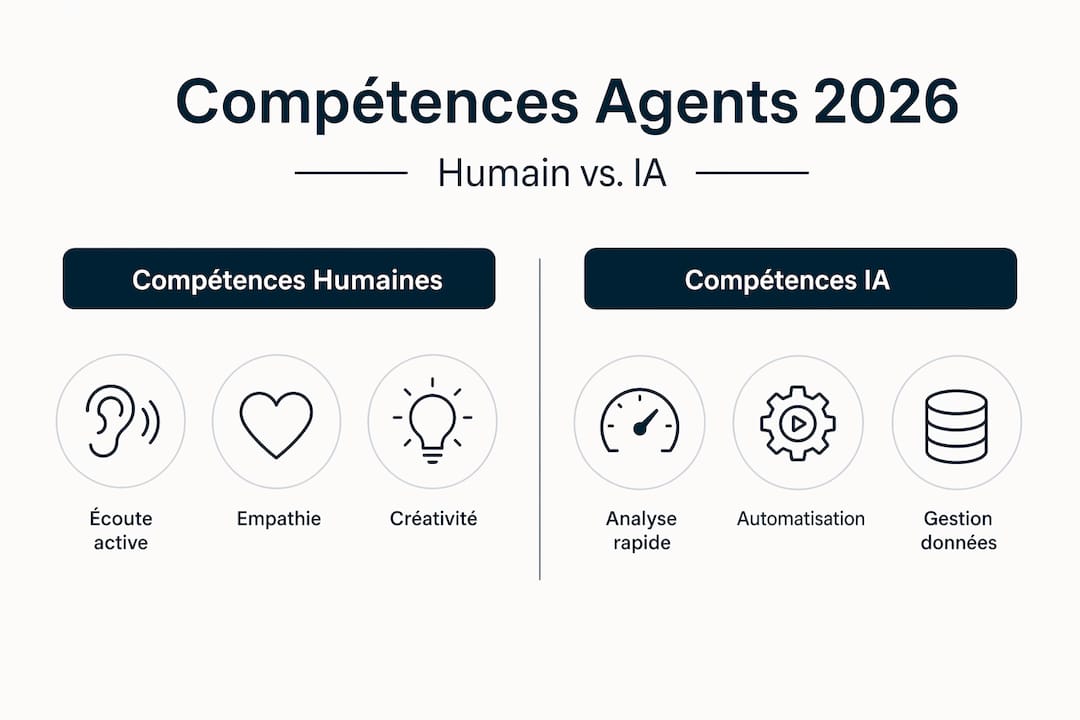
To evaluate these qualities, the most reliable methods remain role-playing scenarios, simulations, and 360-degree feedback. A standard interview is not enough to measure how an agent reacts to an angry customer or an ambiguous situation.
The impact on performance is direct. An agent who combines these two dimensions handles more cases, generates fewer escalations, and contributes to a better customer experience. The real-world AI customer service use cases at companies like Ralph Lauren and Telus show that human agents augmented by AI achieve significantly better results than those who work without assistance.
Pro tip: Create an evaluation grid that assigns a score to each soft skill during role-play sessions. Make the criteria visible to the agent being evaluated before the simulation. Transparency improves engagement and progression.
Training and development strategies for agents
Training agents, whether human or AI, no longer boils down to a two-day classroom session. Modern approaches rely on dynamic systems that adapt continuously.
Skill ontologies and knowledge graphs
A skill ontology is a structured mapping of the knowledge and know-how required in your organization. It links each skill to roles, mastery levels, and progression paths. At Unilever, the adoption of dynamic skills management coupled with agentic AI reduced hiring time from 4 months to 2 weeks, with a 16% improvement in recruitment quality. That is a result that should convince skeptics.
For managers, here are the concrete levers to activate:
- Adaptive learning platforms: they analyze each agent's gaps and propose targeted modules, reducing unnecessary training time.
- Real-time monitoring: dashboards that track the evolution of skills by agent, by team, and by period make it possible to anticipate needs before they become problems.
- Immediate feedback after interactions: AI conversation analysis tools can automatically flag situations where an agent missed an opportunity or mishandled an objection.
- Skill sharing between AI agents: modular skills platforms make it possible to reuse proven skills from one agent to another, accelerating the deployment of new capabilities.
For managers who supervise hybrid teams, the central question is task allocation. Which interactions should be entrusted to an AI agent? Which absolutely require a human? The answer depends on the emotional complexity of the situation and the level of judgment required. A guide to integrating AI into your business without technical skills can help establish that decision framework.
Pro tip: Define a delegation matrix: task complexity on one axis, relational risk on the other. Simple and low-risk tasks go to AI agents. Complex and sensitive situations stay with humans. Review this matrix every quarter.
Challenges and best practices in skills management
Managing agent skills comes with real pitfalls that many organizations discover too late.
Main risks to monitor
| Risk | Observable symptom | Best practice |
|---|---|---|
| Instruction overload | The agent produces inconsistent responses or forgets directives | Break down into independent modular skills |
| No versioning | Impossible to roll back to a stable version after an update | Version each skill like a software asset |
| Behavioral drift | The agent adopts unintended behaviors over time | Regular testing on edge cases and extreme scenarios |
| Decision opacity | Neither the customer nor the manager understands why the agent made a decision | Decision logging and active human oversight |
Agent skills must be versioned and tested on edge cases, and maintained as full-fledged organizational assets. This is not a theoretical recommendation. An unversioned skill that receives a poorly calibrated update can degrade service quality across thousands of interactions before the problem is detected.
Legal and ethical considerations deserve particular attention. Transparency with customers about the use of AI agents is now a requirement in many European regulatory contexts. Human oversight remains mandatory for high-impact decisions, such as a refund refusal or a dispute escalation.
Continuous integration of skills and their governance are essential to prevent drift and guarantee interaction quality. Organizations that treat their skills as code, with reviews, tests, and controlled deployments, achieve far better results than those who manage them informally.
My perspective on agent skills and management
I have supported several organizations in integrating AI agents over the past few years, and what strikes me most is the resistance to breaking things down. Managers want an agent that "does everything." They create a 300-line prompt, call it a "sales agent," and then wonder why the results are unpredictable.
What I have learned is that the manager of tomorrow will be an architect of a hybrid system, combining humans and AI agents with a fine-grained distribution of roles. This is not a futuristic vision. It is what the highest-performing teams are already doing today.
My most concrete piece of advice: start by mapping your agents' interactions over a week. Identify the five most repetitive tasks. These are your first candidates for modularization into AI skills. Keep complex situations for your human agents, and invest in their soft-skills training rather than in additional tools. The tool does not replace judgment. It amplifies it.
— BotiqueAI
How BotiqueAI can transform your agents
You now have a clear understanding of what agent skills cover, both human and AI. The next step is taking action in your organization.
BotiqueAI designs custom intelligent agents for companies that want to go further than generic solutions. Whether you need to automate lead qualification, improve your customer service responsiveness, or deploy modular AI agents tailored to your business processes, BotiqueAI's solutions cover the entire cycle. The agents developed by BotiqueAI incorporate the modularity and versioning principles described in this article, with human support at every stage of deployment. For e-commerce teams, BotiqueAI's WhatsApp Business chatbot makes it possible to manage customer interactions at scale without sacrificing the quality of the relationship.
FAQ
What exactly is an agent skill?
An agent skill is a self-contained module containing instructions, resources, and executable scripts, structured in a SKILL.md file with a YAML frontmatter. It allows the capabilities of an AI agent to be extended in a targeted and reusable way.
What are the key skills of a human agent in 2026?
The best human agent skills combine CRM tool mastery and KPI analysis on the technical side, with empathy, active listening, and stress management on the soft-skills side. Both dimensions are inseparable for performance in customer service and sales.
Why is modularity so important for AI agents?
An AI agent whose instructions are all concentrated in a single prompt produces inconsistent responses that are difficult to correct. Modularity makes it possible to test, version, and update each skill independently, which guarantees reliability at scale.
How can you effectively train human agents on new skills?
The most effective approaches combine adaptive learning platforms, immediate feedback after interactions, and regular role-play scenarios. Evaluation through role-plays and 360-degree feedback remains the most reliable method for measuring soft skills.
What are the main risks in managing agent skills?
The major risks are instruction overload, lack of versioning, behavioral drift, and a lack of decision transparency. Rigorous governance, with regular tests on edge cases and active human oversight, makes it possible to keep them in check.