The Corporate AI Audit Checklist: 2026 Enterprise Guide
The Corporate AI Audit Checklist: 2026 Enterprise Guide
A corporate AI audit must start with a complete model inventory and risk-tiered checks across technical performance, data lineage, security, governance, operations, and reporting to be genuinely audit-ready. That is the bottom line. Everything else in this checklist builds on those two anchors.
Here are the top-level checkpoints your audit team needs to cover:
- Model inventory and registry: Every AI system named, owned, and risk-tiered before any testing begins
- Technical validation: Performance benchmarks, edge-case tests, robustness checks, and explainability artifacts
- Data lineage and privacy: Provenance records, PII/PHI classification, consent logs, and training-vs-production alignment
- Vendor and third-party controls: Contract clauses, continuous monitoring evidence, and exit/portability documentation
- Security and adversarial risk: Access controls, secrets management, prompt injection reviews, and red-team outputs
- Monitoring and drift detection: Alerting thresholds, drift baselines, rollback procedures, and incident playbooks
- Evidence and reporting: Severity taxonomy, remediation owners, and an auditor-ready evidence package
Executive verdict: If your organization cannot produce a named owner, minimum evidence, and a reassessment trigger for each of those checkpoints, you are not audit-ready. Start with the inventory. Everything else follows.
Key Takeaways
A corporate AI audit that starts with a complete, risk-tiered model inventory and produces operating evidence for each control is the only kind that holds up under regulatory scrutiny.
| Point | Details |
|---|---|
| Inventory is the prerequisite | Build a complete model registry with named owners and risk tiers before any other audit work begins. |
| Evidence beats policy | Every control requires documented proof it operates, not just a written policy, per the Paul Okhrem governance standard. |
| Phase your effort by risk | Allocate roughly 60% of audit depth to high-risk systems; use sampling for low-risk systems on a rotating basis. |
| Monitoring must show real alerts | A dashboard with no alert history is a finding, not evidence of control. |
| Botiqueai accelerates the process | Botiqueai’s readiness assessment, audit engagement, and ongoing monitoring subscription move teams from gap identification to operating controls. |
Table of Contents
- What does an AI audit checklist for corporations cover, phase by phase?
- How do you run the technical checks: metrics, robustness, and explainability?
- What does a data audit actually require?
- How do governance artifacts and vendor controls map to NIST AI RMF and ISO 42001?
- What security controls and adversarial tests does an AI audit require?
- How do you prove your AI monitoring actually works?
- How do you triage findings and report to executives and regulators?
- What are the best practices for running AI audits at scale?
- Which tools and frameworks accelerate an AI audit?
- How do you run the checklist in practice: sampling, scoring, and cadence?
- How Botiqueai approaches AI readiness and practical audits
- Quick audit scorecard: 12 checks for a site visit or internal review
- When should an audit be internal vs. external?
- Botiqueai helps you go from audit-exposed to audit-ready
- Sources
What does an AI audit checklist for corporations cover, phase by phase?
A phased approach keeps large audit programs from collapsing under their own scope. The structure below runs five phases, each with checklist items and minimum evidence examples. Use the risk-priority guideline at the end to allocate depth.
Phase 0: Preparation
Scope and stakeholders
- Define audit boundaries: which systems, business units, and geographies are in scope
- Confirm executive sponsor and name a governance lead with sign-off authority
- Identify control owners for each AI system (model owner, data owner, security lead, compliance officer)
- Set the audit timeline with milestone dates and evidence submission deadlines
Model registry and inventory
- Build or validate the model registry: system name, version, owner, business purpose, data inputs, and deployment environment
- Flag shadow AI: tools adopted without IT or governance review (discovery tooling helps here; see Section 10)
- Assign a risk tier (high/medium/low) to each system using criteria such as regulatory exposure, decision autonomy, and business impact
- Minimum evidence: Completed registry spreadsheet or CMDB entry, signed risk-tier assignment, and a list of out-of-scope systems with rationale
Evidence requirements and timeline
- Define what “complete” means for each control: a named owner, documented evidence, a decision threshold, and a reassessment trigger. The AI Governance Checklist for Enterprises by Paul Okhrem makes this the minimum definition of a complete control.
- Agree on evidence formats (logs, screenshots, signed approvals, test outputs) and storage location
- Schedule evidence collection windows by phase
Phase 1: Technical assessment
- Retrieve or create the model card for each in-scope system
- Run performance benchmarks against agreed thresholds (accuracy, AUC, precision/recall, calibration)
- Execute edge-case and stress tests; document failure modes
- Conduct robustness checks: distribution-shift scenarios, adversarial input tests
- Verify explainability artifacts: SHAP or LIME outputs, counterfactual examples, decision audit trails
- Minimum evidence: Benchmark report, test case log with pass/fail results, explainability output files
Phase 2: Risk and compliance
- Classify data assets: PII, PHI, PCI, and confidential business data
- Map data flows against privacy obligations (GDPR for EU data subjects, HIPAA for health data, CCPA for California residents)
- Check alignment with NIST AI RMF functions (Govern, Map, Measure, Manage) and ISO 42001 elements
- Screen for EU AI Act prohibited practices if any systems touch EU markets; note that high-risk conformity programs realistically take 12–24 months
- Review vendor and third-party AI contracts for audit rights, data handling clauses, and exit provisions
- Minimum evidence: Data classification register, privacy impact assessment, framework mapping matrix, vendor contract excerpts
Phase 3: Operational review
- Confirm monitoring is live: performance metrics, fairness metrics, latency, and error rates are all instrumented
- Validate drift detection: baseline captured, alerting rules configured, regression tests scheduled
- Review human oversight procedures: who can override, pause, or roll back each system
- Audit access controls: least-privilege enforcement, API key rotation logs, identity entitlement review
- Check runbooks: incident playbook exists, roles are assigned, rollback/kill-switch procedure is documented
- Minimum evidence: Monitoring dashboard screenshots, alert configuration exports, access review logs, signed runbook
Phase 4: Reporting and remediation
- Triage findings using a severity taxonomy (critical, high, medium, low) tied to business impact and regulatory exposure
- Assign a named owner and remediation deadline to every finding
- Compile the evidence package: test artifacts, logs, approvals, and a signed executive summary
- Present residual risk decisions with documented acceptance rationale
- Minimum evidence: Findings report, remediation tracker, evidence package index, signed residual-risk acceptance
Risk-priority guideline: High-risk systems (autonomous decisions, regulated data, external-facing) get full-depth coverage across all five phases. Medium-risk systems can skip adversarial red-team exercises but still require technical benchmarks and data classification. Low-risk internal tools need inventory, owner assignment, and basic monitoring confirmation only. Allocate the majority of audit effort to high-risk systems regardless of how many there are.
How do you run the technical checks: metrics, robustness, and explainability?
Technical validation is where most corporate AI assessments expose their weakest evidence. Auditors want numbers, not narratives.
Core metrics and when to use them
| Metric | Purpose | Minimum evidence to collect |
|---|---|---|
| Accuracy | Overall correctness for classification tasks | Confusion matrix on held-out test set |
| AUC-ROC | Discrimination ability across thresholds | ROC curve plot, AUC score with confidence interval |
| Precision / Recall | Trade-off between false positives and false negatives | Precision-recall curve; business cost of each error type documented |
| Calibration | Whether predicted probabilities match actual outcomes | Reliability diagram; Brier score |
| F1 Score | Balanced metric for imbalanced classes | F1 by class; macro and weighted averages |
| Latency / throughput | Operational SLA compliance | latency logs under production load |
Choose metrics based on the cost asymmetry of errors. A fraud detection model where a missed fraud costs ten times more than a false alert should be evaluated primarily on recall, not accuracy.
Robustness tests
Robustness testing answers one question: does the model break when conditions shift? Four test types cover most enterprise scenarios.
- Adversarial inputs: Deliberately crafted inputs designed to fool the model. For LLMs, this means prompt injection attempts. For image classifiers, pixel perturbations. Document the attack surface and the model’s failure rate.
- Distribution-shift scenarios: Feed the model data from a different time period, geography, or demographic segment than the training set. Measure performance degradation.
- Stress tests: Push the system to volume and latency limits. Record where it degrades or fails.
- Red-team exercises: A small team attempts to elicit harmful, biased, or policy-violating outputs. Capture all successful exploits as findings.
Explainability checks
Explainability is not optional for high-risk systems. Regulators and internal audit committees increasingly expect it. SHAP (SHapley Additive exPlanations) and LIME (Local Interpretable Model-agnostic Explanations) are the two most widely used feature-attribution methods. Run SHAP on your top-performing model and verify that the features driving predictions align with the business rationale. If a credit-scoring model weights zip code heavily, that is a fairness and legal exposure issue, not just a technical curiosity.
Counterfactual tests ask: “What would need to change for this decision to flip?” They are particularly useful for demonstrating compliance with adverse-action notice requirements under the Equal Credit Opportunity Act (ECOA) and similar regulations.
Pro Tip: *When selecting edge cases for testing, prioritize scenarios where the business cost of an error is highest, not scenarios that are merely statistically rare.
What does a data audit actually require?
Data is where most AI risk originates and where evidence is hardest to produce. The AI compliance checklist from Strac makes this point directly: policies are easy to write, but evidence of actual data controls is the real deliverable.
Provenance and lineage
- Trace each training dataset to its original source: internal database, third-party vendor, public dataset, or synthetic generation
- Document every transformation step: cleaning scripts, feature engineering logic, aggregation rules
- Verify retention policies: confirm data used in training is still within its authorized retention window
- Check ingestion pipeline logs for completeness and integrity (row counts, checksums, timestamps)
Data quality checks
- Missing data: Measure missingness rates by feature; flag any feature above a threshold agreed with the model owner (commonly 5–10%)
- Label error rates: For supervised models, sample labels and verify accuracy. Tools like Cleanlab can automate label-error detection.
- Sampling bias: Compare the demographic and temporal distribution of training data against the production population. Document any gaps.
- Class imbalance: Record class distribution; confirm the model’s training approach (oversampling, undersampling, weighted loss) is documented and appropriate for the use case
For a deeper look at building the data foundation that makes these checks tractable, the AI data strategy guide from Botiqueai covers data governance and quality processes in detail.
Privacy checks
- Classify all data assets: PII (names, emails, SSNs), PHI (health records), PCI (payment card data), and confidential business data
- Verify data minimization: confirm the model uses only the data it actually needs, not everything available
- Check consent records: for consumer-facing models, confirm the data subjects consented to the use case
- Validate pseudonymization and encryption: data at rest encrypted (AES-256 or equivalent), data in transit over TLS 1.2+, and re-identification risk assessed
Sample data tests and artifacts to collect
- Pull a stratified random sample (minimum 500 records for medium-risk systems, 2,000+ for high-risk) and manually verify labels, feature values, and PII handling
- Capture data snapshots at the time of audit as evidence of the production data distribution
- Collect pipeline logs showing the last three ingestion runs with row counts and error rates
- Document the mapping between training features and their source systems
Statistic callout: The Strac AI compliance checklist identifies shadow AI discovery and data-agent access mapping as the hardest steps in any compliance program, not policy writing. Most organizations underestimate the gap between having a data governance policy and being able to prove it works.
How do governance artifacts and vendor controls map to NIST AI RMF and ISO 42001?
Governance without evidence is just paperwork. Every control needs a named owner, documented evidence, a decision threshold, and a trigger for reassessment. That four-part structure, drawn from the Paul Okhrem enterprise governance checklist, is the minimum definition of a complete control for any serious audit.
Inventory and accountability
- Name the accountable executive for AI governance (typically the Chief Risk Officer, Chief Data Officer, or a designated AI Governance Lead)
- Assign a control owner for each item in the model registry
- Maintain a RACI matrix covering governance, technical, data, security, and compliance roles
- Record review dates and version history for all governance artifacts
Framework mapping
The table below maps common audit control areas to NIST AI RMF functions and ISO 42001 elements. Use it to confirm coverage and identify gaps.
For EU-market systems, layer the EU AI Act compliance checklist on top of this mapping. Start by screening for prohibited practices, then classify risk tiers, and then follow the high-risk conformity program. Build the 12–24 month timeline into your remediation plan from day one.
Vendor and third-party review
- Inventory all third-party AI tools and APIs in use, including shadow AI discovered during Phase 0
- Review contracts for: audit rights, data handling obligations, breach notification timelines, and model change notification requirements
- Confirm portability and exit evidence: can you extract your data and model artifacts if the vendor relationship ends?
- Set a continuous monitoring cadence for high-risk vendors (quarterly review minimum)
Roles and responsibilities
- Governance lead: Owns the framework, maintains the control register, and signs off on the overall audit report
- Model owner: Accountable for technical performance, drift monitoring, and model card accuracy
- Data owner: Responsible for lineage documentation, classification, and privacy compliance
- Security lead: Signs off on access controls, encryption, and adversarial test results
- Compliance officer: Verifies regulatory mapping, manages residual risk acceptance, and owns regulator-facing documentation
The AI governance framework guide from Botiqueai covers how to structure these roles and design controls that hold up under scrutiny.
What security controls and adversarial tests does an AI audit require?
Security for AI systems goes beyond standard IT controls. Models, training data, and inference interfaces each introduce attack surfaces that traditional security audits miss.
Access control audit
- Enforce least-privilege access: each role accesses only the data and model components it needs
- Rotate API keys and secrets on a defined schedule; confirm rotation logs exist
- Review identity and entitlement records: who has access to model weights, training data, and inference endpoints?
- Verify that service accounts used by AI pipelines have scoped permissions, not broad admin rights
- Collect evidence: access review sign-off, key rotation logs, entitlement export from your identity provider
Infrastructure and model protection
- Confirm encryption at rest (AES-256 or equivalent) for model weights, training datasets, and inference logs
- Verify TLS 1.2+ for all data in transit between model components, APIs, and downstream systems
- Check network segmentation: AI inference endpoints should not be reachable from general corporate networks without authentication
- Protect model weights from unauthorized extraction: confirm storage access policies and audit logs on model artifact repositories
Adversarial risk tests
- Prompt injection reviews (LLMs): Attempt to override system prompts, extract training data, or cause the model to ignore safety guardrails. Document successful injections as critical findings.
- Data poisoning checks: Review the data ingestion pipeline for unauthorized modification points. Confirm integrity checks (checksums, signed datasets) are in place.
- Model inversion and extraction: Test whether an attacker with API access could reconstruct training data or replicate the model. Relevant for models exposed via public APIs.
- Supply chain attacks: Review dependencies (open-source libraries, pre-trained model weights) for known vulnerabilities using tools like Dependabot or Snyk.
Logs and SIEM integration
Auditors expect logs to be forwarded to a SIEM (Security Information and Event Management) platform in near real-time. Minimum log types to collect:
- Inference request logs (inputs, outputs, timestamps, user IDs)
- Model pipeline execution logs (data ingestion, training runs, deployment events)
- Access and authentication logs for all AI infrastructure components
- Alert and anomaly detection logs from monitoring systems
Present SIEM integration evidence as a screenshot of the log forwarding configuration plus a sample alert that fired and was investigated.
How do you prove your AI monitoring actually works?
Deploying a model is not the end of the audit cycle. Production monitoring is where most governance programs have the thinnest evidence. The CTAIO enterprise AI audit checklist ties audit cadence directly to risk tier, which is the right way to think about it.
Monitoring checklist
- Performance metrics: Accuracy, AUC, or task-specific KPIs tracked in production with alert thresholds set at agreed degradation levels
- Fairness metrics: Demographic parity, equalized odds, or calibration by subgroup, monitored on a defined schedule
- Latency and error rates: p95 latency and HTTP error rates tracked with SLA thresholds; alerts fire when thresholds are breached
- Data drift: Statistical tests (Population Stability Index, Kolmogorov-Smirnov) run on incoming feature distributions against the training baseline
- Concept drift: Model output distribution monitored for shifts that indicate the underlying relationship has changed
Drift detection and alerting
Capture a baseline distribution of input features and model outputs at deployment. Run drift tests on a schedule tied to risk tier: daily for high-risk systems, weekly for medium-risk, monthly for low-risk. When drift exceeds the agreed threshold, trigger an alert that routes to the model owner and the governance lead. Document the alert configuration as evidence.

Incident playbook
Every production AI system needs a written incident playbook. At minimum, it should cover:
- Roles: Who declares an incident, who investigates, who communicates to stakeholders
- Timelines: Time-to-acknowledge (commonly 15–30 minutes for critical), time-to-resolve SLA by severity
- Rollback procedure: Step-by-step instructions to revert to the previous model version or disable the system
- Kill-switch: A documented, tested procedure to halt inference immediately if the system causes harm
- Notification requirements: Which regulators, customers, or internal stakeholders must be notified, and within what timeframe
- Postmortem: Required within 5 business days of resolution; captures root cause, timeline, and corrective actions
For detailed guidance on post-deployment monitoring and evidence capture, the post-implementation AI audit process guide from Botiqueai covers the operational side in depth.
Pro Tip: The fastest way to prove your monitoring works to an auditor is to show a real alert that fired, the investigation record, and the resolution. A dashboard with no alert history looks like a system that has never been tested.
How do you triage findings and report to executives and regulators?
A finding without an owner and a deadline is just a note. The reporting phase converts audit observations into a managed remediation program.
Severity taxonomy
- Critical: Immediate regulatory exposure, active harm potential, or a control failure that invalidates the audit. Requires executive notification within 24 hours and a remediation plan within 72 hours.
- High: Significant risk to data privacy, model integrity, or compliance posture. Remediation plan required within 2 weeks; resolution within 60 days.
- Medium: Control gaps that increase risk but do not create immediate exposure. Remediation plan within 30 days; resolution within 90 days.
- Low: Documentation gaps, process improvements, or best-practice deviations with minimal risk impact. Tracked in the next audit cycle.
Remediation matrix
- For each finding: document the control gap, the business impact, the named owner, the estimated effort (hours/days), and the verification step that confirms remediation
- Assign a unique finding ID so the tracker can be referenced in regulator communications
- Set a verification date: the owner must demonstrate the fix is in place, not just planned
- Track open findings in a shared tool (Jira, ServiceNow, or equivalent) with automated reminders
Report structure
An auditor-ready report should include:
- Executive summary: One page covering scope, methodology, top findings by severity, and overall risk posture
- Findings register: Full list of findings with severity, owner, deadline, and current status
- Evidence package index: List of all attached artifacts (test outputs, logs, screenshots, signed approvals) with file names and locations
- Framework mapping: Confirmation of coverage against NIST AI RMF, ISO 42001, and any applicable regulations
- Residual risk statement: Named risks that will not be remediated in this cycle, with documented acceptance rationale and the executive who accepted them
Presenting residual risk clearly is often what separates a credible audit report from one that regulators push back on. Regulators understand that not every gap closes immediately. What they do not accept is an undocumented gap.
What are the best practices for running AI audits at scale?
The difference between a one-time audit and a repeatable program is team structure, tooling, and process discipline.
Team structure
- Central governance lead: Owns the audit framework, maintains the control register, and coordinates across business units. This role needs executive sponsorship to function. The AI transformation champions guide from Botiqueai explains why governance sponsors are the single most important factor in making programs stick.
- Distributed control owners: Each business unit or product team owns the evidence for its AI systems. Central governance sets the standard; distributed owners collect the proof.
- Independent auditor: For high-risk systems or regulatory submissions, an auditor who did not build the system should review the evidence. Internal audit teams can fill this role if they have the technical skills; external assessors are preferable for systems under active regulatory scrutiny.
- Cadence responsibilities: High-risk systems audited pre-deployment and then quarterly in production. Medium-risk systems audited pre-deployment and annually. Low-risk systems audited at deployment and on a trigger basis (material change, incident, or regulatory inquiry).
Automation
- Use discovery tools to continuously scan for new AI deployments and shadow AI, not just at audit time
- Automate test execution: regression tests, drift checks, and fairness metric calculations should run on a schedule and push results to a shared dashboard
- Capture audit evidence automatically where possible: log exports, test outputs, and access review results should flow into the evidence repository without manual steps
- Integrate with SIEM and ticketing: alerts from monitoring systems should automatically create tickets in your remediation tracker
Living policies and change triggers
Policies that are not updated when systems change are a liability, not an asset. Define change triggers that automatically initiate a re-audit: a new model version, a change in training data, a new use case, a regulatory update, or a production incident above a defined severity threshold.
Pro Tip: When auditing many systems with limited bandwidth, tier your depth by risk and use a sampling approach for low-risk systems. You get continuous signal without burning the team.
Which tools and frameworks accelerate an AI audit?
Frameworks
- NIST AI RMF: The foundational U.S. framework. Its four functions (Govern, Map, Measure, Manage) map directly to audit phases and provide a vocabulary regulators and auditors recognize.
- ISO 42001: The international standard for AI management systems. Particularly useful for organizations with global operations or EU market exposure.
- EU AI Act: Relevant for any system touching EU data subjects or deployed in EU markets. Use the EU AI Act compliance checklist to screen for prohibited practices and classify risk tiers before running the full audit.
- SOC 2: Where AI systems process customer data, SOC 2 Type II provides a recognized evidence framework for security and availability controls.
- GDPR / CCPA: Privacy regulations that impose specific obligations on automated decision-making, data subject rights, and consent management.
Tool categories by audit phase
- Discovery and shadow AI detection: Tools that scan cloud environments, SaaS subscriptions, and network traffic to identify AI tools in use. Relevant in Phase 0.
- Data classification and DLP (Data Loss Prevention): Platforms that automatically classify data assets and flag PII/PHI exposure. Relevant in Phase 2.
- Model testing frameworks: Open-source libraries for bias testing (Fairlearn, AI Fairness 360), robustness testing (Foolbox, TextAttack for NLP), and performance benchmarking. Relevant in Phase 1.
- Monitoring and observability: Platforms that track model performance, data drift, and fairness metrics in production. Relevant in Phase 3.
- Evidence capture and GRC platforms: Governance, Risk, and Compliance tools that centralize control evidence, map to frameworks, and generate audit-ready reports. Relevant across all phases.
How to choose tools
Three criteria matter most. First, SIEM integration: the tool must forward logs and alerts to your existing security infrastructure without manual export. Second, audit evidence export: the tool must produce artifacts (reports, logs, screenshots) in a format auditors accept. Third, least-privilege enforcement: the tool itself must not require broad admin access to your AI infrastructure.
The Microsoft AI Readiness Assessment and the Cisco AI Readiness Index are both useful starting points for scoping tool gaps across governance, infrastructure, data, and model management dimensions before committing to a tooling investment.
How do you run the checklist in practice: sampling, scoring, and cadence?
Sampling guideline
- For high-risk systems, test the full production dataset slice from the most recent 90 days plus a stratified sample covering demographic subgroups, edge cases, and peak-load periods.
- For medium-risk systems, a stratified random sample of 10–15% of production records from the last 90 days is sufficient, provided the sample covers known edge-case categories.
- For low-risk systems, a spot check of 100–200 records plus a review of the last three pipeline run logs is adequate.
- Always include records that triggered past alerts or complaints. These are the highest-value test cases and are often excluded from standard samples.
Evidence checklist
- Signed model card or equivalent documentation
- Benchmark test output with pass/fail against agreed thresholds
- Data classification register with PII/PHI flags
- Access review sign-off from the identity team
- Monitoring dashboard screenshot with alert configuration visible
- Incident log (even if empty, confirm it is being maintained)
- Vendor contract excerpt confirming audit rights
- Residual risk acceptance signed by the accountable executive
Scoring rubric
Convert findings into a red/amber/green (RAG) score per control area:
- Green: All evidence present, no findings, or only low-severity findings resolved
- Amber: Medium findings open with active remediation plans and owners assigned
- Red: Critical or high findings open without a remediation plan, or evidence missing for a required control
Trigger escalation to the executive sponsor when any control area scores red, or when three or more amber findings cluster in the same system. Do not wait for the final report.
Recommended audit cadence
- Pre-deployment: Full five-phase audit before any high-risk or medium-risk system goes to production
- Production cadence: High-risk systems quarterly; medium-risk systems annually; low-risk systems on a rotating 20% sample per quarter
- Event-driven re-audits: Material model change, new training data, production incident above severity threshold, regulatory inquiry, or a significant change in the system’s use case
How Botiqueai approaches AI readiness and practical audits
A corporate AI audit is only as good as the organizational infrastructure behind it. Botiqueai frames AI readiness across six pillars that map directly to audit scope: strategy, governance, data, infrastructure, model management, and organization. That structure aligns with both the Microsoft AI Readiness Assessment (seven pillars including AI governance and security) and the Cisco AI Readiness Index (six dimensions from strategy through culture), which use tiered scoring to show where organizations should focus next.
What distinguishes a practitioner-led audit from a compliance checkbox exercise is the emphasis on operating evidence over policy documents. As the Strac AI compliance checklist notes, most organizations can write a policy in a day. Producing evidence that the policy is actually followed is where programs stall.
Botiqueai’s audit engagements produce five core deliverables:
- Inventory register: A complete model registry with risk tiers, owners, and data classifications
- Findings report: Severity-tiered findings with named owners, remediation timelines, and verification steps
- Remediation plan: Prioritized action list with effort estimates and milestone dates
- Monitoring dashboard: Live observability for performance, fairness, and drift, integrated with the client’s SIEM
- Evidence pack: Auditor-ready artifacts organized by control area and framework mapping
The most common gap we see is not a missing policy. It is a monitoring system that has never fired an alert, a model registry that was built once and never updated, and a vendor contract that grants audit rights no one has ever exercised. Closing those three gaps moves most organizations from audit-exposed to audit-ready faster than any framework mapping exercise.
The goal is not a one-time audit. Botiqueai operationalizes audit findings into ongoing controls: automated regression tests, scheduled drift checks, and a living evidence repository that updates continuously rather than scrambling before the next audit cycle.
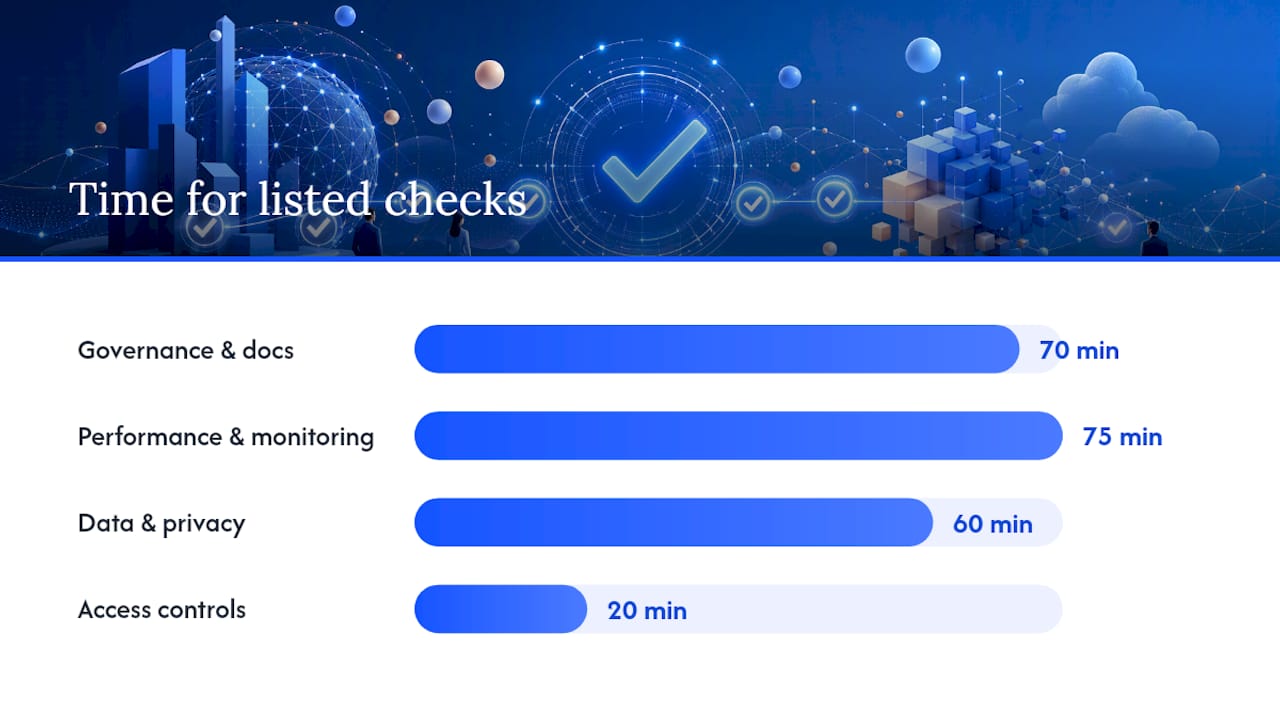
Quick audit scorecard: 12 checks for a site visit or internal review
Use this scorecard for a rapid internal check or a field visit. Each item has a pass/fail/needs-evidence rating and a time estimate.
- 1. Model registry complete (30 min): Every in-scope system has a named owner, risk tier, and version record. Pass / Fail / Needs evidence
- 2. Risk tiers assigned and documented (20 min): Each system has a written risk-tier rationale signed by the governance lead. Pass / Fail / Needs evidence
- 3. Model card or equivalent exists (20 min): Technical documentation covers purpose, inputs, outputs, known limitations, and performance benchmarks. Pass / Fail / Needs evidence
- 4. Performance benchmarks on file (45 min): Benchmark report exists with results against agreed thresholds; dated within the last audit cycle. Pass / Fail / Needs evidence
- 5. Data classification register current (30 min): All training and production data assets classified; PII/PHI flagged and controls documented. Pass / Fail / Needs evidence
- 6. Privacy controls verified (30 min): Consent records, pseudonymization, and encryption evidence on file. Pass / Fail / Needs evidence
- 7. Access review completed (20 min): Least-privilege review signed off; API key rotation logs available. Pass / Fail / Needs evidence
- 8. Monitoring live with alerts configured (30 min): Dashboard shows live metrics; at least one alert has fired and been investigated in the last 90 days. Pass / Fail / Needs evidence
- 9. Drift detection baseline captured (20 min): Baseline distribution documented; drift alerting rules configured and tested. Pass / Fail / Needs evidence
- 10. Incident playbook signed and tested (20 min): Playbook exists, roles are assigned, and rollback procedure has been tested. Pass / Fail / Needs evidence
- 11. Vendor contracts reviewed (45 min): Audit rights, data handling, and exit clauses confirmed for all third-party AI tools. Pass / Fail / Needs evidence
- 12. Residual risk accepted in writing (20 min): Any open findings have documented acceptance rationale signed by the accountable executive. Pass / Fail / Needs evidence
Total estimated time: 5–6 hours for a single system; scale by the number of in-scope systems.
Escalation instructions: If items 1, 5, 7, or 8 score “Fail,” pause deployment or production use of the affected system immediately and notify the governance lead and executive sponsor. Do not proceed to the reporting phase until those four controls have at least a documented remediation plan with an owner and a deadline.
[Download the printable checklist PDF — link to be inserted by the brand team]
| Point | Details |
|---|---|
| Start with inventory | A complete, risk-tiered model registry is the prerequisite for every other audit check. |
| Evidence over policy | Every control needs a named owner, documented evidence, and a reassessment trigger, not just a written policy. |
| High-risk systems first | Allocate roughly 60% of audit effort to high-risk systems regardless of total system count. |
| Monitoring must fire | A monitoring system with no alert history is not evidence of control; it is evidence of a gap. |
| Cadence by risk tier | High-risk systems quarterly, medium-risk annually, low-risk on a rotating sample basis. |
When should an audit be internal vs. external?
The decision is not about preference. It is about what the situation actually requires.
Use internal audit when:
- Controls and owners are already defined and the audit is primarily a verification exercise
- Evidence can be independently reviewed by an internal team that did not build or operate the system
- The system is low-to-medium risk with no active regulatory scrutiny
- The organization has internal technical expertise covering the system’s architecture and data flows
- The primary goal is continuous improvement rather than a formal attestation
Use external audit when:
- A regulator, customer, or board requires an independent attestation
- The system is high-risk under NIST AI RMF, ISO 42001, or the EU AI Act
- The organization lacks internal expertise in adversarial testing, LLM security, or specialized fairness analysis
- Supply-chain complexity makes it hard for internal teams to assess vendor controls objectively
- A prior audit found significant gaps and an independent review is needed to confirm remediation
Factors that strongly favor external assessment:
- Active regulatory inquiry or enforcement action
- Systems making autonomous decisions affecting legally protected classes
- Third-party AI components where the vendor will not provide full technical disclosure
- Limited internal audit independence (the same team that built the system cannot credibly audit it)
Decision checklist:
- Is there an active regulatory requirement for independent attestation? If yes, go external.
- Is the system high-risk under your risk-tier framework? If yes, strongly consider external for at least the technical and adversarial components.
- Does your internal team have the specific technical skills the system requires (LLM red-teaming, fairness auditing, adversarial ML)? If no, supplement with external specialists.
- Can internal audit access all evidence independently, without relying on the system’s own team to produce it? If no, external review is needed.
- Is the audit result intended for a board, regulator, or external stakeholder? If yes, external adds credibility that internal cannot replicate.
A hybrid model works well for most large enterprises: internal teams run the operational and governance checks continuously, while external assessors conduct the technical red-team and adversarial testing on an annual or event-driven basis.
Botiqueai helps you go from audit-exposed to audit-ready
Most organizations running their first formal AI audit discover the same thing: the inventory is incomplete, the monitoring has never been tested, and the vendor contracts were signed without audit rights. Closing those gaps quickly requires both a clear framework and the technical capacity to implement it.
Botiqueai works with corporate risk and compliance teams to move from checklist to operating controls. The engagement model covers four stages: a readiness assessment that scores your current posture against NIST AI RMF and ISO 42001, a full audit engagement that produces the evidence package your auditors need, remediation implementation that closes critical and high findings through custom automation and integration work, and an ongoing monitoring subscription that keeps evidence current between audit cycles. The readiness assessment is the fastest way to know where you stand. Start your AI readiness assessment with Botiqueai and get a prioritized gap list within two weeks.
Sources
- AI Governance Checklist for Enterprises (2026) | Paul Okhrem
- EU AI Act Compliance Checklist: Step-by-Step Assessment
- AI Audit: The 10-Step Enterprise Checklist | CTAIO