
Your AI Go-to-Market Strategy: A 30–90 Day Playbook
Your AI Go-to-Market Strategy: A 30–90 Day Playbook
An effective AI go-to-market strategy follows a phased, data-first path: audit your data infrastructure first, then automate repeatable tasks, then layer in predictive models, and finally deploy agentic workflows that respond to buyer signals in real time. ZoomInfo frames this as a maturity path that B2B teams can follow without betting the whole budget on a single transformation project.
Three things make this approach work in practice:
- Google’s AI for Marketing Engine groups every AI marketing opportunity into three buckets: measurement and insights, media and personalization, and creativity and content. Pilots that touch at least two buckets show faster revenue influence.
- HubSpot’s adoption data shows rapid uptake across data analysis, content creation, and workflow automation, with the fastest-moving teams running structured pilots rather than ad hoc experiments.
- Metadata ties AI GTM directly to CRM integration: without connecting campaigns to pipeline data, you cannot close the loop between spend and revenue.
Pro Tip: In the next 24–72 hours, pull your CRM and analytics data into one place and answer three questions: What data do you actually have? Where are the gaps? Which one marketing workflow wastes the most manual hours? That audit is your pilot brief.
Key Takeaways
A successful AI go-to-market strategy requires clean first-party data, a phased pilot structure, and a named cross-functional owner before any model goes live.
| Point | Details |
|---|---|
| Start with a data audit | CRM field completion and event capture gaps will determine your pilot’s ceiling before the model does. |
| Score use cases on impact and feasibility | High-impact, high-feasibility pilots (ICP scoring, enrichment) show measurable ROI within 30–60 days. |
| Govern with a Magic Circle | Keep the pilot team to seven or fewer stakeholders with a named champion who owns weekly decisions. |
| Measure leading indicators first | Define baseline, target uplift, and a 30-day go/no-go threshold before launch, not after. |
| Botiqueai accelerates the build phase | Custom automations and AI agents connect your existing CRM and marketing stack to the pilot framework above. |
Table of Contents
- What does an AI go-to-market strategy look like in practice?
- How do you choose the right AI use cases first?
- Is your data and tech stack actually ready for AI?
- Who needs to be involved, and how do you govern it?
- How do you measure whether the pilot is working?
- How do you manage risk and govern AI vendors?
- Your 30–90 day pilot template
- What we have learned from building GTM AI for B2B teams
- Ready to run your first AI GTM pilot?
- Sources
What does an AI go-to-market strategy look like in practice?
A practical AI GTM strategy is not a single tool purchase. It is a phased operating model that moves your team from manual execution to AI-assisted decisions to, eventually, autonomous campaign orchestration.
Phase 1: Discovery and data audit (days 1–14)
Map your existing data assets: CRM records, web analytics, ad platform data, and any enrichment feeds. Identify gaps in identity stitching and event capture. Output: a one-page data-readiness scorecard.
Phase 2: Quick-win automation pilots (days 15–30)
Pick one or two high-volume, low-risk workflows to automate. Lead enrichment, email sequence personalization, and campaign reporting are the most common starting points. Sendbird’s implementation guide recommends pairing each pilot with a clear KPI before you write a single line of configuration.
Phase 3: Predictive modeling (days 31–60)
With clean data and at least one live automation, you can start scoring. Ideal customer profile (ICP) scoring, churn propensity, and predictive lifetime value are the three models that show the fastest payback for B2B marketing teams.
Phase 4: Multichannel orchestration (days 61–75)
Connect your scoring models to your paid media, email, and SDR workflows so that a high-propensity signal in the CRM automatically adjusts bid strategy, triggers a personalized sequence, or routes a lead to the right rep.
Phase 5: Agentic workflows (days 76–90)
Agentic AI monitors buyer signals across channels and takes pre-approved actions without waiting for a human to log in. This is the payoff phase, but it only works reliably if phases 1–4 are solid.
Phase 6: Scale and operationalize (day 90+)
Retrain models on fresh data, expand winning pilots to new segments or channels, and formalize governance. Document what worked and hand it to the team as a repeatable playbook.
| Phase | Timeline | Owner | Success criteria |
|---|---|---|---|
| Discovery and data audit | Days 1–14 | Analytics lead | Data-readiness scorecard complete |
| Quick-win automation pilots | Days 15–30 | Marketing ops | At least one pilot live with baseline KPI |
| Predictive modeling | Days 31–60 | Data engineer + marketing | ICP score model in CRM |
| Multichannel orchestration | Days 61–75 | RevOps | Signals connected to at least two channels |
| Agentic workflows | Days 76–90 | ML/product owner | At least one autonomous workflow live |
| Scale and operationalize | Day 90+ | Cross-functional | Governance doc and retrain cadence set |
Pro Tip: Scope your first pilot to a single segment or product line. A narrow pilot that shows a 15% lift in one metric is more fundable than a broad pilot that shows a 3% lift everywhere.
How do you choose the right AI use cases first?
Google separates productivity AI from transformational AI: productivity AI saves time on existing tasks; transformational AI changes what is possible. Start with productivity wins to build credibility, then fund transformational bets with the savings.
Score each candidate use case on two axes: expected business impact (pipeline influence, cost reduction, conversion lift) and feasibility (data availability, integration complexity, time to first result). Plot them on a simple 2×2. The top-right quadrant, high impact and high feasibility, is your pilot list.
Common high-scoring use cases for B2B GTM teams:
- AI ICP scoring: Rank your entire addressable market by fit and intent. Feeds directly into paid targeting and SDR prioritization.
- Automated lead enrichment: Fill CRM gaps with firmographic and technographic data without manual research. Alchemail’s component model shows this alone can cut SDR research time substantially.
- Personalized outbound sequences: Generate first-draft outreach tailored to a prospect’s industry, role, and recent signals. Human review stays in the loop.
- Creative asset optimization: Test headline, image, and copy variants at a scale no human team can match manually.
Before committing to a use case, validate it against four criteria:
- Data availability: Do you have at least 6–12 months of clean, labeled data for the model to learn from?
- Integration surface: Can the AI output connect to your CRM, ad platform, or email tool without a custom build?
- Measurement clarity: Can you define a control group and a success metric before you start?
- Speed to impact: Will you see a measurable signal within 30–60 days?
Pro Tip: For AI lead generation, the fastest path to a fundable result is ICP scoring on your existing pipeline, not net-new outreach. You already have the data; you just need the model.
Is your data and tech stack actually ready for AI?
Most AI pilots fail not because the model is wrong but because the data feeding it is incomplete. Run this checklist before you build anything.
First-party data checklist:
- CRM contacts have at least 80% field completion for company size, industry, and role
- Web analytics capture user-level events (page views, form fills, product usage) with consistent UTM tagging
- Ad platform conversion data is connected to CRM deals, not just form submissions
- You have a defined identity-stitching approach for anonymous-to-known-visitor resolution
Technical requirements:
- APIs exist between your CRM, marketing automation platform, and data warehouse
- Event capture covers the full funnel (awareness through closed-won)
- A model retraining cadence is defined (monthly at minimum for fast-moving GTM signals)
- Data is stored in a U.S.-compliant environment with clear data-processing agreements in place
On privacy: U.S. teams must account for state-level privacy laws (California’s CPRA, Virginia’s CDPA, and others) when building first-party data programs. Any vendor processing personal data should provide a Data Processing Agreement and clear documentation of where data is stored and for how long. An AI-powered CRM that centralizes this data also centralizes your compliance surface, which simplifies vendor audits considerably.
Singlegrain’s implementation guide identifies data infrastructure as one of four non-negotiable foundations for AI marketing success, alongside cross-functional teams, clear success metrics, and governance frameworks.
Who needs to be involved, and how do you govern it?
The “Magic Circle” for an AI GTM pilot typically includes five functions: marketing, sales/RevOps, product, finance, and legal. Each has a distinct role.
Recommended RACI for a pilot:
- Marketing lead: Accountable for use-case definition, KPI ownership, and campaign execution.
- Data engineer: Responsible for data pipelines, integrations, and model infrastructure.
- ML/product owner: Responsible for model selection, training, and performance monitoring.
- RevOps/sales lead: Consulted on CRM data quality and pipeline attribution.
- Finance: Consulted on budget approval and ROI thresholds for scaling.
- Legal/compliance: Informed on vendor contracts, data handling, and IP ownership.
Change management is where most pilots stall. Three steps that actually move the needle:
- Run a pre-mortem. Before launch, ask the team: “If this pilot fails in 60 days, what went wrong?” The answers surface the real blockers early.
- Assign a pilot champion. One person owns the weekly status update and escalates blockers. Without a named champion, pilots drift.
- Celebrate early signals. A 10% improvement in email open rates is not the final win, but sharing it with the broader team builds the advocacy that funds phase 2.
Pro Tip: Keep the Magic Circle to seven people or fewer for the pilot phase. Every additional stakeholder adds a decision cycle. Expand the group only when you move to scale.
How do you measure whether the pilot is working?
Measurement starts before the pilot does. Define your baseline, your target uplift, and your evaluation cadence on day one. Google’s AI marketing strategy guidance recommends pairing leading indicators (engagement, model accuracy, pipeline velocity) with lagging revenue metrics so you can catch problems before they show up in revenue.
Experiment design matters as much as the metrics. For each pilot:
- Define a control group before launch (a segment that does not receive the AI treatment).
- Set a minimum sample size that gives you statistical confidence. For most B2B pilots, 200–500 contacts per arm is a reasonable floor.
- Set a go/no-go threshold at 30 days. If leading indicators are flat, diagnose before you invest more.
- At 60 days, evaluate lagging metrics. If pipeline influence is measurable, proceed to scale planning.
How do you manage risk and govern AI vendors?
Governance is not a bureaucratic layer. It is the mechanism that keeps a failed experiment from becoming a brand or legal problem.
Vendor due diligence checklist:
- Does the vendor provide a Data Processing Agreement covering U.S. state privacy laws?
- Who owns the IP on models trained on your data?
- What are the SLA commitments for uptime and model performance?
- Does the vendor support integration with your existing CRM and marketing stack? (See vendor selection criteria for a broader evaluation framework.)
Operational risk controls:
- Build a human-in-the-loop gate for any AI output that touches a customer directly (outbound copy, pricing, support responses).
- Set automated monitoring alerts for model drift. If prediction accuracy drops more than 10 percentage points week-over-week, pause and retrain.
- Document a rollback procedure before go-live. Know exactly how to revert to the manual workflow within 24 hours.
Responsible AI guardrails:
- Test your ICP and scoring models for demographic bias before deployment.
- Require explainability for any model that influences a hiring, pricing, or credit decision.
- Schedule a quarterly AI audit that reviews model performance, data freshness, and compliance posture.
Pro Tip: The fastest way to kill executive support for AI GTM is a public data incident. Treat vendor due diligence as a revenue-protection activity, not a legal formality.
Your 30–90 day pilot template
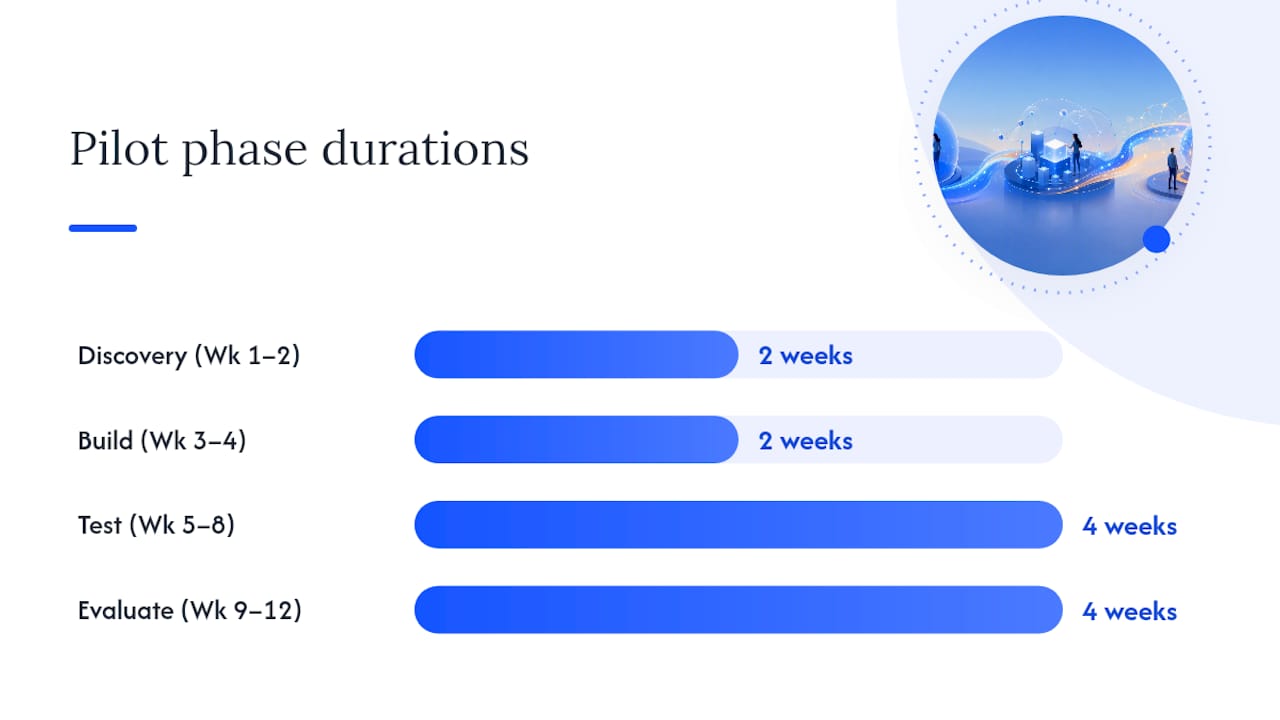
This template is designed for a marketing and RevOps team running a first AI GTM pilot on ICP scoring and personalized outbound.
Weeks 1–2: Discovery
- Audit CRM data quality and identify enrichment gaps
- Define ICP criteria with sales leadership
- Select and contract an enrichment or scoring vendor
- Deliverable: Data-readiness scorecard and signed vendor agreement
Weeks 3–4: Build
- Configure data pipeline from CRM to scoring model
- Build two outbound sequence variants (AI-assisted and control)
- Set baseline metrics for reply rate, meeting rate, and pipeline
- Deliverable: Live scoring model and two sequences ready to send
Weeks 5–8: Test
- Launch to a defined segment (200–500 contacts per arm)
- Monitor leading indicators weekly (open rate, reply rate, model accuracy)
- 30-day checkpoint: go/no-go on leading indicators
- Deliverable: 30-day checkpoint report with recommendation
Weeks 9–12: Evaluate and decide
- Evaluate lagging metrics: pipeline influenced, cost per meeting
- 60-day checkpoint: scale, pivot, or stop decision
- If scaling: draft expansion plan with budget and owner
- 90-day checkpoint: full ROI summary and operationalization plan
| Checkpoint | Decision threshold | Owner |
|---|---|---|
| 30 days | Leading indicators trending positive | Marketing lead |
| 60 days | Measurable pipeline influence | RevOps + Finance |
| 90 days | Positive ROI case for scale | CMO/VP Marketing |
What we have learned from building GTM AI for B2B teams
The teams that get the most from an AI GTM strategy are not the ones with the most sophisticated models. They are the ones that start with the cleanest data and the narrowest pilot scope.
Two lessons come up repeatedly. First, the data audit in phase one almost always reveals that CRM field completion is worse than anyone expected. Teams that skip the audit and go straight to model building spend weeks debugging outputs that are actually data-quality problems in disguise. Second, the Magic Circle governance structure works, but only if the pilot champion has real authority to make decisions between weekly check-ins. A champion who has to escalate every minor call adds two weeks to every sprint.
For B2B teams exploring AI’s role in their growth motion, the clearest next step is a structured readiness audit before any vendor conversation. Know what you have before you decide what to buy.
Ready to run your first AI GTM pilot?
Botiqueai builds the custom AI infrastructure that makes this playbook executable: from workflow automations that connect your CRM to your marketing stack, to intelligent agents that score, enrich, and personalize at scale. The difference from a generic platform is that every solution is built to your data model and your existing stack, not the other way around.
Your data stays in your environment. Every project starts with a scoping session that maps your current infrastructure to the phases above, so you know exactly what to build and in what order. To start, book a pilot scoping call and get a readiness assessment within five business days.
Sources
- gtm-ai
- AI Marketing Strategy Guide for 2026 - Think with Google
- AI marketing: how to implement AI in digital marketing (HubSpot blog)
- Metadata
- What Is AI GTM? A Practical Guide for B2B Companies | Alchemail
- How to implement AI in marketing (Use cases, examples, best practices) | Sendbird