
AI in E-Commerce: Real Recent Retail Automation Use Cases
AI in E-Commerce: Real Recent Retail Automation Use Cases
AI-driven retail automation is defined as the use of intelligent software agents to handle customer interactions, catalog management, merchandising decisions, and purchasing workflows without manual intervention. This is the industry term for what retail professionals increasingly call “agentic commerce.” The shift is real, measurable, and already producing results at scale. Macy’s Ask Macy’s conversational assistant increased revenue per visit by 4.75x and scaled to 100% of site traffic within one week of beta launch. THG Ingenuity’s AI Shopping Assistant, built on Google Cloud’s Gemini Enterprise Agent Platform, delivered a 5.5x lift in first-time buyer conversions and a 22% increase in average basket size. These are not pilots buried in a lab. They are production deployments reshaping how retail professionals think about AI e-commerce retail automation real recent use cases.
What are the leading AI use cases driving e-commerce retail automation today?
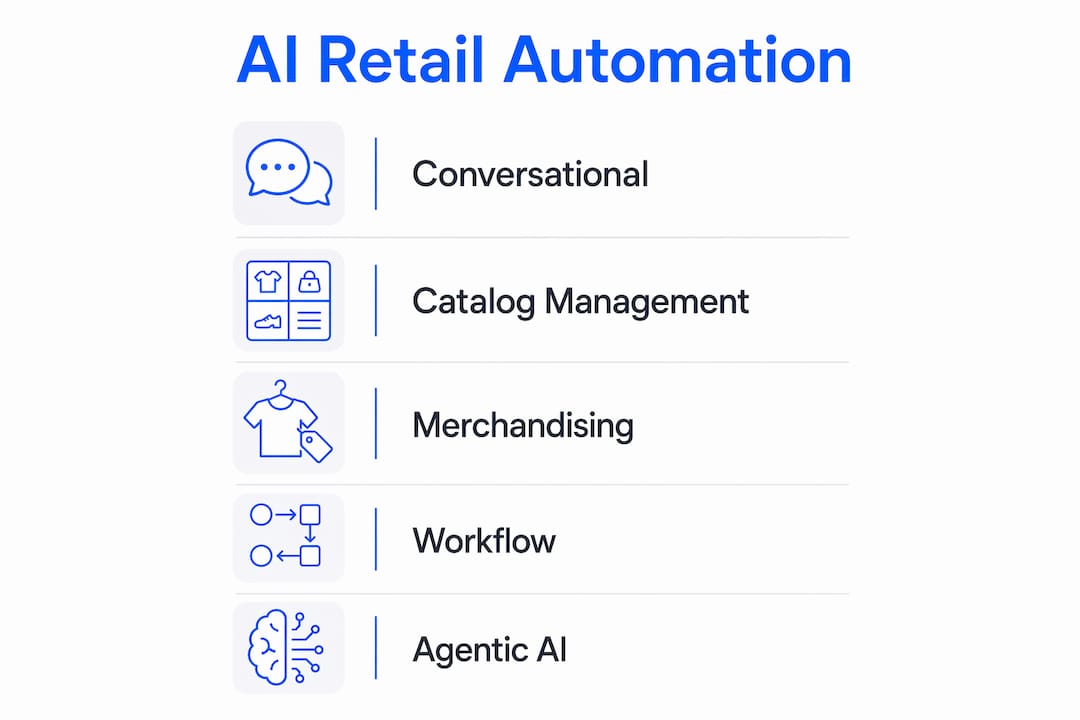
The most impactful AI applications in retail fall into four categories: conversational shopping assistants, dynamic product experience management, catalog data automation, and AI-enabled merchandising workflows.
Conversational shopping assistants
Macy’s Ask Macy’s moves beyond keyword search. It interprets shopper intent, asks follow-up questions, and guides customers to purchase. That intent-driven approach is why the revenue per visit jumped 4.75x compared to standard browsing sessions. THG Ingenuity’s assistant, deployed at Myprotein, achieved an 8x conversion rate lift in its pilot. The common thread is closed-loop commerce: the AI connects discovery directly to checkout, not just to a product page.
Catalog and data quality automation
Wayfair uses AI to automatically correct 2.5 million product attribute tags and handle roughly 41,000 supplier requests every month. That automation reduced manual catalog curation time by 67% and lifted certain conversion rates by 2%. Catalog accuracy is a hidden ROI lever. Bad product data degrades search results, breaks recommendations, and frustrates shoppers before they ever reach checkout.

AI-enabled merchandising and workflow automation
Adidas launched an ecommerce-as-a-service model using Salesforce agentic AI. The result: a business opportunity exceeding $100 million and the ability to launch the Audi F1 team’s e-commerce site in eight weeks. AI agents handled personalized merchandising and site configuration at a speed no manual team could match.
| Use case | Example brand | Key outcome |
|---|---|---|
| Conversational shopping assistant | Macy’s Ask Macy’s | 4.75x revenue per visit |
| First-time buyer conversion | THG Ingenuity / Myprotein | 5.5x conversion lift, 22% basket uplift |
| Catalog data automation | Wayfair | 2.5M tags corrected, 67% less manual work |
| Merchandising workflow automation | Adidas with Salesforce | $100M+ opportunity, 8-week site launch |
Pro Tip: Measure AI shopping assistant ROI by tracking the full closed loop from first interaction to completed purchase and return rate, not just click-through. Closed-loop metrics reveal the true commercial impact.
How do agentic AI systems differ from traditional e-commerce AI tools?
Traditional e-commerce AI was reactive. It waited for a query, matched keywords, and returned a ranked list. Agentic AI is proactive. It evaluates options, makes decisions, and can complete transactions on a customer’s behalf without waiting for the next prompt.
The NRF describes agentic AI as a structural shift in retail, not an incremental upgrade to search. An agentic system can monitor inventory, adjust pricing, reroute a fulfillment order, and notify a customer, all within a single workflow. That is categorically different from a recommendation engine suggesting “customers also bought.”
The adoption gap is stark. 94% of retailers explore agentic AI but only 17% have scaled deployments. The reason is not a lack of interest. Legacy systems were not built for real-time autonomous decision-making. Integrating an AI agent with a live inventory database, a payment processor, and a customer service queue requires engineering work that most retailers underestimated.
Key differences between traditional AI and agentic AI in retail:
- Traditional AI: Responds to explicit queries, returns static results, requires human action to complete a transaction.
- Agentic AI: Interprets intent across a multi-turn conversation, takes autonomous actions, and completes transactions with minimal human input.
- Traditional AI: Operates within a single interface, typically search or recommendation widgets.
- Agentic AI: Operates across systems, connecting CRM, inventory, payment, and fulfillment in one workflow.
- Traditional AI: Optimized for click-through rate.
- Agentic AI: Optimized for completed purchase, repeat behavior, and lifetime value.
Pro Tip: Before deploying an agentic AI system, map every system it needs to touch, including inventory, payments, and CRM. Integration gaps are the primary reason pilots fail to scale.
What are real-world examples of AI automation success in retail e-commerce?
The strongest recent AI use cases in e-commerce retail automation share one trait: they connect AI directly to revenue-generating or cost-reducing workflows.
Macy’s Ask Macy’s scaled from beta to full site traffic in under a week. The assistant handles product discovery, comparison, and purchase guidance in real time. The 4.75x revenue per visit result is the clearest proof that intent-driven AI outperforms passive browsing.
THG Ingenuity and Myprotein ran a pilot that produced an 8x conversion rate lift. The assistant asked clarifying questions about fitness goals and dietary needs, then recommended specific products. That personalization at scale is what drove the 22% basket size uplift.
Wayfair automated supplier request handling and product data correction at a scale no human team could sustain. Processing 41,000 supplier requests monthly with AI freed merchandising teams to focus on strategy rather than data cleanup.
Adidas used Salesforce agentic AI to build an ecommerce-as-a-service platform. Brands can now launch full e-commerce sites in weeks. The Audi F1 site went live in eight weeks, a timeline that would have taken months with traditional development.
Walmart deployed an AI chatbot for shopping assistance that helps customers find products, check availability, and get personalized recommendations across its app and website. The system handles millions of interactions weekly, reducing load on human agents.
TheFork implemented AI for hospitality booking, using conversational agents to match diners with restaurants based on occasion, dietary preference, and location. The AI handles booking modifications and reminders autonomously.
Nordea and Mastercard completed a live agentic transaction pilot where an AI agent made a purchase and processed payment on a customer’s instruction. The customer authorized the action; the agent handled every subsequent step. This is the clearest signal yet that autonomous purchasing is moving from concept to production.
Retailers like Gap, Best Buy, and Dick’s Sporting Goods use AI for personalization and operational productivity across merchandising, planning, and supply chain, not just customer-facing features.
| Retailer | AI application | Key metric |
|---|---|---|
| Macy’s | Conversational shopping assistant | 4.75x revenue per visit |
| THG Ingenuity / Myprotein | Intent-driven product recommendation | 8x conversion rate lift |
| Wayfair | Catalog data correction and supplier triage | 2.5M tags fixed, 67% less manual work |
| Adidas | Ecommerce-as-a-service with AI agents | $100M+ opportunity, 8-week launch |
| Nordea / Mastercard | Autonomous payment transaction | First live agentic purchase pilot |
| Walmart | Shopping assistance chatbot | Millions of weekly interactions |
| TheFork | AI hospitality booking agent | Autonomous booking and modification |
What challenges do e-commerce retailers face deploying AI automation?
Deploying AI automation in retail is not a plug-and-play exercise. The 17% scaled deployment rate tells the real story. Most retailers hit the same walls.
The six most common problems, and their solutions:
- Data fragmentation: Product data lives in separate systems, ERPs, PIMs, and spreadsheets, making it impossible for AI to access a single source of truth. The solution is a unified data layer or a product information management platform that feeds all AI systems.
- Siloed legacy systems: AI agents cannot act across workflows if inventory, CRM, and payment systems do not communicate. The solution is API-first integration architecture before deploying any agent.
- Single-shot search interfaces: Many retailers still rely on one-query, one-result search. AI shopping assistants require multi-turn dialog infrastructure. Retrofitting this onto legacy search is expensive and often requires a full platform replacement.
- Scaling agentic AI: Moving from a controlled pilot to full production exposes edge cases that pilots never surface. Scaling agentic AI requires engineering for consistent, reliable autonomous behavior, not just accuracy in demos.
- Real-time decision consistency: AI agents making pricing, inventory, or fulfillment decisions must be consistent across every touchpoint. Inconsistent decisions erode customer trust faster than no AI at all.
- Lack of guardrails for autonomous actions: AI agents without escalation rules can make decisions that damage customer relationships or create legal exposure. Production-grade deployments need hard limits on what the agent can do without human review.
- Measurement gaps: Retailers often track AI performance with vanity metrics like session length. The right metrics are conversion rate, revenue per interaction, and return rate.
- Talent and change management: Deploying AI changes how merchandising, customer service, and operations teams work. Without internal champions and training, adoption stalls regardless of the technology.
Pro Tip: Build your AI deployment plan backward from the failure mode. Ask: what happens when the agent makes a wrong decision? If you cannot answer that, you are not ready to scale.
What is the future of chatbot platforms in retail for chat-shopping?
The next phase of retail AI is not a better search bar. It is a personal shopping agent that browses, compares, and buys on a customer’s behalf. Platforms like OpenAI’s GPT-4o and Google’s Gemini Enterprise are already powering multi-turn, context-aware shopping conversations that feel less like a search engine and more like a knowledgeable sales associate.
The Nordea and Mastercard pilot is the clearest preview of where this goes. An AI agent received a customer instruction, selected a product, and completed the payment. The customer authorized the transaction; the agent handled everything else. That model will expand.
The stages of chatbot evolution in retail:
- Static FAQ bots: Answer pre-written questions. No personalization. No transaction capability.
- Keyword-triggered recommendation engines: Match queries to product catalogs. One-shot, no follow-up.
- Multi-turn conversational assistants: Ask clarifying questions, refine recommendations, guide to checkout. Current leading edge for most retailers.
- Agentic shopping assistants: Browse across catalogs, compare prices, apply coupons, and complete purchases autonomously with customer authorization.
- Proactive AI shopping agents: Monitor wish lists, price drops, and stock levels, then initiate purchases based on pre-set customer preferences without a new prompt.
Voice assistants, payment systems, and loyalty programs will integrate into this stack. A customer will tell their AI agent to “reorder my usual protein powder when it drops below $40” and the agent will execute. Retailers that build the infrastructure for stages 3 and 4 now will be positioned to deploy stage 5 without a full rebuild. You can explore more on this trajectory in Botiqueai’s AI and e-commerce insights.
Key Takeaways
AI retail automation delivers the strongest ROI when it connects customer intent directly to completed transactions and automates backend workflows at scale, not when it simply replaces a search bar.
| Point | Details |
|---|---|
| Closed-loop commerce drives ROI | AI assistants that guide from discovery to checkout outperform passive recommendation engines. |
| Catalog quality is a hidden lever | Fixing product data at scale, as Wayfair did with 2.5M tags, directly lifts conversion rates. |
| Agentic AI has a wide adoption gap | 94% of retailers explore it, but only 17% have scaled deployments due to integration friction. |
| Real deployments show strong results | Macy’s, THG Ingenuity, and Adidas all report measurable commercial outcomes from production AI. |
| Autonomous purchasing is arriving | The Nordea and Mastercard live transaction pilot confirms agentic buying is moving to production. |
What I have learned from watching retail AI deployments succeed and fail
The retailers winning with AI automation share one discipline: they treat AI as an operational system, not a marketing feature. Macy’s did not launch Ask Macy’s as a chatbot experiment. They built it to close sales. That framing changes everything, from how you measure success to how you integrate with backend systems.
The retailers struggling are the ones who started with the technology and worked backward to the use case. They deployed a chatbot because competitors had one. They measured success by session count. They never connected the AI to their actual transaction data. The result is a pilot that looks good in a press release and does nothing for revenue.
Catalog integrity is the use case most retail professionals underestimate. Wayfair’s 2.5 million tag corrections are not a data hygiene story. They are a conversion story. Bad product data is invisible to the team that created it and devastating to the customer trying to find the right product. AI that fixes data at scale is AI that earns its budget.
My honest advice: start with one workflow where you can measure a direct commercial outcome. Conversational assistants tied to checkout are the fastest path to a number you can defend. Once you have that number, the internal case for scaling writes itself. The AI customer service case studies at brands like Ralph Lauren show exactly how that progression works in practice.
— Botiqueai
How Botiqueai helps retailers deploy AI automation that performs
Botiqueai builds custom AI agents and chatbot solutions for retail and e-commerce businesses that need more than an off-the-shelf tool. The Aria chatbot is designed specifically for e-commerce customer engagement, handling product discovery, purchase guidance, and post-sale support in real time.
Beyond Aria, Botiqueai develops custom AI automations for catalog management, supplier triage, merchandising workflows, and internal operations. Every solution is built to integrate with your existing systems and measure commercial outcomes from day one. If you are ready to move from pilot to production, Botiqueai’s team works with you to design the architecture, not just the interface. Reach out to discuss what a closed-loop AI deployment looks like for your specific retail operation.
FAQ
What is AI retail automation in e-commerce?
AI retail automation is the use of intelligent software agents to handle customer interactions, catalog management, and purchasing workflows without manual intervention. It covers everything from conversational shopping assistants to autonomous transaction agents.
How much can AI shopping assistants improve conversion rates?
Results vary by deployment, but THG Ingenuity’s pilot at Myprotein showed an 8x conversion rate lift, and Macy’s Ask Macy’s delivered 4.75x revenue per visit compared to standard browsing sessions.
Why do most retailers struggle to scale agentic AI?
94% of retailers explore agentic AI but only 17% have scaled deployments. The primary barriers are legacy system integration, data fragmentation, and the absence of guardrails for autonomous decision-making.
What is the difference between a chatbot and an agentic AI shopping assistant?
A chatbot answers questions. An agentic AI assistant evaluates options, makes decisions, and can complete transactions autonomously on a customer’s instruction, as demonstrated in the Nordea and Mastercard live transaction pilot.
What is the fastest AI automation win for an e-commerce retailer?
Catalog data quality automation delivers fast, measurable ROI. Wayfair’s AI corrected 2.5 million product attribute tags and reduced manual curation time by 67%, directly improving search relevance and conversion rates.