
AI Lead Generation Explained: A 2026 Marketing Guide
AI Lead Generation Explained: A 2026 Marketing Guide
AI lead generation is the use of machine learning, predictive modeling, and automation to identify, qualify, and engage high-value prospects faster and more accurately than any manual process can. The industry term for this practice is “AI-powered demand generation,” though marketers commonly call it AI lead generation. With 67% of B2B marketers already using AI for lead generation as of mid-2026, this is no longer an experimental tactic. It is the operational standard for teams that want to grow pipelines without proportionally growing headcount. This guide breaks down how the technology works, what results it produces, and how to deploy it without the common mistakes that waste budget and damage data quality.
How does AI lead generation work?
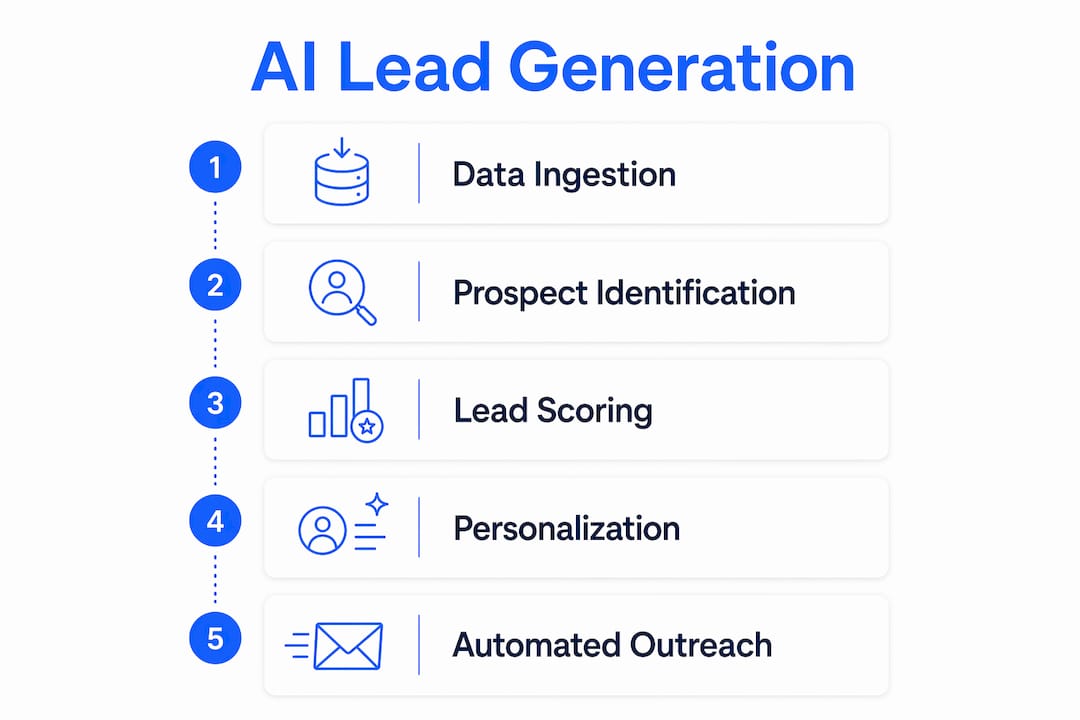
AI lead generation works by connecting six functional layers: data ingestion, prospect identification, data enrichment, lead scoring, personalization, and outreach automation. Each layer feeds the next. Weakness in one layer degrades every layer downstream.
Data ingestion and unification
The system starts with data. AI models pull from CRM records, website behavior, third-party intent signals, firmographic databases, and social activity. The critical requirement is that this data must be clean and unified before any AI model touches it. Deploying AI over unclean data amplifies errors at scale rather than correcting them.

Prospect identification and enrichment
Once data is unified, AI identifies high-intent prospects by reading behavioral and firmographic signals simultaneously. A prospect visiting your pricing page three times in a week while matching your ideal customer profile triggers identification. AI then enriches that record automatically, pulling verified contact details, technographic data, and buying signals from multiple sources. This removes the manual research step that slows most sales teams.
Predictive lead scoring
Predictive lead scoring uses machine learning models trained on historical conversion data to rank every prospect by their likelihood to buy. AI models analyze over 100 variables simultaneously, far beyond what a human analyst or a rules-based filter can process. That depth is why AI scoring outperforms traditional threshold-based systems.
Personalization and outreach automation
AI-driven personalization engines generate tailored messages based on a prospect’s industry, behavior, and stage in the buying cycle. Outreach automation then delivers those messages across email, LinkedIn, and other channels at the right time. The system adapts messaging based on response signals, creating a feedback loop that improves with every campaign.
Pro Tip: Map your existing data sources before selecting any AI lead generation tool. The tool is only as good as the data you feed it.
What are the measurable benefits of AI in lead generation?
The business case for AI in lead generation is built on documented performance gains, not theory.
AI-powered lead nurturing produces 451% more qualified leads and improves marketing ROI by 20%. That figure reflects what happens when AI replaces manual segmentation with continuous, behavior-driven qualification. Personalized email campaigns driven by AI generate 2.5x higher click-through rates and 6x more sales compared to generic outreach.
Speed is equally significant. AI-driven workflows reduce campaign launch times by up to 80%, compressing execution cycles from 7.5 weeks to hours. That acceleration means marketing teams can test more campaigns, respond to market shifts faster, and capture demand that slower competitors miss. Revenue growth of 10–30% is attributed to hyper-personalization at scale.
Lead qualification accuracy also improves. AI lead scoring improves qualification accuracy by 40% and speeds up the qualification process by 3x compared to manual methods. Sales teams spend less time on low-probability prospects and more time on accounts that are actually ready to buy.
| Metric | Traditional lead gen | AI-powered lead gen |
|---|---|---|
| Lead qualification speed | Baseline | 3x faster |
| Qualification accuracy | Baseline | 40% improvement |
| Qualified leads produced | Baseline | 451% more |
| Campaign launch time | 7.5 weeks average | Hours |
| Email click-through rate | Baseline | 2.5x higher |
These numbers represent the gap between teams running AI as a system and teams still relying on manual scoring and batch email blasts.
How does AI lead gen differ from rules-based systems?
Traditional lead generation uses rules-based filtering: if a prospect matches criteria A, B, and C, they qualify. The problem is that rules are static. Markets change, buyer behavior shifts, and the rules do not update themselves.
AI lead generation uses probabilistic machine learning instead. Marketers can define their ideal customer profile in plain language, and the AI parses unstructured signals to find matching prospects. The model updates continuously as new conversion data comes in. A rules-based system scores the same way on day one as it does on day 365. An AI model gets sharper every month.
AI also handles unstructured data that rules-based systems cannot read. Job change notifications, earnings call transcripts, LinkedIn activity, and support ticket sentiment are all inputs an AI model can process. A rules-based filter ignores all of it.
The tradeoff is transparency. Rules-based systems are fully auditable. AI models, particularly deep learning models, can behave as black boxes. Marketers who cannot explain why a prospect scored 94 out of 100 face internal credibility problems when sales teams push back.
Pro Tip: Require your AI vendor to provide score explainability features. If the model cannot tell you which signals drove a score, you cannot trust it or improve it.
How to implement AI lead generation in your marketing workflow
Getting AI lead generation right requires a specific sequence. Skipping steps creates the data quality problems that undermine the entire system.
-
Audit and clean your CRM. Remove duplicate records, standardize field formats, and fill critical gaps in contact and account data. Chasing the latest AI tool without a solid data foundation produces poor outcomes regardless of how advanced the tool is.
-
Unify your data sources. Connect your CRM, marketing automation platform, intent data provider, and website analytics into a single data layer. AI lead generation requires integrated context layers linking CRM, intent data, and communication channels to function as a system.
-
Layer AI across three stages. Apply AI at the data stage for enrichment and deduplication, at the activation stage for scoring and segmentation, and at the optimization stage for campaign performance analysis. This three-layer structure enables centralized strategy with localized execution across regions or segments.
-
Integrate with your existing tools. AI lead generation does not require replacing your current stack. Tools like HubSpot and Pipedrive have native AI integrations that add scoring and automation without a full migration. Start with what you have before buying new platforms.
-
Set human-in-the-loop controls. High-value accounts require manual review even when AI handles the initial qualification. Define which account tiers trigger human review before any automated outreach goes out. This protects brand tone and prevents AI-generated messages from reaching the wrong contacts.
-
Measure and iterate. Track qualified lead volume, sales acceptance rate, pipeline velocity, and conversion rate by campaign. AI systems improve when they receive feedback. Feed closed-won and closed-lost data back into your scoring model every quarter.
The teams that get the most from AI lead generation treat it as an ongoing system, not a one-time deployment. Effective AI lead gen treats all components as interconnected rather than siloed tools running in parallel.
Key Takeaways
AI lead generation delivers measurable gains in speed, accuracy, and revenue only when deployed as an integrated system built on clean, unified data.
| Point | Details |
|---|---|
| Data quality comes first | Clean and unify your CRM before deploying any AI scoring or enrichment tool. |
| AI scoring outperforms rules | Machine learning models analyze 100+ variables and improve over time; static rules do not. |
| Speed gains are significant | AI compresses campaign cycles from weeks to hours, enabling faster market response. |
| Human oversight is non-negotiable | High-value accounts and sensitive outreach require human review to protect brand trust. |
| Treat it as a system | AI lead gen works only when data, activation, and optimization layers connect and share feedback. |
What I’ve learned about AI lead generation after working with dozens of deployments
The most common mistake I see is treating AI lead generation as a tool purchase rather than a system design problem. A team buys a predictive scoring platform, connects it to a CRM full of three-year-old contacts, and wonders why the pipeline does not improve. The AI is not broken. The foundation is.
Agentic AI is the direction the industry is moving. These systems can autonomously execute multi-step marketing processes, from identifying a prospect to sending a follow-up sequence without human input at each step. More than half of marketers had not yet adopted agentic AI as of early 2026. That gap is an opportunity, but only for teams that have already built the data foundation to support it.
The trust question is real and underappreciated. AI augments marketers’ abilities rather than replacing them, but that framing only holds when the AI is producing outputs that humans can verify and correct. When a model scores a prospect at 91 and no one can explain why, sales teams stop trusting the scores. When trust breaks, adoption collapses.
My recommendation: start with one use case where the data is clean and the success metric is clear. Nail that, then expand. AI lead generation built incrementally on proven wins scales far better than a full-stack deployment that nobody fully understands or trusts.
— Botiqueai
Botiqueai’s AI tools for lead generation workflows
Botiqueai builds custom AI solutions for marketing teams that need more than off-the-shelf software.
The Aria Chatbot captures and qualifies leads directly on your website, engaging visitors in real time and routing high-intent prospects to your sales team automatically. For teams that need deeper workflow integration, Botiqueai’s custom AI automation connects scoring, enrichment, and outreach into a single pipeline built around your existing CRM and data sources. Both solutions are designed for B2B marketing teams that want AI to work within their current processes, not around them. You can review Botiqueai’s full range of AI solutions for business to find the right starting point for your pipeline goals.
FAQ
What is AI lead generation in simple terms?
AI lead generation is the use of machine learning and automation to find, score, and engage potential customers faster and more accurately than manual methods. It replaces static rules with models that learn from real conversion data.
How does AI lead scoring differ from traditional scoring?
Traditional scoring uses fixed rules and a limited set of criteria. AI scoring analyzes over 100 variables simultaneously and updates its model as new conversion data arrives, producing more accurate rankings over time.
What results can I expect from AI lead generation?
Research shows AI-powered lead nurturing produces 451% more qualified leads, improves qualification accuracy by 40%, and can reduce campaign launch times by up to 80% compared to manual processes.
Do I need to replace my CRM to use AI lead generation?
No. Tools like HubSpot and Pipedrive support native AI integrations that add scoring and automation without replacing your existing stack. Clean data matters more than new software.
What is the biggest risk of deploying AI for lead generation?
Poor data quality is the primary risk. Deploying AI over unclean or siloed data amplifies errors at scale. Auditing and unifying your data sources before deployment is the single most important step.