
What Makes an AI Pilot Project Actually Succeed
What Makes an AI Pilot Project Actually Succeed
AI pilots succeed when three things are locked down before day one: a named business owner who answers for results, KPIs tied to a real business outcome with a 30 to 90 day payback window, and a data and integration scope that matches what your systems can actually deliver. A slick demo tells you almost nothing about any of this: it shows the model works in a controlled setting, not that your organization can operationalize it.
If you take nothing else from this article, do these three things this week:
- Write a one-sentence success definition. Something like: “We reduce average support ticket resolution time from 14 hours to under 4 hours for our top 3 ticket categories within 90 days.”
- Name a single business owner. Not a committee, not IT, not “the AI team.” One person whose bonus or performance review depends on the pilot’s outcome.
- Map your actual data sources before you write a line of code. List where the data lives, who controls access, and what shape it’s in.
A pilot that hits a substantially lower cost-per-resolved-ticket target compared to its baseline is a pilot leadership will fund again. For a longer walkthrough of the mechanics, Botiqueai’s guide on running an AI pilot project covers the operational steps in more depth.
Key Takeaways
AI pilots succeed when a named owner, business-tied KPIs with a 30 to 90 day payback window, and realistically scoped data and integration work are all in place before the build starts.
| Point | Details |
|---|---|
| Name one owner | A single accountable executive, not a committee, should hold go/no-go authority at every checkpoint. |
| Fix the KPI before the model | Choose cost-per-task, adoption rate, or time-to-value as the target metric before any code is written. |
| Budget integration separately | Data and integration work often takes 40 to 60% of total effort and needs its own timeline. |
| Run a strict 30/60/90 cadence | Set pass/fail signals at each checkpoint and commit to killing pilots that miss them. |
| Use a managed partner to close the gap | Botiqueai structures pilot engagements around named ownership, scoped data work, and staged checkpoints from day one. |
Table of Contents
- AI Pilot Project Success Factors Start With Diagnosing Failure
- A Compact Framework The Successful 5% Follow
- Which KPIs Actually Predict Whether A Pilot Will Scale
- How To Scope Data And Integration Work Without Getting Blindsided
- Scoping The Pilot And Setting Kill Criteria That Actually Stick
- The Team And Adoption Habits That Make A Pilot Stick
- What It Takes To Move A Successful Pilot Into Production
- How Botiqueai Approaches The Pilot-To-Production Gap
- A Mistake Worth Learning From Before You Repeat It
- Let Botiqueai Handle The Parts That Sink Most Pilots
- Sources
AI Pilot Project Success Factors Start With Diagnosing Failure
Most AI pilots don’t fail because the technology is bad. They fail because of who talked to whom, and about what. RAND’s interview-based research on AI project failures identified five root causes, and the leading one is miscommunication between business leaders and technical teams about what problem the project is actually solving. Not a data problem. Not a model problem. A conversation problem that happens before anyone writes code.
That finding should reframe how you think about pilot risk entirely. Teams spend weeks tuning hyperparameters and comparing vendors, then discover in month three that finance wanted fraud detection and the data science team built anomaly scoring for a different use case. The RAND analysis found this kind of framing failure recurs across industries and company sizes, which suggests it isn’t a knowledge gap. It’s a process gap: nobody forced the business and technical sides to write down the same success sentence before work began.
Beyond miscommunication, four practitioner-level failure modes show up over and over in pilots that stall:
- No named business owner. When accountability sits with “the project team” instead of a specific executive, nobody has the authority or incentive to kill a bad pilot early or push a good one into production.
- Automating an undocumented process. If nobody can describe the current workflow in writing, step by step, an AI system can’t replicate or improve it. Teams often discover the “standard process” varies by region, by employee, or by day of the week.
- Integration shock. The pilot works in a sandbox with clean, exported data. Then it hits the production CRM, the legacy ERP, and three spreadsheets nobody admitted existed, and the timeline triples.
- Measuring activity instead of outcomes. Dashboards tracking “queries processed” or “model calls made” look busy but say nothing about whether the business is better off.
The 95% failure framing you’ve likely seen circulating isn’t a scare tactic. It reflects a consistent pattern: most pilots collect data, build a model, run a demo, and then stall before anyone measures a dollar of business impact. The gap between “the model works” and “the business changed” is where nearly every pilot dies.
The pattern behind the number: RAND’s research points to organizational and communication failures, not model quality, as the dominant cause of AI project failure. That’s the opposite of where most teams spend their pilot budget. If you’re pouring resources into model selection while skipping a written problem definition signed off by both business and technical leads, you’re optimizing the wrong variable.
A Compact Framework The Successful 5% Follow
Pilots that make it to production don’t look smarter. They look more disciplined. The teams that consistently scale AI pilots run a version of the same six-pillar framework, and none of the pillars require exotic technology.
Ownership and governance. One executive owns the outcome. Not sponsors it, not attends the steering committee, owns it. Their name is on the results, good or bad.
Outcome-first metrics. The KPI is a business number (cost per task, hours saved, revenue lift) decided before the model is built, not backfilled once you see what the model happens to measure well.
Data and integration scope. You know, in writing, which systems the pilot touches, who owns access to each one, and how long integration realistically takes based on those systems, not based on a vendor’s best-case slide.
Resource cadence. Effort is allocated deliberately across phases rather than dumped entirely into model-building.
Kill criteria. Defined before the pilot starts, not negotiated after the sponsor gets nervous.
Roadmap to scale. A rough sketch, from day one, of what production would require: monitoring, retraining, ownership handoff.
Teams that flip this ratio, pouring most of their time into model tuning, are the ones who build something clever that nobody can plug into a real workflow.
Pair that allocation with a strict 30/60/90 day cadence. Practitioner guidance from KUMO on failed AI pilots recommends exactly this structure: a defined checkpoint at day 30 to confirm the technical approach is viable, day 60 to confirm real users are adopting it, and day 90 to confirm it’s moving a real business metric. Each checkpoint has a go or no-go decision attached. Nobody “keeps evaluating” past day 90 without a specific reason tied to a specific metric.
Here’s what that looks like in practice:
- Day 30: Is the core technical approach working on real (not sample) data? If not, pivot the approach or kill the pilot.
- Day 60: Are target users actually using it, unprompted? If adoption is under 20% of the target group, the problem is usually workflow fit, not model quality.
- Day 90: Has the target business metric moved measurably against baseline? If yes, plan the scale-up. If no, and the trend line is flat, kill it.
Pro Tip: Tie your executive sponsor’s involvement to the payback window, not the launch date. A sponsor who commits to reviewing results at day 90, with authority to fund scale-up or pull the plug, keeps a pilot honest in a way that quarterly check-ins never do.
The IBM implementation framework echoes several of these pillars directly. Its guidance on AI implementation stresses defining goals up front, assessing data readiness before committing to a build, and investing in infrastructure as a distinct workstream rather than an afterthought. None of that is exotic advice. It’s just rarely followed under deadline pressure, which is exactly why it separates the pilots that scale from the ones that quietly disappear.
Which KPIs Actually Predict Whether A Pilot Will Scale
Model accuracy tells you almost nothing about whether a pilot will survive contact with your budget process. ThoughtSpot’s research on AI metrics makes a sharp distinction: metrics that measure the model versus metrics that predict business value are not the same thing, and most pilots track the wrong one.
Six KPI categories consistently separate pilots that get funded again from pilots that get quietly shelved:
- Decision velocity. How much faster does a decision or task get made with the AI system involved versus without it?
- Cost per successful task. Not cost per API call, cost per outcome actually delivered, whether that’s a resolved ticket, an approved loan, or a completed order.
- Adoption rate. What percentage of the target user group uses the tool without being told to, week over week?
- Time-to-value. How long from pilot launch to the first measurable business result?
- Revenue or cost impact. A dollar figure, even a rough one, that a CFO would recognize.
- Auditability. Can you trace why the system produced a given output, especially in regulated workflows?
A support chatbot pilot makes the mapping concrete. Say your baseline is a $3.50 average cost per resolved ticket and a 14-hour average resolution time.
That kind of table only works if every number is real for your business, not borrowed from a case study. Build your own baseline before you set a target.
Google Cloud’s guidance on production AI agent KPIs makes a related point specific to generative and agentic systems: model accuracy scores don’t capture whether users trust the output enough to act on it, and that gap between “correct” and “adopted” is where a lot of GenAI pilots quietly underperform. Adoption and business-value metrics matter as much as, or more than, raw output quality.
Monitoring cadence matters as much as metric choice. A static monthly report leaves you blind to a pilot going sideways for weeks. Automated, live dashboards that surface cost-per-task and adoption rate in near real time let a business owner catch a stalling pilot at week 6 instead of week 14, when there’s still budget and runway left to fix it.
How To Scope Data And Integration Work Without Getting Blindsided
The single most common budget-buster in AI pilots isn’t the model. It’s the plumbing around it. Data preparation and system integration commonly consume 40 to 60% of total pilot effort, and teams that budget the model-building phase as if it were the whole project run out of runway right when integration work actually starts.
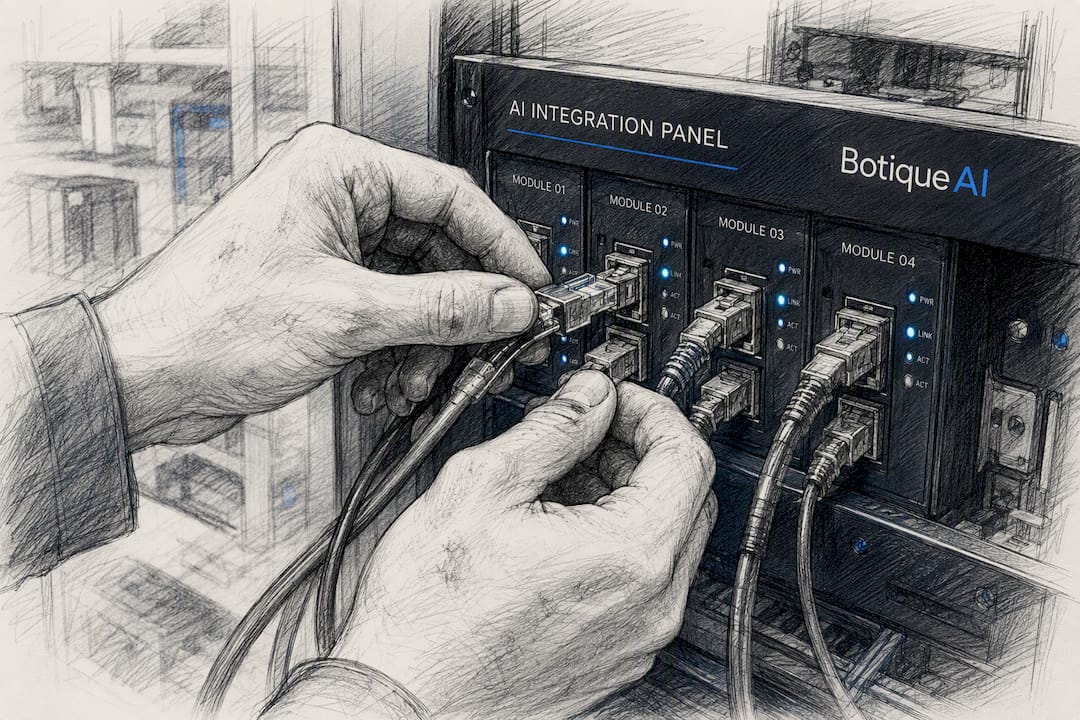
A useful rule of thumb from practitioner guidance splits effort roughly into thirds: about one-third on integration work, one-third on the actual AI logic, and one-third on evaluation and operations. If your project plan allocates 80% of the timeline to model selection and 20% to “everything else,” you’ve already mis-scoped the pilot.
Before committing to a launch date, run through this checklist:
- Digital availability. Is the data you need actually captured digitally, or does it live in someone’s notebook or a PDF scan?
- Schema documentation. Does anyone have a written map of what each field means, or will the team be reverse-engineering column names in week 3?
- Access approvals. Who has to sign off before the pilot team can query production data, and how long does that approval typically take at your organization?
- Cleaning and normalization. How much of the data is duplicated, missing, or recorded in inconsistent formats across systems?
- Pipeline construction. Does data need to move automatically between systems, or is a one-time export good enough for a pilot?
- Monitoring and security. Who watches for data drift or access anomalies once the pilot goes live, and what’s the escalation path?
Real blockers show up fast once you start this checklist honestly. A common one: customer records exist in both the CRM and a separate billing system, with slightly different name and address fields in each, and nobody canonicalized which one is the source of truth. The fix isn’t to solve the entire data-quality problem before the pilot starts. It’s to build a narrow canonical dataset, covering only the fields the pilot actually needs, and defer the broader cleanup to a later phase.
Effort split at a glance: Roughly 40 to 60% of pilot effort typically goes to data and integration work, according to Codelevate’s analysis of stalled AI projects. Budgeting that work as a distinct line item, with its own timeline and owner, is one of the clearest differences between pilots that ship and pilots that drift.
For teams without deep technical staff, a practical no-code integration guide can shortcut a lot of this scoping work by mapping which existing tools already support the connections you need.
Scoping The Pilot And Setting Kill Criteria That Actually Stick
A pilot without a written success sentence will drift indefinitely, because nobody can prove it’s failing.
Once that sentence exists, checkpoints become mechanical rather than political.
- Day 30 checkpoint. Confirm the technical approach works against real production data, not a curated sample. Pass signal: the model or agent produces usable output on at least 70% of real test cases. Fail signal: it only works on cleaned, cherry-picked examples. Action on fail: revisit the approach or narrow the scope before continuing.
- Day 60 checkpoint. Confirm real users are engaging with it voluntarily. Pass signal: weekly active usage above 40% of the target group. Fail signal: usage requires constant reminders from a manager. Action on fail: investigate workflow friction, not model quality.
- Day 90 checkpoint. Confirm the target business metric has moved. Pass signal: measurable progress toward the baseline-to-target gap defined in your success sentence. Fail signal: flat or negligible movement despite technical function and adoption. Action on fail: kill the pilot and redirect budget.
For a narrow, well-scoped workflow pilot, practitioner budget guidance puts realistic costs somewhere between $12,000 and $40,000 for a small team running a 60 to 90 day pilot with tightly limited scope. Production builds that move beyond pilot scope often exceed $50,000, which is exactly why the kill criteria matter: they stop you from spending production-level money on a pilot-level problem that was never going to pan out.
The Team And Adoption Habits That Make A Pilot Stick
A pilot can hit every technical milestone and still die because nobody uses it. Adoption is a staffing and change-management problem as much as an engineering one, and the roles you assign at the start largely determine whether people actually use what gets built.
A cross-functional pilot team typically needs:
- Business owner: accountable for the outcome and the go/no-go decision at each checkpoint.
- Subject matter expert (SME): the person who actually does the workflow today and can spot when the AI system is getting it wrong.
- Data engineer: builds and maintains the pipelines connecting source systems to the pilot.
- ML or AI engineer: builds and tunes the model or agent logic itself.
- Project manager: keeps the 30/60/90 cadence on track and documents decisions at each checkpoint.
- Operations lead: plans for what happens after the pilot, staffing, monitoring, and escalation paths.
- Security or compliance contact: reviews data access and handling before anything touches production systems.
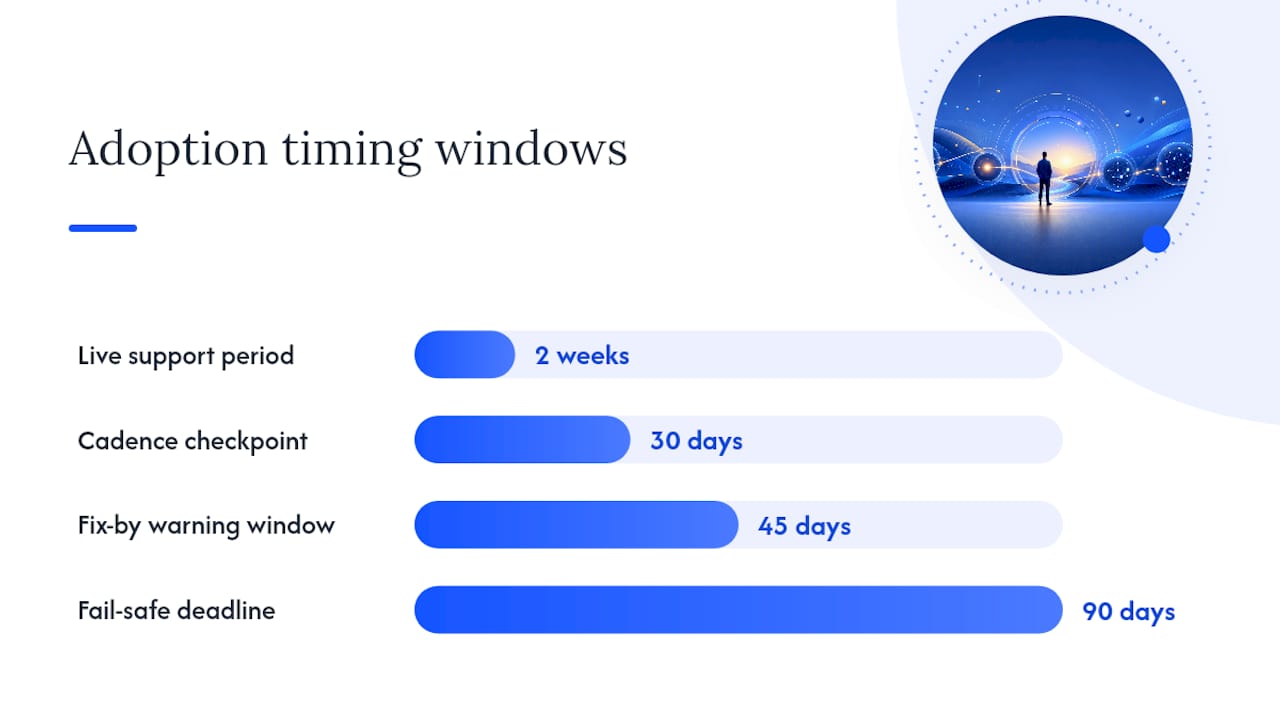
Getting the team right solves half the adoption problem. The other half is rollout tactics. Embed the tool directly into the workflow people already use rather than asking them to open a separate app. Roll out to a small group of 5 to 10 motivated users first, not the entire department. Staff live support during the first two weeks so friction gets fixed same-day instead of festering into “this doesn’t work” folklore. Build a lightweight feedback loop, even a shared form, so users can flag bad outputs without filing a ticket.
Pro Tip: Track a single adoption warning sign closely: if usage spikes right after a training session and then drops within a week, the tool isn’t fitting the actual workflow. That pattern almost always means friction, not resistance, and it’s fixable if caught by day 45 rather than day 90.
If the stakeholder buy-in work was done properly before the pilot launched, most of these adoption problems shrink considerably, because the people using the tool were part of shaping it.
What It Takes To Move A Successful Pilot Into Production
A pilot that hits its day-90 targets isn’t automatically ready for production. It’s ready for a different, harder set of decisions about how the system runs when nobody is watching it closely anymore.
Production readiness requires a specific set of operational capabilities:
- MLOps and CI/CD pipelines so model updates deploy without manual, error-prone steps.
- Monitoring for data drift and performance decay, since real-world data shifts in ways pilot-phase data usually doesn’t.
- A defined retraining cadence, whether that’s monthly, quarterly, or triggered by a performance threshold.
- Incident and rollback playbooks so a bad output or outage has a documented response, not an improvised one.
- Cost monitoring since production-scale inference costs can behave very differently from pilot-scale costs.
- Compliance and audit trails, especially in regulated workflows where you need to explain a decision after the fact.
The build versus buy versus partner decision hinges on a few honest questions. Build in-house when the workflow is core to your competitive position and you have the engineering capacity to maintain it long-term, not just launch it. Buy a packaged tool when the use case is common across your industry and a vendor has already solved the hard integration problems, customer service chatbots are a good example. Partner with an outside team when you need production-grade AI capability but don’t want to carry the ongoing MLOps and monitoring burden internally, which is often the fastest path from a validated pilot to a reliable service.
A minimal production governance checklist covers who approves model updates before deployment, how often drift gets reviewed, who owns the rollback decision if something breaks, and how access to the system is audited on a recurring basis.
A pilot that worked for 90 days with a dedicated team watching it closely is not the same system running unattended in production six months later. The operational discipline that gets skipped in the rush to “go live” is usually the discipline that determines whether the system is still trusted a year on.
How Botiqueai Approaches The Pilot-To-Production Gap
Botiqueai’s engagement model is built around the same discipline this article describes: a named business owner, an outcome sentence agreed before build work starts, and a staged 30 to 90 day cadence rather than an open-ended build. That structure comes directly from watching pilots stall for the reasons covered above, miscommunication, unscoped integration, and metrics that measure activity instead of impact, and designing the engagement to avoid them from day one.
The 30 to 90 day go-to-market playbook Botiqueai uses with clients maps closely to the framework in this article: define the success sentence and owner in week one, scope data and integration realistically in weeks two through four, and hit a measurable checkpoint by day 90 rather than an indefinite “still evaluating” status. Specific client outcome figures and case data are gathered on a rolling basis and shared during scoping conversations, since results vary meaningfully by industry and starting data maturity.
Readers evaluating vendors or building an internal business case can use this one-page pilot brief checklist, copied directly into an RFP or internal memo:
- Named business owner with go/no-go authority at each checkpoint
- One-sentence success definition with baseline and target metric
- Data source map with access owners identified
- 30/60/90 day cadence with defined kill criteria at each stage
- KPI dashboard plan (not a one-time report) covering adoption and cost per task
- Rough effort split across integration, model logic, and evaluation/ops
For teams that want to see how this plays out across different industries, Botiqueai’s collection of AI transformation examples covers a range of use cases and starting points.
A Mistake Worth Learning From Before You Repeat It
The most common mistake in early pilot conversations isn’t technical. It’s skipping the success sentence because everyone in the room assumes they already agree on what “success” means. They rarely do. One team means “the model runs correctly.” Another means “our customers stop complaining.” Those are different projects wearing the same name.
The fix costs almost nothing: force the sentence into writing, with a number and a date, before any code gets written. It surfaces disagreement while it’s still cheap to resolve.
If you want a low-risk way to test this, run a 30-day experiment on a workflow you already understand well. Pick one narrow task, write the success sentence, name an owner, and check in at day 30 on exactly one question: is the model producing usable output on real data yet? Don’t measure anything else. That single checkpoint tells you more about whether the pilot deserves another 60 days than a month of dashboards ever will.
— Botiqueai
Let Botiqueai Handle The Parts That Sink Most Pilots
The pilots that stall usually stall on the same two things: nobody scoped the data and integration work honestly, and nobody kept a live eye on adoption once the initial excitement faded. Botiqueai builds both of those disciplines into the engagement from the start, rather than treating them as problems to solve after the pilot already looks shaky.
For a customer-facing pilot, like the support chatbot example covered earlier, Aria is built specifically for that use case, with containment rate and resolution time baked into how it’s deployed rather than bolted on afterward. For pilots that need custom logic connected to your existing CRM, ERP, or internal tools, Botiqueai’s custom AI development service covers the full path from scoped pilot through production monitoring, so the 30/60/90 cadence described in this article isn’t just a template you’re left to execute alone.
If you’re at the stage of writing a success sentence and mapping your data sources, that’s exactly the conversation worth having before you commit budget to a build. Reach out to scope a pilot brief together and get a realistic read on timeline and effort split before day one.
Sources
- The Root Causes of Failure for Artificial Intelligence Projects and How They Can Succeed
- The 7 AI metrics that drive real business value
- The KPIs that actually matter for production AI agents
- Why your AI pilot project failed (KUMO)
- Artificial intelligence implementation: 8 steps for success | IBM