
AI-Powered Lead Qualification Process: 2026 Guide
AI-Powered Lead Qualification Process: 2026 Guide
The ai-powered lead qualification process is the use of machine learning models to automatically score, rank, and route leads based on behavioral, demographic, and intent data. Sales teams that adopt this approach, using platforms like Demandbase and Monday.com, can increase leads and appointments by over 50% through real-time analysis of complex behavior patterns. Traditional manual qualification forces reps to guess which prospects deserve attention. AI removes that guesswork by processing hundreds of data points simultaneously and updating scores as new signals arrive. The result is a faster, more consistent pipeline that scales without adding headcount.
What are the essential tools for AI-powered lead qualification?
A functional AI lead qualification system requires three layers: a CRM, a marketing automation platform, and a data enrichment tool. Salesforce, HubSpot, and Pipedrive each serve as the central data repository where lead records live. Marketing automation platforms like Marketo or HubSpot Marketing Hub feed behavioral signals, such as email opens, page visits, and form fills, directly into that record. Enrichment tools like Clearbit or ZoomInfo append firmographic data, including company size, industry, and technology stack, to fill gaps that inbound forms miss.
AI lead scoring integrates CRM data, marketing interactions, website behavior, and social media signals for a complete lead profile. That breadth matters because a lead’s job title alone tells you very little. Their pattern of visiting your pricing page three times in one week tells you far more.

Data hygiene is the foundation that makes all of this work. Around 90% of commercial leaders expect to use generative AI frequently in lead management, yet teams consistently fail by skipping data cleanup before deployment. Duplicate records, missing fields, and inconsistent formatting corrupt model outputs before the first score is ever generated.
Pro Tip: Run a data audit on your CRM before connecting any AI scoring tool. Remove duplicates, standardize field formats, and fill in missing company domains. A model trained on dirty data will produce confidently wrong scores.
| Platform | CRM Integration | Enrichment Built In | Behavioral Scoring | Routing Automation |
|---|---|---|---|---|
| Demandbase | Yes | Yes | Yes | Yes |
| Monday.com CRM | Yes | Partial | Yes | Yes |
| HubSpot AI Scoring | Yes | Partial | Yes | Yes |
| Salesforce Einstein | Yes | Via AppExchange | Yes | Yes |
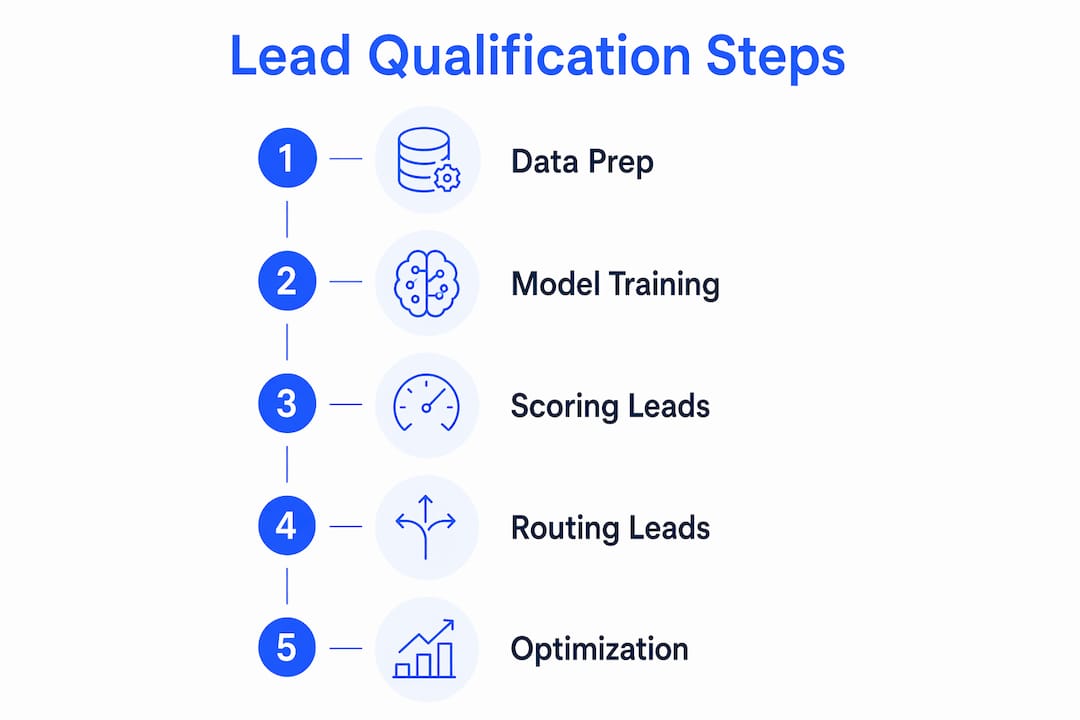
How to build and train an AI lead scoring model
Building an accurate AI lead scoring model starts with defining your Ideal Customer Profile, commonly called the ICP. The ICP captures the firmographic and behavioral traits of your best customers: company size, industry vertical, tech stack, buying role, and typical sales cycle length. Without a clear ICP, the model has no target to learn toward.
The training process follows four steps:
- Export historical deal data. Pull all closed-won and closed-lost opportunities from your CRM for at least the past 12–18 months. Include deal size, sales cycle length, lead source, and any enrichment fields available.
- Label the data. Tag each record as a positive example (closed-won) or a negative example (closed-lost or disqualified). Effective AI scoring models must be trained on company-specific historical data to achieve market-specific accuracy. Generic rubrics are the single biggest risk to model performance.
- Select behavioral indicators. Identify the actions that most reliably preceded a closed-won deal. Common signals include pricing page visits, demo requests, repeated email engagement, and content downloads tied to late-stage buying intent.
- Set score thresholds and triggers. Assign score bands, such as 0–40 for low priority, 41–70 for nurture, and 71–100 for sales-ready, then configure automated actions for each band.
Relational machine learning that connects CRM, product, billing, and support data is becoming standard for sophisticated scoring teams. These models identify signal patterns that flat, single-source models miss entirely. A lead who opened five emails but never visited the product page scores very differently from one who visited the pricing page twice without opening a single email.
Pro Tip: Never train your model on fewer than 500 historical deals. Below that threshold, the model lacks enough signal diversity to generalize reliably. If your deal history is thin, supplement with enrichment data to increase feature depth.
How to implement and automate your lead qualification workflow
Deploying an AI lead qualification workflow requires more than turning on a scoring feature inside your CRM. The process involves connecting data sources, configuring routing logic, and building feedback loops that keep the model accurate over time.
Follow these steps to deploy a production-ready workflow:
- Connect your CRM, marketing automation platform, and enrichment tool through native integrations or a middleware layer like Zapier or Make.
- Activate real-time scoring so that every new lead receives a score within seconds of entering the system. Automated AI workflows can score leads from 0–100 in under 30 seconds and route them immediately to the correct follow-up action.
- Configure routing rules by score tier. High-scoring leads go directly to a senior sales rep with a same-day follow-up task. Mid-tier leads enter a nurture sequence. Low-scoring leads receive automated educational content.
- Deploy AI agents for initial outreach. These agents can send personalized first-touch messages, answer qualification questions, and book meetings without human involvement.
- Monitor key metrics weekly: response time by tier, conversion rate from scored lead to opportunity, and score distribution across your pipeline.
Sales teams also need training on how to read and act on AI scores. Reps who distrust the model will override it manually, which defeats the purpose entirely.
Key behaviors to build into your team’s workflow:
- Review score rationale before each call, not just the final number
- Flag leads where the score feels wrong so the model can be recalibrated
- Use score trends over time, not just point-in-time snapshots, to assess buying intent
- Treat AI routing as a starting point, not a final verdict
AI lead qualification handles a 10x increase in lead volume without extra staff by automating qualification, scoring, and routing. That capacity gain is real, but only if the routing rules are configured correctly from the start.
What are the common mistakes in AI lead qualification?
The most damaging mistakes in AI lead qualification share a common root: teams treat the model as a finished product rather than a living system. A model trained in january may be significantly less accurate by july if market conditions or buyer behavior shift.
Watch for these specific failure patterns:
- Skipping data hygiene. Incomplete or inconsistent CRM data produces inaccurate scores from day one. Common mistakes include neglecting data hygiene, using non-customized scoring models, and failing to train sales teams on AI workflows.
- Using generic scoring rubrics. Off-the-shelf models not trained on your specific deal history will misclassify leads at a high rate. A B2B SaaS company and a professional services firm have completely different buying signals.
- Ignoring multi-source data. Teams that score only on CRM fields miss the behavioral and intent signals that live in product usage data, billing history, and support interactions.
- Failing to recalibrate. If your close rate on “high-score” leads drops over two consecutive quarters, the model needs retraining, not just threshold adjustments.
“AI lead qualification must be customized and continuously refined to adapt to evolving sales contexts and client behavior.” — Demandbase AI Lead Scoring Guide
Poor integration between data sources is the technical failure that kills the most deployments. A CRM that does not sync in real time with your marketing automation platform creates scoring lag. A lead who just requested a demo still shows a low score for hours because the sync runs nightly. That delay costs you the conversation. Review your data architecture before you build any scoring logic on top of it.
Key Takeaways
An AI-powered lead qualification process delivers consistent, scalable results only when it combines clean data, customized model training, and continuous recalibration tied to real sales outcomes.
| Point | Details |
|---|---|
| Data hygiene comes first | Clean, complete CRM data is the prerequisite for any accurate AI scoring model. |
| Train on your own history | Models trained on company-specific closed-won and closed-lost data outperform generic rubrics. |
| Automate scoring and routing together | Real-time scoring only delivers value when paired with immediate, tier-based routing rules. |
| Build feedback loops | Sales reps should flag score mismatches so the model recalibrates against current buyer behavior. |
| Phase your implementation | Start with scoring and routing before adding full AI agent automation for better team adoption. |
What I’ve learned from watching AI lead qualification succeed and fail
The teams that get the most from AI lead qualification share one trait: they treat the model as a hypothesis, not a truth. They deploy, measure, and adjust. The teams that fail treat the model as a black box they bought and forgot.
The most common mistake I see is skipping the ICP definition step. Teams connect their CRM to a scoring tool, turn it on, and expect magic. What they get instead is a model that scores leads based on whatever patterns happened to exist in their messy historical data. Garbage in, garbage out is not a cliché here. It is the literal mechanism of failure.
AI should augment, not replace, human expertise in sales. That balance matters more than most vendors admit. The best deployments I have seen keep a human in the loop for any lead scoring above 80. The rep reviews the rationale, confirms the fit, and then acts. The AI handles volume. The human handles judgment.
Starting simple also matters more than most teams expect. Implementing AI lead qualification in phases, beginning with scoring and routing before full automation, produces better adoption and better results. A team that trusts a simple model will use it. A team overwhelmed by a complex one will ignore it.
The final lesson: budget for ongoing maintenance. A lead scoring model is not a one-time project. It is a system that needs quarterly reviews, annual retraining, and constant feedback from the sales floor. Teams that treat it as a set-and-forget tool will find their pipeline quality degrading quietly until a bad quarter forces a reckoning.
— Botiqueai
Botiqueai’s tools for your lead qualification workflow
Botiqueai builds AI systems designed specifically for the kind of lead qualification workflows described in this article.
The Aria chatbot qualifies website visitors in real time, asking the right questions, scoring responses, and booking meetings directly into your sales team’s calendar without any manual review. For teams that need a fully tailored workflow, Botiqueai’s custom AI automation service builds scoring models, routing logic, and CRM integrations matched to your specific ICP and sales process. Both products are built for B2B sales teams that need to move faster without adding headcount. Contact Botiqueai for a demo tailored to your pipeline.
FAQ
What is an AI-powered lead qualification process?
An AI-powered lead qualification process uses machine learning models to automatically score and rank leads based on behavioral, demographic, and intent data. It replaces manual review with real-time scoring that routes each lead to the correct follow-up action instantly.
How does automated lead scoring work?
Automated lead scoring assigns a numerical value to each lead by analyzing data points from your CRM, marketing platform, website, and enrichment tools. The model compares each lead’s profile against historical closed-won patterns to predict sales readiness.
What data do I need to start AI lead management?
You need at least 12 months of closed-won and closed-lost deal data from your CRM, plus behavioral data from your marketing automation platform. Data hygiene, meaning complete and consistent records, is the minimum requirement before any model can be trained accurately.
How long does it take to implement AI lead qualification?
A basic scoring and routing workflow can be live within two to four weeks if your CRM data is clean and your ICP is defined. Full automation with AI agents and multi-source data integration typically takes eight to twelve weeks depending on system complexity.
Can AI lead qualification replace my sales team?
AI lead qualification handles volume, scoring, and routing, but it does not replace human judgment for complex deals. The most effective deployments use AI to surface the best leads and automate first-touch outreach, while sales reps focus on high-value conversations and closing.