AI Social Media Listening: A 2026 Guide for Marketers
AI Social Media Listening: A 2026 Guide for Marketers

AI social media listening is defined as the use of artificial intelligence technologies, including Natural Language Processing (NLP) and machine learning, to monitor, analyze, and extract business intelligence from social media conversations at scale. The industry standard term is “AI-powered social listening,” and it goes far beyond what is ai social media listening in its simplest form. Traditional monitoring counts mentions. AI listening interprets meaning, detects sentiment, clusters topics, and surfaces emerging trends before they peak. For marketing professionals and social media managers, this shift from reactive tracking to predictive intelligence is the most significant change in brand monitoring in a decade. Botiqueai builds exactly this kind of AI capability for marketing teams that need real answers, not raw data.
What is AI social media listening and how does it work?
AI social media listening is the practice of applying AI models to social data so that machines, not analysts, do the heavy interpretive work. The result is predictive intelligence that replaces reactive metric tracking. That means your team spends less time sorting through noise and more time acting on clear signals.
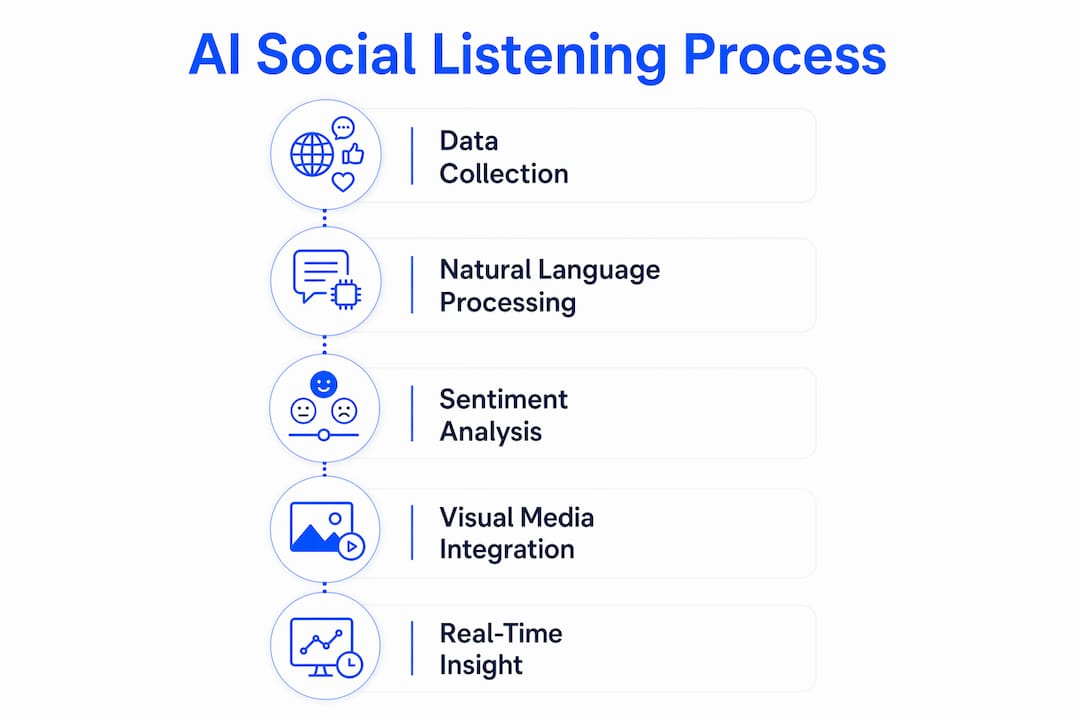
The core engine is NLP. NLP reads posts, comments, and reviews the way a human would, picking up on context, tone, and even sarcasm. Machine learning then identifies patterns across millions of data points and flags anomalies, such as a sudden spike in negative sentiment around a product launch, before your team would ever catch it manually.

Beyond text, modern AI platforms apply computer vision to images and video. Non-text brand mentions in visual media are significant and often missed by text-only tools. A photo of your product at an event, a meme using your logo, a video review with no caption: AI with computer vision captures all of it.
Real-time processing ties it together. AI systems ingest and analyze social signals continuously, so the insight you act on at 9:00 AM reflects what happened at 8:45 AM, not last Tuesday’s report.
Pro Tip: Set up keyword clusters around your brand’s specific language, including product nicknames and industry slang, before you launch any AI listening program. Generic out-of-box models will miss the vocabulary your customers actually use.
How does AI social listening differ from traditional monitoring?
Traditional social media monitoring tools track keyword mentions and count them. They tell you how many times your brand name appeared on Twitter this week. AI social listening tells you what those mentions mean, who is saying them, and what is likely to happen next.
| Capability | Traditional monitoring | AI social listening |
|---|---|---|
| Mention tracking | Yes, keyword-based | Yes, plus unlinked mentions |
| Sentiment analysis | Basic positive/negative | Nuanced, context-aware classification |
| Topic clustering | Manual tagging | Automated narrative grouping |
| Anomaly detection | None | Real-time spike and trend alerts |
| Visual content | Text captions only | Computer vision for images and video |
| Insight delivery | Static dashboards | Conversational AI queries |
The practical gap is enormous. Traditional tools require an analyst to pull a report, read it, and draw conclusions. AI listening platforms cluster millions of signals into narratives and surface what matters automatically. That analyst can now focus on strategy instead of data wrangling.
The other major difference is scale. Manual monitoring realistically covers dozens of sources per day. AI social listening processes millions of signals daily without adding headcount. That scale changes what is possible for a marketing team of any size.
Pro Tip: Do not retire your human analysts when you adopt AI listening. Use them to interpret AI-generated narratives and connect insights to campaign decisions. AI finds the signal; your team decides what to do with it.
What are the practical benefits of AI social listening for brand management?
The benefits of AI in social media go well beyond faster reporting. AI social listening changes the nature of the decisions marketing teams can make.
- Real-time sentiment tracking. You know how customers feel about your brand right now, not after a weekly report cycle. A product issue that generates negative sentiment on a Tuesday morning can be addressed by Tuesday afternoon.
- Early trend detection. AI detects shifts in consumer behavior before they peak, giving your team time to shape the conversation rather than react to it. That is the difference between leading a trend and chasing one.
- Crisis prevention. Anomaly detection flags unusual spikes in negative mentions before they become a PR crisis. Teams that use AI listening move from crisis management to crisis prevention.
- Competitive intelligence. AI social listening captures what customers say about your category, not just your brand. That gives marketing teams a clear view of market sentiment and competitor weaknesses without manual research.
- Data-driven content strategy. When you know which topics generate the most positive engagement in your category, you can build content around those themes with confidence. AI social analytics removes the guesswork from editorial planning.
The organizational impact extends beyond the marketing department. Social data is evolving from isolated marketing metrics into a performance engine that drives decisions across product, customer service, and executive strategy. Marketing teams that share AI social insights with other departments multiply the value of every data point they collect.
The shift from reactive to proactive communication is the clearest competitive advantage. Brands that wait for customers to complain publicly are always behind. Brands that detect dissatisfaction early and address it directly build stronger loyalty and spend less on reputation repair.
How can marketing professionals maximize AI social listening?
Getting full value from AI social listening requires more than turning on a platform. The technology performs at its best when marketing teams actively configure and maintain it.
- Calibrate your AI models with prompt engineering. Generic sentiment models misread brand-specific language and sarcasm. Active model calibration with brand-specific prompts and examples prevents misinterpretations that lead to bad decisions. Treat your AI as a partner that needs ongoing training, not a set-and-forget system.
- Integrate multimodal data sources. Text alone gives you an incomplete picture. Connect your AI listening program to image and video analysis so you capture the full range of brand sentiment across social formats. Visual content now represents a growing share of brand exposure on platforms like Instagram, TikTok, and YouTube.
- Use conversational AI agents for faster insights. Agentic AI workflows let you ask strategic questions in plain language and receive synthesized recommendations in minutes. One natural language question replaces hours of manual filtering and cross-referencing. This is especially valuable for social media managers who need answers before a campaign goes live.
- Share insights across departments. AI social data is most powerful when it informs product development, customer service scripts, and executive reporting, not just marketing campaigns. Build a process for distributing key findings to the teams that can act on them. An AI data strategy formalizes this cross-functional flow.
- Avoid over-reliance on default models. Out-of-box sentiment models are trained on general language. They perform poorly on industry-specific vocabulary, regional slang, and emerging terminology. Schedule quarterly model reviews to keep your AI calibrated to how your customers actually speak.
Pro Tip: Build a “brand language glossary” before you configure your AI listening tool. Include product names, internal terms, common customer nicknames, and known sarcasm patterns. Feed this glossary into your prompt engineering process to improve accuracy from day one.
The teams that get the most from AI social listening treat it as a living system. They test, adjust, and refine continuously. The teams that get the least treat it as a reporting tool and check it once a week.
Key Takeaways
AI social media listening converts raw social data into business intelligence by combining NLP, machine learning, and computer vision to deliver real-time, predictive insights that traditional monitoring cannot produce.
| Point | Details |
|---|---|
| Core technology | NLP and machine learning interpret sentiment, context, and behavior at scale. |
| Beyond text | Computer vision captures brand mentions in images and video, not just written posts. |
| Proactive advantage | AI detects emerging trends before they peak, enabling brands to lead conversations. |
| Model calibration | Ongoing prompt engineering keeps AI accurate for brand-specific language and sarcasm. |
| Organizational value | Social insights shared across departments drive decisions beyond the marketing team. |
Why AI social listening is now a core marketing function
Most marketing teams I work with at Botiqueai initially treat social listening as a monitoring checkbox. They set up keyword alerts, glance at a dashboard weekly, and call it done. That approach misses the entire point of what AI makes possible.
The real value is not in knowing what happened. It is in knowing what is about to happen. AI social listening, when properly configured, gives marketing teams a genuine early warning system. A shift in sentiment around a product category, a new phrase customers are using to describe a problem your brand solves, an emerging competitor narrative gaining traction: these signals appear in social data days or weeks before they show up in sales numbers or customer service tickets.
What I find most underused is the connection between social insights and other business functions. Marketing teams collect rich AI-generated data and keep it inside the marketing department. The product team never sees it. The customer service team never sees it. That is a significant missed opportunity. When you connect AI-driven social insights to lead generation, content strategy, and customer experience, the return on your AI investment multiplies.
The shift I encourage every marketing team to make is from crisis management to opportunity identification. AI social listening is not just a tool for catching problems early. It is a tool for finding the conversations your brand should be leading, and getting there first.
— Botiqueai
AI tools that put social intelligence to work
Botiqueai builds AI solutions designed for marketing teams that need more than dashboards. If your team is ready to move from passive monitoring to active intelligence, the right AI tools make that transition direct and measurable.
The Aria Chatbot IA is Botiqueai’s conversational AI agent built for website and e-commerce engagement. It captures customer intent signals in real time, feeding the kind of behavioral data that strengthens your social listening strategy. For marketing professionals who want a complete picture of customer sentiment across digital touchpoints, Aria connects on-site interaction data with broader brand intelligence. Explore Botiqueai’s AI solutions to see how custom AI agents and automation fit your marketing operation.
FAQ
What is AI social media listening in simple terms?
AI social media listening is the use of NLP and machine learning to automatically analyze social media conversations for sentiment, trends, and brand mentions at scale. It goes beyond counting mentions to interpreting what those mentions mean.
How does AI sentiment analysis work for social media?
AI sentiment analysis applies NLP models to classify social posts as positive, negative, or neutral, while also detecting nuance like sarcasm and context. Advanced models trained on brand-specific language deliver significantly more accurate results than generic tools.
What is the difference between social listening and social monitoring?
Social monitoring tracks mentions and engagement metrics. Social listening interprets the meaning behind those metrics, including sentiment, topic clusters, and behavioral trends, to inform strategy rather than just report activity.
Can AI social listening detect a brand crisis before it happens?
AI social listening detects anomalies and sentiment shifts in real time, giving marketing teams early warning of emerging negative narratives. Early detection enables proactive response before a situation escalates publicly.
How do conversational AI agents improve social listening workflows?
Conversational AI agents let marketing professionals ask strategic questions in plain language and receive synthesized answers instantly. Agentic AI workflows reduce hours of manual data filtering to minutes, making social insights accessible without technical expertise.