
Audit Ready Client Data Anonymization for DPOs: EDPB's Three Tests
Audit Ready Client Data Anonymization for DPOs: EDPB’s Three Tests
Anonymisation of client data means transforming records so no one, including your own team, can re-identify the person behind them. That is a much higher bar than pseudonymisation, and only true anonymisation lets a dataset leave GDPR’s scope entirely. Before you label anything “anonymised,” scope the dataset, identify the recipient, and run re-identification tests against the three regulator criteria described below.
TL;DR:
- True anonymisation must pass re-identification tests for no record isolation, no linkage, and no inference, ensuring datasets leave GDPR scope entirely.
- Techniques like generalisation, suppression, and differential privacy should be matched to specific data types such as numbers, dates, or locations for effective anonymisation.
- Testing should include metrics like k-anonymity, l-diversity, and linkage success rates, with documented results used as evidence for audit and regulatory review.
- Relying on manual scripts or hashing alone can create false security; implementing automated pipelines with versioned logic reduces re-identification risks over time.
- Anonymisation is an ongoing governance effort requiring clear scope, regular re-testing, and operational controls to prevent re-identification through auxiliary datasets or overlooked fields.
Table of Contents
- What Anonymisation Means and How It Differs From Pseudonymisation
- Why Anonymize Client Data (and When Not To)
- Which Techniques Actually Work for Client Data?
- How Do You Test Whether Data Is Actually Anonymous?
- Implementation Checklist for Auditable Anonymisation
- Common Mistakes That Undermine Anonymisation Claims
- Integrating Anonymisation Into Analytics and ML Pipelines
- Anonymisation as a Governance Project, Not a Checkbox
- Get GDPR-Aware Data Pipelines Built Around Your Client Data
- Sources
- FAQ
What Anonymisation Means and How It Differs From Pseudonymisation
The CNIL defines anonymisation as processing that makes it impossible to re-identify a person from a dataset, by any reasonably available means. Pseudonymisation, by contrast, only replaces identifiers with tokens, and the original data or a mapping key still exists somewhere. Under GDPR, pseudonymised data stays personal data and remains fully in scope; genuinely anonymised data does not.
The assessment has to be made from the recipient’s point of view, not your own comfort level. A dataset your analytics team can’t re-identify might still be re-identifiable once shared with a partner who holds outside data sources, according to the EDPB’s Guidelines 02/2026. That guidance sets out three tests any dataset must pass:
- No record isolation: no single record can be picked out from the rest of the group.
- No linkage: records can’t be connected to other datasets to narrow down an individual.
- No inference: attributes about a person can’t be deduced with confidence, even without direct identification.
Fail any one of the three, and you’re looking at pseudonymised data, not anonymised data, regardless of what your documentation calls it.
Why Anonymize Client Data (and When Not To)
Anonymisation earns its place when a use case genuinely doesn’t need identifiers. Article 5.1© of GDPR requires data minimisation: if you can hit the analytical goal without names, emails, or account IDs, you’re obligated to try.
Good candidates for anonymisation include:
- Publishing aggregate usage statistics or research datasets to third parties.
- Feeding historical transaction data into long-term trend models that don’t need individual tracking.
- Sharing benchmark data with external analytics vendors who have no legitimate need for identity.
If your team still needs to trace a record back to a customer for support, billing disputes, or fraud investigation, anonymisation is the wrong tool. Pseudonymisation with strict access governance, key separation, and audit logging is the safer, more honest choice, and it’s far easier to defend in an audit than an anonymisation claim that doesn’t hold up.
Which Techniques Actually Work for Client Data?
Different data types call for different transformations, and no single method covers a whole dataset. The core toolkit looks like this:
- Suppression: delete a field or record entirely when it carries too much re-identification risk on its own.
- Generalisation: replace precise values with ranges (birth year instead of birth date), a technique CNIL specifically recommends for reducing exposure while keeping utility.
- Aggregation: report totals or averages across groups rather than individual rows.
- Perturbation or noise addition: shift numeric values slightly so exact figures can’t be traced back.
- K-anonymity: ensure every record shares its quasi-identifier combination with at least k others.
- L-diversity: add a requirement that sensitive attributes within each group aren’t all identical.
- Differential privacy: inject calibrated mathematical noise into query results or statistics.
- Synthetic data generation: build artificial records that mimic statistical patterns without mapping to any real person.
- Masking and tokenization: useful for pseudonymisation, but rarely sufficient alone for true anonymisation.
Match the method to the field. Numeric fields (salary, age) usually respond well to generalisation or noise. Dates work best generalized to month or year. Geographic data needs coarsening to a region rather than a postal code. Free text and log files are the hardest category. They routinely hide names, IP addresses, and identifying details that automated scripts miss entirely.
Two tools show up repeatedly in technical implementations: ARX, an open-source anonymisation tool built for k-anonymity and l-diversity computation on structured tables, and sdcMicro, an R package tuned for statistical disclosure control on survey and microdata. Neither replaces a legal review, but both give you measurable risk scores instead of guesswork.
Pro Tip: Run your transformation logic through an automation pipeline instead of ad-hoc scripts. Manual masking is where most re-identification risk creeps back in, because someone forgets a free-text field or a log export.
How Do You Test Whether Data Is Actually Anonymous?
Testing turns the EDPB’s three criteria into something you can measure and file away as evidence. Each criterion maps to a specific check:
- Test for record isolation: compute k-anonymity across your quasi-identifiers. Any group of size 1 or 2 fails immediately.
- Test for linkage: attempt a simulated join against publicly available or partner datasets using shared fields like ZIP code, birth year, or gender.
- Test for inference: check l-diversity within groups, and if you’re using differential privacy, confirm your epsilon parameter keeps query outputs within an acceptable noise band.
- Run a uniqueness test: flag any record whose attribute combination appears only once in the dataset.
A basic audit report should track the following:
| Metric | What It Tells You |
|---|---|
| K-anonymity value | Minimum group size sharing the same quasi-identifiers |
| L-diversity score | Variation of sensitive attributes within each group |
| Unique record count | Records isolatable without any transformation |
| Simulated linkage success rate | How often a test join re-identifies a record |
Keep the raw tool output, the queries you ran, and the parameters you chose. That’s the evidence an auditor or a regulator will ask for if your anonymisation claim is ever challenged.
Implementation Checklist for Auditable Anonymisation
Treat anonymisation as a project with a paper trail, not a one-time script run.
- Define scope and purpose. Name the recipient and the acceptable re-identification risk for that specific use case.
- Inventory quasi-identifiers. List every field that could contribute to identification, including indirect ones like device fingerprints or timestamps.
- Choose and apply transformations. Match each field to a technique from the toolkit above.
- Test, iterate, and log. Run the checks from the previous section, record results, and adjust generalisation levels until you clear the thresholds.
- Document the decision. Write down why the retained granularity is safe, per the EDPB’s documentation guidance.
Operational controls matter as much as the transformation itself:
- Separate anonymisation environments from production and development copies.
- Restrict access to any pre-transformation dataset on a strict need-to-know basis.
- Version every transformation script and keep it tied to its test report.
- Set a retention policy for both the anonymised output and the source data used to produce it.
Pro Tip: File your transformation log next to your model documentation. If you’re feeding anonymised data into an ML pipeline, that pairing is exactly what an auditor will ask to see first, and it mirrors the checkpoints in a GDPR and AI compliance checklist.
Common Mistakes That Undermine Anonymisation Claims
Hashing a customer ID feels like anonymisation, but it isn’t. A hash is deterministic. Anyone with the same hashing function and a guessable input space can reverse it, which makes it pseudonymisation at best.
Watch for these recurring failure points:
- Auxiliary datasets: an attacker doesn’t need your data alone. Public records, social media, or a leaked dataset elsewhere can re-identify records you thought were safe.
- Developer and staging copies: teams often anonymise the production dataset and forget the export sitting in a developer’s local database.
- Logs and free-text fields: support tickets, chat transcripts, and application logs routinely contain names or emails that automated masking scripts never touch.
- Reuse over time: a dataset anonymised for one purpose can become re-identifiable months later once new external data becomes available.
When any of these risks can’t be fully closed, pseudonymisation with documented governance is the more defensible position, not a weaker one.
Integrating Anonymisation Into Analytics and ML Pipelines
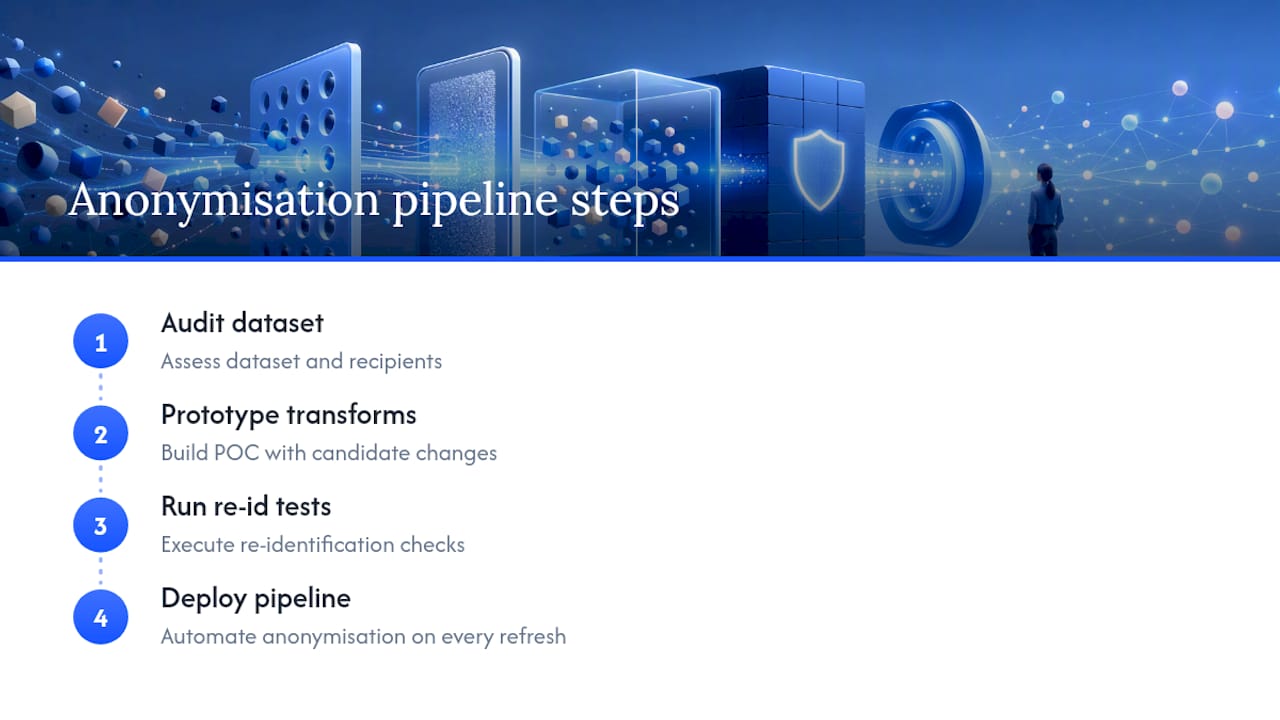
A workable process looks like this: audit the dataset and its recipients, build a proof of concept with candidate transformations, run the re-identification tests, then wire the validated pipeline into production so anonymisation happens automatically on every data refresh, not as a manual one-off.
BotiqueAI develops chatbots, automation workflows, and machine learning integrations for companies that need this exact discipline applied to production data, not just a one-time export.
The practical payoff: once anonymisation logic is embedded as a pipeline step with versioned scripts and stored test reports, teams stop treating compliance as a blocker and start treating it as infrastructure.
Anonymisation as a Governance Project, Not a Checkbox
Anonymisation done right is what lets a company reuse client data responsibly instead of hoarding it or deleting it out of caution. That only works when it’s treated as an ongoing governance program, with owners, versioned logic, and recurring re-testing, rather than a script someone runs once before a launch. If your team needs a second opinion on whether a dataset clears the bar, an outside audit or a proof of concept is usually the fastest way to find out.
— Botiqueai
Get GDPR-Aware Data Pipelines Built Around Your Client Data
Botiqueai is the alternative to hiring a full-time data governance team just to anonymise and validate client datasets. We build the anonymisation logic directly into your pipeline instead of leaving it as a manual script someone runs once and forgets.
Our engagement starts with a free audit of your current client data flows, followed by a proof of concept applying the right mix of generalisation, k-anonymity, or differential privacy to your actual fields. From there, we wire the validated transformation into your production systems using custom automation workflows, so every data refresh runs the same tested logic automatically. No long-term contract is required to get started.
If your client data feeds a chatbot, CRM enrichment process, or analytics dashboard, the same pipeline can carry the anonymisation step through without adding manual work downstream. Reach out through our services overview to scope your dataset and start the free audit.
Sources
- L’anonymisation de données personnelles — CNIL
- Guidelines 02/2026 on Anonymisation — EDPB
- Regulation (EU) 2016/679 (General Data Protection Regulation) — EUR-Lex
FAQ
What Are the Main Solutions for Anonymizing Data?
The main techniques are generalisation, suppression, aggregation, noise addition, k-anonymity, l-diversity, differential privacy, and synthetic data generation. Most real projects combine several methods, since a single technique rarely covers every field type in a client dataset.
How Do You Anonymize Data Digitally?
Digitally, teams typically automate transformations through scripts or dedicated tools like ARX or sdcMicro rather than editing data by hand. The process runs the chosen technique, then re-tests the output against re-identification risk before treating it as anonymised.
What Is the Anonymisation Procedure?
The procedure follows a fixed sequence: scope the dataset and define the recipient, inventory quasi-identifiers, apply transformations, then test the result against the EDPB’s three criteria, no record isolation, no linkage, and no inference. Every step gets documented for audit purposes.
What Is the Difference Between Anonymizing and Pseudonymizing Data?
Anonymised data can’t be traced back to a person by any reasonably available means and falls outside GDPR’s scope. Pseudonymised data replaces identifiers with tokens, but a mapping key or the original data still exists somewhere, so it remains personal data under the regulation.