
AI Project Budget for Decision Makers: Build, Then 1.5–2× 3 Year TCO
AI Project Budget for Decision Makers: Build, Then 1.5–2× 3 Year TCO
Budget projet IA should always cover two numbers, not one: the build cost and the three-year total cost of ownership. A working chatbot or automation build typically runs $40,000 to $500,000 depending on scope, but the real number to defend to your board is 1.5 to 2 times that over three years. Anchor your planning to three project types: a proof of concept, a RAG chatbot, or a predictive model, and start with a paid discovery phase before quoting anything else.
TL;DR:
- Most AI projects typically cost between $40,000 and $150,000 to build, with three-year total ownership estimates reaching 1.5 to 2 times the initial investment.
- Data readiness, integration complexity, and accuracy targets significantly influence project costs, especially for predictive models and complex chatbots.
- The key components driving costs include data cleaning, talent, compute resources, system integration, testing, and contingency, with hidden expenses often adding 28 to 42 percent to the initial build.
- A phased approach with discovery, MVP, and production stages reduces risk, with each phase requiring specific budgets and decision points based on real data.
- Factoring in recurring expenses like inference, hosting, and maintenance more accurately predicts the three-year expenditure, advocating for detailed vendor quotes and staged delivery.
Table of Contents
- Budget Ranges by AI Project Type
- What Actually Drives the Bill: Cost Components Explained
- Recurring Costs and Your Three-Year Total Cost of Ownership
- Project Phases and What to Budget at Each Stage
- How to Calculate ROI and Build Your Business Case
- Funding, Subsidies, and Tax Levers Worth Checking First
- Cost-Control Tactics and a Procurement Checklist
- Why This Budgeting Approach Holds Up
- What We’ve Learned Running These Projects
- Get a Tailored Estimate for Your AI Project
- Sources
Budget Ranges by AI Project Type
Every AI budget conversation stalls at the same point: someone asks “how much does an AI project cost” and gets an answer so vague it’s useless. The honest answer depends entirely on which of five categories your project falls into, and how ready your data is before anyone writes a line of code.
Here’s how the bands actually break down, based on what’s changed heading into 2026 pricing realities:
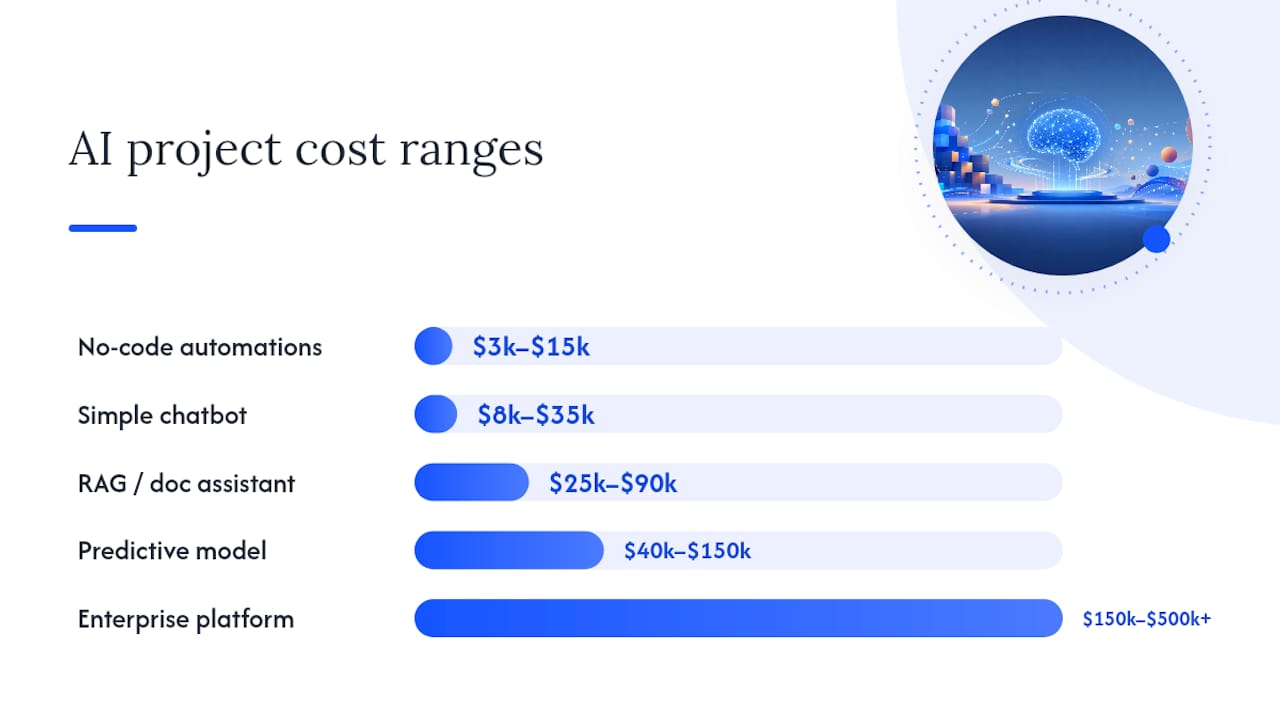
- No-code automations and workflow bots: $3,000 to $15,000, delivered in 2 to 6 weeks. This covers connecting existing tools (CRM, email, Slack) with triggers and simple logic, no custom model training involved.
- Simple chatbot (FAQ or lead capture): $8,000 to $35,000, delivered in 4 to 10 weeks. Pricing swings based on whether it needs multilingual support, WhatsApp integration, or a CRM handoff.
- RAG or document assistant: $25,000 to $90,000, delivered in 8 to 16 weeks. This is the fastest-growing category right now, and also the one most likely to blow its budget when document quality is poor.
- Predictive model (forecasting, scoring, churn prediction): $40,000 to $150,000, delivered in 10 to 20 weeks. Costs here hinge on how much historical data exists and whether it needs cleaning before a model can touch it.
- Enterprise multi-system platform: $150,000 to $500,000+, delivered in 6 to 12 months. Think an AI layer spanning ERP, CRM, and customer service systems simultaneously, with governance and compliance built in from day one.
Industry data backs the middle of that range: median MVP costs land around forty-two thousand dollars (Dev), which tracks closely with what a competent RAG chatbot or lightweight predictive model actually costs once you count integration and testing.
Three variables move a project from the low end of its band to the high end. Data readiness is the biggest one. A company with clean, structured, well-labeled data pays less for a predictive model than one that needs six weeks of data cleaning before training even starts. Integration count matters almost as much. A chatbot that only needs to answer questions costs far less than one that needs to read from your inventory system, write to your CRM, and trigger a fulfillment workflow. Accuracy targets close out the list. Getting a model from 85% to 95% accuracy on ambiguous cases often costs more than getting it from 60% to 85%, because the remaining errors are the hard ones.
If you’re evaluating a no-code automation to start, a practical guide to integrating AI without technical skills walks through what’s realistic at that budget floor.
What Actually Drives the Bill: Cost Components Explained
Every AI quote breaks down into the same handful of line items, but vendors rarely itemize them the way you’d expect. Knowing the split helps you spot a lowball quote that’s hiding costs downstream, or a padded one that’s charging enterprise rates for a simple build.
Pro Tip: Ask every vendor to break their quote into these six categories before you compare prices. A single lump-sum number tells you nothing about where the risk sits.
Here’s the typical allocation for a mid-size AI project (say, a $60,000 RAG chatbot build):
- Data preparation and cleaning: 20-30% of budget. This is consistently the most underestimated line item, and Gartner names a lack of AI-ready data as one of the leading causes of project failure.
- Talent (engineers, prompt specialists, project management): 30-40% of budget. This is your largest single line, and it scales with project complexity, not just duration.
- Compute and model training/inference: 10-20% of budget, though this often gets underquoted because vendors estimate development-phase usage, not production-phase token volume.
- Integration with existing systems: 10-15% of budget. Every additional API connection (CRM, ERP, payment processor) adds cost and testing time.
- Testing, QA, and security review: 8-12% of budget, frequently squeezed when timelines slip.
- Contingency: 10-15% held in reserve, and if your vendor’s quote doesn’t include this line, add it yourself.
The items people underestimate most consistently: vector database hosting for RAG systems, ongoing prompt engineering as edge cases surface post-launch, and monitoring infrastructure to catch model drift before it costs you a customer. None of these show up in a typical build quote, and all of them show up on your first production invoice.
Statistic to remember: hidden first-year costs commonly add 28 to 42 percent on top of the initial build price. If your vendor’s quote doesn’t mention any of that, ask why.
Recurring Costs and Your Three-Year Total Cost of Ownership
Build cost is the number everyone negotiates. Total cost of ownership is the number that actually determines whether the project pays off. Three-year TCO for most AI projects lands at 1.5 to 2 times the initial build cost, driven mainly by inference billing, hosting, and ongoing maintenance.
Inference costs scale with usage, which means a chatbot that starts at 500 conversations a month and grows to 5,000 will see its API bill grow right alongside it. Model routing, sending simple queries to cheaper, smaller models and reserving expensive frontier models for complex requests, along with response caching for repeated questions, can cut that spend by 40 to 60 percent once implemented properly. Managed inference platforms like Azure AI services offer tiered pricing that makes this kind of routing easier to manage than running everything on a single flat-rate endpoint.
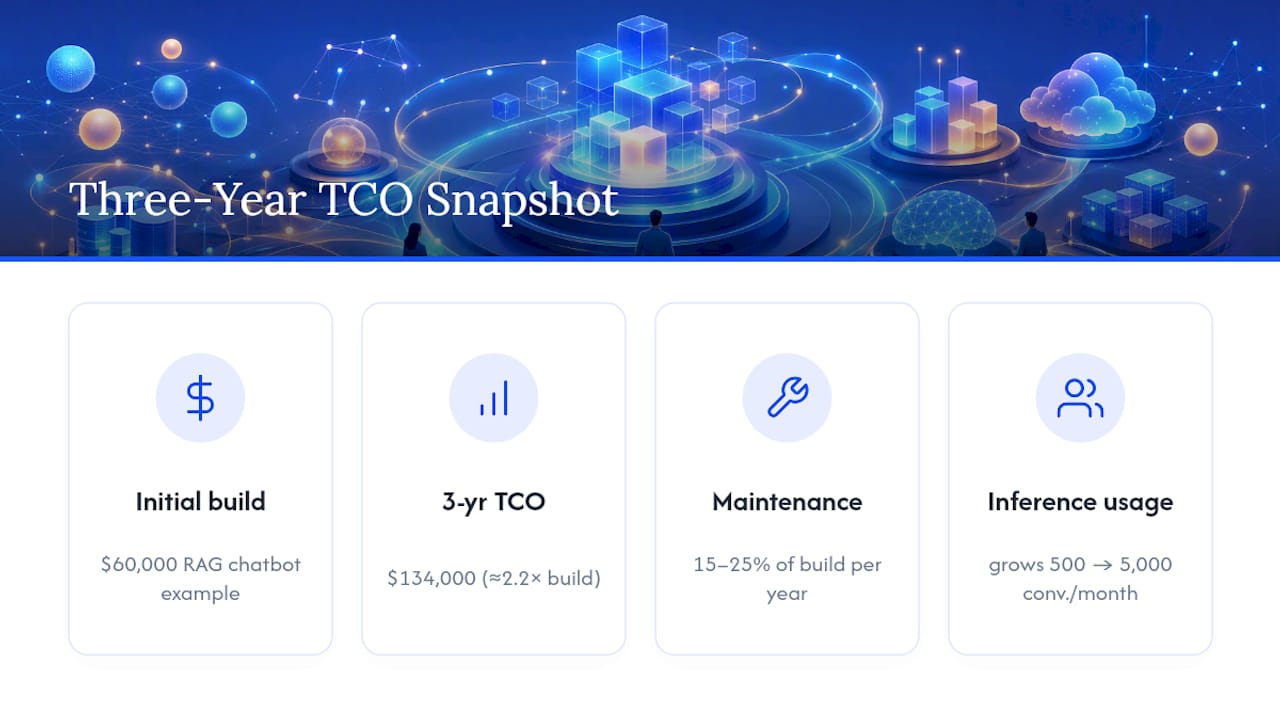
Maintenance is the other recurring line, typically between fifteen and twenty-five percent of the initial build cost per year. That covers bug fixes, prompt updates as your product or policies change, and periodic retraining when model drift starts degrading accuracy.
Here’s what a $60,000 RAG chatbot build looks like projected over three years:
That $134,000 three-year figure is roughly 2.2 times the initial build, on the higher end of the typical range, which is exactly why the rule of thumb exists: quote the build, then double it for board-level planning.
Project Phases and What to Budget at Each Stage
AI projects fail less often because of bad models and more often because of skipped phases. A phased budget forces decision gates at exactly the points where problems are cheapest to catch.
- Discovery and audit (5-15% of total budget, 2-4 weeks): Data readiness assessment, technical feasibility check, and a clear definition of what “done” looks like. Skipping this phase is the single most common reason projects go over budget, since scope ambiguity discovered mid-build costs far more to fix than scope ambiguity caught upfront.
- Proof of concept (10-20% of total budget, 3-6 weeks): A narrow, working demonstration on real (not synthetic) data, built to answer one question: does this actually work for our use case?
- MVP (30-40% of total budget, 6-12 weeks): A production-lean version deployed to a limited user group, with real integrations and real feedback loops.
- Production launch (20-30% of total budget, 4-8 weeks): Full deployment, security hardening, monitoring setup, and staff training.
- Scale (ongoing, budgeted separately as part of TCO): Expanding to new use cases, user groups, or geographies once the core system has proven itself.
Each gate should require a go/no-go decision backed by data, not momentum. A step-by-step pilot framework can help structure those checkpoints if your organization hasn’t run one before.
How to Calculate ROI and Build Your Business Case
The ROI formula for AI projects isn’t complicated: (financial benefit minus total cost) divided by total cost, expressed as a percentage. What’s complicated is agreeing on what counts as a financial benefit, and Harvard Business Review’s 2026 analysis points out that most companies struggle to measure this cleanly because AI benefits often show up as avoided costs rather than new revenue.
Three metrics make the calculation defensible:
- Time saved, converted to dollars using fully loaded hourly labor cost, not just salary.
- Cost avoided, such as reduced error rates, fewer support tickets escalated, or lower churn.
- Revenue uplift, which is the hardest to prove and should carry the most conservative estimate in your model.
Here’s a worked example for a customer service chatbot that cost $50,000 to build and costs $15,000 a year to run. If it deflects 2,000 support tickets a year at $12 in fully loaded cost per ticket, that’s $24,000 in annual savings. Over three years: $72,000 in savings against $50,000 build plus $45,000 in three-year operating cost, or $95,000 total. That’s a negative return in year one, breakeven partway through year two, and a positive return by year three, roughly a 24-month payback window when you factor in ramp-up time.
Track these KPIs during pilot and after launch: ticket deflection rate, average handling time, user satisfaction score, and cost per resolved query. OECD research on generative AI’s productivity effects backs the broader case that these efficiency gains compound over time rather than appearing instantly, which is worth setting as an expectation with your leadership team before launch.
Funding, Subsidies, and Tax Levers Worth Checking First
Several French and EU programs can meaningfully reduce your net AI budget, and most companies never check eligibility before signing a vendor contract.
- France Num lists digital transformation aid programs, including some that cover AI diagnostic and implementation costs for SMEs, detailed on France Num’s financial aid directory.
- Bpifrance offers innovation loans and grants for companies developing or deploying AI as part of a broader digital transformation plan.
- CII/CIR (Crédit d’Impôt Innovation / Crédit d’Impôt Recherche) can offset R&D-adjacent AI development costs, particularly for custom model work rather than off-the-shelf tool licensing.
- OPCO funding, tied to Qualiopi-certified training providers, can cover staff training on new AI tools once deployed.
Documentation requirements typically include a project description, cost breakdown, and proof of SME status. Coverage levels vary by program and change year to year, so confirm current eligibility with your accountant or a Bpifrance advisor before you build these savings into your budget projections.
Cost-Control Tactics and a Procurement Checklist
Fixed-scope discovery phases, staged delivery with go/no-go gates, and service-level agreements on token spend are the three tactics that prevent budget creep more than any negotiation tactic after the fact.
Before signing with any vendor, ask for:
- A written breakdown separating build cost from year-one operating cost.
- A clear definition of what “production-ready” means in their contract, not just their pitch deck.
- Named accountability for who monitors inference spend once you’re live.
- A maintenance line item, priced, not bundled vaguely into “support.”
Pro Tip: If a vendor’s proposal doesn’t mention total cost of ownership at all, that’s not an oversight, it’s a red flag. Ask directly what year two and year three look like before you sign anything.
Watch for vague “production” definitions and missing contingency lines. Those two gaps account for most of the budget surprises decision-makers report after launch. A lean development approach built around staged delivery tends to catch these issues before they become invoices.
Why This Budgeting Approach Holds Up
Botiqueai builds every engagement around a discovery-first model precisely because Gartner’s data on agentic AI project cancellation risk confirms what we see in practice: projects that skip validation get canceled at a far higher rate than those that stage investment deliberately.
The typical engagement runs discovery, then MVP, then production, and then an ongoing subscription for the deployed tool, whether that’s a custom chatbot, an automation pipeline, or a predictive model connected to your existing systems. Each phase ends with a clear go/no-go decision backed by real usage data, not projections. Enterprise clients evaluating this model in more depth can review a case study on AI deployment at scale to see how phased budgeting plays out on a larger platform build.
What We’ve Learned Running These Projects
Three lessons repeat across nearly every engagement. First, discovery isn’t optional, it’s the phase that catches the assumption that kills the budget later. Second, TCO conversations belong in the first meeting, not the invoice six months in. Third, unit economics (cost per query, cost per resolved ticket) matter more than the sticker price on the build. One retail client’s chatbot budget doubled in scope only after a proper discovery phase revealed integration needs nobody had flagged. That correction, caught early, saved far more than it cost.
— Botiqueai
Get a Tailored Estimate for Your AI Project
Botiqueai is the direct route to a defensible AI budget instead of a guess built on a generic vendor quote. Where most agencies hand you a single build price and let year two surprise you, our engagements start with a paid discovery phase that maps your actual data, integrations, and accuracy needs before we quote anything, so the number you get is one you can defend to your board.
If you’re budgeting a customer-facing chatbot, the Aria AI chatbot is built for exactly the RAG and support-deflection use cases covered in the ROI section above, deployable across web, e-commerce, and WhatsApp. For a broader build, whether that’s a predictive model or a multi-system automation, custom AI development covers the no-code and full-code range discussed in the budget bands. Request a discovery call, and you’ll walk away with a phased budget and a three-year TCO estimate instead of a single number that only tells part of the story.
Sources
- State of AI Development Costs 2026 — Pharos production research report (DEV Community)
- AI development cost in 2026: what businesses actually pay — Keyhole Software
- Gartner press release — lack of AI-ready data puts AI projects at risk
- What’s the ROI on AI? — Harvard Business Review (2026)