
Launch AI in 2–4 Months: Deployment Calendar for Decision Makers
Launch AI in 2–4 Months: Deployment Calendar for Decision Makers
Most single-use-case AI deployments run 2 to 4 months for smaller companies and 3 to 6 months for enterprises, moving through six phases: strategy, data audit, scoping, pilot, validation gate, and production. Every calendar in this guide is built around that structure, with sample week-by-week schedules and the KPIs you need to defend a go/no-go decision.
TL;DR:
- Data quality issues often cause delays during the pilot phase, especially if they are discovered too late in the project timeline.
- Enterprise deployments typically extend across 12 to 24 weeks due to longer audits, stakeholder approvals, and system integrations.
- Critical roles such as sponsors, tech leads, and product owners should be scheduled before starting the pilot to prevent delays at validation gates.
- Setting clear success thresholds for KPIs like resolution rate and customer satisfaction at the project’s outset is essential for making go/no-go decisions.
- Continuous monitoring, weekly reviews, and regular retraining are necessary to maintain performance and avoid degradation of AI tools post-launch.
Table of Contents
- What Does a Realistic AI Deployment Calendar Look Like?
- SME vs. Enterprise: Two Timelines You Can Copy Into a Calendar
- Who Should Be Staffed, and When?
- How Do You Know When to Go Live?
- What Technical Checks Come Before Launch?
- How Often Should You Retrain and Review After Launch?
- BotiqueAI’s Perspective on Deployment Timing
- Compress Your Timeline Without Skipping the Validation Gate
- Where This Timeline Data Comes From
- Sources
What Does a Realistic AI Deployment Calendar Look Like?
An AI deployment calendar isn’t a single date. It’s six phases stacked in sequence, each with its own deliverable and its own way of eating weeks you didn’t budget.
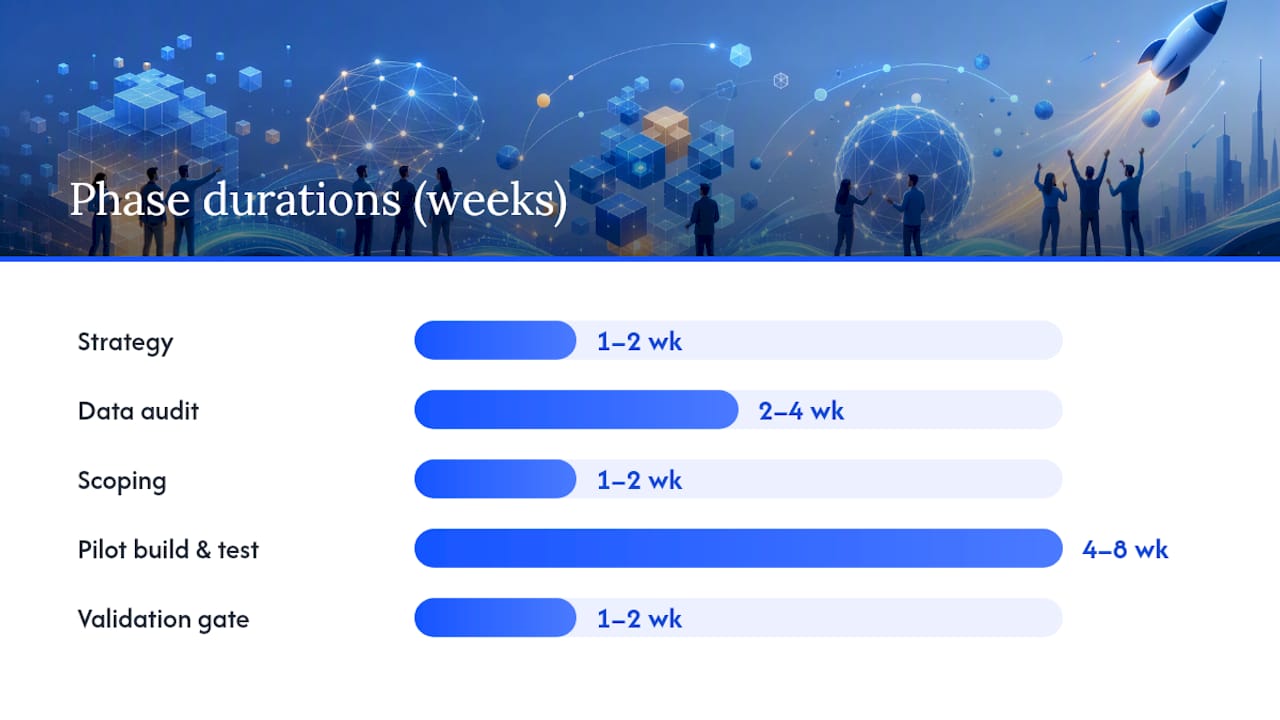
Strategic alignment comes first: a short exercise to define the vision and pick a use-case portfolio. Next is the data and infrastructure audit, which produces a data readiness report. This phase is where projects quietly stall, because nobody checked whether the CRM export was clean before the contract got signed.
Scoping follows, setting success criteria and an MVP definition. Then comes the pilot: build and test, typically the longest visible chunk of the AI roadmap and phases, running 4 to 8 weeks for a single use case according to Gartner. After the pilot, a validation gate forces a go or no-go decision (more on that template below). Production deployment closes the loop with monitoring and continuous optimization.
- Strategy (1-2 weeks): vision statement, use-case shortlist, budget sign-off.
- Data audit (2-4 weeks): data quality report, integration inventory, access permissions mapped.
- Scoping (1-2 weeks): success metrics, MVP scope, stakeholder agreement.
- Pilot build & test (4-8 weeks): working prototype, internal QA, first user feedback.
- Validation gate (1-2 weeks): KPI review, go/no-go decision, sign-off from sponsors.
- Production & optimization (ongoing): phased rollout, monitoring dashboards, retraining schedule.
Delays almost always trace back to one of two causes: undiscovered data quality problems surfacing mid-pilot, or a validation meeting that can’t get on three executive calendars at once. Plan around both, and you’ll beat the average timeline rather than live inside it.
SME vs. Enterprise: Two Timelines You Can Copy Into a Calendar
A small company chatbot pilot and an enterprise agent rollout don’t share a calendar, even when they share a roadmap. Here’s what each actually looks like week by week.
SME timeline (8 to 16 weeks):
- Week 1: Kickoff, use-case confirmed, success metrics drafted.
- Weeks 2 to 3: Data prep and integration mapping (CRM or ticketing export).
- Weeks 4 to 6: Prototype built, internal review.
- Weeks 7 to 9: Pilot launches with a small user group.
- Week 10: Validation gate meeting, KPI review against thresholds.
- Weeks 11 to 12: Production launch on primary channel.
- Day 30 post-launch: First optimization check and adoption review.
Enterprise timeline (12 to 24 weeks): the same six phases stretch out, mostly in the audit and integration windows. Data audits often run 4 to 6 weeks against multiple systems. Architecture decisions and integration testing (CRM, ticketing, identity management) can add another 4 to 8 weeks. Stakeholder sign-off, which took one meeting for the SME, now requires alignment across legal, security, and multiple business units. The Alicelabs implementation roadmap notes that calendar conflicts at senior levels alone can add 2 to 4 weeks to any enterprise deployment.
Block three calendar entries the day you kick off: the validation gate meeting, a 30-day and 90-day ROI review, and a recurring monthly optimization sprint. Miss the first one and everything downstream slips with it.
Who Should Be Staffed, and When?
An MVP chatbot or automation needs a surprisingly small team: a product owner to define scope, one engineer who can handle both the model and the integration work, and someone from the business side who actually knows the workflow being automated. That’s often three people, not ten.
Enterprise rollouts need more separation of duties. Expect a product owner, a dedicated ML engineer, an MLOps or platform engineer for monitoring and retraining, a UX lead for conversational design, a business subject-matter expert, and a support lead who owns escalations once the tool is live.
- Product owner: owns scope and KPIs from strategy through production.
- ML/automation engineer: builds and tunes the pilot, then hands off to MLOps for scaling.
- UX lead: shapes conversation flows and error states before pilot launch.
- Business SME: validates that automated decisions match real workflow logic.
- Support lead: owns escalation paths and user feedback after go-live.
Bring in an external partner to own delivery when internal teams lack ML engineering depth or MLOps experience. Keep them as advisors, not owners, when the internal team just needs a second set of eyes on architecture decisions. The Fraunhofer implementation guide stresses planning training and change management early, even though execution happens closer to launch.
Pro Tip: Schedule the roles you’ll need for the validation gate (sponsor, technical lead, product owner) on calendars before the pilot even starts. Waiting until pilot week 6 to find a free slot is how a two-week gate turns into a six-week one.
How Do You Know When to Go Live?
A pilot without predefined kill criteria never actually ends. It just quietly absorbs budget until someone asks why. Set thresholds before the pilot starts, not after you see the results.
Core KPIs to define upfront: resolution rate (the share of interactions handled without human intervention), customer satisfaction score, escalation rate, and average response time. A chatbot pilot with a 60% resolution rate and rising CSAT is a clear go; one stuck below 40% with climbing escalations is a clear no.
- Define resolution rate, CSAT, escalation rate, and response time thresholds before pilot launch.
- Require sign-off from the business sponsor, technical lead, and product owner at the gate meeting.
- Set a kill criterion in advance (for example, resolution rate under 40% after four weeks triggers a redesign, not an extension).
- Schedule the 90-day ROI review the same week you schedule the gate meeting.
| KPI | Weak signal | Strong signal |
|---|---|---|
| Resolution rate | Below 40% | Above 60% |
| CSAT | Declining week over week | Stable or rising |
| Escalation rate | Rising | Flat or falling |
| Response time | Slower than human baseline | Faster than human baseline |
Building a pilot project around these thresholds from day one is what separates a decision from a guess.
What Technical Checks Come Before Launch?
Most launch failures aren’t model failures. They’re integration failures nobody caught because testing skipped straight from demo to production.
- Confirm data readiness: clean records, correct formatting, and no orphaned fields in the source system.
- Verify authentication and identity/security permissions across every connected system.
- Test integrations individually: CRM, ticketing platform, and knowledge base, before testing them together.
- Confirm escalation and rollback paths work before the first real user touches the system.
For architecture, a simple API call against a knowledge base often suffices for narrow tasks; a retrieval-augmented generation (RAG) setup is worth the added complexity only when answers depend on large, frequently updated knowledge sources. Per the chatbot deployment checklist, a working prototype can take days, an MVP on a single channel runs 2 to 4 weeks, and a full chatbot with RAG and multiple integrations typically takes 6 to 12 weeks.
- Internal QA against test scripts covering edge cases, not just happy paths.
- Limited pilot with real users on one channel.
- Monitoring hooks confirmed live before wider rollout.
- Staged rollout by user segment, expanding only after each stage clears its KPIs.
How Often Should You Retrain and Review After Launch?
Go-live is the start of a maintenance cycle, not the finish line. Treat it that way and the tool keeps improving; treat it as done and it quietly degrades.
Track intents missed, escalation rate, CSAT, and cost per contact continuously, with a weekly review of what’s trending wrong. Weekly fixes handle small drift. A monthly retrain cycle keeps the model current with new products, policies, or seasonal language. Quarterly, revisit the roadmap itself, since Gartner’s guidance treats the roadmap as a living document that needs updating after any maturity assessment or strategy shift.
- Weekly: review escalation and CSAT trends, ship small fixes.
- Monthly: retrain on new data, run an optimization sprint.
- Quarterly: revisit the roadmap and scope for the next use case.
- 30 and 90 days post-launch: formal business review against original ROI targets.
Pro Tip: Rank next-sprint work by which monitoring signal is degrading fastest, not by what’s easiest to fix. A slowly rising escalation rate is usually more urgent than a flat CSAT score everyone assumes is fine.
BotiqueAI’s Perspective on Deployment Timing
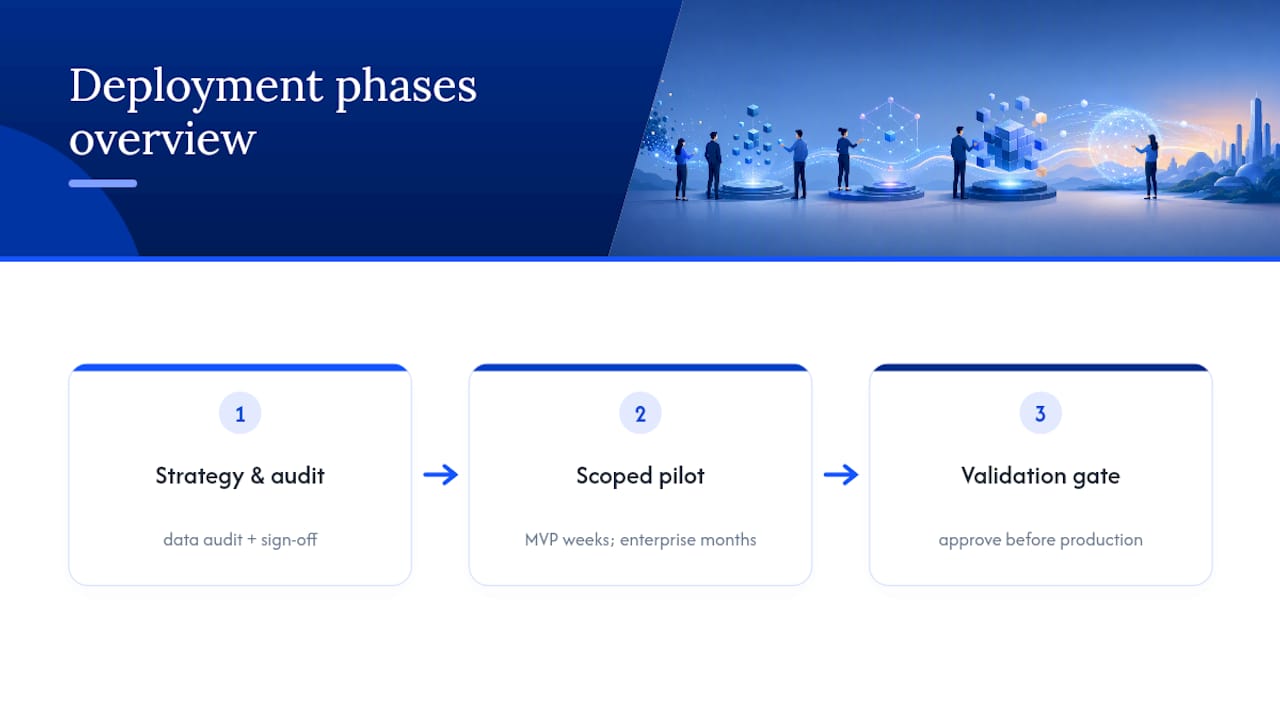
We phase every project the same way this guide describes: strategy and audit first, a scoped pilot second, and a validation gate before anything touches production. What changes is speed. A packaged chatbot MVP can launch in weeks; an enterprise agent tied into several backend systems needs the fuller runway.
The gap most teams underestimate isn’t the build. It’s the data audit and the sign-off meeting. We plan for both from week one, not week six.
— Botiqueai
Compress Your Timeline Without Skipping the Validation Gate
An alternative to building this roadmap from scratch with a patchwork of contractors exists. Instead of spending your data-audit weeks discovering which CRM fields are broken, this audit can be run as part of a scoped engagement, then move straight into a pilot on dedicated tooling.
The Aria chatbot is designed to shorten the phase that often takes the most calendar time: getting from scoping to a testable pilot. If your use case leans more toward internal process automation than customer-facing chat, our workflow automation services follow the same phased calendar, just with different integration points. Reach out to scope your use case and get a realistic delivery date instead of a guess.
Where This Timeline Data Comes From
- Gartner’s AI roadmap and phases: the source for the six-phase structure and the 3 to 6 month enterprise, 2 to 4 month SME benchmarks used throughout.
- Alicelabs’s pilot-to-production roadmap: backs the validation gate emphasis and the 2 to 4 week delay risk from executive scheduling conflicts.
- Fraunhofer’s AI implementation guide: informs the staffing and change-management points in the resourcing and monitoring sections.
- Relation-client: source for the technical build timings, from prototype to full RAG-integrated chatbot.
Sources
- AI roadmap and phases — Gartner
- Guide to the implementation of AI projects — Fraunhofer (KI-ULTRA)
- Relation-client
- AI implementation roadmap: From pilot to production — Alicelabs