
Chatbot Customer Service Setup for SMBs: 2026 Guide
Chatbot Customer Service Setup for SMBs: 2026 Guide
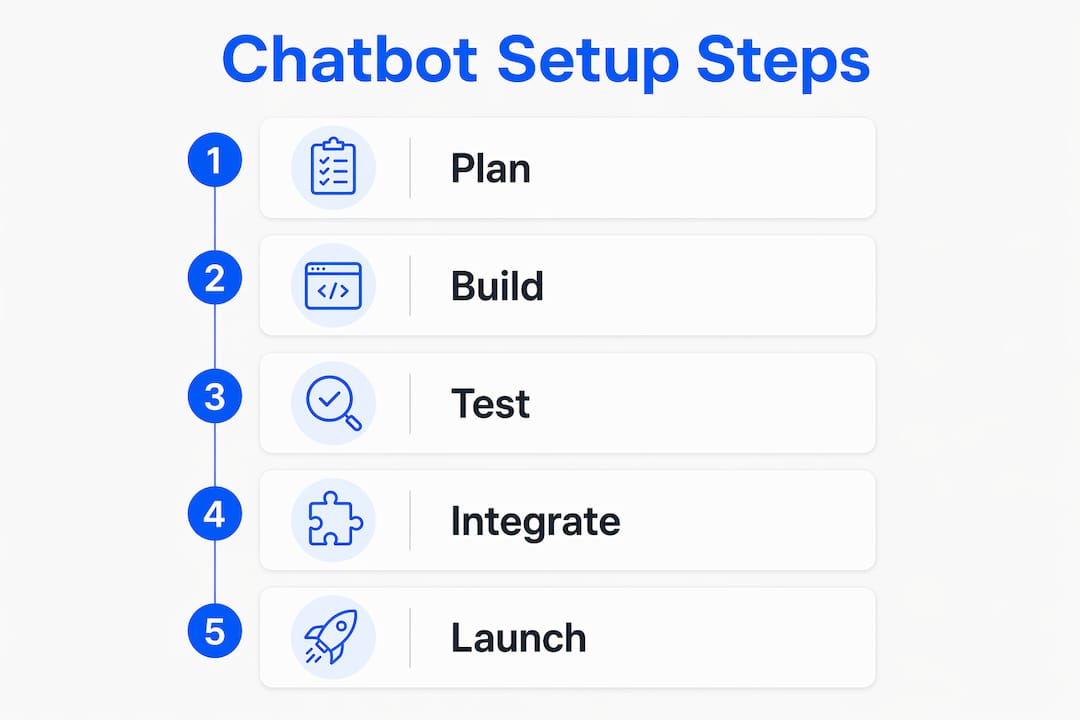
A chatbot customer service setup is the process of deploying an AI-powered conversational agent to handle customer inquiries automatically, without requiring a human to respond each time. For small and mid-sized businesses, this is no longer a luxury. 89% of Gen Z customers prefer chatbots for simple interactions, and that demographic is now a primary buying force. The industry term for this practice is “conversational AI deployment,” though most SMB owners simply call it setting up a chatbot. The good news: the technical setup takes 30–120 minutes, including account creation, uploading your knowledge base, and going live on your website. This guide walks you through every step.
What tools do you need for chatbot customer service setup for SMBs?
The right tools determine whether your chatbot handles real conversations or frustrates customers into leaving. No-code platforms are the correct starting point for most SMBs. They require zero programming knowledge and let you build, test, and deploy a chatbot through a visual interface in a single afternoon.
Chatbots live most commonly as a small widget on your website, but the best small business chatbot solutions extend to social media DMs, WhatsApp, and SMS. That multi-channel reach matters because your customers are not all in the same place. A retail SMB might need WhatsApp coverage; a B2B service firm might prioritize website chat and email follow-up.

Before you pick a platform, define your primary goal. The three most common SMB use cases are lead qualification, customer support deflection, and e-commerce order tracking. Each use case shapes which features you actually need. A lead qualification bot needs form-capture logic and CRM sync. A support bot needs a deep FAQ library and a clear escalation path.
Here are the core requirements to have ready before you start:
- A knowledge base: a document or FAQ list covering your top 20–30 customer questions
- A defined channel: website widget, WhatsApp, or social DM
- A CRM connection: native integrations with HubSpot, Zoho, or ActiveCampaign are standard on most platforms
- A clear escalation rule: who gets the chat when the bot cannot answer?
- A brand voice guide: even two or three sentences describing your tone
| Feature category | What to look for |
|---|---|
| Setup method | Visual drag-and-drop builder, no coding required |
| Channel support | Website, WhatsApp, Instagram DM, SMS |
| CRM integration | Native sync with HubSpot, Zoho, or ActiveCampaign |
| Escalation options | Live chat handoff, email ticket creation |
| Analytics | Conversation logs, unanswered question tracking |
CRM integration and automation can be configured in under 20 minutes on most modern platforms. That speed means your chatbot starts capturing and tagging leads from the first conversation, with no manual data entry required.
How do you build conversation flows for SMB customer service?
Conversation flows are the scripts your chatbot follows. They are not rigid scripts. They are decision trees that branch based on what the customer types or clicks. Getting these right is the difference between a bot that helps and one that loops customers in circles.
Every SMB chatbot needs at least four core flows:
- Greeting flow: Welcomes the visitor, asks what they need, and routes them to the right branch
- FAQ flow: Answers your top questions directly, with a fallback if the answer is not found
- Booking or lead flow: Collects name, email, and inquiry details, then syncs to your CRM
- Handoff flow: Transfers the conversation to a human agent with full context preserved
Keyword triggers are what activate specific flows. When a customer types “pricing,” the bot routes to the pricing FAQ. When they type “frustrated” or “speak to someone,” the bot triggers the handoff flow immediately. Configuring keyword triggers like “human” or “frustrated” and setting failure fallbacks after two failed AI responses prevents the most common source of customer frustration: feeling stuck with a bot that cannot help.
Failure fallbacks deserve special attention. If your bot cannot match a customer’s question after two attempts, it should not try a third time. It should offer a human handoff or ask the customer to rephrase. That single rule eliminates most negative chatbot experiences.
Pro Tip: Write your chatbot responses in the same voice your team uses on the phone. If your business is casual and friendly, the bot should be too. Formal language from an otherwise relaxed brand feels off, and customers notice.
When building flows for lead qualification, keep the questions short and sequential. Ask for one piece of information at a time. Asking for name, email, phone, and project details in a single message overwhelms customers and drops completion rates.
What are the best integration and testing practices before going live?
Testing is where most chatbot projects stall. Teams build a solid flow, skip aggressive testing, and discover problems only after real customers hit the bot. Edge-case testing, mobile device validation, and failed handoff simulations are the most overlooked steps in the entire setup process.
Run your chatbot through these checks before launch:
- Edge-case questions: Ask the bot things your customers would never ask politely. Typos, slang, and off-topic questions reveal where your flows break.
- Mobile responsiveness: Test on at least two mobile browsers. Most website visitors are on phones, and a widget that renders poorly on mobile kills the experience.
- Escalation simulation: Trigger the handoff flow deliberately. Confirm the human agent receives the full conversation history, not just the last message.
- CRM sync check: Submit a test lead and verify it appears in HubSpot, Zoho, or ActiveCampaign with the correct tags.
- Loop detection: Walk through a flow and deliberately give wrong answers. Confirm the bot exits the loop after two failed attempts.
After launch, reviewing chatbot conversations regularly identifies unanswered questions and knowledge base gaps within weeks. Set a calendar reminder to review chat logs every two weeks for the first three months. Each review session will surface three to five questions your bot cannot yet answer. Adding those answers compounds the bot’s accuracy over time.
Pro Tip: Track the “unanswered question” report in your platform’s analytics dashboard weekly. That single report is your most direct signal for where to improve the knowledge base next.
Connecting your chatbot to your customer support automation tools also means your team sees every conversation, not just the ones that escalate. That visibility helps managers spot patterns and coach the bot more effectively.
What mistakes should SMBs avoid during chatbot setup?
The most common chatbot failures are not technical. They are planning and process failures that show up after launch.
- Skipping user experience testing. Building a flow that works for you does not mean it works for your customers. Always test with someone who has no context about your business.
- Missing escalation rules. A bot with no clear handoff path traps customers. Every flow must have an exit to a human agent.
- Overloading the bot at launch. Start with your top five customer questions. Add complexity after the core flows are working reliably.
- Ignoring mobile users. A chatbot that works on desktop but breaks on mobile fails the majority of your visitors. Mobile testing is not optional.
- Letting the knowledge base go stale. A bot trained on last year’s pricing or outdated policies gives wrong answers. Schedule quarterly content reviews as a standing task.
The chatbot vs. AI agent decision also matters here. SMBs that try to deploy a fully autonomous AI agent before mastering basic chatbot flows almost always struggle. Start with a structured chatbot, then graduate to more autonomous AI behavior once your flows are proven.
Neglecting the common deployment mistakes that sink most chatbot projects is the fastest way to waste your setup investment. The fix is simple: treat launch as the beginning of the process, not the end.
Key Takeaways
A successful SMB chatbot customer service setup requires clear goals, tested conversation flows, CRM integration, and a commitment to ongoing improvement after launch.
| Point | Details |
|---|---|
| Start with a knowledge base | Compile your top 20–30 customer questions before touching any platform. |
| Define one primary use case | Choose lead qualification, support deflection, or order tracking before building flows. |
| Build escalation rules first | Configure keyword triggers and failure fallbacks before any other flow logic. |
| Test aggressively before launch | Run edge-case, mobile, and handoff simulations to catch failures before customers do. |
| Review chat logs regularly | Check unanswered questions every two weeks for the first three months post-launch. |
What I’ve learned from watching SMBs set up chatbots
The businesses that get the most from their chatbots are the ones that treat the bot as a team member, not a ticket deflection machine. That shift in mindset changes everything. When you think of the bot as a team member, you give it a name, a voice, and clear boundaries. You also invest in its ongoing training the same way you would onboard a new hire.
The biggest mistake I see is designing the handoff trigger as an afterthought. Teams spend hours on greeting flows and FAQ responses, then add a single “type HUMAN to talk to someone” line at the bottom. That is not a handoff strategy. The handoff trigger should be the first thing you design, because it is the safety net for every other flow.
Quick setup timelines are real. An SMB can go from zero to a live, functional chatbot in an afternoon. But the businesses that see lasting results are the ones that spend the next 90 days iterating on their knowledge base. The setup is the easy part. The ongoing refinement is what separates a bot that customers trust from one they ignore.
— Botiqueai
How Botiqueai’s Aria can accelerate your SMB chatbot setup
Setting up a customer service chatbot does not have to mean weeks of configuration and technical headaches.
Botiqueai’s Aria chatbot is built specifically for SMBs that need a no-code setup, multi-channel support, and deep CRM integration out of the box. Aria connects to HubSpot, Zoho, and ActiveCampaign natively, handles website chat, WhatsApp, and social DMs from a single dashboard, and includes intelligent escalation rules that route customers to a human agent at exactly the right moment. For SMBs that want a proven AI customer service solution without the trial-and-error, Aria is worth evaluating as your first deployment.
FAQ
How long does it take to set up a chatbot for an SMB?
The technical setup of an AI chatbot for SMBs typically takes 30–120 minutes, covering account creation, knowledge base upload, and website deployment.
What is the difference between a chatbot and an AI agent?
A chatbot follows structured conversation flows and responds to defined triggers. An AI agent operates more autonomously, making decisions across multiple steps without a fixed script.
Do SMB chatbots need to integrate with a CRM?
CRM integration is strongly recommended. It enables automatic lead capture, tagging, and segmentation, and most platforms connect to HubSpot, Zoho, or ActiveCampaign in under 20 minutes.
How do I prevent my chatbot from frustrating customers?
Configure keyword triggers for frustration signals like “frustrated” or “speak to someone,” and set failure fallbacks that hand off to a human agent after two failed AI responses.
How often should I update my chatbot’s knowledge base?
Review your chat logs every two weeks for the first three months after launch. Each review surfaces unanswered questions that, once added, improve accuracy quickly.