
Chatbot or AI Agent: Which One to Choose for Your Business?
Chatbot or AI agent: the two terms are often used interchangeably. Yet they refer to very different tools, with distinct use cases and levels of complexity. Choosing the right one from the start will save you from paying for features you don't need — or hitting a ceiling too soon.
The chatbot: simple, fast, effective within a defined scope
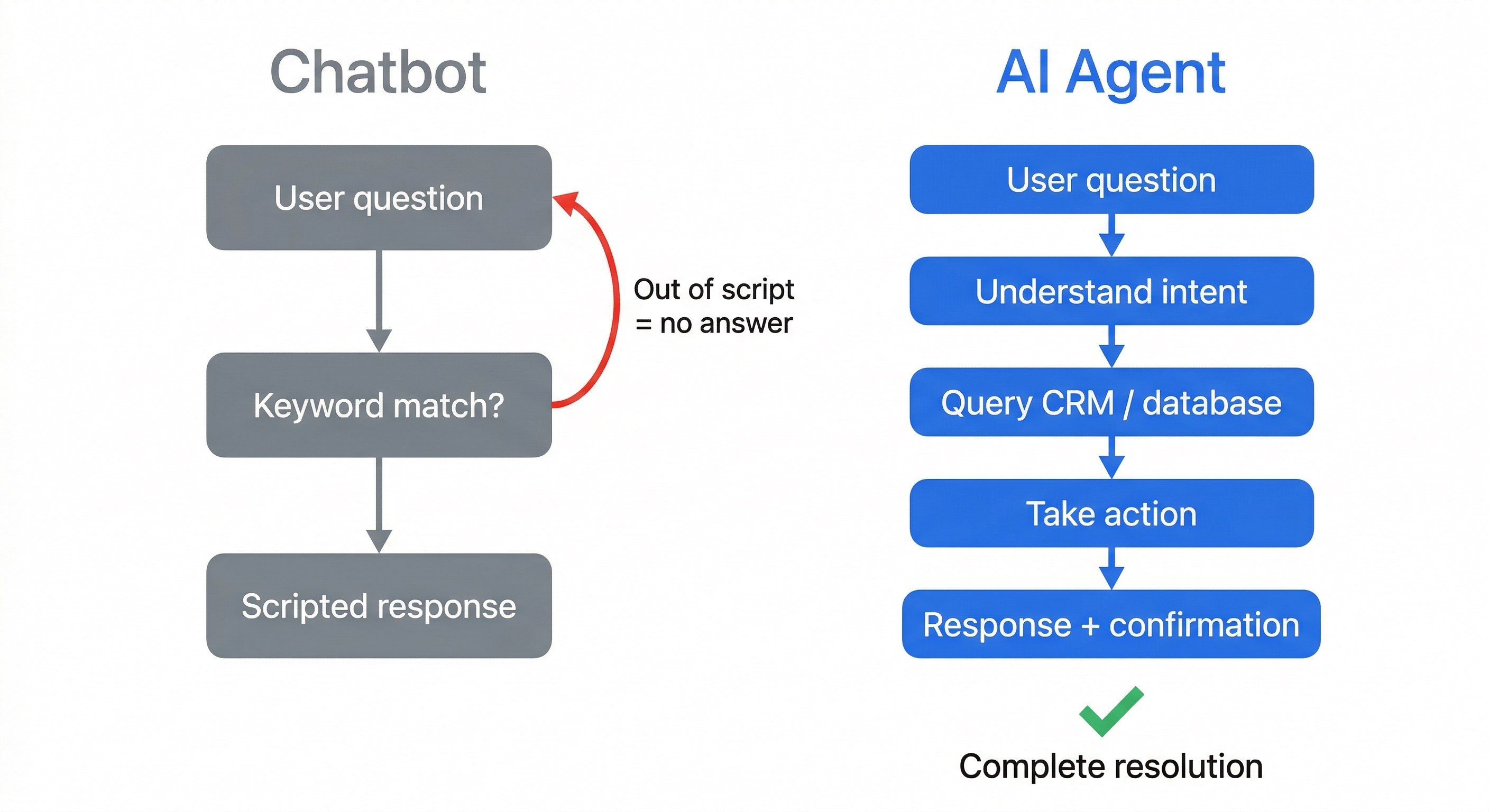
A traditional chatbot operates on predefined scenarios. It follows a decision tree: if the user says X, it replies Y. Modern chatbots incorporate natural language processing (NLP), making them more flexible. Their logic nonetheless remains fundamentally reactive and limited to what they have been trained on.
Strengths:
- Fast to deploy (a few days)
- Lower cost
- Ideal for FAQs, appointment booking, first-level support
- Easy to maintain on a stable scope
Limitations:
- Cannot handle requests outside the script
- Cannot execute complex multi-step tasks
- Limited contextual memory between conversations
The AI agent: autonomous, versatile, capable of acting
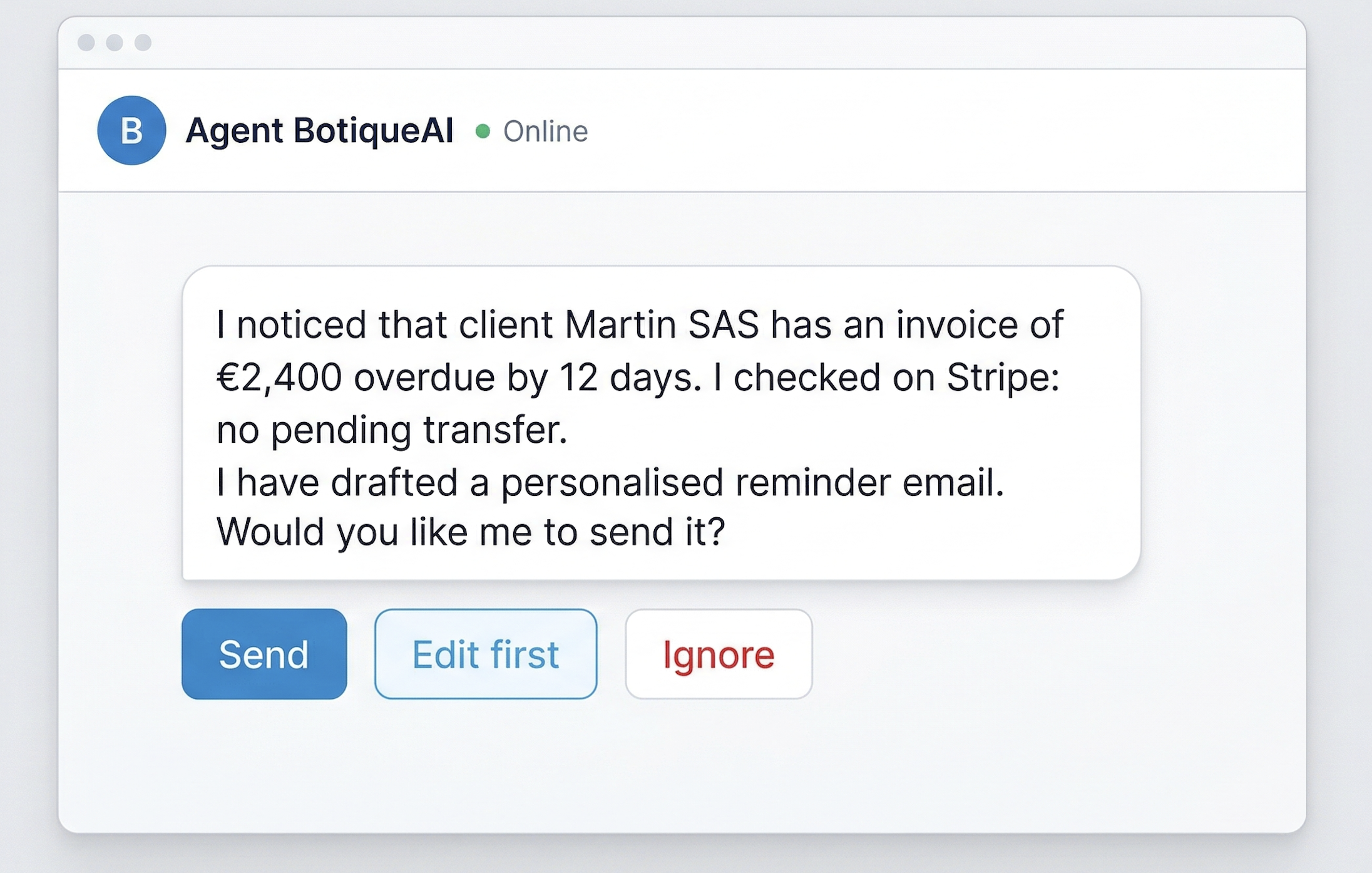
An AI agent is a system that can reason, plan and act. It doesn't just answer questions: it can call APIs, query databases, send emails, update a CRM, or chain multiple actions based on context. And unlike a chatbot, which is purely reactive, a well-configured agent can detect a problem before the customer even reports it and act proactively.
Where a chatbot says "your order is on its way," an AI agent can check the status in your logistics software, detect a delay, draft a proactive email and send it automatically.
Strengths:
- Autonomy across complex workflows
- Can make decisions and adapt in real time
- Deeply integrates with your business tools
- Improves its responses over time
- Anticipates potential issues before the customer raises them
- Analyses sentiment and tone in real time to adapt its responses
Limitations:
- Longer to configure and test
- Higher cost
- Requires more rigorous initial supervision
- Broad access to your systems and data: requires an appropriate security policy
- A "shadowing" phase is essential at launch: a human validates the agent's decisions before they're sent, long enough to calibrate its behaviour and build trust
What's happening under the hood
In practice, an AI agent relies on four components that set it apart from a chatbot:
RAG (Retrieval-Augmented Generation): your agents don't reason in a vacuum. Before responding, they consult your PDFs, contracts, internal procedures and knowledge bases in real time. The result: answers grounded in your actual data, with no risk of fabricating information.
Multimodality: in 2026, an AI agent can analyse a screenshot sent by a customer to diagnose an issue, read a purchase order from a photo, or process a WhatsApp voice message. A classic chatbot is generally incapable of this.
📊 Finance: you ask your agent to prepare a monthly report. It identifies the relevant sources, extracts the data, flags anomalies, generates a summary document and updates your dashboard. Zero human intervention between steps.
👥 HR / Onboarding: a new employee starts Monday. The agent automatically sends documents for signature, sets up access rights, schedules onboarding meetings and follows up if any step is missed.
📦 Logistics: a customer dispute is opened. The agent reviews the order history, identifies the likely cause, drafts an appropriate response and escalates to the right person if needed.
Two ways to think about it
Comparison table
| Criteria | Chatbot | AI agent |
|---|---|---|
| Deployment | A few days | 1 to 3 weeks |
| Cost | € | €€ |
| Use cases | FAQs, appointment booking, simple support | Complex workflows, CRM, multi-step automation |
| Autonomy | Low | High |
| Maintenance | Simple | Requires regular monitoring |
Which one is right for your business?
Choose a chatbot if:
- You have a high volume of repetitive, predictable questions
- You're just starting with AI and want a quick first result
- Your monthly budget is under €250
Choose an AI agent if:
- You want to automate complete business processes (sales, support, onboarding)
- You have integrations to manage (CRM, ERP, e-commerce)
- You're looking to significantly reduce human processing time
Not sure which one you need?
Two approaches are possible depending on your situation:
Option 1: start simple, then evolve. Most businesses begin with a chatbot for one specific use case, measure the results, then move to an AI agent once the value is proven. It's the natural progression.
A chatbot is an assistant. An AI agent is a fully-fledged digital colleague.
Option 2: both in parallel. Some businesses use a chatbot for public-facing customer interactions (where brand voice control is a priority) and an AI agent for internal workflows or complex sales processes. It's not one or the other: it's often "both together, on distinct scopes"¹.
✔ Free audit included
✔ Recommendation tailored to your context
✔ Deployed in under a week
Book a free slot →
Sources
¹ Salesforce — AI Agent vs. Chatbot: What's the Difference? salesforce.com