
Conversational Robots for Business: A 2026 Guide
Conversational Robots for Business: A 2026 Guide
Conversational robots are AI-powered agents that understand natural language, hold multi-turn dialogues, and execute tasks inside business systems without human intervention. Unlike basic AI chatbots that answer FAQs from a fixed script, conversational robots use natural language processing to interpret intent, maintain context across a conversation, and trigger real actions. The industry term for this category is “conversational AI agents,” and the distinction matters: these systems do not just respond, they act. Botiqueai builds custom conversational agents that connect directly to business workflows, making them a practical example of what this technology looks like in production.
What are conversational robots, and how do they differ from chatbots?
Conversational robots are fundamentally different from traditional chatbots in one critical way: agency. A scripted chatbot follows a decision tree. It reads a keyword, matches it to a pre-written response, and stops there. A conversational AI agent reads intent, asks clarifying questions, and then performs a multi-step action inside a connected system.
The practical difference shows up in real scenarios. A scripted bot can tell a customer that appointments are available on Tuesdays. A conversational robot checks the live calendar, books the slot, sends a confirmation, and updates the CRM record, all within the same conversation. Agents execute multi-step workflows mid-conversation rather than simply providing information. That shift from information delivery to task execution is what separates conversational robots from FAQ-style virtual assistants.

The concept of agency also changes how these systems integrate with enterprise tools. A conversational robot connects to CRM platforms, booking systems, payment gateways, and support ticketing tools. It does not summarize what a human should do next. It does the task itself.
Key capabilities that distinguish conversational robots from simpler automated conversation agents:
- Multi-turn memory: The agent remembers what was said earlier in the conversation and uses it to shape later responses.
- Live system access: The agent reads and writes to connected platforms in real time, not after the conversation ends.
- Intent resolution: The agent interprets ambiguous requests and asks targeted follow-up questions to clarify before acting.
- Conditional logic: The agent adapts its path based on what it learns during the conversation, not a fixed script.
- Human handoff with context: When escalation is needed, the agent passes the full conversation record to a human agent, so the customer never repeats themselves.
Pro Tip: When evaluating whether you need a chatbot or a conversational robot, ask one question: does the interaction require a system action, or just an answer? If the answer is “a system action,” you need a conversational AI agent.
How are conversational robots built and integrated into business systems?
Building a conversational robot used to require months of engineering work. That timeline has compressed significantly. Low-code visual builders reduce deployment from weeks to days by providing pre-built templates, drag-and-drop conversation flows, and native connectors to common business tools. That speed matters for organizations that need to move fast without large development teams.
The development process typically follows four stages:
- Define the use case and success criteria. Identify the specific task the agent will handle, the systems it needs to access, and how you will measure whether it is working. Vague goals produce vague agents.
- Design the conversation flow with AI scaffolds. AI scaffolds help overcome the “blank page problem” in conversational design by generating structured dialogue flows from business goals. This produces clearer, more consistent interactions than building from scratch.
- Connect to live business systems. Wire the agent into your CRM, ERP, support platform, and communication channels. An agent that cannot access live data cannot take live action.
- Deploy, test, and iterate. Run the agent against benchmark scenarios before going live. After launch, automated regression testing prevents conversational failures when you update the bot’s logic or connected systems.
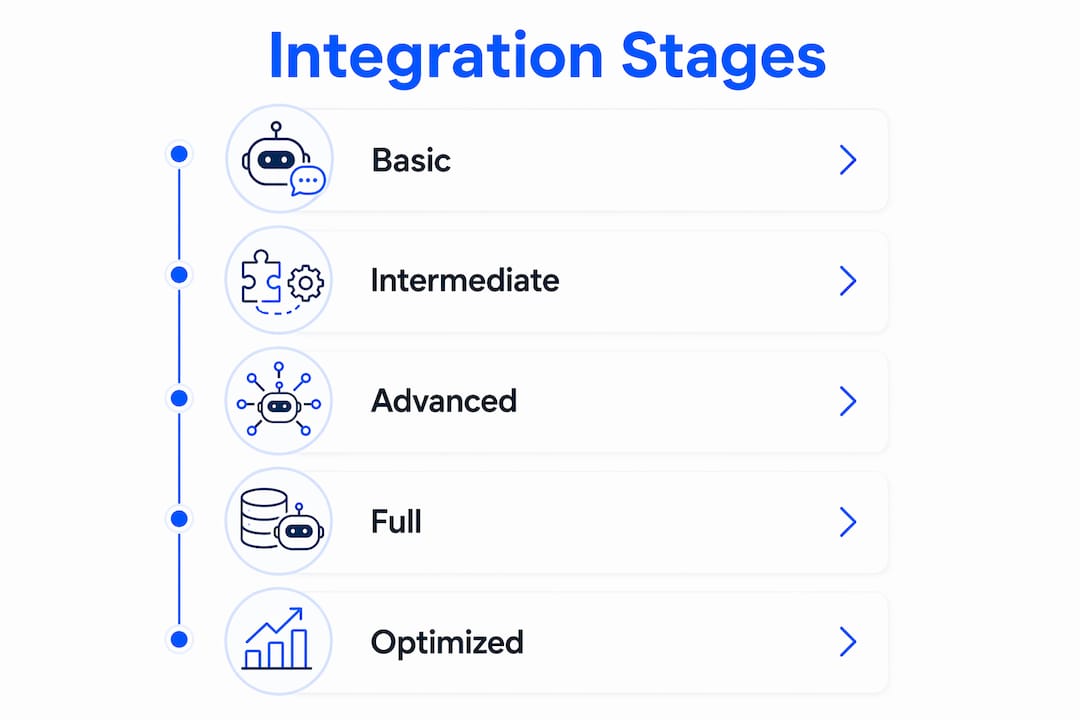
Integration depth determines the agent’s real value. A conversational robot connected only to a knowledge base behaves like a search engine. One connected to your CRM, calendar, and ticketing system behaves like a trained employee. The difference in business impact is significant.
| Integration level | Systems connected | Capabilities unlocked |
|---|---|---|
| Basic | Knowledge base only | FAQ answers, document retrieval |
| Intermediate | CRM + support ticketing | Lead capture, ticket creation, status updates |
| Advanced | CRM + calendar + ERP + payments | Full transaction execution, booking, billing |
| Enterprise | All above + voice + multichannel | Omnichannel automation at scale |
Pro Tip: Start with one high-volume, well-defined use case. A focused agent that handles appointment booking perfectly delivers more value than a broad agent that handles everything poorly.
What practical applications do conversational robots serve?
The business case for conversational AI agents is strongest where volume is high and tasks are repetitive. These are the areas where the technology pays for itself fastest.
Customer support is the most common starting point. An intelligent dialogue system handles password resets, order status checks, return requests, and billing questions without involving a human agent. Enterprise-grade conversational AI platforms achieve a 92% first-attempt success rate across 172 benchmarked scenarios when integrated with business workflows. That rate means the vast majority of routine support interactions resolve without escalation.
Lead qualification and sales support represent a second high-value application. A conversational robot engages a website visitor, asks qualifying questions, scores the lead based on responses, and books a sales call, all automatically. This removes a manual step that often delays follow-up by hours or days.
Outbound engagement is an underused application. Voice interaction technology handles outbound calls for appointment reminders, payment collection, and customer satisfaction surveys. Voicebots handle thousands of calls with natural speech synthesis and multilingual support, reducing call center load without a drop in quality. For organizations running high-volume outbound programs, this is a direct cost reduction.
Multichannel deployment multiplies the impact of a single agent. The same conversational robot can operate across web chat, SMS, WhatsApp, email, and voice channels from one configuration. Customers interact on the channel they prefer, and the agent maintains context across all of them.
Practical applications by business function:
- Customer service: Resolve tier-1 support tickets, handle returns, and answer billing questions automatically.
- Sales: Qualify inbound leads, schedule demos, and follow up with prospects who did not convert.
- Operations: Automate internal IT helpdesk requests, HR onboarding questions, and facilities management.
- Marketing: Run conversational surveys, collect feedback, and deliver personalized content recommendations.
- Finance: Send payment reminders, process basic billing inquiries, and flag overdue accounts for human review.
The AI automation potential for repetitive business tasks is broad. Organizations that map their highest-volume workflows first find the clearest path to measurable returns.
What are the best practices for deploying conversational robots?
Most conversational robot deployments that fail do so for predictable reasons. The technology is not usually the problem. The design and integration decisions are.
The most common mistake is building an agent that cannot take action. An agent connected only to a knowledge base can answer questions but cannot resolve problems. Customers who cannot get a resolution from a bot escalate to a human anyway, which defeats the purpose. Wiring agents into live business systems is not optional. It is the feature that makes the agent useful.
Conversation design is a second frequent failure point. Most people underestimate how difficult it is to write dialogue that feels natural and handles unexpected inputs gracefully. Conversational design benefits greatly from structured AI scaffolds that generate flows based on business goals rather than starting from a blank document. This produces more consistent interactions and reduces the time spent on revisions.
Context-aware escalation is non-negotiable for customer-facing agents. Context-aware handoff preserves the full conversation record when transferring to a human agent. Customers who have to repeat their problem after being transferred report significantly worse experiences. Building escalation with context transfer from day one prevents this.
Best practices for a successful rollout:
- Map the conversation before building it. Write out the full dialogue path, including edge cases and failure states, before touching any platform.
- Connect to live systems from the start. Do not prototype with static data and plan to connect later. Integration issues surface early and are easier to fix before launch.
- Test with real users before going live. Internal testing misses the unexpected ways real customers phrase requests.
- Set up automated regression testing. Every update to the agent’s logic or connected systems can introduce new failures. Automated tests catch these before customers do.
- Review failure logs weekly. Conversations where the agent failed to resolve the issue are the most valuable source of improvement data.
Pro Tip: Review the most common chatbot mistakes in customer support before you finalize your design. Most of them are avoidable with a small amount of upfront planning.
Key Takeaways
Conversational robots deliver measurable business value only when they combine natural language understanding with direct integration into live business systems and a disciplined approach to ongoing testing.
| Point | Details |
|---|---|
| Agency separates the categories | Conversational robots execute tasks in connected systems; chatbots only provide information. |
| Integration depth drives ROI | Agents connected to CRM, calendars, and ERP deliver far more value than knowledge-base-only bots. |
| Low-code tools cut deployment time | Visual builders reduce deployment from weeks to days, lowering the barrier to entry. |
| Context-aware handoff protects experience | Passing full conversation context to human agents prevents customers from repeating themselves. |
| Treat agents as living systems | Automated regression testing after every update prevents quality degradation over time. |
The real shift is not the technology. It’s the expectation.
Working with conversational AI agents across different industries, the pattern I see most often is this: organizations underinvest in integration and overinvest in the conversation interface. They spend weeks perfecting the tone of the bot’s responses and then deploy it connected to nothing but a PDF knowledge base. The result is a sophisticated-sounding agent that cannot actually do anything.
The transformation from chatbot to conversational robot is not a technology upgrade. It is an architectural decision. The moment you wire an agent into your CRM and give it write access to your calendar, you have crossed a line. The agent stops being a search tool and starts being a team member. That shift requires a different kind of planning, a different kind of testing, and a different kind of ongoing ownership.
I also think the industry underestimates how fast deployment timelines will continue to compress. AI scaffolds that generate conversation flows from business goals already cut design time dramatically. Low-code platforms already cut build time. The organizations that treat their first deployment as a learning exercise, rather than a finished product, will be the ones that compound those gains over time. The agent you deploy today should be meaningfully better in six months. If it is not, you are not treating it as a living system.
— Botiqueai
Aria: Botiqueai’s conversational robot for your business
Botiqueai built Aria as a conversational robot designed for businesses that need more than a FAQ bot. Aria connects to your existing tools, handles customer interactions across chat and voice channels, and executes tasks inside your workflows without requiring a large technical team to deploy or maintain it. The platform is built for organizations that want a production-ready agent, not a prototype. If you are evaluating conversational AI for customer support, lead qualification, or operational automation, Aria is worth a close look. Visit the Botiqueai solutions page to see what a custom deployment looks like for your industry.
FAQ
What is a conversational robot?
A conversational robot is an AI agent that understands natural language, holds multi-turn dialogues, and executes tasks inside connected business systems. It differs from a basic chatbot by performing actions, not just providing answers.
How do conversational robots differ from virtual assistants?
Virtual assistants typically respond to single commands. Conversational robots maintain context across a full dialogue and trigger multi-step workflows inside enterprise systems like CRM or booking platforms.
What success rates do conversational AI agents achieve?
Enterprise-grade conversational AI platforms achieve a 92% first-attempt success rate across 172 benchmarked scenarios when integrated with business workflows. GPT-4 powered robotic systems achieved a 74.17% success rate across 120 tasks in controlled testing.
How long does it take to deploy a conversational robot?
Low-code visual builders reduce deployment from weeks to days. The timeline depends on integration complexity, not the conversation design itself.
What is the biggest mistake companies make when deploying conversational robots?
The most common mistake is deploying an agent that is not connected to live business systems. An agent that cannot take action cannot resolve customer problems, which means customers escalate to humans anyway.