
3 Messaging Flows That Close Deals: Conversational CRM for EU Teams
3 Messaging Flows That Close Deals: Conversational CRM for EU Teams
Conversational CRM is a customer relationship system built around live, message-based dialogue, on WhatsApp, web chat, or voice, that feeds every exchange back into one central customer record in real time. The payoff: faster responses, personalized follow-up at scale, and continuity across channels that traditional form-and-ticket CRM can’t match. BotiqueAI builds these systems for companies moving from static contact records to active conversation as the primary data source.
TL;DR:
- Support for multiple messaging channels like WhatsApp, web chat, and RCS is crucial, with WhatsApp excelling in markets where it is the default messaging app.
- Context retention across channels is essential for a seamless customer experience, enabling agents to see complete conversation histories without disjointed threads.
- Automating routine questions and low-ambiguity exchanges reduces handle times and frees human agents to focus on complex, high-value interactions.
- KPIs such as response time, conversion rate, and customer satisfaction should be measured from day one to track the impact of conversational CRM implementation.
- Small and e-commerce businesses benefit from ready-made solutions like Aria, which offer faster deployment and better alignment with their support and sales needs.
Table of Contents
- What Is Conversational CRM, Really?
- What Business Results Does Conversational CRM Deliver?
- Which Features Actually Matter in a Conversational CRM?
- Which Messaging Channels Actually Move the Needle?
- How Do You Actually Roll Out Conversational CRM?
- What Do Real Conversational CRM Use Cases Look Like?
- How Does BotiqueAI Approach Conversational CRM Projects?
- Where Does Conversational CRM Belong in Your Stack?
- Ready to Move From Pilot to Production?
- Sources
- FAQ
What Is Conversational CRM, Really?
A conversational CRM system replaces the static contact card with a running dialogue. Instead of logging a customer as a row in a database that someone updates after the fact, the platform captures every message, on WhatsApp, web chat, SMS, or voice, and writes it straight into a shared customer timeline the moment it happens. That timeline becomes the CRM record.
The architecture behind this has four moving parts working together. A conversational AI layer (natural language understanding, or NLU) reads what the customer typed or said and figures out intent. A messaging API connects the platform to WhatsApp, Instagram, or web chat widgets. Integration middleware pushes structured data, “customer asked about refund,” “customer added item to cart and abandoned checkout”, into the CRM database. And a human handover layer routes anything the AI can’t resolve to a live agent who already sees the full conversation history.
Traditional CRM depends on someone filling out a form or an agent typing case notes after a call ends. That creates lag and gaps. Gestion de la relation client as a discipline has always been about organizing customer interactions, but conversational CRM changes what counts as an interaction worth recording. Every message becomes structured data automatically, tagged, timestamped, and searchable, without a human re-entering it.
The enabling technologies worth knowing:
- Conversational AI / NLU engines that parse intent, sentiment, and entities from free-text messages
- Messaging APIs (WhatsApp Business API, RCS, web chat SDKs) that carry the conversation itself
- Integration middleware (webhooks, iPaaS tools like n8n or Make) that syncs conversation data with the CRM and downstream systems
- Unified customer profiles that merge conversation history across channels into one timeline
The difference in practice: a support agent using a legacy CRM opens a ticket and reads a summary someone else wrote. An agent using conversational CRM opens the actual thread, sees exactly what the customer said an hour ago on WhatsApp, and picks up mid-sentence.
What Business Results Does Conversational CRM Deliver?
The numbers that matter to a CFO or a VP of sales break down into four categories: speed, efficiency, experience, and revenue.
Lead qualification speed improves because a conversational agent can ask qualifying questions the instant a prospect messages in, day or night, instead of waiting for a rep to return a form submission the next business day. That shrinks the gap between first contact and a scheduled call, which is often where deals are won or lost.
Support efficiency shows up in average handle time. When an AI agent resolves routine questions (order status, return policy, account access) without human involvement, the queue that reaches live agents shrinks and those agents move faster because they’re not context-switching between systems.
Customer experience metrics, CSAT and NPS, tend to rise when customers get an answer in seconds on the channel they already use, rather than being pushed into an email thread or a phone queue. Retention follows from that: a customer who gets fast, contextual answers is less likely to go looking for alternatives.
Revenue signals are the clearest business case. Faster, more relevant follow-up during checkout or post-purchase tends to lift conversion rate and average order value, particularly when the conversation references what the customer already put in their cart.
Industry signal: Gartner found that 85% of customer-service leaders planned to explore or pilot customer-facing conversational generative AI by 2025, and Gartner separately tied conversational AI capabilities to growth in the worldwide contact-center market. That’s not a niche bet; it’s where most service organizations are already headed.
The KPIs worth tracking from day one:
- First-response time and average handle time
- Lead-to-meeting conversion rate
- CSAT and NPS on conversational channels specifically
- Conversion rate and average order value for conversation-assisted purchases
Which Features Actually Matter in a Conversational CRM?
Vendor pitches all sound similar. The features below are where the real differences show up once you’re live.
- Context retention. The system must hold a unified timeline per customer across every channel. If a customer starts on WhatsApp and finishes on web chat, the agent, human or AI, needs to see both halves of that conversation, not two disconnected threads.
- Multichannel handling with smooth handover. The platform should route between AI and human agents without the customer repeating themselves. A customer service chatbot that hands off cleanly, with full context attached, is the difference between a good experience and a frustrating one.
- Automation depth. Look for visual flow builders, intent-based routing, and AI agents that can take action (check order status, update a record, schedule a call) rather than just answer questions.
- Privacy and consent management. Opt-in tracking, WhatsApp template approval workflows, and EU data residency options are not optional extras for European operations.
- Integration capabilities. Prebuilt CRM connectors, open APIs, and webhook support determine whether the conversational layer plugs into what you already run or becomes its own isolated silo.
Pro Tip: Ask any vendor to show you a live handover from AI to human agent, not a slide. If the human agent has to ask “what’s this about?” the context retention isn’t real.
Which Messaging Channels Actually Move the Needle?
Messaging apps outperform email on nearly every engagement metric that matters for conversational CRM, open rates, response speed, and completion of multi-step flows like appointment booking. That’s the core reason WhatsApp has become what one industry outlet called a new pillar of conversational CRM in European markets specifically.
Channel choice depends on where your customer already lives, not where it’s easiest to build.
- WhatsApp works best for markets where it’s the default messaging app, order updates, appointment reminders, and support that needs a persistent thread the customer can return to days later.
- Web chat fits pre-purchase questions and site-based support where the customer is already on your page and wants an immediate answer without switching apps.
- RCS is emerging as a richer alternative to SMS on Android devices, useful for retail and logistics notifications with images or buttons.
- Voice still matters for complex, high-stakes conversations, financial disputes, technical troubleshooting, where typing feels slower than talking.
WhatsApp Business API carries specific requirements: businesses need explicit opt-in before messaging a customer, and outbound marketing-style messages must use pre-approved templates. Skip that step and messages get blocked or accounts get suspended.
A practical sequencing by journey stage: web chat for discovery and pre-sale questions, WhatsApp for order confirmation and ongoing support, voice reserved for escalations that need a human tone rather than text.
How Do You Actually Roll Out Conversational CRM?
Most failed rollouts skip step one and jump straight to picking a vendor. Here’s the sequence that works.
- Define business outcomes and KPIs first. Decide whether you’re solving for support cost, sales velocity, or retention before evaluating a single tool. The KPI you pick determines which channel and which features matter most.
- Prepare data and consent. Map where customer data will live, confirm EU data residency if you operate in Europe, and build your GDPR consent workflow before the first message goes out.
- Design conversation journeys and handover rules. Script the common paths (order status, return request, sales inquiry) and set clear rules for when the AI escalates to a human.
- Integrate with existing systems. Connect the conversational layer to your CRM, e-commerce platform, and analytics stack so conversation data flows into the reports you already use.
- Pilot, measure, and scale. Run a limited pilot on one channel and one use case, measure against your baseline KPIs, then expand.
Before scaling past the pilot, confirm these are in place:
- A documented consent and opt-in process for every messaging channel in use
- Clear escalation rules that a human agent can actually follow
- A dashboard tracking response time, resolution rate, and conversion by channel
- Ongoing monitoring for conversation quality, not just volume
What Do Real Conversational CRM Use Cases Look Like?
Three flows show up constantly across industries, and each one maps to a specific KPI set.
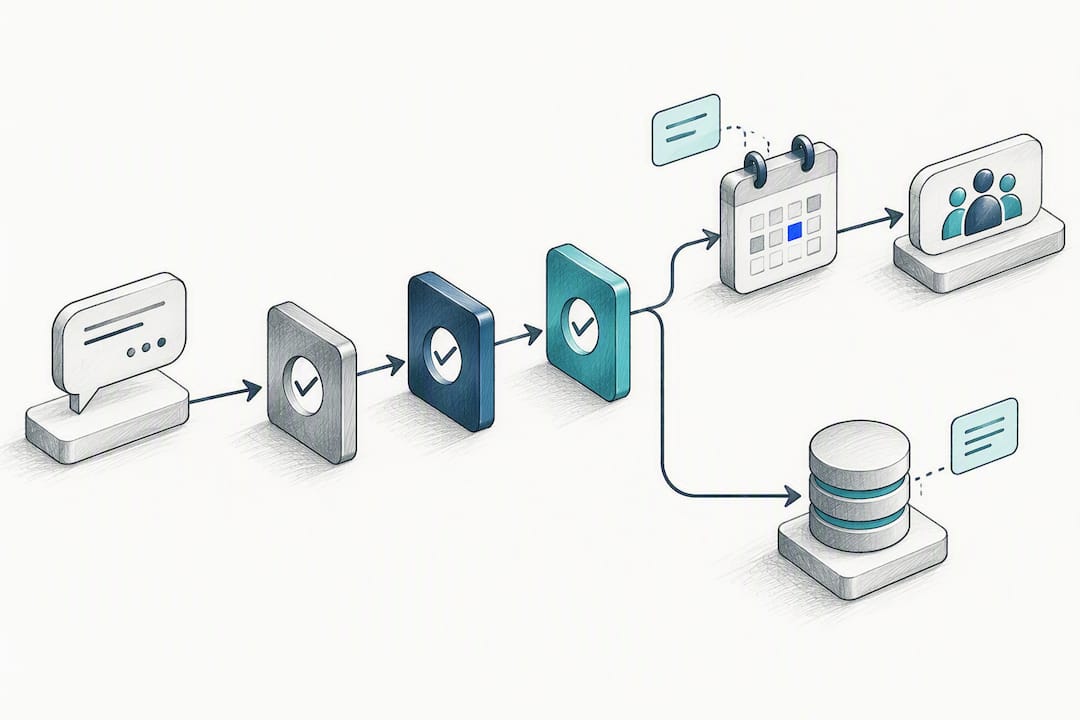
Sales qualification and meeting scheduling. A prospect messages in through web chat or WhatsApp, the AI agent asks two or three qualifying questions, checks calendar availability, and books a meeting directly, no back-and-forth email chain. Teams running this kind of automated lead qualification flow typically see meetings booked faster simply because the friction between “interested” and “on the calendar” disappears.
E-commerce cart recovery. A customer abandons checkout, and within minutes a WhatsApp message references the exact item left behind, sometimes with a reminder of stock levels or a support link if they hit a snag. This kind of contextual, channel-native recovery tends to outperform generic email reminders on both open rate and completed purchase. Retailers pairing this with broader AI-driven e-commerce automation often see it lift average order value too, since the message can suggest a complementary item.
Support triage. Incoming questions get classified instantly, order status and password resets resolve without a human touch, and only genuinely complex cases reach a live agent with full context attached.
The KPIs to track per use case: response time and conversion rate for sales flows, cart recovery rate and average order value for e-commerce, and average handle time plus CSAT for support triage. Gartner’s projection that conversational AI would help drive contact-center market growth reflects exactly this kind of measurable efficiency gain across support-heavy operations.
How Does BotiqueAI Approach Conversational CRM Projects?
BotiqueAI builds the conversational layer end to end rather than handing over a generic chatbot template. That means WhatsApp Business integration wired to your existing CRM, custom automation flows built with tools like n8n and Make, and Aria by BotiqueAI as a ready-to-deploy AI agent for teams that want a faster starting point than a from-scratch build.
The typical engagement starts as a proof of concept scoped to one journey, sales qualification or support triage, then moves to production once the KPIs prove out. Whatever vendor you evaluate, ask for three things specifically:
- A live demonstration of AI-to-human handover with full context intact
- A clear answer on where conversation data is stored and whether EU residency is supported
- A defined path from pilot to production with named KPIs, not vague promises of “efficiency”
Read more on how conversational agents connect to backend systems to understand what a production-grade integration actually requires before signing anything.
Where Does Conversational CRM Belong in Your Stack?
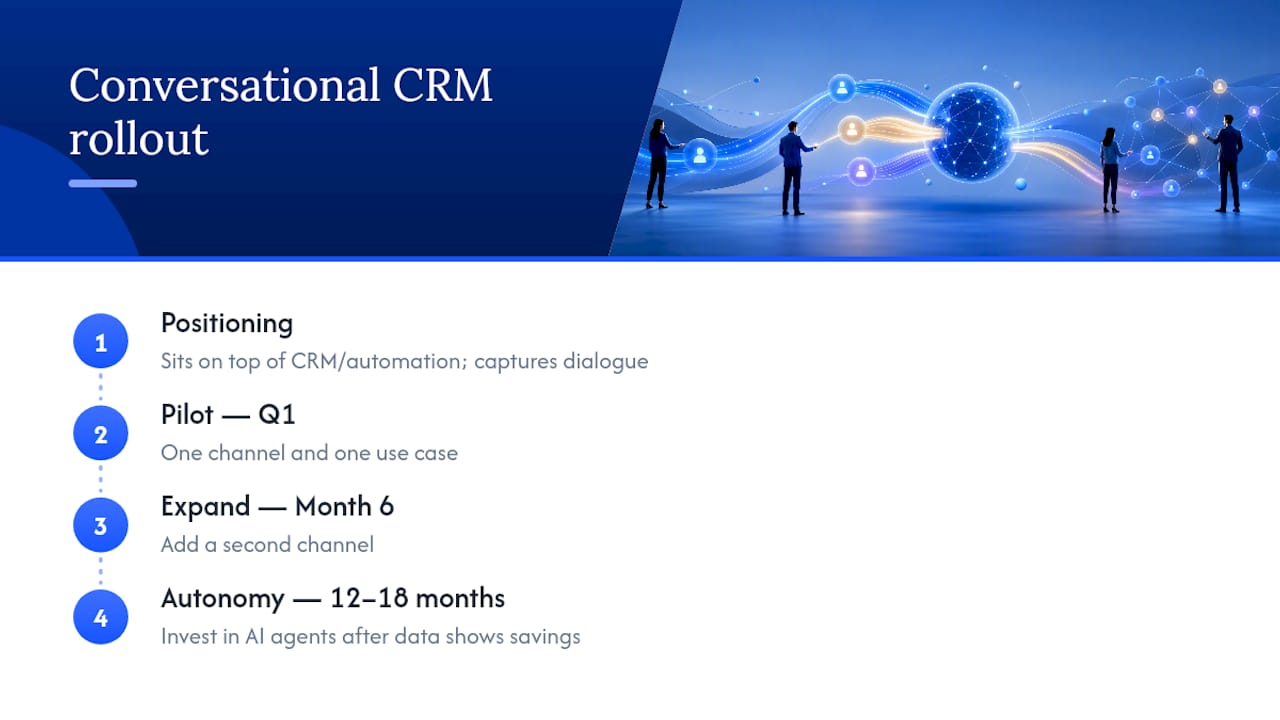
Conversational CRM doesn’t replace your existing CRM or marketing automation platform. It sits on top of them as the layer that captures and acts on real-time dialogue, then pushes structured data back into the systems your sales and support teams already trust.
The sequencing question isn’t automation versus human agents; it’s which conversations deserve which treatment. Automate the repetitive, high-volume, low-ambiguity exchanges first, order status, FAQ, basic qualification. Reserve human agents for anything emotionally charged, high-value, or genuinely novel. Over a 12 to 18 month horizon, most teams should pilot one channel and one use case in the first quarter, expand to a second channel by month six, and only invest in deeper AI agent autonomy once the data shows where automation is actually saving time rather than just shifting it around.
— Botiqueai
Ready to Move From Pilot to Production?
If you’ve been comparing generic chatbot builders against full-scale CRM suites, there’s a middle path that doesn’t require either a bloated enterprise contract or a DIY tool that stalls at the pilot stage. Botiqueai is the alternative to hiring a traditional software agency for conversational CRM: custom-built chatbots, WhatsApp integration, and automation workflows delivered around your actual sales and support process, with no long-term contract required to get started.
For teams running on Shopify, Aria by BotiqueAI offers a ready-made conversational agent for customer questions and cart recovery, with the Plan Starter at $19 per month or the Plan Pro at $49 per month depending on volume. SMEs and e-commerce teams tend to fit best with Aria as a starting point, while enterprise CX teams with more complex routing needs typically start with a scoped custom AI automation engagement instead. Either way, the first step is a free audit of your current setup, request one directly through BotiqueAI’s contact page to see where a conversational layer would save the most time.
FAQ
What Are the Most Well-Known CRM Systems?
The market includes large enterprise suites, mid-market platforms, and specialized conversational CRM tools built specifically around messaging channels like WhatsApp and web chat. Rather than naming specific vendors, evaluate any CRM against your actual channel mix and integration needs, since the best fit depends heavily on where your customers already message you.
What Does CRM Actually Mean?
CRM stands for customer relationship management, a system for organizing and acting on customer interactions and data. Traditional CRM centers on stored records updated after the fact, while conversational CRM makes live dialogue itself the primary data source, updating the customer record in real time as messages happen.
What Are the 4 Types of Customers Businesses Typically Segment?
Most customer segmentation models group buyers into four broad categories: new prospects still evaluating, active customers with an ongoing relationship, loyal repeat customers, and at-risk or lapsed customers who need re-engagement. Conversational CRM helps identify which category a customer falls into in real time, based on their message history and behavior, rather than waiting for a quarterly report to flag the shift.
How Is Conversational CRM Different From a Basic Chatbot?
A basic chatbot answers questions in isolation, with no memory once the session ends. Conversational CRM connects every exchange to a persistent customer record, so context carries across channels and over time, and the data feeds directly into sales and support workflows.
Does Conversational CRM Work for Small Businesses, Not Just Enterprises?
Yes. Smaller teams often see faster returns because they can launch a single channel, typically WhatsApp or web chat, without the lengthy integration work larger organizations need. BotiqueAI’s Aria product is built specifically for this scale, letting smaller e-commerce and service businesses deploy a conversational agent without a custom build.