
92–98% Detection, 1–3% False Positives: AI Fraud Detection for Teams
92–98% Detection, 1–3% False Positives: AI Fraud Detection for Teams
AI-based fraud detection works by scoring transactions and behaviors in real time against patterns learned from historical fraud, catching schemes that static rules miss while cutting the number of good customers who get blocked. Done well, teams see detection rates climb into the 90s with false positives dropping into the low single digits. The rest comes down to model choice, data quality, and how the system runs in production.
TL;DR:
- Models should be retrained regularly using fresh data and drift metrics like PSI, with post-authorization signals included to improve accuracy over time.
- Starting with simple models like gradient-boosted trees is recommended because they are faster, more interpretable, and perform close to neural networks on transactional data.
- Real-time scoring must be optimized by simplifying models, caching static signals, and asynchronously enriching data without delaying checkout decisions.
- Fraud typologies such as account takeover, card testing, and fraud rings respond best to ML detection, but friendly fraud remains challenging without strong post-transaction evidence.
- Balancing detection accuracy with customer experience involves risk-tiered responses, with low risk approved automatically and high risk routed for manual review or outright decline.
Table of Contents
- What Détection Fraude IA Actually Means in Practice
- Core Machine Learning Approaches Used in Fraud Detection
- Building a Real-Time Architecture That Doesn’t Slow Down Checkout
- Measuring What Matters: Metrics, Drift, and Model Upkeep
- The Operational Playbook for Cutting False Positives
- How Botiqueai Approaches Fraud Detection Deployment
- Privacy and Ethical Considerations You Can’t Skip
- Regulatory Compliance Shapes What You Can Build
- Why Human Analysts Still Matter Alongside AI
- Fraud Typologies AI Detection Is Built to Catch
- The Part of Fraud Detection Most Teams Get Backwards
- Getting a Fraud Detection System Built Right
- Sources
What Détection Fraude IA Actually Means in Practice
Détection fraude IA, or AI fraud detection, is the discipline of using statistical models and machine learning to flag suspicious transactions, logins, or account activity faster and more accurately than manual rules alone. The standard industry term for this practice is “fraud detection algorithms” or “automated fraud detection systems,” and you’ll see both used interchangeably across vendor documentation and academic papers.
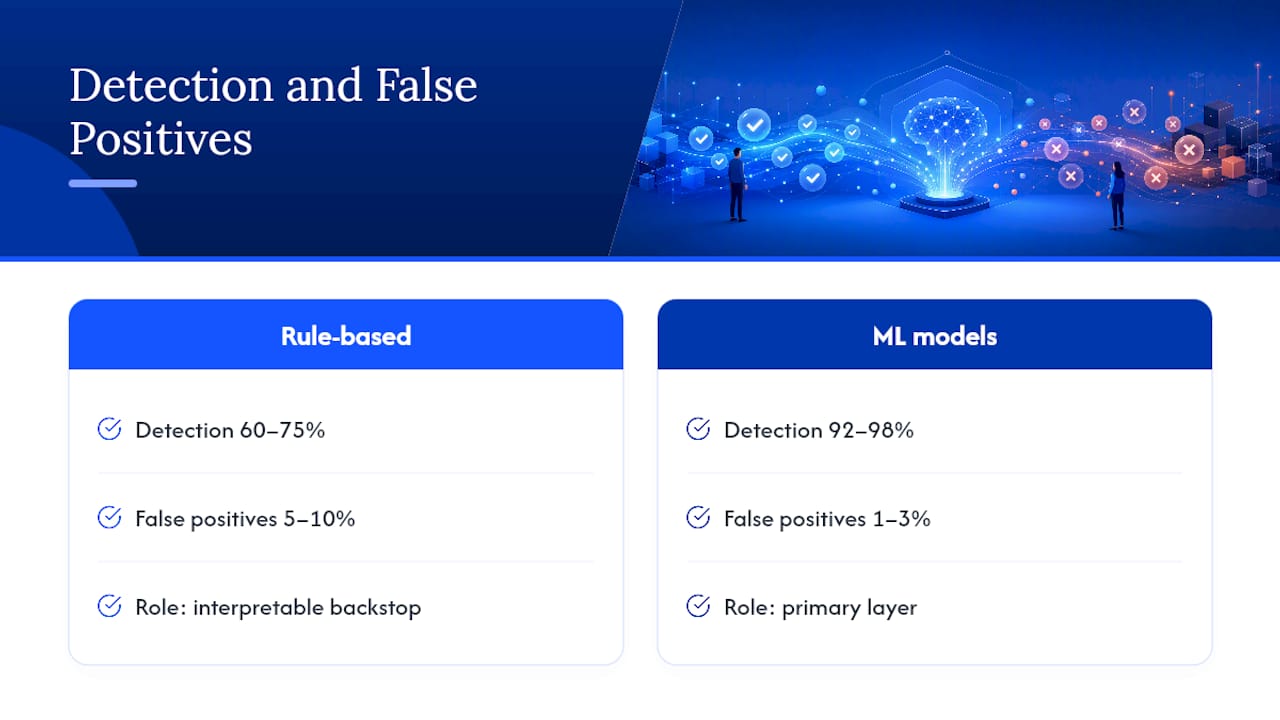
Rule-based systems (a transaction over $500 from a new device triggers a review, for example) still catch obvious fraud, but they top out around 60 to 75% detection with false-positive rates of 5 to 10%, according to industry benchmarks from ECOSIRE’s fraud detection guide. That gap is why most serious fraud programs now run ML models as the primary layer and rules as a fast, interpretable backstop.
The rest of this guide walks through model choices, the data pipeline, the real-time architecture, and the operational habits that separate a fraud system that works from one that just looks good in a slide deck.
Core Machine Learning Approaches Used in Fraud Detection
Choosing a model class depends on how much labeled fraud data you have and how fast fraud patterns change in your business. A Coursera overview of ML fraud detection breaks the landscape into a few practical categories worth understanding before you write a single line of code.
- Supervised models (logistic regression, gradient-boosted trees, random forests) learn from labeled past fraud and work well once you have enough confirmed cases to train on.
- Unsupervised models (isolation forest, clustering, autoencoders) catch novel fraud patterns nobody has labeled yet, which matters when fraudsters shift tactics faster than your labeling team can keep up.
- Ensemble methods combine several models to reduce variance and are often the sweet spot for production fraud scoring because they balance accuracy against interpretability.
- Neural networks handle complex, nonlinear signal interactions (device plus behavior plus network graph) but need more data and more engineering effort to keep explainable.
- Graph neural networks (GNNs) map relationships between accounts, devices, and payment instruments, exposing fraud rings that look clean at the individual-transaction level.
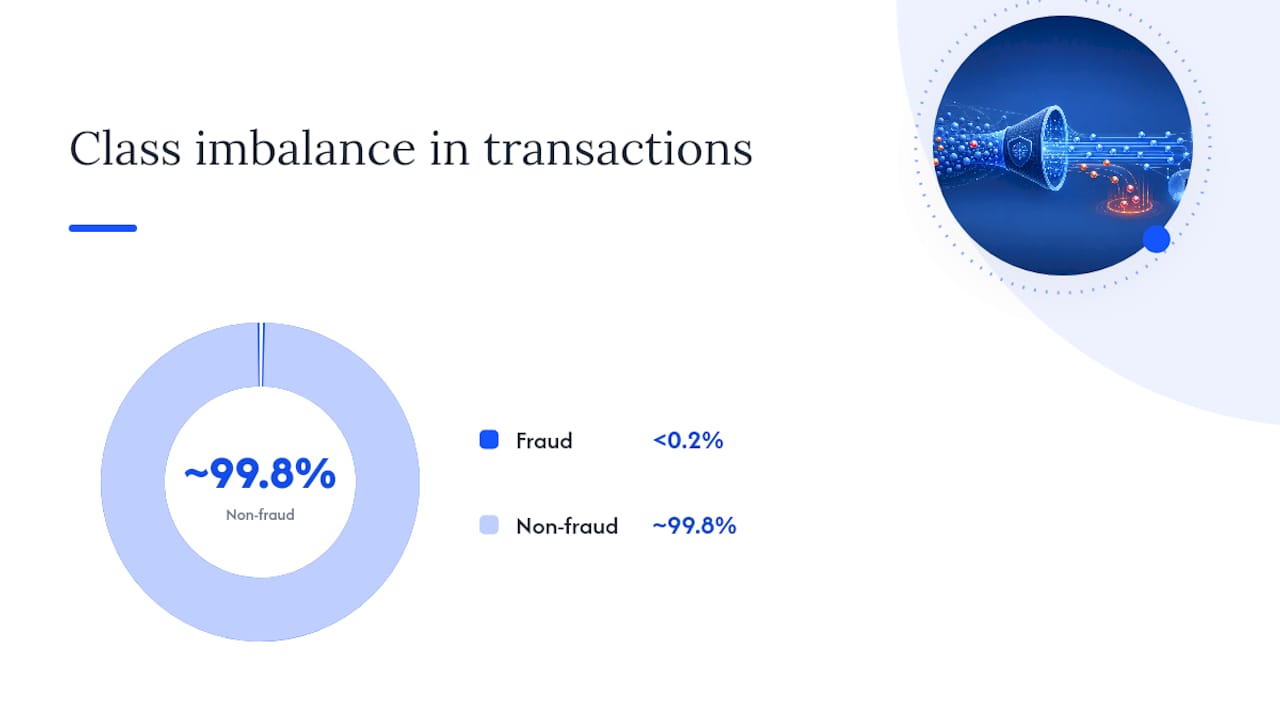
Class imbalance is the first wall every team hits. Fraud typically makes up less than 0.2% of transactions in some payment datasets, according to research on cost-sensitive training approaches, which means a naive model can hit 99.8% accuracy by predicting “not fraud” every time and still be useless. Techniques like SMOTE oversampling and cost-weighted loss functions correct for this by forcing the model to pay attention to the rare positive class during training.
Pro Tip: Start with a simple gradient-boosted tree model before reaching for neural networks. Trees are faster to train, easier to explain to compliance teams, and often perform within a few percentage points of deep architectures on tabular transaction data.
Watch for data leakage, where a feature accidentally encodes the outcome you’re trying to predict (a “chargeback flag” column that only exists after the fraud already happened). It inflates test accuracy and collapses the moment the model hits real traffic.
Building a Real-Time Architecture That Doesn’t Slow Down Checkout
A production fraud pipeline typically flows through five stages: a client SDK captures device and behavioral signals, a feature enrichment layer adds external data (IP reputation, velocity counters), a scoring API returns a risk score, a policy engine translates that score into a decision, and an action layer executes it (approve, step-up verification, or decline).
Latency is the constraint that breaks naive implementations. Real-time risk scoring typically adds 20 to 80 milliseconds to a payment API call, and progressive verification (an extra OTP or 3DS challenge) only kicks in for roughly 15 to 25% of transactions, according to ECOSIRE’s implementation data. Keeping that budget tight requires a few deliberate choices:
- Simplify the model for the hot path. A gradient-boosted tree with 50 features scores faster than an ensemble stacking five model types; save the heavier model for asynchronous batch re-scoring.
- Cache repeat lookups. Device reputation and IP scores rarely change transaction to transaction within a session, so cache them instead of recomputing on every call.
- Run enrichment asynchronously where possible. Non-blocking checks (deeper velocity history, network graph lookups) can update the risk profile after the initial decision without holding up checkout.
Many teams start with a hybrid deployment: a payment processor’s baseline ML score handles day-one coverage, and a locally trained model layers on top as labeled fraud data accumulates, often needing six months and around 500 confirmed fraud cases before it adds real lift. Chat-based verification, through a conversational agent handling step-up identity checks, integrates cleanly into this flow when a transaction lands in the gray zone.
Pro Tip: Log every signal, score, and decision with a timestamp, even for approved transactions. When a chargeback dispute lands weeks later, that evidence trail is often the difference between winning and losing the dispute.
Measuring What Matters: Metrics, Drift, and Model Upkeep
Detection rate and false-positive rate are the headline numbers, but they don’t tell the whole story on their own. F2 score weights recall higher than precision, which fits fraud use cases where missing a fraudulent transaction costs more than an extra manual review. Matthews Correlation Coefficient (MCC) holds up better than accuracy or F1 when your fraud class is a tiny fraction of total volume, since it accounts for all four cells of the confusion matrix rather than just the positive class.
Models decay. Fraud tactics shift, seasonal spending changes transaction patterns, and a model trained on last year’s data slowly drifts out of alignment with this year’s reality. A 2026 framework published in Scientific Reports recommends tracking Population Stability Index (PSI), Kolmogorov-Smirnov (KS) statistics, and Jensen-Shannon divergence to catch that drift before it shows up as a spike in missed fraud.
- Use chronological train/test splits, never random splits, so the model is validated the way it will actually be used: predicting forward in time.
- Retrain on a fixed cadence or when drift metrics cross a defined threshold, whichever comes first.
- Reintegrate chargeback outcomes into training data. Stripe’s guidance on fraud metrics points out that post-authorization signals close the feedback loop that pure point-of-sale scoring misses.
Statistic callout: Machine learning fraud models can sustain detection rates of 92 to 98% with false positives held to 1 to 3%, according to ECOSIRE’s industry analysis, a gap wide enough to justify the engineering investment on its own.
Threshold tuning should map to an actual cost function: what does a missed fraud case cost versus what does an unnecessary decline cost in lost revenue and customer trust? Run champion/challenger tests before fully replacing a threshold in production.
The Operational Playbook for Cutting False Positives
Detection accuracy means little if legitimate customers get bounced at checkout. A risk-tiered flow gives the system room to be uncertain without defaulting to a hard decline.
- Approve automatically for low-risk scores, the majority of legitimate traffic.
- Step up verification for mid-risk scores using 3D Secure, an SMS one-time password, or a quick identity confirmation through a chat interface.
- Route to manual review for higher-risk scores that don’t clear automated checks, with SLAs tight enough to avoid abandoned carts.
- Decline outright only for scores that cross a threshold calibrated against your actual fraud loss tolerance.
Visa’s fraud research team highlights balancing detection against customer friction as the central operational challenge, favoring nuanced risk scores over binary block-or-allow decisions. Prioritize manual review queues by dollar value and risk score together, not just chronological order, so a $50 false positive doesn’t tie up an analyst who should be looking at a $5,000 case.
Pro Tip: When you decline a transaction, tell the customer something specific enough to be useful (“we couldn’t verify your billing address”) rather than a generic “transaction denied.” It cuts support tickets and rebuilds trust faster.
Automate what you can around dispute handling: pulling stored evidence (device history, prior order patterns, verification logs) into a structured packet for chargeback contests saves analyst hours on every case.
How Botiqueai Approaches Fraud Detection Deployment
A typical rollout moves through discovery (mapping your existing data and fraud loss patterns), a proof-of-concept scored against historical transactions, production integration into your payment and checkout flow, then ongoing monitoring and retraining. Expect early wins in reduced manual review volume before detection-rate gains fully materialize. Governance matters just as much as the model: data contracts, explainability documentation, and a clear handoff to your operations team keep the system accountable once it’s live. Real deployment examples from past AI transformation projects follow a similar arc.
Privacy and Ethical Considerations You Can’t Skip
Fraud models run on sensitive data by nature: transaction history, device identifiers, sometimes biometric behavioral patterns. That creates a tension every fraud team has to manage directly rather than hope goes unnoticed. Collecting more data usually improves model performance, but every additional field is also a liability if it’s breached or misused.
Minimize collection to what the model actually needs, and document why each signal is included. A device fingerprint earns its place if it measurably improves detection; a customer’s full browsing history probably doesn’t, and holding it anyway just expands your breach surface for no real gain.
Bias is the other ethical fault line. A model trained on historical fraud data can inherit patterns tied to geography, spending behavior, or demographic proxies that correlate with protected characteristics even when they aren’t explicit inputs. Regularly audit false-positive rates across customer segments. If declines cluster disproportionately around one region or demographic group without a fraud-loss pattern to justify it, that’s a signal the model needs retraining or a feature review, not a policy memo explaining it away.
Explainability ties directly into ethics here. A model that can’t explain why it declined a transaction can’t be meaningfully audited for bias, and it leaves customer support unable to give a coherent answer to an upset customer. Techniques like SHAP values, which attribute a prediction to specific input features, give both your compliance team and your support staff a concrete answer instead of a black-box shrug.
Regulatory Compliance Shapes What You Can Build
Data protection law sets the outer boundary of what a fraud model is allowed to use and how long it can keep it. Under the EU’s GDPR framework, fraud prevention qualifies as a legitimate interest in many cases, but that doesn’t grant unlimited data collection. Retention periods, data minimization, and a documented legal basis for automated decision-making all apply, and a fully automated decline with no human review path can trigger the GDPR’s provisions on automated decision-making for the customer affected.
Payment-specific rules add another layer. Strong Customer Authentication requirements under the EU’s revised Payment Services Directive push many step-up verification flows toward 3D Secure by default, which shapes how a risk-tiered decision engine should be designed from the start rather than bolted on afterward.
Government use of AI for fraud detection is expanding too. France’s economy ministry has piloted AI tools at Bercy for large-scale anomaly detection in tax and fraud investigations, a public-sector signal that regulatory bodies increasingly expect private companies to meet a comparable technical bar.
Build compliance into the architecture, not as an afterthought. That means audit logs for every automated decision, a documented model card explaining what data trains the model, and a clear escalation path to a human reviewer for any decline a customer disputes.
Why Human Analysts Still Matter Alongside AI
The best fraud programs treat AI as a force multiplier for analysts, not a replacement for them. A model can score ten thousand transactions a minute; it can’t testify to a chargeback dispute, negotiate with a payment network, or make the judgment call on an ambiguous case that doesn’t fit the training data’s patterns.
Analysts handle three things AI can’t: novel fraud patterns the model has never seen, edge cases where context matters more than statistics, and the feedback loop that keeps the model current. Every manual review decision, correct or incorrect, becomes a labeled data point that improves the next training cycle. Skip that feedback loop and the model slowly drifts away from the fraud patterns actually hitting your business.
Analyst time is also your scarcest resource, so the model’s real job is triage. Teams that route everything to manual review because they don’t trust the model waste analyst hours on cases the model already resolved correctly.
Fraud Typologies AI Detection Is Built to Catch
Certain fraud patterns respond especially well to machine learning because they involve subtle, multi-signal patterns that rule-based systems can’t express cleanly.
Account takeover shows up as a login from an unfamiliar device combined with behavioral biometric deviations, like a different typing cadence, even when the password is correct. Card testing, where fraudsters run small transactions across many stolen card numbers to find which ones work, produces a velocity signature (many small charges to different merchants in a short window) that’s a natural fit for anomaly detection. Synthetic identity fraud, where a fraudster builds a fake identity from real and fabricated data, hides well from static rules but leaves graph-level traces GNN models can surface, like one device linked to a dozen “different” applicants.
Friendly fraud, where a legitimate customer disputes a charge they actually made, is harder for any model to catch cleanly since the transaction itself looks normal. It’s where documented evidence trails matter most for winning the dispute after the fact. Fraud rings, multiple coordinated accounts sharing devices, payment instruments, or shipping addresses, are essentially invisible to per-transaction scoring but stand out clearly once you model relationships as a graph instead of isolated events.
The Part of Fraud Detection Most Teams Get Backwards
Most teams optimize for catching more fraud first and worry about false positives later. That’s backwards. Visa’s own research frames reducing false positives as often delivering more ROI than incremental gains in raw detection, because every wrongly declined customer is lost revenue and, often, a lost customer relationship entirely.
The conventional advice tells teams to chase the highest possible detection rate. The better instinct is to start conservative, protect legitimate customers aggressively, and tighten the model as your labeled data and confidence grow. A model that declines too much in month one erodes trust with both customers and the internal stakeholders who approved the project.
The single highest-leverage move for a team early in this process isn’t a fancier model. It’s clean, chronologically split data and a real drift-monitoring habit. A mediocre model on disciplined data beats a sophisticated model trained on leaky or stale data every time. Get that foundation right before reaching for neural networks or graph models, and the harder architecture choices become much easier to justify.
— Botiqueai
Getting a Fraud Detection System Built Right
Building this in house means hiring data scientists, standing up MLOps infrastructure, and spending months before the first model touches production. Botiqueai builds this differently: custom fraud-scoring models integrated directly into your existing checkout, CRM, or payment stack, with the feature engineering and drift monitoring already accounted for from day one.

Botiqueai’s custom AI development covers the model build, the integration work, and the ongoing monitoring, so a fraud program doesn’t stall out after the proof-of-concept stage the way many in-house projects do. For step-up verification and identity checks inside a conversational flow, the Aria chatbot handles that customer interaction directly, cutting the friction of a redirect to a separate verification page. Teams juggling manual review queues and dispute workflows can also automate the routing and evidence-collection steps through Botiqueai’s automation services, freeing analysts to focus on the ambiguous cases that actually need a human judgment call.
If fraud losses or false-positive complaints have been piling up, the next step is a scoping conversation to map your current data against what a production model would need. Get in touch with Botiqueai to start that conversation.
Sources
The technical framework in this guide draws on a peer-reviewed drift-detection study from Scientific Reports, alongside operational guidance from Stripe on fraud metrics and approval rates and Visa’s research on balancing detection with customer experience. For public-sector context, France’s economy ministry documents its own AI fraud detection trials at Bercy. A broader introduction to the algorithm choices covered here is available through Coursera’s fraud detection overview.
- A robust machine learning framework for detecting temporal drift in financial fraud prevention | Scientific Reports
- Payment fraud detection and approval rates | Stripe
- Visa — AI fraud detection insights
- Détection des fraudes, analyse de données… : comment l’IA a fait son entrée à Bercy
- Machine learning for fraud detection | Coursera