
Stop Hallucinations: One Page Chatbot Functional Spec for GDPR and LLM RAG
Stop Hallucinations: One Page Chatbot Functional Spec for GDPR and LLM RAG
A chatbot functional specification defines what the bot must do, for whom, on which channels, and how success gets measured before a single line of code gets written. At minimum it needs use cases, conversational scope, persona and tone, knowledge sources, integrations, privacy rules, KPIs, and escalation logic. Skip any of these and you get scope creep, a bot that hallucinates in production, or a compliance gap nobody catches until a regulator asks.
TL;DR:
- A detailed chatbot functional specification must include use cases, persona, tone, knowledge sources, integrations, privacy rules, and escalation logic to prevent scope creep and compliance issues.
- The document should organize use cases into clearly defined families like customer support, pre-sales, or internal assistance, and prioritize launching one family first to avoid delays.
- Explicit mapping of integration data flows, trigger conditions, latency, and error handling is essential for reliable backend connections and accurate implementation.
- The spec must contain clear privacy and GDPR compliance details, including data retention, subprocessor disclosures, and transparency requirements for AI systems.
- Building the specification in a collaborative workshop with a detailed, testable checklist greatly reduces post-launch revisions and miscommunications.
Table of Contents
- What Is Chatbot Functional Documentation, Exactly?
- Section-by-Section Checklist for the Functional Document
- Integrations and Data Flows: CRM, Ticketing, and APIs
- Privacy and Regulatory Constraints: What GDPR Requires You to Document
- Garde-Fous: Anti-Hallucination Rules and Escalation Design
- Testing Strategy, Acceptance Criteria, and KPIs
- Maintenance, Governance, and Knowledge-Base Lifecycle
- The Copyable Template and One-Page Checklist
- How to Run a Workshop That Fills This Spec in One Sitting
- What BotiqueAI Sees Across Real Chatbot Deployments
- Editorial Take: What Most Chatbot Specs Get Backward
- Sources
What Is Chatbot Functional Documentation, Exactly?
Chatbot functional documentation, often called a cahier des charges in French project teams, is the reference document that translates business intent into buildable, testable requirements. It sits between the business case and the technical design. Where the technical architecture document describes servers, models, and APIs, the functional spec describes what the bot promises to a user and how you will prove it kept that promise. Separating the two matters: a functional requirements section should prioritize user stories, interaction flows, and behavioral scenarios that non-technical stakeholders can actually validate, while architecture details live in a companion document that references it.
Three groups use this document across its lifecycle, and each reads it differently. Product owners and business sponsors use it to confirm the bot solves the right problem. Developers and integration engineers use it to build against fixed requirements instead of guessing. QA teams and compliance reviewers use it as the source of truth when writing test cases or answering a data protection audit. The document does not die at launch. It gets versioned, reopened, and amended every time you add a channel, retrain the knowledge base, or discover a new failure mode in production.
Good objectives in this document follow the SMART pattern, but generic SMART advice (“make it measurable”) doesn’t help you write one. Here’s what that looks like concretely for a chatbot: instead of “improve customer support,” write “resolve 60% of Tier 1 billing questions without human handoff, within 90 days of launch, measured by ticket deflection rate.” That single sentence gives developers a target, gives QA a test threshold, and gives your sponsor something to report to leadership.
Most functional specs organize use cases into three families:
- Customer support deflection — password resets, order status, billing disputes, return policy questions. High volume, repetitive, and the easiest to justify on ROI.
- Pre-sales and lead qualification — product recommendations, pricing tiers, appointment booking. Lower volume, higher value per conversation, and usually tied to a CRM handoff.
- Internal employee assistance — HR policy lookups, IT ticket triage, onboarding FAQs. Often the fastest to deploy because the knowledge base is smaller and the audience is more forgiving of imperfect answers.
Pick one family to launch first. Trying to cover all three in v1 is the single most common reason chatbot projects slip their timeline.
Section-by-Section Checklist for the Functional Document
Once you know your use-case family and objectives, the actual document needs a fixed skeleton. Below is the section order that works across most production chatbot projects, based on the structure recommended in La Fabrique du Net’s cahier des charges model, adapted for LLM and RAG-based bots rather than pure decision-tree scripts.
- Executive summary. One paragraph: business objective, target launch date, primary channel, budget band, and the single metric that defines success.
- Scope and out-of-scope. List what the bot will answer and, just as important, what it will explicitly refuse to discuss (medical advice, legal advice, competitor comparisons, pricing negotiations outside published tiers)
- Intent list. Every question category the bot must recognize, grouped by use-case family, with three to five sample phrasings per intent so developers can test paraphrase tolerance.
- Persona and tone. Name, voice (formal, casual, technical), reading level, and language register. This section gets skipped constantly, and it shouldn’t: persona and tone decisions measurably affect user trust and adoption, according to ConseilsMarketing’s chatbot spec template guidance, because users abandon conversations with bots that feel either too robotic or too casual for the context.
- Multi-language support. List every language the bot must handle, whether translation happens live or via pre-translated knowledge base entries, and how tone rules change per language (formal vous in French customer service, for instance, versus a casual English equivalent).
- Channel matrix. A table mapping each deployment channel to its constraints.
- Acceptance criteria fields. For every requirement listed above, a matching test: input, expected output, pass/fail threshold.
Pro Tip: Write your intent list as actual user sentences, not category labels. “How do I get a refund” tests differently than “Refund policy” as a label, and developers need the raw phrasing to tune retrieval and matching.
The channel matrix deserves its own attention because channel-specific constraints trip up more launches than any other single item. A web widget can render buttons, carousels, and rich cards, and users expect near-instant replies. WhatsApp, by contrast, restricts you to approved message templates for anything outside a live customer-initiated session, and Meta enforces a 24-hour response window before you need pre-approved templates again. Telephony is the strictest of all: no visual UI, so every intent needs a voice-friendly fallback, and you’re working against latency tolerances measured in a second or two before callers assume the line dropped.
Odoo’s chatbot documentation offers a useful reference point here, showing how scripted chatbot flows map to channel constraints step by step. Even if your bot is LLM-driven rather than fully scripted, that same discipline of mapping each conversational step to what a channel can actually render is worth stealing.
Acceptance criteria are where most specs fall apart, because teams write requirements as vague intentions rather than testable statements. A weak requirement reads: “The bot should handle billing questions well.” A strong one reads: “Given the input ‘why was I charged twice,’ the bot retrieves the billing FAQ, cites the source document, and offers human escalation if confidence is below 70%.” The second version converts directly into a QA test case with no ambiguity left for the developer to interpret. This story-first structure, where every requirement resembles a testable scenario rather than a policy statement, is exactly what turns a functional document into something a non-technical stakeholder can validate before launch.
Build your checklist as a living table rather than a static document if you can. Recent academic work on template-driven specification for LLM-based chatbots proposed pairing each functional requirement with its own “requirement card,” a structured entry linking the requirement to test cases and monitoring metrics, and demonstrated the approach with 46 such cards covering both functional and non-functional needs. That card-based traceability is worth adopting even in a lightweight spec, because it forces you to answer “how will we know this works” at the moment you write the requirement, not three sprints later when QA asks.
Integrations and Data Flows: CRM, Ticketing, and APIs
Every integration the bot touches needs its own mini-contract inside the spec, because “connects to Salesforce” tells a developer almost nothing about what actually needs to happen at runtime. A workable integration entry answers four questions: what data does the bot read, what data does it write, what triggers the call, and what latency can the conversation tolerate before the user notices a stall.
Take a ticketing integration as an example. The bot might read a customer’s open ticket status on request, write a new ticket when it can’t resolve an issue, trigger that write the moment escalation criteria fire, and needs a response inside two seconds or the conversation feels broken. Document all four explicitly, and the integration becomes buildable. Document only “integrates with Zendesk,” and your developer will make three assumptions, at least one of which will be wrong.
Your integration checklist should specify:
- Data direction per system. Read-only lookups (order status, account balance) versus write actions (creating a ticket, updating a CRM field, booking an appointment).
- Trigger conditions. Exactly which user intent or confidence threshold fires each API call, not just “when needed.”
- Latency budget. The maximum acceptable delay per integration, since a CRM lookup that takes four seconds will feel broken on a web widget but might be fine over WhatsApp where users expect a beat before a reply.
- Field mapping. A short table linking the bot’s internal variable names to the target system’s actual field names, so nobody discovers a mismatch during integration testing.
- Authentication method. API key, OAuth token, or service account, and who owns rotating those credentials.
- Error and retry policy. What the bot says to the user if the CRM times out, how many retries happen silently before it gives up, and whether a failed write gets queued for manual reconciliation or simply dropped with an alert.
Testing these integrations in isolation, using a mock or sandbox mode that simulates each API’s responses without touching production data, catches most mapping errors before they reach a live customer conversation. For teams juggling multiple backend systems, a broader look at enterprise chatbot infrastructure and rollout considerations is worth reviewing alongside this section, since integration sprawl is usually where launch timelines slip hardest.
Privacy and Regulatory Constraints: What GDPR Requires You to Document
Privacy isn’t a legal appendix you bolt onto the spec after the fact. It shapes architecture decisions, so it needs to be documented early enough to influence which vendor or hosting model you choose.
Your functional document needs to state, in plain language, the legal basis for processing user conversations (consent, contract, or legitimate interest), how long conversation logs get retained before deletion, and where the data physically lives. Under GDPR-oriented chatbot specification guidance, EU hosting should be the stated preference whenever a bot processes personal data, precisely because it simplifies your compliance story compared to routing conversation data through non-EU infrastructure.
The subprocessor question deserves special weight because it’s the one companies forget most often. If your RAG pipeline sends user queries to a third-party LLM API, that provider is a subprocessor under GDPR, full stop, and your spec needs to name it, state what data it receives, and confirm the contractual terms restrict that provider from training on your conversation data. The EU AI Act also introduces transparency obligations for AI systems interacting with people, so documenting that the bot discloses its non-human nature to users, where that requirement applies to your use case, is a line item worth adding now rather than retrofitting later.
Garde-Fous: Anti-Hallucination Rules and Escalation Design
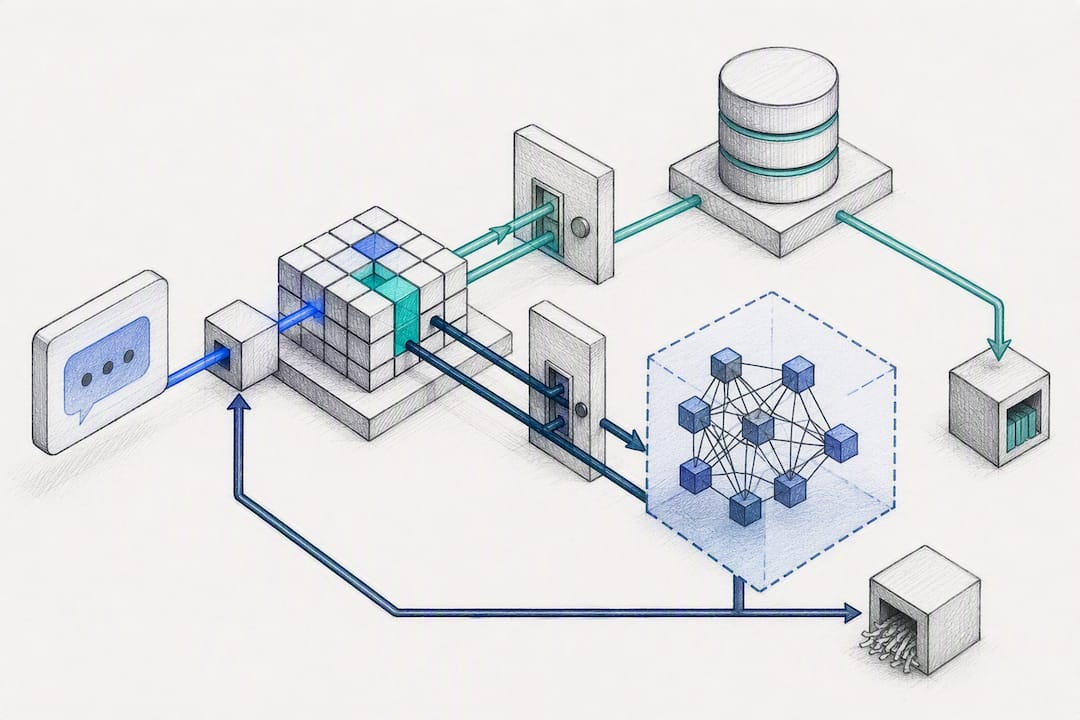
A functional spec without explicit fallback rules is an invitation for the bot to guess, and guessing is exactly what LLMs do worst under pressure. The document needs to state, in unambiguous terms, what the bot says when it doesn’t know the answer, and precisely when it hands the conversation to a human instead of attempting one more try.
Practitioner guidance on chatbot specifications consistently flags three non-negotiable rules here: a defined “I don’t know” fallback rather than a fabricated guess, citation and provenance requirements for any RAG-sourced answer, and an explicit list of prohibited topics the bot will refuse regardless of how the question is phrased.
Your garde-fous section should include:
- Confidence threshold for escalation. A stated retrieval or generation confidence score below which the bot hands off automatically, rather than answering.
- Prohibited topics list. Medical diagnoses, legal advice, competitor comparisons, or anything your legal team has flagged, refused consistently regardless of rephrasing attempts.
- Provenance citation rule. Every RAG-sourced answer references the document it drew from, at minimum internally for audit purposes, and ideally visibly to the user for trust.
- Escalation SLA. The maximum time a human agent has to pick up an escalated conversation before the experience degrades, stated per channel since a live chat SLA differs sharply from a WhatsApp SLA.
- Repeat-failure rule. If a user rephrases the same question twice without a satisfying answer, escalate automatically rather than trying a third variation.
Pro Tip: Test your “I don’t know” fallback with adversarial questions on purpose, things slightly outside scope, phrased to sound like they’re in scope. If the bot confidently answers a question it should have refused, that’s a garde-fou failure, not a retrieval failure, and it needs a spec fix, not just a prompt tweak.
Testing Strategy, Acceptance Criteria, and KPIs
Every requirement in the document should convert into a testable user story before development starts, not after. A story like “as a customer, I want to check my order status without logging in” needs a matching test: input phrasing variations, expected data retrieved, and a pass threshold for how many phrasings the bot must handle correctly.
Run your test matrix across every channel separately, because a bot that passes on the web widget can still fail on WhatsApp if message-length limits truncate a response, or fail over telephony if a voice-to-text transcription mangles a product SKU.
Production KPIs worth building into the spec from day one:
- Automatic resolution rate — the percentage of conversations closed without human involvement.
- Escalation rate — the percentage handed to a human, tracked by reason (low confidence, prohibited topic, repeat failure).
- Intent coverage — the percentage of real user queries matched to a defined intent versus falling into a generic fallback.
- CSAT — post-conversation satisfaction score, ideally captured with a one-tap rating rather than a multi-question survey that nobody completes.
- Response latency — median and 95th-percentile time to first response, per channel.
Wire these into a dashboard with alert thresholds from week one rather than reviewing them manually. A resolution rate that quietly drops from 60% to 40% over three weeks is far easier to catch with an automated alert than in a monthly report someone reads two weeks late.
Maintenance, Governance, and Knowledge-Base Lifecycle
A functional spec that stops at launch day is only half a document. The bot’s knowledge base, prompts, and intent list all drift the moment real users start talking to it, and someone needs clear authority to update each piece without breaking the others.
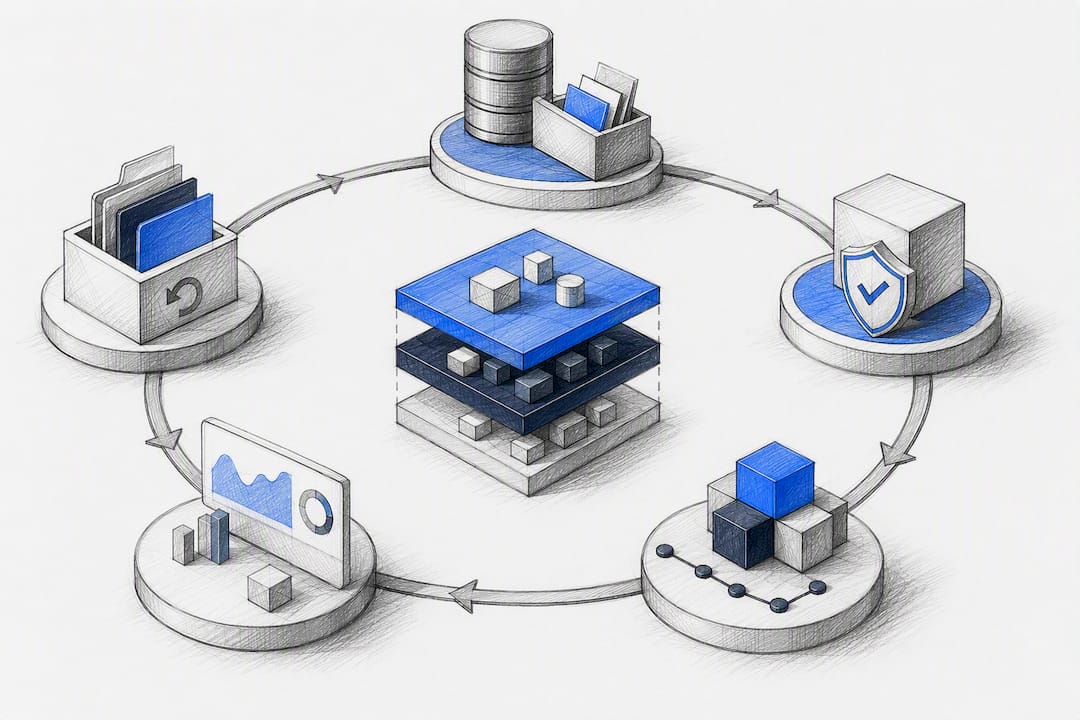
Name an owner for content (usually the same team that owns the help center or FAQ) and a separate owner for technical changes like prompt edits or model swaps. These are rarely the same person, and the spec should state the approval workflow connecting them: who proposes a change, who reviews it against the test set, and who signs off before it ships to production.
Governance items your spec needs to lock down:
- Content ownership. Who updates the knowledge base when a policy changes, and how fast that update needs to propagate.
- Prompt versioning. Every system prompt change tracked with a version number and a rollback path, exactly as covered in the architecture section.
- Knowledge-base snapshotting. A dated snapshot before every significant update, so you can diagnose a regression by comparing against the last known-good state.
- Monitoring cadence. Who reviews the KPI dashboard weekly, and what triggers an incident review rather than a routine check-in.
- Incident playbook. A short, named procedure for what happens when the bot starts giving wrong answers in bulk, including who can pull it offline and how fast.
- Continuous improvement cycle. A recurring review, monthly or quarterly, where escalated conversations get mined for missing intents and knowledge gaps.
The Copyable Template and One-Page Checklist
Here’s a skeleton you can paste directly into a blank document and start filling in today.
- Project name and version. [Bot name] v1.0, drafted [date], owner [name].
- Executive summary. One paragraph covering objective, channel, and success metric.
- Scope. In-scope intents listed by family; out-of-scope topics listed explicitly.
- Persona. Name, tone descriptors (three adjectives max), reading level, languages supported.
- Intent list. Table: intent name, sample phrasings, priority (must-have vs. nice-to-have).
- Channel matrix. Table: channel, message format constraints, expected latency, fallback behavior.
- Knowledge sources. Table: source name, format, owner, refresh frequency.
- Integrations. Table: system, data direction, trigger, latency budget, auth method.
- Privacy. Legal basis, retention period, hosting location, subprocessor list.
- Garde-fous. Confidence threshold, prohibited topics, citation rule, escalation SLA.
- KPIs. Target values for resolution rate, escalation rate, CSAT, latency.
- Governance. Content owner, technical owner, review cadence.
| Pre-delivery check | Why it matters |
|---|---|
| Every intent has three or more sample phrasings | Catches paraphrase gaps before QA does |
| Every requirement has a matching acceptance test | Prevents “should work well” ambiguity |
| Privacy section names every subprocessor | Closes the most common GDPR audit gap |
| Escalation SLA stated per channel | Avoids a one-size-fits-all SLA that fails on telephony |
| KPI targets have a red-flag threshold, not just a goal | Turns metrics into alerts, not just reports |
On cost, treat the spec itself as the cheapest phase of the project and the one most likely to save money downstream. A thorough functional document takes days to a couple of weeks to draft properly, depending on how many integrations and channels you’re covering, and typically costs a fraction of a single development sprint spent rebuilding a feature nobody specified correctly the first time. When you ask vendors for a quote, ask them to break out setup cost separately from the recurring monthly cost of hosting, model usage, and maintenance. That split matters more than the headline number, because a low setup fee paired with a high per-conversation model cost can end up pricier over a year than the reverse.
How to Run a Workshop That Fills This Spec in One Sitting
You don’t need six weeks of back-and-forth email threads to fill this document. A focused workshop with the right people in the room gets you 80% of the way there in one sitting.
- Book 90 to 120 minutes with a product owner, one developer or technical lead, one support or sales representative who knows the real questions customers ask, and a compliance or legal contact for the privacy section.
- Spend the first 20 minutes on scope and objectives. Lock the executive summary and the SMART objective before moving on. If the room can’t agree on the metric, stop and resolve that first.
- Spend 30 minutes on intents and persona. Have the support representative list real customer questions from memory or recent tickets rather than guessing categories abstractly.
- Spend 20 minutes on integrations and privacy, with the technical lead and compliance contact driving those sections directly.
- Close with 20 minutes converting entries into acceptance tests. For every intent captured, write the test sentence on the spot: input, expected behavior, pass threshold. This step is what turns a workshop output into a developer-ready backlog rather than a wish list.
- If you’re briefing an external vendor, package the completed template along with your KPI targets and integration list as the RFx essentials. That gives vendors enough to quote accurately instead of padding estimates to cover unknowns.
What BotiqueAI Sees Across Real Chatbot Deployments
Specs built with this level of detail consistently launch faster and drift less after go-live, because the ambiguity that normally surfaces mid-sprint gets resolved on paper instead. BotiqueAI’s own specification process for client deployments always locks persona and tone before touching architecture, documents RAG source freshness and citation rules explicitly, and ties every integration to a named field mapping before a developer writes a connector.
That structure showed up directly in a RAG-based agentic chatbot deployment for Acolad, where mapping the functional spec to production architecture up front avoided the rework that typically follows an under-specified launch. For teams weighing where a chatbot fits against other AI investments, it’s worth reviewing the broader enterprise AI agent taxonomy before finalizing scope.
If your team needs help turning this template into a production deployment, BotiqueAI’s Aria chatbot offers a ready-built starting point for web and e-commerce assistants, and BotiqueAI’s custom AI development service covers full spec workshops through managed delivery for teams that would rather not build this alone.
Editorial Take: What Most Chatbot Specs Get Backward
The industry default treats the functional spec as a formality to clear before “real” work starts on architecture. That’s backward. The research on requirement-card traceability and the practitioner consensus on garde-fous both point to the same conclusion: the spec is the real work, and architecture is just the implementation of decisions the spec should have already made.
Where conventional advice falls short is treating persona and privacy as afterthoughts bolted onto a technical document. They’re not afterthoughts. Tone decisions drive adoption, and subprocessor disclosures drive whether you pass an audit. Both belong in the first draft, not the second review.
If you take one thing from this checklist, prioritize the acceptance criteria over everything else. A spec with vague requirements and perfect formatting still produces an unpredictable bot. A spec with rough formatting but every requirement converted into a testable scenario produces one you can actually trust in production.
— Botiqueai
Sources
For a downloadable starting template and generator, La Fabrique du Net’s cahier des charges model covers the full checklist referenced throughout this piece. For the academic case behind requirement-card traceability, the WBOTS 2025 template-driven study documents the method in detail. Developers wanting a lightweight, markdown-based authoring example should look at ChatMD’s documentation, and RAG-specific implementation notes live in LightOn’s chatbot use-case guide.
- La Fabrique du Net — Cahier des charges chatbot (model + generator)
- Gabor Melli RKB — Chatbot Functional Requirements Section