
Ship a Fine Tuned LLM in Two Weeks for Engineers
Ship a Fine Tuned LLM in Two Weeks for Engineers
Fine-tuning is the continued training of a pretrained LLM on task-specific examples so it durably adopts a new style, format, or domain skill. Pick it over retrieval-augmented generation when the behavior you need is stable rather than fact-hungry. For most production projects in 2026, start with parameter-efficient fine-tuning, specifically LoRA or QLoRA, and only escalate to full fine-tuning once you’ve proven PEFT can’t hit your accuracy target.
TL;DR:
- Fine-tuning does not reduce a model’s parameter count; choosing between methods depends on data size, behavioral shift needed, and production cost constraints.
- Use parameter-efficient fine-tuning methods like LoRA or QLoRA for most projects, especially with datasets under a few thousand examples or tight latency budgets.
- Proper dataset formatting, stratified splits, and high-quality data are essential to achieve reliable performance and avoid overfitting or bias amplification.
- Hyperparameters such as learning rate, batch size, precision, and evaluation cadence critically influence fine-tuning success and should be carefully tuned.
- Evaluate whether PEFT methods meet accuracy needs before considering full fine-tuning, which is more costly and suited for significant capability shifts or proprietary datasets.
Table of Contents
- Choosing the Right Model and Fine-Tuning Method
- Preparing Your Dataset: Formatting, Tokenization, and Splits
- Training Configuration and Hyperparameters That Matter
- LoRA and QLoRA: What They Actually Trade Off
- Evaluation and Validation: Building a Checklist That Actually Catches Problems
- Deploying and Optimizing Inference for Production
- RAG or Fine-Tuning: A Quick Decision Map
- BotiqueAI’s Practitioner Notes on Fine-Tuning Projects
- Fine-Tuning vs. Adapter Methods and Prompt Tuning
- Cost and Resource Planning for Fine-Tuning Projects
- Ethics and Bias Mitigation in Fine-Tuning
- Transfer Learning: Choosing and Reusing Pretrained Checkpoints
- Author Perspective: The Default Workflow I’d Recommend
- How BotiqueAI Handles Fine-Tuning, Integration, and Deployment
- Where to Go Deeper
- Sources
- FAQ
Choosing the Right Model and Fine-Tuning Method
Fine-tuning changes how a model behaves. It does not shrink it. A model retains its original parameter count after fine-tuning, so inference costs, memory footprint, and latency are governed by the base model’s size. If you want a smaller footprint, you need distillation or a smaller base checkpoint, not fine-tuning. That single fact resolves a surprising number of “why is our fine-tuned model still slow” tickets.
The real decision isn’t whether to fine-tune. It’s which method, and that depends on three variables: how much labeled data you have, how much the model’s behavior needs to shift, and what your latency and cost ceiling looks like in production.
Run through this before committing engineering time:
- Dataset size under a few thousand examples: Lean PEFT. Full fine-tuning on small datasets tends to overfit and degrade general capability.
- Need a large behavioral shift (new output schema, a different reasoning style, a new language register): Full fine-tuning or a higher-rank LoRA adapter, tested against a PEFT baseline first.
- Tight latency and cost budget: PEFT wins almost every time. Adapter weights are small, swap-friendly, and don’t require re-hosting the full model per task.
- Multiple related tasks on one base model: LoRA adapters let you keep one base checkpoint in memory and hot-swap task-specific adapters, which full fine-tuning can’t do without duplicating the entire model per task.
Databricks’ guidance on PEFT is blunt about this: LoRA and QLoRA let teams fine-tune large models at a fraction of the compute cost of full fine-tuning while keeping most of the base model’s general language ability intact. That’s the entire reason PEFT became the default rather than a compromise.
Licensing matters more than most teams budget for. Not every open checkpoint permits commercial fine-tuning and redistribution, and some licenses restrict use above a certain monthly active user count or require attribution in production. Check the base model’s license terms before you sink two weeks into data prep, because switching base models after training is essentially starting over.
A quick example: a support ticket classifier with 3,000 labeled tickets and a hard 200-millisecond latency budget is a textbook LoRA case. A model that needs to rewrite legal contract clauses into a completely different structural format, with 50,000+ examples available, is a stronger candidate for full fine-tuning, or at minimum a high-rank adapter tested rigorously against a full fine-tune baseline.
Preparing Your Dataset: Formatting, Tokenization, and Splits
Dataset quality determines the ceiling on your fine-tuned model’s performance more than any hyperparameter choice. Get this stage wrong and no amount of learning-rate tuning saves you.
- Format your examples consistently. For supervised fine-tuning, structure each row as a prompt/response pair in JSONL, one JSON object per line. For instruction tuning, add a system instruction field alongside prompt and response so the model learns to generalize across phrasings, not memorize one template.
- Tokenize with intention, not defaults. Set
max_lengthto cover roughly the 95th percentile of your example lengths rather than the absolute max. Usetruncation=Truedeliberately, and drop unused columns before training withremove_columnsto cut memory overhead. Hugging Face’s Trainer documentation recommendsDataCollatorForLanguageModelingfor dynamic padding, which avoids wasting compute on padded tokens that add nothing to the loss. - Split with stratification, not random sampling, when classes are imbalanced. An 80/10/10 train/validation/test split is a reasonable starting point, but if 5% of your examples represent a rare intent, random splitting can leave your validation set with zero examples of it. Stratify by label or by task type instead.
- Augment when you’re data-poor. Back-translation, paraphrasing with a stronger model, and template-based synthetic generation all work, but synthetic data needs the same quality bar as real data. A batch of low-effort synthetic examples can quietly poison your fine-tune with repetitive phrasing patterns the model then overfits to.
- Document data lineage before you touch personal data. If your dataset includes customer conversations, support tickets, or any personally identifiable information, log where it came from, who consented to what, and how long you’re retaining it. Under GDPR, training a model on personal data without a documented legal basis is a compliance risk, not a technical detail you can backfill later.
One pitfall specific to instruction data: mixing formats inconsistently (some examples with a system prompt, some without) teaches the model that the system prompt is optional, which usually isn’t what you want in production. Pick one schema and enforce it across every row before training starts.
Training Configuration and Hyperparameters That Matter
Most fine-tuning failures trace back to four settings: learning rate, batch size, precision, and checkpoint strategy. Get these approximately right and the rest is fine-tuning around the margins.
- Learning rate: For LoRA, start in the 1e-4 to 2e-4 range with a cosine or linear decay schedule and a short warmup (roughly 3 to 5% of total steps). Full fine-tuning needs a much lower rate, often 1e-5 to 5e-5, because you’re updating every weight, not a small adapter.
- Batch size and gradient accumulation: GPU memory usually caps your per-device batch size well below what’s ideal for stable gradients. Use
gradient_accumulation_stepsto simulate a larger effective batch size without exceeding memory. An effective batch size of 16 to 32 is a solid starting point for most instruction-tuning runs. - Mixed precision: Prefer
bf16overfp16on hardware that supports it (A100, H100, and newer). bf16 has a wider dynamic range and is less prone to the overflow issues that cause fp16 training to diverge midway through a run. - Gradient checkpointing: Trades compute for memory by recomputing activations during the backward pass instead of storing them. Turn it on whenever you’re memory-constrained, expect a 20 to 30% slowdown in exchange for fitting a larger model or batch size.
- Checkpointing and evaluation cadence: Evaluate every 100 to 500 steps depending on dataset size, save checkpoints at the same cadence, and set
load_best_model_at_end=Trueso training doesn’t hand you the final checkpoint if it overfit past the optimal point. - Early stopping: Monitor validation loss and stop when it plateaus or climbs for two consecutive eval rounds. This is your primary defense against catastrophic forgetting, where the model gets better at your new task but quietly loses general capability it had before.
The Hugging Face Transformers Trainer documentation walks through these training arguments with working code, including the collator setup and mixed-precision flags, and it’s worth reading end to end once even if you’re using a wrapper library.
Pro Tip: Run a tiny pilot, 200 to 500 steps on a data subset, before committing to a full training run. It surfaces broken tokenization, mismatched label formats, and out-of-memory errors in minutes instead of after a four-hour job crashes on step 3,800.
For hardware, a single consumer or workstation GPU with 24GB of VRAM can handle QLoRA fine-tuning on a 7B to 13B model comfortably. Anything larger, or full fine-tuning at any scale, typically needs multi-GPU distributed training with a framework like DeepSpeed or FSDP to shard optimizer states across devices.
LoRA and QLoRA: What They Actually Trade Off
LoRA works by freezing the base model’s weights and injecting small trainable low-rank matrices into specific layers, usually the attention projections. Instead of updating billions of parameters, you’re updating a few million. Common adapter ranks in practice run from 8 to 64, with rank 16 or 32 covering most instruction-tuning and domain-adaptation use cases without excessive parameter overhead.
QLoRA adds one more layer: it quantizes the frozen base model to 4-bit precision before applying LoRA adapters on top, in higher precision. That combination is what makes it possible to fine-tune a 13B or even 70B parameter model on a single high-memory consumer GPU, something that would otherwise require a multi-GPU cluster. Databricks documents this trade-off directly: PEFT methods, and QLoRA specifically, cut compute costs dramatically while preserving most of the accuracy gains of full fine-tuning.
The practical trade-offs break down like this:
- Adapter size and storage: A LoRA adapter for a 7B model typically weighs in at tens of megabytes rather than the 13GB-plus of the full base checkpoint, which makes versioning, rollback, and multi-tenant deployment far cheaper.
- Training speed: QLoRA trains slower per step than standard LoRA because of the quantization and dequantization overhead, but it’s still dramatically faster and cheaper than full fine-tuning on the same hardware tier.
- Inference implications: You can merge a LoRA adapter into the base weights for a single deployed model, or keep it separate and load multiple adapters at inference time for a multi-task serving setup. The unmerged approach costs a small amount of latency per adapter swap.
- Accuracy ceiling: For most classification, extraction, and style-adaptation tasks, LoRA and QLoRA land within a few points of full fine-tuning. For tasks requiring the model to acquire genuinely new capabilities, not just adjust existing ones, full fine-tuning still has an edge.
Full fine-tuning earns its cost when PEFT’s adapter capacity genuinely can’t represent the shift you need, when you’re training on a truly massive proprietary dataset where the marginal accuracy gain justifies the compute spend, or when you’re building a foundation checkpoint you intend to distribute as a new base model for others to adapt further. For nearly everything else, treat full fine-tuning as the fallback you reach for after PEFT has been tested and found wanting, not the starting point.
Evaluation and Validation: Building a Checklist That Actually Catches Problems
A fine-tuned model that looks great on your training loss curve and falls apart on real traffic is the single most common failure mode in production LLM work. Evaluation has to be built as deliberately as the training pipeline itself.
- Pick metrics that match the task, not the field’s default. Classification and extraction tasks call for F1 and accuracy against a held-out test set. Generation tasks need BLEU, ROUGE, or exact-match scoring where applicable, plus a custom correctness check when the output has domain-specific right and wrong answers a generic metric won’t catch.
- Build an automated test suite of edge cases before launch. Include adversarial phrasings, empty inputs, and the two or three failure patterns your team already knows the base model struggles with.
- Add human grading for anything subjective. Tone, helpfulness, and format adherence resist automated scoring; a rubric-based human review of a sample each release cycle catches what your metrics miss.
- Roll out in stages, not all at once. Canary a small percentage of live traffic to the new model, shadow it against the current production model without serving its outputs, then widen the rollout once both agree on quality.
- Watch for drift after launch, not just before it. A model that performed well at launch can degrade as real-world input distribution shifts away from your training data; mitigate with periodic replay of production edge cases back into your training set.
OpenAI’s own optimization guidance treats evaluation as a continuous loop rather than a one-time gate, recommending teams run evals repeatedly as they iterate between prompt engineering and fine-tuning, not just once before shipping. That loop is also your earliest warning system for catastrophic forgetting, where a model that’s gotten sharper on your target task has quietly lost ground on tasks it used to handle fine.
Deploying and Optimizing Inference for Production
A fine-tuned checkpoint sitting in a training script isn’t a product. Getting it into production cheaply and fast takes its own set of decisions.
- Export cleanly first. Save the model weights, the tokenizer, and the generation config together, and write a model card documenting training data provenance, intended use, and known limitations. This isn’t paperwork; it’s what saves the next engineer three days of guessing why outputs look different from the demo.
- Apply quantization before deciding you need a bigger GPU. Post-training quantization methods like AWQ or GPTQ can shrink memory footprint substantially with minimal accuracy loss, and NVIDIA’s Model Optimizer supports quantization-aware training, pruning, and export pipelines that integrate directly with Hugging Face checkpoints.
- Reach for pruning or distillation only when quantization isn’t enough. Pruning removes redundant weights; distillation trains a smaller student model to mimic your fine-tuned model’s outputs. Both take more engineering effort than quantization, so exhaust the cheaper option first.
- Match your serving framework to your traffic pattern. vLLM and Text Generation Inference (TGI) both handle continuous batching well for high-throughput chat workloads; Triton and TensorRT-LLM give you more control for latency-sensitive, high-volume enterprise deployments where every millisecond is budgeted.
- Tune the runtime knobs that actually move latency. KV cache management, dynamic batching, speculative decoding, and tensor or pipeline parallelism across GPUs are where most of your inference cost savings live. Google Cloud’s GKE inference guidance covers KV cache quantization and tensor parallelism strategies in detail, and stresses testing quantization choices on your actual serving hardware rather than trusting benchmark numbers from a different GPU generation.
- Monitor what production actually cares about. Track latency percentiles, tokens-per-second throughput, and cost-per-request continuously, and set rollback triggers tied to quality regressions, not just uptime.
RAG or Fine-Tuning: A Quick Decision Map
Reach for retrieval-augmented generation when your knowledge base changes weekly or daily and needs to stay auditable. Fine-tuning bakes knowledge into weights, which makes it a poor fit for facts that go stale fast, and expensive to correct once they do.
Reach for fine-tuning when you need a durable shift in format, tone, or task structure, or when you want to cut runtime prompt length and cost by teaching the model a behavior instead of instructing it every call.
- Frequently changing knowledge, must stay current: RAG. A pricing catalog or policy document that updates monthly has no business being baked into model weights.
- Stable structural or stylistic behavior: Fine-tuning. A model that must always output valid JSON in your schema benefits from learning that pattern, not being reminded of it every prompt.
- Both apply at once: Hybrid. Fine-tune lightly for tone, format, and domain vocabulary, then layer RAG on top for facts that shift. This is the most common production pattern for customer-facing assistants.
BotiqueAI’s Practitioner Notes on Fine-Tuning Projects
Across production engagements, the same failure patterns show up again and again: teams skip a proper evaluation loop and ship on training loss alone, KPIs stay vague (“make it better”) instead of measurable, or training data quietly leaks personal information nobody flagged.
BotiqueAI’s engagements run a two-phase pattern. Phase one is a proof-of-concept evaluation against a fixed test set and success threshold, agreed upon before training starts. Phase two moves the model into staging with monitored traffic and drift checks before any production rollout. Our two-phase evaluation playbook breaks this down further, and the chatbot deployment mistakes post covers the specific pitfalls that sink otherwise well-trained models at launch.
Fine-Tuning vs. Adapter Methods and Prompt Tuning
Fine-tuning, LoRA-style adapters, and prompt tuning all sit on the same spectrum of how many parameters you touch and how much they cost to train. Full fine-tuning updates every weight. LoRA and its relatives update a small injected set of parameters while freezing the base model. Prompt tuning goes further still, training only a small set of continuous “soft prompt” embeddings prepended to the input, while the entire model stays frozen.
Prompt tuning is the cheapest of the three by a wide margin and can work well for narrow, well-defined tasks where you mainly need to steer output style or focus, not teach new knowledge. Its ceiling is lower than LoRA’s for tasks requiring genuine capability shifts, because it has far less representational capacity to work with.
Adapter-based methods beyond LoRA, like classic bottleneck adapters inserted between transformer layers, occupy a similar niche to LoRA but generally see less use now because LoRA’s merge-friendly design and mature tooling ecosystem give it a practical edge. For most teams choosing among these options in 2026, the real decision isn’t prompt tuning versus LoRA versus adapters. It’s whether any PEFT variant covers your need, or whether the task demands full fine-tuning’s larger capacity. Prompt tuning earns its place mainly in low-budget, narrow-scope projects; LoRA covers the broad middle; full fine-tuning is reserved for genuine capability expansion.
Cost and Resource Planning for Fine-Tuning Projects
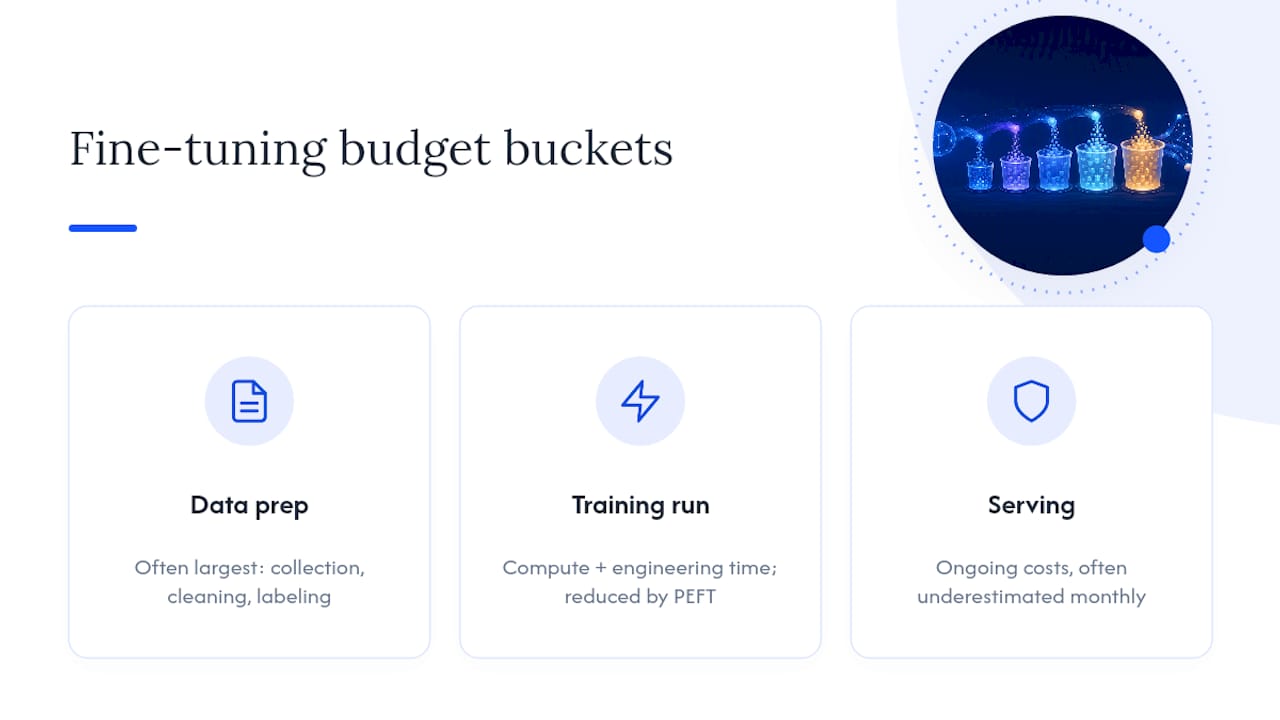
Compute is only one line item in a fine-tuning budget, and often not the largest one. Data collection, cleaning, and labeling frequently eat more engineering hours than the training run itself, especially for domain-specific tasks where existing public datasets don’t cover your use case.
PEFT methods change the cost equation substantially. Because LoRA and QLoRA train a small fraction of total parameters, they let teams fine-tune models on a single GPU that would otherwise require a multi-GPU cluster for full fine-tuning, cutting both compute rental costs and the engineering time spent managing distributed training infrastructure. That’s the core economic argument behind PEFT’s popularity, not just its accuracy ceiling.
Ongoing costs matter as much as training costs. Inference serving, monitoring infrastructure, and the engineering time spent on retraining as data drifts all recur monthly, while training itself is typically a one-time or occasional cost. Budget for evaluation infrastructure explicitly. Teams that treat evals as a footnote end up paying for it later in production incidents that cost far more than the automated test suite would have.
A realistic budgeting exercise separates three buckets: data preparation and labeling, the training run itself (compute plus engineering time), and production serving and monitoring costs over the model’s operational lifetime. Most teams underestimate the third bucket the most.
Ethics and Bias Mitigation in Fine-Tuning
Fine-tuning can amplify biases already present in your training data, sometimes more aggressively than pretraining does, because the dataset is smaller and each example carries proportionally more influence on the final weights. A support-ticket dataset that skews heavily toward one demographic’s phrasing patterns, or a legal-document corpus reflecting one jurisdiction’s biases, teaches the model those patterns as the norm.
Audit your training data composition before training starts, not after a bias incident in production. Check for demographic skew, language register imbalance, and whether your labels themselves encode a biased judgment call (a “quality” label assigned by reviewers who all share one background, for instance).
Mitigation during fine-tuning includes balancing underrepresented categories in your dataset rather than letting the natural distribution dictate training weight, running fairness-focused evaluation slices alongside your standard accuracy metrics, and keeping a human review step for any deployment touching high-stakes decisions like hiring, lending, or healthcare triage. Document these decisions in your model card so the next person maintaining the model understands what trade-offs were made and why, rather than rediscovering them after a complaint.
Transfer Learning: Choosing and Reusing Pretrained Checkpoints
Fine-tuning is transfer learning in practice: you’re taking knowledge a base model learned from a massive, general pretraining corpus and redirecting it toward your specific task. The choice of base checkpoint matters more than most teams initially budget time for.
Pick a base model whose pretraining domain overlaps with your target task where possible. A model pretrained heavily on code will transfer faster to a code-generation fine-tune than a general chat model will, even with identical fine-tuning data. Check the base checkpoint’s documented training corpus and known strengths before assuming a popular general-purpose model is automatically the right starting point.
Newer isn’t always better for your specific task. A smaller, well-matched checkpoint often outperforms a larger, more general one after fine-tuning, while costing less to serve. Test at least two candidate base models on a small slice of your data before committing to full-scale training on either.
Author Perspective: The Default Workflow I’d Recommend
Start with PEFT, build evaluation before you build excitement, and roll out in stages. That order isn’t conservative caution. It’s the sequence that gets a working model into production fastest, because full fine-tuning without a proven eval loop just means you fail expensively instead of cheaply.
Timebox your proof-of-concept to two weeks. If PEFT hasn’t cleared your success threshold by then, the problem is usually your data or your metric, not your hyperparameters. And treat data handling compliance as a design constraint from day one, not a legal review bolted on at the end.
— Botiqueai
How BotiqueAI Handles Fine-Tuning, Integration, and Deployment
Our service is suited for teams who want to bypass lengthy infrastructure setup and obtain a working, evaluated model ready for production quickly. Our Automatisations IA sur mesure service maps directly onto everything covered above: dataset preparation, PEFT-based fine-tuning, staged evaluation, and production deployment, built around your actual data rather than a generic template.
We focus on timely delivery of proof-of-concept models, GDPR-compliant deployment practices, and establishing measurable KPIs before training starts. If your project leans toward a full conversational deployment rather than a narrow classification or extraction task, Aria by BotiqueAI offers a packaged chatbot layer you can pair with a fine-tuned model underneath. Teams building on WhatsApp or Shopify have a direct path through our chatbot development and Shopify app services.
Clients can begin with an initial audit of their use case and data readiness, with no long-term contract required, to evaluate whether PEFT approaches meet their accuracy needs before committing to a full project.
Where to Go Deeper
A handful of primary sources cover everything above in more technical depth than a single article can hold:
- Hugging Face Transformers Training docs: working Trainer code for tokenization, data collators, and mixed-precision training arguments.
- Databricks’ Practical Guide to LLM Fine-Tuning: when to reach for PEFT versus full fine-tuning, with cost and overfitting guidance.
- OpenAI’s Model Optimization guide: the fine-tuning workflow and the continuous evaluation loop OpenAI recommends.
- Google Cloud’s GKE inference optimization docs: quantization, tensor parallelism, and KV cache strategy for serving.
- The arXiv survey on LLM fine-tuning methods: a method taxonomy and empirical comparison across fine-tuning approaches, useful background before choosing a technique.
Sources
- Training — Hugging Face Transformers documentation
- A Practical Guide to LLM Fine Tuning | Databricks Blog
- Model optimization | OpenAI API
FAQ
What Is LLM Fine-Tuning?
LLM fine-tuning is the process of continuing to train a pretrained language model on a smaller, task-specific dataset so it adapts its behavior, tone, or accuracy to that task. It changes how the model responses; it does not reduce the model’s parameter count or its base compute footprint.
Can You Fine-Tune Any LLM?
Most open-weight models can be fine-tuned if their license permits it, but check the base checkpoint’s license terms before starting, since some restrict commercial use or redistribution. Closed models accessible through an API, like those covered in OpenAI’s optimization guidance, typically offer a managed fine-tuning workflow rather than direct weight access.
What’s the Difference Between Fine-Tuning and Training From Scratch?
Fine-tuning starts from a model that already learned general language patterns during pretraining and adjusts it toward your task, which takes a fraction of the data and compute that training from scratch requires. Training a model from scratch means starting with random weights and building all language understanding from your own dataset, a scale of effort only a handful of organizations attempt.
How Do You Fine-Tune an LLM in Practice?
In practice, you format a labeled dataset as prompt/response pairs, tokenize it, choose a method (LoRA and QLoRA are the standard starting points), set training arguments like learning rate and batch size, then train while monitoring validation loss. The Hugging Face Trainer documentation walks through the exact code for this workflow, from data collation through the final training loop.
Should I Choose PEFT or Full Fine-Tuning First?
Start with PEFT, specifically LoRA or QLoRA, for nearly every project, since it trains a small fraction of parameters at a fraction of the cost while preserving most of the base model’s general capability. Move to full fine-tuning only if a well-tested PEFT baseline clearly falls short of your accuracy target, which Databricks’ guidance confirms is the exception rather than the rule for most production use cases.