
Five Steps to Audit Ready Generative AI Guardrails for Leaders
Five Steps to Audit Ready Generative AI Guardrails for Leaders
Guardrails are the middleware controls that stop harmful, off-policy, or non-compliant outputs from a generative AI system before they reach a customer, a regulator, or a courtroom exhibit. If you deploy a chatbot, agent, or copilot without them, you are shipping unreviewed model behavior into production. The immediate action is not a model swap. It is setting a written policy and turning on input and output filters this quarter, with logging enabled from day one.
TL;DR:
- Implementing guardrails before deployment is crucial, with input and output filters addressing most risks like hallucinations and bias.
- Guardrails are distributed across five points in the request pipeline: input, retrieval, execution, dialog, and output, each targeting specific failure modes.
- Clear policies and risk appetite must be defined first; tools and layered checks should follow, with continuous testing, logging, and staged rollouts to maintain control.
- Deploy guardrails as a governance decision with measurable KPIs, incident logs, and audit trails to satisfy regulatory expectations and demonstrate system safety.
- Most organizations benefit from ready-made guardrail tools and expert guidance to set up production-grade controls quickly without building from scratch.
Table of Contents
- What Are Generative AI Guardrails and Why Do They Matter?
- Where Do Guardrails Sit? The Five Insertion Points That Matter
- How to Implement Guardrails: A Step-by-Step Playbook
- Architecture Choices: Latency, Layering, and Where to Host Guardrails
- Proving It Works: KPIs and Audit Evidence for Guardrails
- How BotiqueAI Approaches Guardrail Engagements
- What Leaders Should Approve This Quarter
- Building Guardrails Without Building From Scratch
- Sources
- FAQ
What Are Generative AI Guardrails and Why Do They Matter?
Generative AI fails in predictable, well-documented ways. Models hallucinate facts, reflect training-data bias, produce toxic or off-brand language, and occasionally leak personal or proprietary information they were never supposed to repeat. None of that is a bug you patch once. It’s a standing property of how large language models generate text, and it’s why the industry converged on a separate control layer sitting outside the model itself.
Guardrails act as middleware: they inspect, filter, or rewrite what goes into a model and what comes back out, without touching the model’s weights. This distinction matters more than most vendors admit. Alignment training (RLHF, fine-tuning, system prompts) shapes how a model behaves on average. Guardrails enforce what must never happen, regardless of how the model was trained, and they are the layer you can audit, version, and roll back independently of a model update.
Regulatory pressure has made that separation a compliance requirement, not just an engineering preference. The OECD’s policy guidance on generative AI names transparency, robustness, and human supervision as core design elements, and national guidance for businesses operating in France increasingly points toward the same expectations for monitoring and documented human oversight. The EU AI Act’s emerging codes of practice follow the same logic: if you can’t show how an output was checked, you can’t prove the system was under control when something went wrong.
The business stakes break down into a few concrete categories:
- Reputational: a hallucinated product claim or an offensive completion screenshotted on social media.
- Legal: outputs that violate advertising law, discrimination rules, or contractual promises made in a customer’s name.
- Operational: a support agent that executes a refund or a database write it was never authorized to perform.
- Data protection: a model that echoes personal data it retrieved from a connected knowledge base, a direct exposure risk under GDPR.
None of these risks require a malicious actor. Ordinary usage triggers most of them within weeks of launch, which is exactly why the Stanford HAI AI Index tracks hallucination and bias benchmarks as a standing category of model risk rather than an edge case.
Where Do Guardrails Sit? The Five Insertion Points That Matter
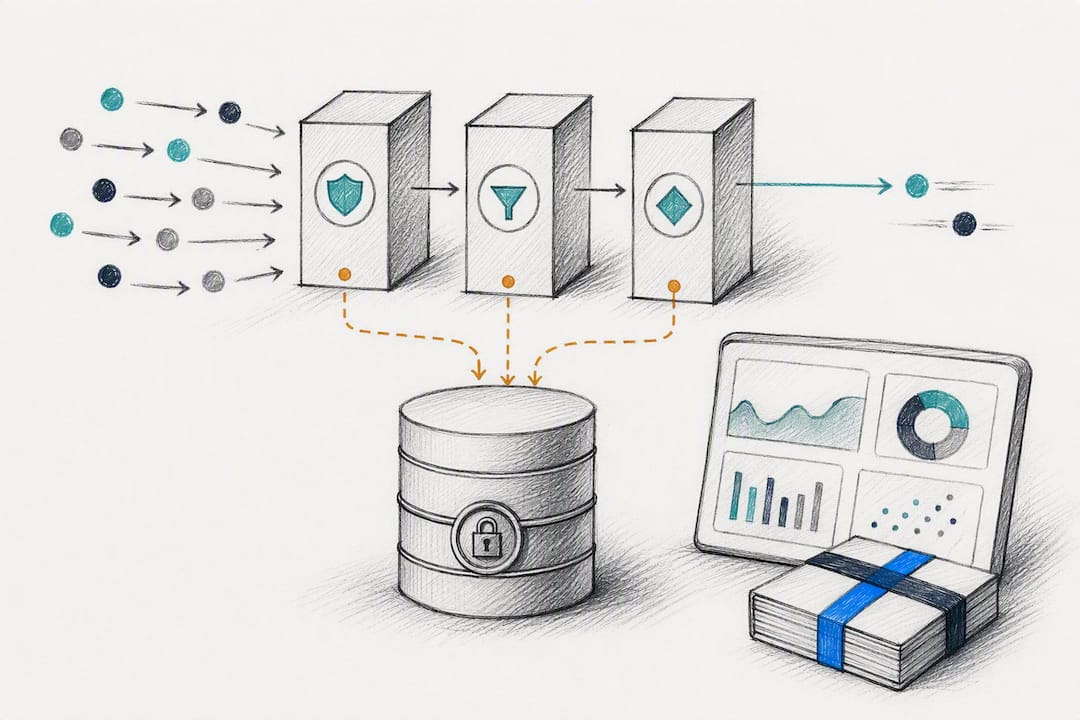
Guardrails aren’t one thing bolted onto a chatbot. They’re a set of checkpoints distributed across the request lifecycle, and each checkpoint uses different techniques because it’s catching a different failure mode. The taxonomy below, broadly consistent with how open-source frameworks describe the pipeline, gives your engineering team a shared map before anyone writes a line of code.
- Input guardrails. This is the first line of defense, applied before the prompt ever reaches the model. Regex and keyword lists catch obvious profanity or banned topics. Prompt sanitation strips or flags suspicious formatting patterns associated with jailbreak attempts. PII masking replaces phone numbers, emails, and ID numbers with placeholders. Injection detection looks for instructions embedded in user text that try to override the system prompt.
- Retrieval guardrails. For any system built on retrieval-augmented generation (RAG), the documents you fetch are as dangerous as the prompt itself. Provenance checks confirm a chunk came from an approved, current source. Chunk redaction strips sensitive fields before they enter the context window. Retrieval filters block documents outside a user’s access scope, which matters enormously once you connect internal knowledge bases to a public-facing agent.
- Execution guardrails. Once an agent can call tools, take actions, or write to a database, the risk profile changes entirely. Whitelisting restricts which functions an agent may invoke. Parameter validation checks the values passed into a tool call before execution. Permission constraints tie tool access to the authenticated user’s actual role, not the model’s assumption of it.
- Dialog guardrails. Controlled conversation flows keep multi-turn interactions inside a defined script for regulated use cases, like a financial disclosure or a medical intake form. Template-based dialog management, the approach popularized by frameworks like NVIDIA NeMo Guardrails, lets you define exactly which topics an assistant may enter and which it must redirect.
- Output guardrails. The last checkpoint before a response reaches the user. Content moderation classifiers score toxicity and policy violations. LLM-as-judge techniques use a second model to evaluate the first model’s answer against a rubric. Schema validation rejects malformed structured output before it hits a downstream system that expects clean JSON.
Pro Tip: Run cheap deterministic checks (regex, allow lists) first and reserve expensive model-based checks, like an LLM-as-judge pass, for the smaller slice of requests that survive the first filter. This keeps latency manageable without giving up coverage on complex cases.
NeMo Guardrails is a useful reference point precisely because it implements all five layers in one open-source toolkit, which makes it a good way to prototype your own architecture before committing to custom middleware.
How to Implement Guardrails: A Step-by-Step Playbook
Most guardrail projects fail for a governance reason, not a technical one. Teams pick a tool before they’ve agreed on what “unacceptable output” actually means for their business. Fix that order first.
- Define scope, policy, and risk appetite. Get legal, compliance, and the product owner in a room before any engineering starts. Decide which outputs are absolutely forbidden (medical advice, discriminatory language, unauthorized financial commitments), which require human review, and which are acceptable with monitoring. Document it. This document becomes your audit artifact later, and the OECD framework treats this kind of written policy as a baseline expectation, not a nice-to-have.
- Choose your first layers. Don’t try to build all five insertion points at once. Input and output filters plus RAG retrieval controls cover the majority of real-world incidents for most customer-facing deployments, and they’re the fastest to stand up.
- Pick your tooling mix. Rule-based checks (regex, allow/deny lists) are fast, cheap, and fully explainable to an auditor, but brittle against novel phrasing. Model-based checks (classifiers, LLM-as-judge) catch nuance and paraphrase attacks but add latency and cost, and they need their own evaluation. Most production systems end up running both, layered.
- Test before you trust. Sandbox testing has to include adversarial prompts, not just happy-path queries. Red-team exercises should probe prompt injection, long-conversation degradation where a model drifts off its instructions after many turns, and RAG-provoked hallucinations where a retrieved chunk gets misquoted. Automate a subset of these as regression tests in your CI pipeline so a model or prompt update doesn’t silently reopen a closed vulnerability.
- Roll out in stages, with a governance owner named before launch. Ship to an internal pilot group first, watch the logs, tighten filters, then expand.
A rollout checklist worth pinning above your desk:
- Assign one named owner for guardrail policy, not a committee.
- Set a false-positive tolerance threshold before launch, not after complaints arrive.
- Build the incident response runbook (who gets paged, how fast, what gets disabled) before the guardrails go live, not during the first real incident.
- Schedule a governance review at 30, 90, and 180 days post-launch.
The organizations that get this right treat guardrails as a living system, not a launch checkbox. Model drift, new attack patterns, and shifting business policy all mean the ruleset from month one won’t be the ruleset you need by month six.
Architecture Choices: Latency, Layering, and Where to Host Guardrails
Where you physically put your guardrail logic changes both your risk exposure and your bill. A middleware proxy sitting between your application and the model API gives you a single choke point to update policy without touching application code. In-model constraints, like a heavily engineered system prompt, are faster to deploy but far easier for a determined user to talk their way around, and they leave no separate audit trail.
Defense-in-depth is the pattern that holds up under real traffic. Run fast, deterministic checks (regex, keyword lists, schema validation) on every single request. Route only the requests that pass, or that trip an ambiguous signal, into heavier model-based checks like a classifier or an LLM-as-judge pass. This tiered approach, sometimes described as L1/L2/L3 checking, keeps median latency low while still catching the harder edge cases that simple rules miss.
A few operational patterns are worth building in from the start:
- Validation pipelines that reject malformed output before it reaches a downstream system expecting structured JSON.
- Immutable logs for every guardrail decision, including what was blocked, why, and which rule or model fired.
- Schema enforcement on any output feeding an API, database, or automated workflow, so a hallucinated field never silently corrupts a record.
- Rollback capability so a bad rule update or an overly aggressive classifier can be reverted in minutes, not days.
Scaling concerns show up fast once traffic grows. A classifier that adds 200 milliseconds per request is invisible at low volume and painful at ten thousand daily conversations. Monitor guardrail latency as its own metric, separate from model latency, because the two failure modes require completely different fixes.
Proving It Works: KPIs and Audit Evidence for Guardrails
You cannot manage what you don’t measure, and regulators increasingly expect you to show your measurements, not just describe your intentions. The NIST commentary on AI governance points toward exactly this kind of institutionalized measurement and logging as a baseline for defensible AI safety practice.
A workable KPI set for a production guardrail system includes:
- Incident count: how many guardrail failures reached a real user in a given period.
- False accept rate: harmful or off-policy content that slipped through undetected.
- False reject rate: legitimate, safe responses blocked unnecessarily, which is the metric most teams under-track and then get blindsided by user complaints.
- Mean detection latency: how long each layer adds to response time, tracked separately per layer.
Treat false accept and false reject rates as a single trade-off curve you tune deliberately, not two unrelated numbers. Tightening a filter to catch more unsafe content almost always increases legitimate refusals, and the right balance point depends on your specific risk tolerance and user base.
Testing has to be continuous, not a pre-launch event. Automated regression tests, periodic red-team exercises, and rolling jailbreak scans catch the drift that happens as attackers adapt and as your model provider ships updates you didn’t ask for.
For audit readiness, build immutable decision traces from day one: every blocked or flagged request, timestamped, with the rule or model that triggered the action. Export a sample audit pack quarterly, with a dashboard summarizing incident trends and open remediation tickets, so a compliance review is a five-minute export, not a scramble.
How BotiqueAI Approaches Guardrail Engagements
BotiqueAI structures every guardrail engagement the same disciplined way: an audit of the current deployment and its exposure, a proof-of-concept scoped to the highest-risk use case, then production hardening with monitoring and a named governance owner before wider rollout.
The mistakes we see repeat across industries are strikingly similar. Teams add output filtering and skip input filtering, leaving prompt injection wide open. Teams deploy a RAG system without provenance checks and then can’t explain why the assistant quoted an outdated policy document. Teams skip logging entirely and discover, only after an incident, that they have no evidence trail to show anyone.
The fix in every case is the same: scope the risk before you scope the tooling, and treat logging as a launch requirement, not a future enhancement.
What Leaders Should Approve This Quarter
If you take one thing from this guide, take this: guardrails are a governance decision before they’re an engineering task, and leaders who treat them as purely technical end up approving deployments they can’t actually defend later.
Assign a named owner and a real budget line for guardrail work, separate from the model or platform budget. Require evidence, meaning logs and KPIs, before any broad rollout gets your sign-off, not after. And prioritize pilots where the exposure is real but contained, so you build institutional confidence before guardrails carry your highest-stakes use case.
— Botiqueai
Building Guardrails Without Building From Scratch
Most companies don’t need a research team to get guardrails right. They need someone who has already built the input filters, the RAG provenance checks, and the audit logging pipeline, and can adapt that work to your specific policy instead of starting from a blank file. That’s the gap BotiqueAI closes: production-grade guardrail architecture without the months of internal tooling most teams budget for and rarely finish.
A typical engagement starts with a short audit of your current or planned AI deployment, moves into a proof-of-concept focused on your highest-risk use case, then into production hardening with the logging and monitoring a compliance review will actually ask for. This applies whether you’re deploying a support chatbot on your website, a WhatsApp assistant handling customer conversations, or custom automation wired into internal systems. If you’re running or planning a Shopify storefront, the same guardrail logic extends into the Shopify app tier, with pricing options that include a Plan Starter and a Plan Pro.
Request an audit of your current setup and BotiqueAI will scope the first guardrail layer worth building before your next deployment.
Sources
- OECD — Initial policy considerations for generative artificial intelligence (2023)
- Stanford HAI — AI Index report 2025 (Chapter on generative AI risks)
- NIST — AI governance / safety commentary
- Entreprendre
FAQ
What Jobs Are Least Likely to Be Replaced by AI?
Roles built on physical dexterity, direct human trust, and situational judgment, like skilled trades, hands-on healthcare, and senior negotiation or crisis management, remain hardest to automate. Generative AI struggles most where accountability and physical presence matter more than information processing.
What Are the Two Biggest Risks of Generative AI?
Hallucination (confidently generated false information) and data leakage (exposure of personal or confidential information through model outputs) are the two risks that show up most consistently across Stanford HAI’s tracked failure modes. Both are directly addressed by input and output guardrails, which is why they’re the first layer most organizations deploy.
What Are the Main Types of AI Systems in Use Today?
Generative models (producing text, images, or code), predictive or analytical models (forecasting and classification), and agentic systems (models that take actions through connected tools) represent the three broad categories organizations deploy. Each category needs a different guardrail emphasis: generative systems lean on output filtering, agentic systems need execution constraints above all.
Are Any Generative AI Uses Legally Banned?
Rules vary by jurisdiction and use case rather than banning generative AI outright; the EU AI Act and related codes of practice restrict specific high-risk applications, such as certain biometric surveillance and manipulative practices, rather than the technology itself. Organizations operating in France should treat sector-specific guidance, not general AI headlines, as the actual compliance source for what’s restricted in their case.
Does BotiqueAI Build Guardrails Into Its Chatbot Projects?
Yes. Guardrail design, including input filtering, RAG provenance checks, and audit logging, is part of how BotiqueAI scopes custom chatbot and automation projects from the proof-of-concept stage onward. Pricing for packaged products like the Shopify app is published directly on the site; custom guardrail engagements are quoted after an initial audit.