
GEO, AEO, and LLM Optimization: How to Rank in ChatGPT
GEO, AEO, and LLM Optimization: How to Rank in ChatGPT
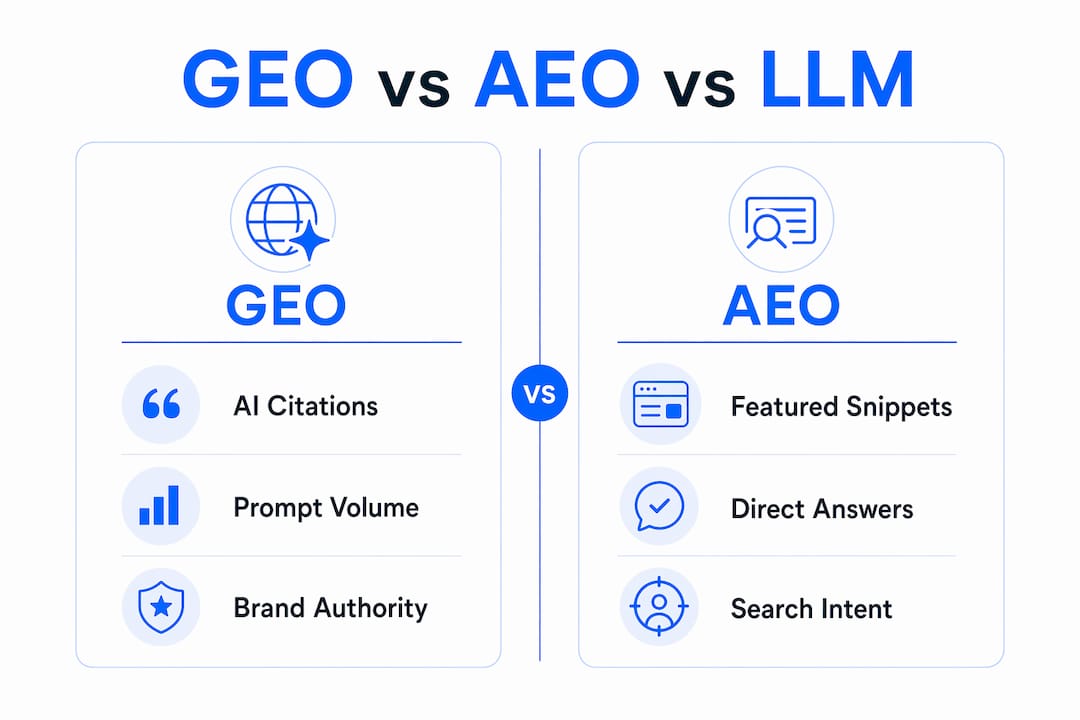
Generative Engine Optimization (GEO) is the practice of structuring your digital content so AI-powered engines like ChatGPT, Google AI Overviews, and Perplexity explicitly cite and feature it in their generated answers. Related terms include Answer Engine Optimization (AEO), which focuses on direct answer surfaces, and Large Language Model Optimization (LLMO), which targets chatbot visibility specifically. GEO, AEO, and LLMO are overlapping but distinct practices, all treated by Google as extensions of SEO rather than separate disciplines. Businesses that ignore this shift are already losing brand visibility to competitors who have adapted their content for AI citation.
What is generative engine optimization and why does it differ from SEO?
GEO targets a fundamentally different output than traditional SEO. Classic SEO earns a blue link on a results page. GEO earns a mention inside an AI-generated paragraph that millions of users read without ever clicking through to your site.
The core mechanics differ too. Traditional SEO rewards rankability: domain authority, backlinks, and keyword density. GEO rewards extractability and rankability as two separate qualities. Extractability means your content is technically parseable by AI. Rankability means the AI’s underlying model trusts your brand enough to cite it. Many brands nail the technical side and still get ignored because their authority signals are weak.
Prompt volume replaces keyword search volume as the primary demand signal in AI search. Users type full questions and conversational requests, not two-word queries. That shift forces marketers to think in semantic content clusters rather than individual keyword targets.

How the rise of zero-click AI searches changed everything
Zero-click searches are queries where the user gets a complete answer from the AI without visiting any website. Google AI Overviews, ChatGPT, Gemini, and Perplexity all deliver this experience by default. The result is that a top organic ranking no longer guarantees traffic.
This creates a real problem for businesses built on click-through traffic. A brand can rank number one on Google and still be invisible if the AI Overview cites a competitor instead. Brand visibility now depends on whether the AI chooses to mention you, not whether your page appears in the index.
The upside is significant. Brands that earn AI citations reach users at the exact moment of decision, inside the answer itself. That placement carries more authority than a ranked link because the AI is effectively endorsing the source.
| Search type | Ranking signal | User behavior | Brand exposure |
|---|---|---|---|
| Traditional SEO | Backlinks, keywords | Clicks to website | Blue link in results |
| GEO / AI search | Authority, extractability | Reads AI answer | Citation inside generated text |
| AEO (Answer Engine) | Structured data, FAQs | Featured snippet | Direct answer box |
Pro Tip: Build a list of 20–30 questions your customers ask conversational AI tools. These are your GEO content targets, not keyword lists.
How companies are “baiting” AI to get cited
The most effective GEO tactic is writing content that AI models find easy to extract and quote. Content containing statistics and named-source quotations increases AI visibility by 30–40%, with inline citations boosting citation rates by over 42% for lower-ranked pages. That number is not a coincidence. AI models are trained to prefer authoritative, verifiable claims.
Companies that win AI citations consistently do several things differently:
- Build a prompt library. They map the exact questions users ask ChatGPT, Perplexity, and Gemini about their category. These prompts reveal “discovery gaps” where no authoritative content exists yet.
- Write quotable passages. Every article contains at least one paragraph that states a clear, data-backed claim in 2–3 sentences. AI models pull these passages directly.
- Earn unlinked brand mentions. Unlinked brand mentions on authoritative platforms like Reddit and YouTube carry strong trust signals for AI models. A genuine discussion of your product on a niche forum can outperform a paid backlink.
- Use named-source quotations. Attributing a claim to a real expert or institution makes the passage more citable. Generic statements get skipped.
- Target authority gaps. When no credible source covers a specific question, a well-structured answer from your brand fills the vacuum and earns the citation by default.
“AI doesn’t rank pages. It cites passages. The brands that win are the ones that write passages worth quoting.” — GEO practitioner insight via GenAlphAI
Casual yet authoritative brand mentions in user-generated content communities boost AI trust signals beyond what traditional backlinks deliver. Getting your brand discussed naturally on forums, review sites, and video platforms is now a core distribution strategy.
Technical steps to make your website AI-friendly
A technically sound website is the foundation of any GEO strategy. Without it, even the best content stays invisible to AI crawlers.
-
Use server-side rendering or static prerendering. AI crawlers struggle with JavaScript-rendered content. If your page content loads via client-side JavaScript, AI bots may index a blank shell. Serve your critical content in static or server-rendered HTML.
-
Write self-contained passages of 200–400 tokens. AI systems cite content at the passage level, not the page level. Each paragraph should answer one question completely without requiring context from surrounding text. A reader, or an AI, should understand the point from that paragraph alone.
-
Add structured data with schema markup. Use Organization schema with
sameAslinks pointing to your LinkedIn, Crunchbase, and Wikipedia profiles. Add FAQ schema to question-and-answer content. These signals help AI models connect your content to your brand entity reliably. -
Register your entity in Wikidata. Registering with Wikidata Q-IDs combined with Organization schema improves LLM attribution. When an AI model encounters your brand name, a Wikidata entry gives it a verified anchor to link claims back to you.
-
Audit your crawlability for AI bots. Check your
robots.txtand server logs for AI crawlers like GPTBot, ClaudeBot, and Google-Extended. Blocking these bots by accident is a common and costly mistake.
Pro Tip: Test each key page by disabling JavaScript in your browser. If the main content disappears, AI crawlers are likely seeing the same empty page.
Actionable GEO tactics for digital marketers and business owners
Knowing the theory is one thing. Executing a repeatable GEO program is another. These tactics translate directly into measurable AI citation gains:
- Build and maintain a prompt library. Document every question your audience asks on ChatGPT, Perplexity, and Gemini. Update it monthly. This library drives your editorial calendar.
- Track AI citations and share of voice. Use tools like Semrush’s AI toolkit to monitor how often your brand appears in AI-generated answers across platforms. GEO measurement requires prompt-cluster and engine-segmented tracking to handle answer volatility across different AI surfaces.
- Publish data-driven content regularly. Original research, proprietary statistics, and expert interviews give AI models new material to cite. Recycled content from other sources rarely earns citations.
- Earn credible third-party mentions. Pitch your brand to journalists, podcasters, and niche community moderators. A mention on a trusted publication trains AI models to associate your brand with authority in your category.
- Test and iterate based on citation data. Run the same prompt weekly and track whether your brand appears. When you update a page, note whether citation frequency changes. This feedback loop replaces traditional rank tracking.
- Align content with natural language prompts. Marketers must anticipate natural language prompts rather than only keywords. Write content that answers full questions, not fragments.
Consistency matters more than volume here. Publishing one well-structured, data-backed article per week outperforms ten thin posts with no quotable passages.
Pros and cons of generative engine optimization
GEO delivers real advantages, but it also introduces new challenges that traditional SEO does not.
| Factor | Advantage | Challenge |
|---|---|---|
| Brand authority | AI citations signal expert status to users | Building authority takes months of consistent effort |
| Zero-click reach | Reaches users who never click through | No direct traffic from AI citations |
| Future-proofing | Positions brand for AI-first search growth | AI platform changes can erase citation gains overnight |
| Measurement | Citation tracking tools are improving fast | No standardized metric like keyword rank exists yet |
| Content quality | Forces clearer, more authoritative writing | Requires more research and production time per piece |
The biggest risk in GEO is over-optimizing for AI at the expense of human readers. Content written purely to be extracted by machines tends to read as dry and mechanical. The best GEO content serves both audiences equally well. It is clear enough for AI to parse and engaging enough for a person to read and share.
Balancing GEO with traditional SEO is not optional. Organic search still drives significant traffic, and a strong backlink profile directly supports AI rankability. The two disciplines reinforce each other when executed together.
Key Takeaways
GEO requires both technical accessibility and genuine brand authority to earn consistent AI citations across platforms like ChatGPT, Google AI Overviews, and Perplexity.
| Point | Details |
|---|---|
| GEO differs from SEO | GEO targets AI citations inside generated answers, not clickable blue links in search results. |
| Extractability and rankability | Technical readability and brand authority are separate requirements. Both must be addressed. |
| Passage-level writing | Write self-contained paragraphs of 200–400 tokens so AI can cite partial page content accurately. |
| Entity registration | Wikidata Q-IDs and Organization schema help AI models reliably attribute claims to your brand. |
| Measurement discipline | Track AI citations by prompt cluster and platform, not just overall brand mentions. |
What I’ve learned about GEO after working with AI-driven brands
The most common mistake I see is treating GEO as a content formatting exercise. Marketers add FAQ sections, sprinkle in statistics, and call it done. Then they wonder why ChatGPT still cites their competitor.
The real differentiator is brand authority at the entity level. AI models do not just read your page. They cross-reference your brand against everything they know: your Wikipedia presence, your Wikidata entry, your mentions across trusted publications, and the consistency of your claims over time. A brand with weak entity signals will not get cited no matter how well-structured its content is.
The second thing I have learned is that prompt libraries are underused. Most marketing teams still build content around keyword tools. The teams winning AI citations are building content around the exact questions their customers type into ChatGPT. That shift in research methodology changes everything downstream, from topic selection to headline structure to the way each paragraph opens.
GEO is not a replacement for SEO. It is the layer you build on top of a healthy SEO foundation. Get the technical basics right, earn real authority signals, and write content that a human would actually quote. The AI will follow.
— Botiqueai
How Botiqueai helps you show up in AI-generated answers
Botiqueai builds AI solutions designed for businesses that want to compete in AI-driven search and conversational commerce. The Aria chatbot is a client-facing AI assistant built for e-commerce sites and service businesses, trained to handle customer questions in a way that reinforces your brand’s authority signals across every interaction. Every conversation Aria handles generates the kind of natural, on-brand language that AI models recognize as a trust signal. Explore Botiqueai’s full AI solutions to see how custom chatbots, intelligent agents, and AI-optimized content workflows can position your brand for citation in ChatGPT, Gemini, and Google AI Overviews.
FAQ
What is the difference between GEO, AEO, and LLMO?
GEO optimizes content to be cited in AI-generated summaries. AEO targets direct answer boxes and featured snippets. LLMO focuses specifically on chatbot visibility inside large language models like ChatGPT and Claude. All three are extensions of SEO, not replacements for it.
Does Google support GEO as a legitimate SEO practice?
Google’s official guidance confirms that GEO, AEO, and LLMO are valid SEO extensions. Google warns against content chunking or creating special files just for AI crawlers, recommending instead that brands focus on clear, authoritative, well-structured content.
How do I know if my brand is being cited by AI engines?
Use Semrush’s AI toolkit or similar monitoring tools to track brand mentions across AI platforms. Run your target prompts manually in ChatGPT, Perplexity, and Gemini weekly and log whether your brand appears in the generated answers.
What type of content gets cited most by AI models?
Content containing statistics, named-source quotations, and self-contained 200–400 token passages earns the most AI citations. Named-source quotes and inline citations can increase AI visibility by 30–40% compared to generic prose.
Can a small business compete with large brands in AI citations?
A small business can win AI citations in specific niches by publishing original data, earning genuine community mentions, and registering its entity in Wikidata. AI models favor the most authoritative answer to a specific question, not the largest brand overall.