
How to Validate an AI Business Idea with Customers
How to Validate an AI Business Idea with Customers
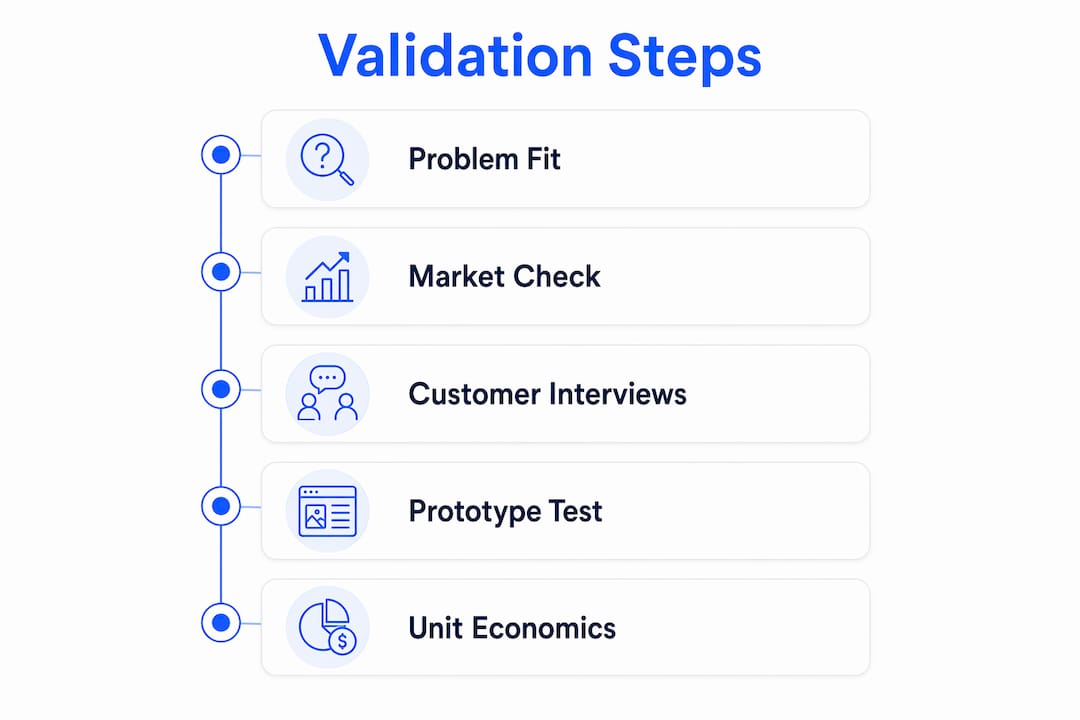
Validating an AI business idea with customers means confirming that real people have the problem you solve, will pay your price, and that your AI can actually deliver the result reliably. Most founders skip this and build first. That mistake costs months of development time and real money. The industry standard for early validation requires at least 5 problem-aware prospects who describe the problem unprompted, have tried other solutions, and show commitment within 30 days. Validation also covers AI feasibility and unit economics, not just demand.
What criteria define a validated AI business idea?
A validated AI business concept meets five distinct tests: problem confirmation, market existence, willingness to pay, AI feasibility, and viable unit economics. Passing only one or two of these tests is not validation. It is wishful thinking.
Problem validation requires direct evidence from prospects, not assumptions. At least 5 qualified prospects must describe the problem without prompting, show they have tried alternatives, and give a commitment signal within 30 days. That threshold filters out polite interest from genuine pain.

Market existence is different from validation. Market research confirms a category exists. Validation proves your specific solution can win customers within that category. Confusing the two leads founders to build products for markets they cannot actually reach.
AI feasibility is the test most founders skip entirely. Build a prototype focused on the single hardest AI task your product must perform. Measure its reliability across varied, real-world inputs before touching anything else. Testing the core AI task for consistent performance is the highest-leverage step in any AI product validation process.
Unit economics are the silent killer of AI startups. Calculate your inference cost per user and compare it to your planned price. Inference cost above 70–80% of your price signals a nonviable model even if customer demand is strong. This check must happen before you scale anything.
- Problem confirmed by 5+ unprompted, committed prospects
- Market existence verified through research, not assumed
- AI core task prototype tested for reliability on real inputs
- Inference cost calculated against planned pricing
- Willingness to pay confirmed through hard commitment signals
Pro Tip: Run your unit economics calculation before your first customer interview. Knowing your cost floor changes how you price and which customer segments you target.
How do you gather real customer feedback to test AI business ideas?
The most reliable way to gather AI startup customer insights is to combine live market data from AI tools with direct human conversations. Neither source alone is sufficient. AI tools surface patterns fast. Customers reveal the nuance, emotion, and context that patterns miss.
AI business context validation uses multiple AI agents pulling live data from 50+ sources, cross-validating claims to produce a real-time viability score with linked sources. That process catches market gaps and competitor blind spots quickly. But it does not replace talking to the people who would actually pay you.
Here is a proven sequence for gathering authentic feedback:
- Write a cold outreach message targeting 20–30 people who match your ideal customer profile. Focus on their problem, not your solution. Ask for 20 minutes to learn about their workflow.
- Open interviews with behavioral questions. Ask “Walk me through the last time this problem cost you time or money.” Avoid hypothetical questions like “Would you use a tool that…”
- Listen for unprompted problem descriptions. When a prospect describes your exact problem without you naming it, that is a strong signal. Record it verbatim.
- Test willingness to pay with a direct ask. After describing your solution concept, ask “What would you expect to pay for this monthly?” Silence or a number tells you more than any survey.
- Follow up with a commitment request. Ask for a pre-order, a deposit, a calendar booking, or an introduction to their budget holder. Hard signals like deposits outperform verbal enthusiasm every time.
After interviews, build a minimal landing page describing the problem and solution. A 5–10% waitlist conversion rate from targeted traffic signals genuine interest. A 1–3% pre-order or deposit rate confirms willingness to pay. These benchmarks apply to targeted traffic, not cold organic visitors.
Pro Tip: Send your landing page to people who declined your interview request. Their conversion behavior tells you more than their polite “no” did.
Cross-check every AI-generated market insight against what customers actually say. If your AI validation tool shows high demand but your interviews reveal no urgency, trust the interviews. Live human behavior beats modeled predictions.
What validation pitfalls should you avoid when testing AI concepts?
The most common mistake founders make is using a general-purpose AI chatbot to validate their idea. A standard large language model gives optimistic, pattern-matched feedback. It has no access to live market data and no incentive to surface fatal flaws. Authentic AI validation requires adversarial review by multiple independent agents, not a single chatbot that agrees with your framing.
Watch for these specific traps:
- Validating demand but skipping feasibility. Strong customer interest means nothing if your AI model cannot perform the core task reliably. Build the prototype first.
- Treating verbal interest as confirmation. “This sounds great, I’d definitely use it” is not a signal. A credit card number or a signed letter of intent is a signal.
- Defining a vague ideal customer profile. Poorly defined ICPs consistently lower validation scores and block founders from reaching the 70-point threshold that separates viable ideas from weak ones.
- Ignoring distribution. Knowing who your customer is means nothing if you have no clear path to reach them. Founder-distribution fit matters as much as product-market fit at the validation stage.
- Pivoting the idea before diagnosing the failure. If your landing page converts poorly, the cause could be the problem framing, the price, the audience, or the channel. Pivot only after you identify which one failed.
Only about 19.9% of SaaS ideas score above 70 on structured validation assessments. That number reflects how often founders skip the hard checks. The ideas that pass share one trait: the founder defined a specific entry wedge and a clear distribution channel before building.
One more trap deserves attention. AI products face a unique economic risk that traditional software does not. Inference costs can undermine unit economics even when customer demand is real and strong. Validate your cost structure as rigorously as you validate your market.
Step-by-step action plan to validate your AI business idea
Follow this sequence to move from concept to a defensible GO or NO-GO decision.
- Define the problem with 5+ qualified prospects. Recruit people who match your target customer profile. Confirm they experience the problem, have tried alternatives, and will commit to a follow-up within 30 days.
- Build a feasibility prototype. Focus only on the hardest AI task your product must perform. Test it on varied, real inputs. If it fails here, no amount of customer enthusiasm fixes the product.
- Run an AI context validation scan. Use a multi-agent validation tool that pulls live competitor data, demand signals, and market context from real sources. Treat its output as a starting hypothesis, not a conclusion.
- Conduct structured customer interviews. Use behavioral questions. Ask about past behavior, not future intent. Collect verbatim quotes and track how many prospects describe the problem unprompted.
- Launch a minimal landing page. Describe the problem and solution clearly. Drive targeted traffic. Measure waitlist and pre-order conversion rates against the 5–10% and 1–3% benchmarks.
How to read your results:
A GO signal requires problem confirmation from 5+ committed prospects, a feasibility prototype that works reliably, unit economics that leave a real margin, and a landing page that hits conversion benchmarks. A NO-GO on any single criterion is a stop signal, not a pivot trigger. Diagnose the failure first.
| Validation method | Strength | Limitation |
|---|---|---|
| Customer interviews | Reveals real pain and context | Small sample, slow to run |
| Landing page test | Measures actual behavior | Requires targeted traffic to be meaningful |
| AI context validation scan | Fast, live market data | Cannot replace human nuance |
| Feasibility prototype | Proves AI can do the job | Does not confirm customer demand |
| Unit economics check | Catches cost-structure failures early | Requires realistic pricing assumptions |
Pro Tip: Run steps 1 and 2 in parallel, not in sequence. Feasibility and problem validation are independent checks. Waiting on one before starting the other wastes weeks.
For founders who want to understand how AI fits into the broader customer acquisition process, AI customer acquisition strategies offer useful context on connecting validated demand to growth channels.
Key Takeaways
Validating an AI business idea requires confirming problem fit, AI feasibility, and unit economics through hard customer signals before writing a single line of production code.
| Point | Details |
|---|---|
| Five-prospect threshold | Confirm 5+ problem-aware prospects who commit within 30 days before proceeding. |
| Feasibility prototype first | Test your core AI task on real inputs before assessing market demand. |
| Hard signals only | Pre-orders and deposits confirm willingness to pay; verbal interest does not. |
| Unit economics check | Inference cost above 70–80% of price makes the model nonviable regardless of demand. |
| Diagnose before pivoting | Identify whether failure is in the problem, price, audience, or channel before changing direction. |
What I’ve learned from watching founders skip the hard checks
Working with entrepreneurs across B2B AI projects, the pattern is consistent. Founders who struggle most are not the ones with bad ideas. They are the ones who validated the wrong thing. They confirmed that a market exists, got excited by positive interview responses, and started building. Then they hit the feasibility wall or the unit economics ceiling six months later.
The uncomfortable truth about AI validation is that the technology adds two failure modes that traditional software does not have. Your model might not perform reliably enough to deliver the promised result. Your inference costs might make the business structurally unprofitable at any realistic price point. Neither of these shows up in a customer interview. Both of them kill companies.
The founders who get this right treat validation as three parallel tracks: customer evidence, technical feasibility, and economic viability. They do not wait for one track to finish before starting another. They also resist the temptation to use a single AI chatbot as a validation shortcut. A chatbot that agrees with your framing is not validation. It is confirmation bias with a chat interface.
The other thing I have seen consistently: founders who define a tight entry wedge and a specific distribution channel before building almost always outperform those who plan to “figure out go-to-market later.” Distribution is not a post-launch problem. It is a validation criterion. If you cannot name exactly how you will reach your first 50 customers, your idea is not validated yet. For teams new to integrating AI without deep technical backgrounds, this practical integration guide covers how to move from concept to working AI solution without getting lost in the technical details.
— Botiqueai
Botiqueai tools that support your validation process
Validation does not end when you confirm demand. The next challenge is building a system that captures customer feedback at scale and tests your AI concept in real conditions.
Botiqueai’s Aria AI chatbot lets you deploy a customer-facing assistant that collects structured feedback, qualifies prospects, and surfaces recurring objections automatically. That data feeds directly into your validation evidence. Botiqueai’s workflow automation services help you build and test the operational backbone of your AI concept before committing to full development. Both tools are built for B2B teams that need real results fast, not prototypes that look good in demos. Contact Botiqueai to discuss a solution tailored to your specific validation stage.
FAQ
What does it mean to validate an AI business idea?
Validating an AI business idea means confirming that real customers have the problem, will pay your price, and that your AI model can deliver the result reliably at a viable cost. It covers demand, feasibility, and unit economics together.
How many customers do I need to validate my AI concept?
The standard threshold is 5 or more problem-aware prospects who describe the problem unprompted, have tried alternatives, and show a hard commitment signal within 30 days.
What is a strong commitment signal in customer validation?
Strong signals include pre-orders, deposits, signed letters of intent, calendar bookings, or introductions to a budget holder. Verbal interest and positive survey responses are weak signals and do not confirm willingness to pay.
What conversion rate should my landing page hit?
A 5–10% waitlist conversion rate from targeted traffic signals genuine interest. A 1–3% deposit or pre-order rate confirms actual willingness to pay. These benchmarks apply only to targeted traffic, not broad organic visitors.
Why do AI business ideas fail validation even with strong demand?
AI products can fail validation because inference costs exceed 70–80% of the planned price, making the unit economics nonviable. Strong customer demand does not fix a cost structure that cannot support a real margin.