
Lean AI Development Explained for Tech Leaders
Lean AI Development Explained for Tech Leaders
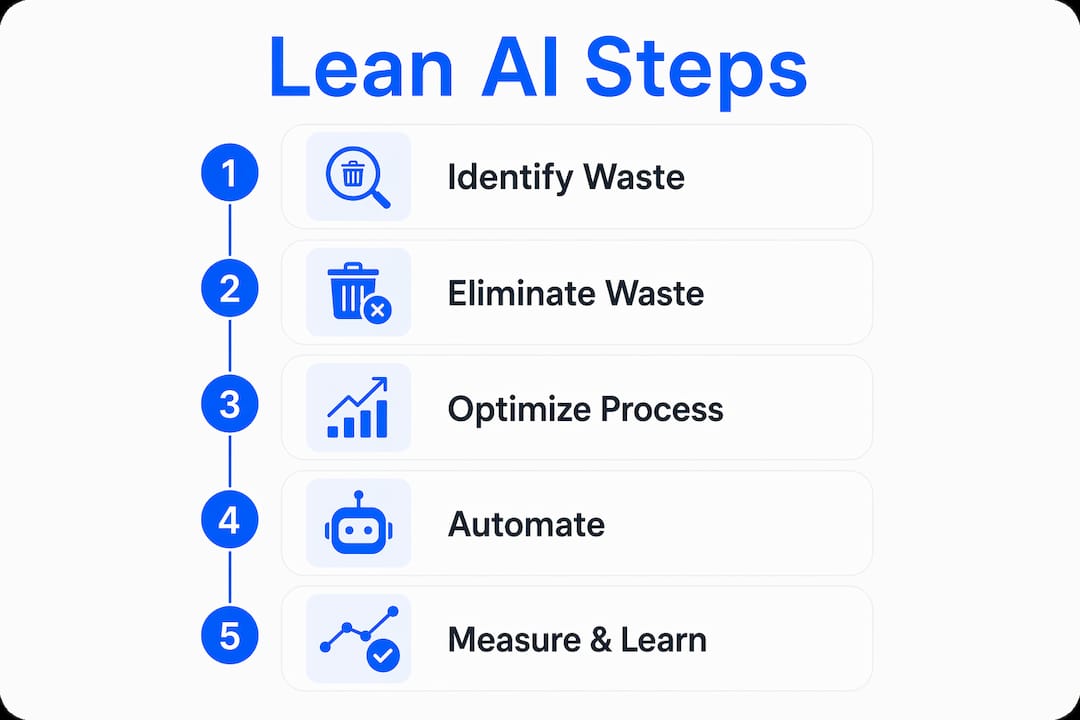
Lean AI development is the practice of applying Lean manufacturing principles to AI integration, with the goal of building value quickly by removing waste and iterating fast. The standard industry term is “Lean AI methodology,” and it follows a strict order: identify waste, eliminate it, optimize the process, then automate. Skipping that sequence is where most AI projects fail. Developers using AI-assisted coding tools completed tasks approximately 55.8% faster than those without AI. That speed advantage only compounds when teams apply Lean thinking first. This guide gives you the practical framework to do exactly that.
What is lean AI development and why does the order matter?
Lean AI development is not simply adding AI to your existing workflows. It is a disciplined methodology borrowed from Lean manufacturing, where Toyota’s production system proved that eliminating waste before adding automation produces better results than automating first and fixing later.
The prescribed sequence is non-negotiable. As Lean East guidance states directly: “If you automate a wasteful process with AI, you simply create faster waste.” The correct order is Identify, Eliminate, Optimize, then Automate. Teams that reverse this order lock inefficiencies into their systems and make future changes far more expensive.
Waste in AI development takes forms that differ from traditional software waste. Common examples include:
- Redundant data preprocessing steps that run on every inference call
- Approval workflows with no clear owner or decision criteria
- Model retraining cycles triggered by noise rather than meaningful data drift
- Prompt chains that call large language models for tasks a simple rule could handle
Process mapping visually every touchpoint before writing a single line of AI code is the recommended starting point. This forces teams to see which steps add value and which ones simply exist because nobody questioned them.
Pro Tip: Before you automate anything, ask whether a junior team member could follow the process with a checklist. If the answer is no, the process is not ready for AI.
How do AI tools accelerate lean software development cycles?
AI tools genuinely accelerate the build-measure-learn cycle that sits at the core of Lean methodology. The 55.8% faster task completion figure is not a marketing claim. It comes from controlled studies comparing developers with and without AI-assisted coding support. That speed means shorter feedback loops, which is exactly what Lean demands.
The acceleration shows up across three specific areas:
| Development Phase | AI Contribution | Lean Benefit |
|---|---|---|
| Coding | Autocomplete, code generation | Faster prototyping, reduced rework |
| Testing | Automated test generation | Earlier defect detection |
| User research | Pattern analysis from interviews | Real user insight in hours, not weeks |
On the user research side, AI tools reduce research cycles from weeks to minutes by analyzing interview transcripts and identifying behavioral patterns at scale. Tools like Dovetail and Maze are real examples of this category. That speed directly supports Lean’s emphasis on grounding decisions in actual user behavior rather than assumptions.

The pitfall is treating speed as the goal. AI acceleration without Lean discipline produces faster wrong answers. Teams that succeed treat AI as an experimental component, continually testing and improving rather than deploying and forgetting.
How do you design lean inference workflows for AI agents?
Lean Inference Workflows are a practitioner-level technique for applying Lean thinking directly to how AI agents reason and respond. The core idea is to minimize unnecessary token usage and reduce variation in outputs by encoding deterministic logic and constraints into the agent architecture before the language model ever runs.
Think of it like a manufacturing jig. A jig constrains a machinist’s movements so the output is consistent every time. In AI agent design, state machines and routing logic play the same role. They prevent the model from wandering into expensive, unpredictable reasoning paths when a simple rule would produce the correct answer faster and cheaper.
Three specific techniques make this work in practice:
- Pull systems: The agent only retrieves context it actually needs for the current step, rather than loading the full conversation history on every call.
- Step-scoped context: Each agent task receives only the information relevant to that task, reducing token count and improving focus.
- Semantic caching: Repeated or similar queries return cached results instead of triggering a full model inference, cutting both latency and cost.
Prompt design matters as much as architecture. Vague prompts produce variable outputs, which means more retries, more tokens, and more cost. Precise prompt constraints act like process specifications in a factory. They define acceptable outputs and reject everything outside that range before the result reaches the user.
Pro Tip: Audit your AI agent’s token usage per task the same way a Lean engineer audits cycle time. If a task consistently uses more tokens than expected, the prompt or routing logic needs tightening, not the model.
How does agile AI development integrate with lean governance?
Agile and Lean are not competing frameworks. Applied together in AI development, they produce what practitioners now call Agentic-Agile development. Agentic-Agile applies Agile practices like specs, acceptance criteria, and incremental delivery to human-agent collaboration, treating AI components with the same engineering rigor as any other software module.
The critical difference from unmanaged prompt-driven development is governance. In Agentic-Agile, governance is integrated from day one with continuous validation and review gates. This is not a compliance checkbox. It is the mechanism that prevents AI outputs from drifting outside acceptable boundaries as the system evolves.
Practical governance in a Lean AI project looks like this:
- Every AI component has a written spec with clear acceptance criteria before development starts.
- Code review applies to prompt templates and agent logic, not just traditional code.
- Validation rules run automatically on every deployment, catching regressions before they reach production.
- Human review gates exist at defined points in the workflow, particularly where AI outputs influence high-stakes decisions.
The Prompt-Do-Check-Act cycle adapts the classic Lean PDCA loop for AI development. Prompt engineering replaces the “Plan” phase, human validation replaces “Check,” and iterative refinement drives “Act.” This keeps human oversight central rather than treating AI as a black box that runs unsupervised.
Automating complex, wasteful processes locks inefficiencies into systems and makes future changes far harder. Lean AI governance prevents this by requiring simplification before any automation goes live.
Pro Tip: Treat every AI prompt template as a software contract. Version it, review it, and test it against edge cases before deploying. Prompt drift is as damaging as code regression.
Key Takeaways
Lean AI development produces better results than raw AI adoption because it eliminates waste before automation amplifies it, applies governance from day one, and uses AI speed to accelerate disciplined iteration rather than replace it.
| Point | Details |
|---|---|
| Follow the correct sequence | Identify waste, eliminate it, optimize, then automate. Reversing this order locks inefficiencies into your system. |
| AI speed requires Lean discipline | Developers complete tasks 55.8% faster with AI tools, but speed without process discipline produces faster wrong answers. |
| Design lean inference workflows | Use deterministic logic, step-scoped context, and semantic caching to reduce token usage and control AI agent behavior. |
| Apply Agentic-Agile governance | Treat AI components like software modules with specs, acceptance criteria, and continuous validation from day one. |
| Simplify before you automate | Process mapping every workflow before adding AI prevents automating complexity that should have been removed first. |
The uncomfortable truth about lean AI adoption
At Botiqueai, we work with business leaders who arrive convinced that AI will fix their broken processes. The honest answer is that it will not. AI amplifies what already exists. A disorganized approval workflow becomes a faster, more confusing approval workflow the moment AI touches it.
The teams we see succeed are the ones willing to spend two weeks mapping their processes before writing a single prompt. That feels slow. It is not. It saves months of rework later. The role of AI in digital transformation is to accelerate good processes, not rescue bad ones.
The other misconception we encounter constantly is that governance slows AI development down. The opposite is true. Teams that build validation rules and review gates from the start ship faster in the long run because they spend less time debugging unpredictable model behavior in production. Lean AI is not a shortcut. It is the method that makes the shortcut sustainable.
— Botiqueai
How Botiqueai applies lean AI principles to real business problems
Botiqueai builds custom AI agents, chatbots, and automation workflows designed around Lean principles. Every engagement starts with process mapping, not tool selection. That sequence is deliberate.
The Aria AI chatbot, for example, is built to handle customer interactions with deterministic routing logic that constrains the model to relevant responses. This reduces unnecessary inference calls and keeps response quality consistent. Teams exploring AI solutions for their business can see how Botiqueai structures each deployment around the Identify-Eliminate-Optimize-Automate sequence. For a concrete example of this methodology applied at scale, the Pernod Ricard case study shows how Lean AI thinking translates into measurable operational results. If you are ready to build AI that works with your processes rather than around them, Aria is the place to start.
FAQ
What is lean AI development?
Lean AI development is the application of Lean manufacturing principles to AI projects, following the sequence of identify, eliminate, optimize, then automate. The goal is to build AI systems that add value without amplifying existing waste.
Why does the order of lean AI steps matter?
Automating a wasteful process with AI creates faster waste, not better outcomes. The Lean East methodology specifies that elimination and optimization must precede automation to prevent locking inefficiencies into the system.
How does AI speed up lean build-measure-learn cycles?
Developers using AI-assisted coding tools complete tasks approximately 55.8% faster than those without AI. That speed shortens feedback loops, which is the core mechanism of Lean’s build-measure-learn cycle.
What are lean inference workflows in AI agent design?
Lean Inference Workflows use deterministic logic, step-scoped context, and semantic caching to minimize token usage and reduce variation in AI agent outputs. They apply the same constraint-based thinking as manufacturing jigs to control model behavior.
How does Agentic-Agile governance differ from standard AI development?
Agentic-Agile integrates specs, acceptance criteria, and continuous validation from day one, treating AI components with the same engineering rigor as traditional software modules. Standard prompt-driven development lacks these review gates, which leads to unpredictable outputs over time.