
Ship Open-Source LLMs in 2026 for Dev Teams: 7B–14B or Frontier
Ship Open-Source LLMs in 2026 for Dev Teams: 7B–14B or Frontier
Open-source LLMs are production-viable in 2026 for most enterprise use cases, and the choice boils down to two paths: an open-weight frontier model for research and heavy reasoning, or a quantized 7B to 14B family for local, low-latency deployment. Which path fits depends on your hardware budget and latency needs, both covered below in the model overview and deployment sections.
TL;DR:
- Self-hosted open-weight models like Mistral Large 3 or Llama are most cost-effective at high volumes and require infrastructure expertise to manage security, uptime, and fine-tuning.
- Genuine open-source licenses (such as Apache 2.0) are crucial to verify before commercial deployment, with attention to training data disclosure and licensing restrictions.
- Quantization formats like GGUF and GPTQ enable running smaller models on consumer hardware, but aggressive compression can reduce reasoning quality, necessitating pre-deployment testing.
- Multi-turn conversational assessments reveal hidden failures such as hallucinations and agreement biases that single prompt tests often miss.
- Organizations should prototype with hosted APIs to understand their needs before transitioning to open-weight models for production to avoid operational pitfalls.
Table of Contents
- What Does “Open Source LLM” Actually Mean?
- Why Choose Open-Source LLMs Over Hosted APIs?
- Which Open-Source LLMs Matter Most in 2026?
- How Do You Match Model Size to Hardware?
- What Should Be on Your Licensing Checklist?
- How Should You Evaluate an Open-Source Model Before Deploying It?
- What Are the Security Risks of Self-Hosting an LLM?
- How Do You Fine-Tune an Open-Source LLM for Your Domain?
- How Do You Troubleshoot Common Open-Source LLM Deployment Issues?
- Open-Source vs. Proprietary LLMs: What’s the Real Trade-Off?
- Where Can You Get Community Support for Open-Source LLMs?
- When Should Your Team Move from Pilot to Production?
- How Botiqueai Helps Teams Deploy Open-Source LLMs
- Sources
- FAQ
What Does “Open Source LLM” Actually Mean?
Most models marketed as “open source” are not open source in the traditional software sense, and that distinction matters for anyone doing procurement or compliance review. The Open Source Initiative draws a sharp line between “open-weight” releases, where you get the trained parameters but not the training data or full pipeline, and genuine open-source releases, which historically implied you could inspect and rebuild everything from source.
Take Meta’s Llama family. The Llama GitHub repository gives you code, toolchains, and detailed model cards, but downloading the actual weights requires accepting a license with acceptable-use restrictions. That’s source-available, not open-source in the classic sense, and the debate over where Llama falls on that spectrum has been running since its first release, as the community discussion around Llama’s licensing) makes clear.
Contrast that with Mistral Large 3, released under a genuine Apache 2.0 license with no acceptable-use gate blocking commercial deployment. Same “open” label, very different legal reality.
This gap has a name: openwashing. A vendor calls a release “open” because weights are downloadable, while withholding training data provenance, evaluation methodology, or fine-tuning recipes. Before you build on any model, check three things:
- The license file itself — not the marketing page. Apache 2.0 and MIT are genuinely permissive; anything labeled “research-only” or “non-commercial” is not.
- The model card — does it disclose training data sources, known biases, and intended use cases, or is it a marketing one-pager?
- Provenance notes — can you trace what data went into training, or at least what filtering and safety processes were applied?
Model openness is genuinely multi-dimensional. License permissiveness, weight availability, training-data disclosure, and model-card completeness are separate axes, and a model can score high on one and low on another. Treat them that way when you evaluate, rather than assuming “open” means all four boxes are checked.
Why Choose Open-Source LLMs Over Hosted APIs?
Control is the real draw, not just cost. When you self-host, you decide where inference runs, what data leaves your network, and how the model behaves across a fine-tuning pass. For teams in regulated industries or anyone handling customer data under strict privacy rules, that control often outweighs the convenience of a hosted API.
The benefits break down cleanly:
- Data never leaves your infrastructure — critical for healthcare, finance, or any workflow touching regulated personal data.
- Fine-tuning is unrestricted — you can adapt weights to domain-specific language without a vendor’s rate limits or fine-tuning fees.
- Cost curves flatten at scale — once you’re running millions of tokens a day, a self-hosted GPU cluster often beats per-token API pricing.
- No vendor lock-in on model behavior — an API provider can silently update a model and change its outputs; a pinned open-weight checkpoint won’t.
But the trade-offs are real and often underestimated. Running your own inference stack means owning uptime, patching security vulnerabilities in your serving layer, and maintaining a safety evaluation pipeline that a hosted provider would otherwise handle. Hidden costs show up in DevOps hours, not just GPU rental.
Pro Tip: If you’re not sure whether self-hosting makes sense yet, prototype on a hosted API first. Once your prompt patterns and token volume stabilize, port to an open-weight model. Guessing at infrastructure needs before you understand your usage pattern wastes more money than it saves.
The rule of thumb: prototype with hosted APIs when you’re still discovering the shape of the problem. Move to open-source once you know your traffic volume, data sensitivity requirements, and fine-tuning needs well enough to justify the operational lift.
Which Open-Source LLMs Matter Most in 2026?
Five model families dominate current conversations among engineering teams evaluating open weights, and each serves a distinct purpose.
Mistral Large 3 is the permissive-license standout. Released under Apache 2.0, the family spans small dense models up to a mixture-of-experts flagship, and Mistral shipped it with NVFP4 quantized checkpoints specifically to make the larger variant runnable without a massive cluster. Best for: teams that want a genuinely unrestricted commercial license and don’t want to build their own quantization pipeline from scratch. The infra footprint scales from a single high-end GPU for the dense variants up to multi-GPU nodes for the full mixture-of-experts model.
Meta’s Llama stack remains the default starting point for teams building on well-documented tooling. The ecosystem around Llama, from fine-tuning scripts to serving integrations, is the deepest of any open-weight family, but remember it’s source-available rather than fully open. You’ll need to accept Meta’s license terms through the official Llama repository before weights unlock. Best for: teams that value ecosystem maturity over license purity and can tolerate an acceptable-use policy.
gpt-oss is OpenAI’s entry into open weights, released as gpt-oss-120b and gpt-oss-20b under a clean Apache 2.0 license. The official gpt-oss documentation covers multiple inference backends, including Triton for server GPUs and Metal for Apple Silicon, which makes it one of the few frontier-adjacent open models with a real story for local Mac deployment. Best for: teams that want OpenAI’s alignment approach without the API dependency, or that need to run inference on Apple hardware.
Qwen3 brings the strongest multilingual and multimodal story of the group. Many Qwen3 checkpoints ship under Apache 2.0, and the Qwen3 GitHub repository documents both Hugging Face and ModelScope distribution paths along with detailed local-inference guidance. Best for: applications serving non-English markets or requiring image-plus-text reasoning in a single model.
DeepSeek-R1 and its distilled variants tackle a different problem: reasoning quality at a fraction of the compute cost. DeepSeek distills chain-of-thought reasoning behavior from a large teacher model into smaller checkpoints built on Qwen and Llama architectures, and the DeepSeek-R1 repository documents permissive licensing for commercial use across most of the distilled family. Best for: teams that need strong step-by-step reasoning (math, code review, multi-step planning) without paying frontier-model inference costs. Distillation pipelines like this one can transfer high-level reasoning behavior into models cheap enough to run in production while keeping most of the capability that matters for business tasks.
Across all five, the trend line is the same: optimized checkpoints and quantized formats have become the standard lever for making large models accessible without a data center’s worth of GPUs.
How Do You Match Model Size to Hardware?
The sizing math is more forgiving than it was two years ago, mostly thanks to better quantization formats, but the basic tiers still hold.
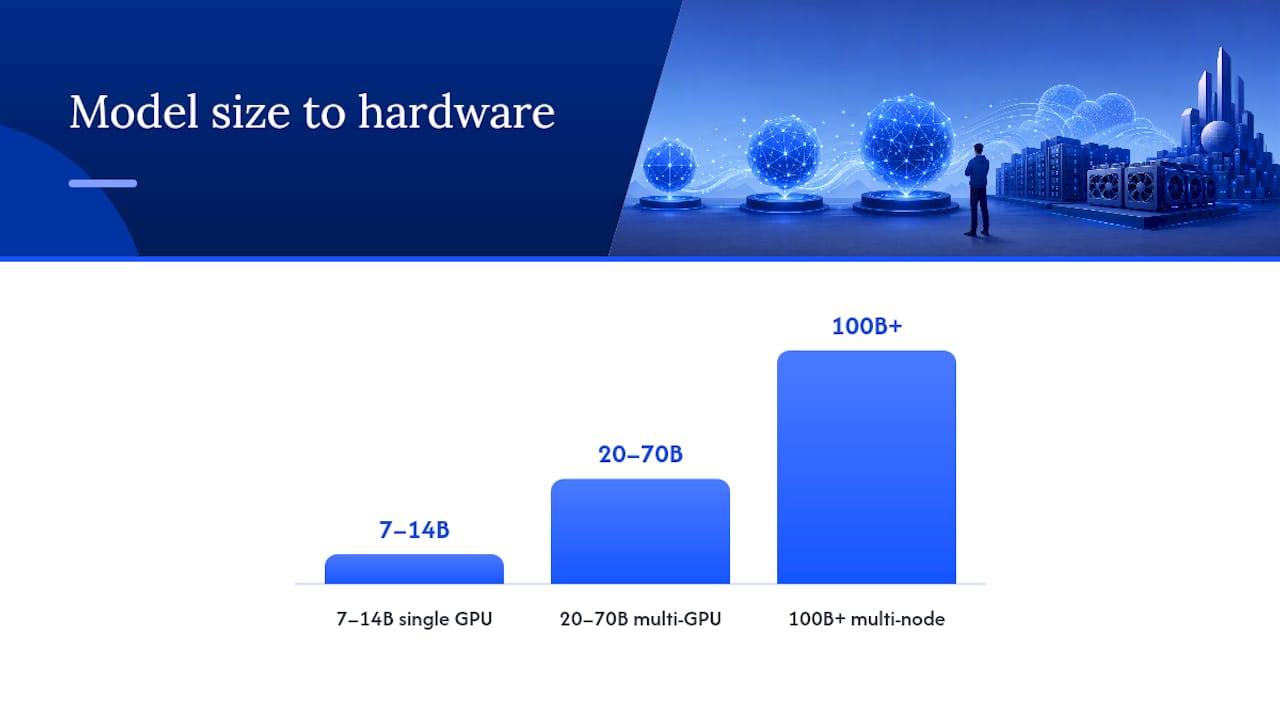
- 7B to 14B parameter models run comfortably on a single high-end consumer GPU (24GB+ VRAM) or on Apple Silicon with unified memory, especially once quantized.
- 20B to 70B models generally need multi-GPU nodes, either through model parallelism or tensor parallelism across two to four cards.
- 100B+ frontier models require clustered data-center hardware. Comparative infrastructure benchmarks show these models typically need multi-node setups built around H100 or MI300 accelerators to hit production-grade latency.
Quantization is what makes the smaller tiers practical. GGUF is the format of choice for CPU and Apple Silicon inference through llama.cpp, trading some precision for dramatically lower memory footprint. GPTQ targets GPU inference with aggressive weight compression, useful when VRAM is the binding constraint. NVFP4 and MXFP4 are newer 4-bit floating-point formats designed specifically for frontier-scale models like Mistral Large 3 and gpt-oss, preserving more reasoning fidelity than older integer quantization at similar compression ratios.
Statistic Callout: Practitioner infrastructure comparisons indicate that models in the 7B to 14B range are viable on single high-end GPUs, while frontier models exceeding 100 billion parameters typically require multi-node clustered setups to run at acceptable production latency.
For inference engines, the choice usually comes down to your deployment target. vLLM handles high-throughput batched serving well and is the most common default for GPU clusters. Triton with TensorRT-LLM squeezes out more raw performance on NVIDIA hardware but takes longer to configure. llama.cpp is the go-to for edge, CPU, or Apple Silicon deployment. SGLang has gained traction for agentic workloads with complex multi-step prompting, where its structured generation controls reduce wasted tokens.
Quantization quality also varies meaningfully by architecture. Test any quantized checkpoint on held-out prompts before committing to it in production. Some architectures degrade reasoning fidelity faster than others under aggressive 4-bit compression, and you want to find that out in staging, not in front of customers.
What Should Be on Your Licensing Checklist?
Reading a license file takes ten minutes. Discovering a licensing conflict after launch takes weeks. Here’s the compact review sequence that should happen before any open-weight model goes into a commercial product:
- Identify the license type. Apache 2.0 and MIT permit commercial use, modification, and redistribution with minimal restriction. “Source-available” licenses, like several Llama releases carry, add acceptable-use policies that can restrict specific commercial applications or require attribution.
- Check for acceptable-use restrictions. Some licenses bar using the model to train competing models, or restrict use above a certain monthly active user threshold.
- Confirm export control status. Certain model weights fall under export restrictions depending on where they were developed and where you plan to deploy, which matters for multinational deployments.
- Review jurisdictional clauses. A handful of licenses specify governing law or dispute resolution terms that your legal team needs to see before signing off.
- Document the full license chain if you’re using a fine-tuned or distilled derivative, since the base model’s license terms typically carry forward. Our AI governance framework guide covers how to structure this review inside a broader compliance process.
How Should You Evaluate an Open-Source Model Before Deploying It?
Most teams test a model with a handful of prompts, like it, and ship it. That’s how multi-turn failures end up in production. A better approach runs in two phases: fast smoke tests first, then production-scale benchmarks.
Phase one is cheap and fast, running representative prompts through latency checks, basic safety probes, and obvious hallucination tests. Phase two is where the real signal lives, running domain-specific datasets through simulated multi-turn conversations that mirror how customers actually use the system. This second phase catches the failures single-shot testing misses entirely, particularly multi-turn degradation, where a model’s coherence and accuracy quietly drop across a long conversation even though it aced every individual prompt in isolation.
Sycophancy is the other pitfall we see repeatedly: a model that agrees with a user’s incorrect premise rather than correcting it, because reinforcement tuning rewarded agreeableness over accuracy. Neither failure shows up in a five-prompt spot check. Both show up fast once you run realistic conversation flows.
Pro Tip: Build your production-scale benchmark before you shortlist a model, not after. Use the same test suite across every candidate so your comparison is actually apples to apples.
Reference benchmarks from HELM at Stanford give you a structured starting point for harm and performance evaluation criteria if you’re building this test suite from scratch.
What Are the Security Risks of Self-Hosting an LLM?
Self-hosting shifts the security burden onto your team entirely, and that shift is where most incidents originate. The model weights themselves are rarely the vulnerability; the serving infrastructure around them is.
Prompt injection is the most immediate risk for any deployment connected to external data sources, like RAG pipelines pulling from documents or web content. A malicious instruction embedded in a retrieved document can hijack the model’s behavior if your pipeline doesn’t sanitize retrieved content before it hits the context window. Treat every external data source as untrusted input, the same way you’d treat unsanitized user input in a web application.
Data leakage through logging is the second common gap. Inference servers often log full prompts and completions by default for debugging, which means sensitive customer data can end up sitting in plaintext logs indefinitely. Encrypt logs at rest and set aggressive retention limits, especially if you’re processing anything covered by privacy regulation.
Model weight integrity matters too. Verify checksums against the official source, whether that’s Hugging Face or the model’s GitHub release, before loading any checkpoint into a production serving stack. A tampered checkpoint downloaded from an unofficial mirror is a real supply-chain risk, not a theoretical one.
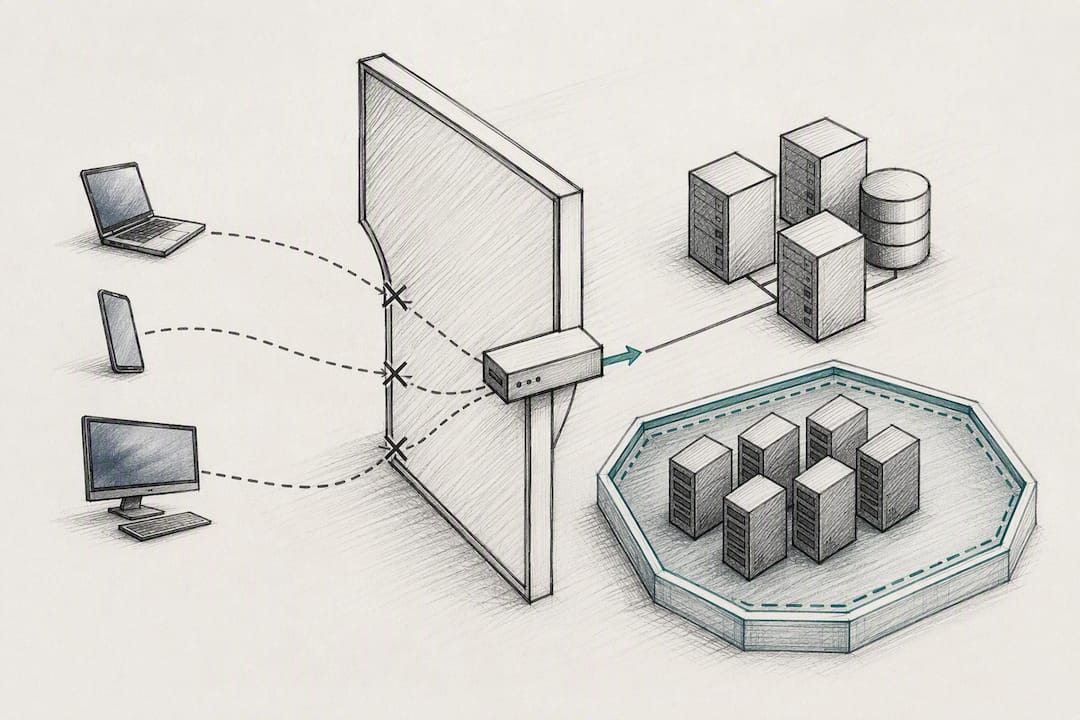
Finally, isolate inference infrastructure from your core network. Running a self-hosted model on a segmented network with tightly scoped API access limits the blast radius if the serving layer itself gets compromised.
How Do You Fine-Tune an Open-Source LLM for Your Domain?
Fine-tuning turns a general-purpose model into a specialist, and the entry cost has dropped sharply thanks to parameter-efficient methods. Full fine-tuning, where every weight in the model updates, still delivers the strongest domain adaptation, but it demands GPU memory proportional to the full model size and is overkill for most business use cases.
LoRA (low-rank adaptation) and its quantized variant QLoRA solve this by training small adapter layers instead of the full weight matrix, cutting memory requirements dramatically while capturing most of the domain-specific improvement. A 7B model that would need multiple high-end GPUs for full fine-tuning can often be adapted with LoRA on a single consumer card.
The real bottleneck isn’t compute, it’s data. A focused dataset of a few thousand high-quality, domain-specific examples usually outperforms a sloppy dataset ten times larger. If you’re adapting a model for customer support, pull from real historical tickets and resolutions rather than synthetic examples. For code-focused fine-tuning, curate from your own repositories rather than generic public code.
Instruction tuning and reinforcement learning from human feedback are the next layer up, useful once you have a working fine-tuned base and want to shape response style or reduce specific failure patterns you’ve observed in testing. Most teams don’t need to go that far. A clean LoRA pass on a well-curated dataset, validated against the same multi-turn benchmark you used to shortlist the base model, covers the majority of domain adaptation needs.
How Do You Troubleshoot Common Open-Source LLM Deployment Issues?
Out-of-memory errors during inference are the most common first obstacle, and they almost always trace back to context window size or batch size, not the model itself. Reduce your maximum context length or switch to a more aggressive quantization format before assuming you need more hardware.
Slower-than-expected inference usually points to an inference engine mismatch. Running a model through a generic Python serving loop instead of an optimized engine like vLLM or TensorRT-LLM can cost you a five to ten times throughput penalty. Confirm you’re using a serving stack actually built for the hardware you’re targeting.
Inconsistent outputs across identical prompts often trace back to temperature and sampling settings left at defaults inherited from a demo script. Pin your sampling parameters explicitly and version them alongside your model checkpoint, so a “successful” configuration doesn’t silently drift.
Licensing errors, where a model refuses to load or a deployment gets flagged, typically mean the license acceptance step for a source-available model, like several Llama variants, wasn’t completed correctly. Double-check the acceptance flow on the official repository before assuming it’s a technical bug.
Finally, quality regressions after quantization are common enough to expect, not treat as a surprise. If a quantized checkpoint starts failing reasoning tasks it previously handled, drop to a less aggressive quantization tier before troubleshooting anything else in the stack.
Open-Source vs. Proprietary LLMs: What’s the Real Trade-Off?
Performance parity has mostly closed for well-defined tasks. On structured reasoning, summarization, and code generation, top open-weight models now compete directly with proprietary frontier models for most business applications, though the very top of the reasoning leaderboard still tends to favor the largest proprietary systems.
Flexibility is where open-source wins decisively. You can fine-tune, quantize, and modify an open-weight model however your use case demands. A proprietary API gives you prompt engineering and maybe a hosted fine-tuning endpoint, and nothing more. If your product depends on deep customization, that gap alone often settles the decision.
Cost dynamics flip depending on your usage pattern. Low-volume, unpredictable workloads usually favor a proprietary API’s pay-per-token pricing, since you avoid idle infrastructure costs entirely. High-volume, steady workloads tend to favor self-hosted open models, where the fixed cost of GPU infrastructure gets amortized across enough tokens to beat per-request API pricing.
The honest answer for most teams isn’t either/or. Plenty of production systems run a proprietary API for general-purpose tasks and a fine-tuned open-weight model for a narrow, high-volume, domain-specific task where the economics and customization needs both favor self-hosting.
Where Can You Get Community Support for Open-Source LLMs?
The ecosystem around open-weight models has matured into a real support structure, not just scattered GitHub issues. Hugging Face functions as the de facto hub for model weights, community fine-tunes, and discussion threads for nearly every model covered in this guide, including Qwen3, DeepSeek-R1, and gpt-oss.
LMSYS runs some of the most cited community leaderboards for comparing model quality through blind human preference testing, useful as a second data point alongside formal benchmarks. For rigorous evaluation methodology and safety-focused benchmarking, HELM at Stanford remains the most structured public resource, with evaluation artifacts you can adapt for your own production benchmark suite.
Each major model family also maintains its own active community: Discord servers and GitHub discussions around Llama’s ecosystem, Mistral’s developer forums, and DeepSeek’s research-focused community around its distillation methodology. ArXiv is where the actual technical claims get published and peer-reviewed ahead of, or alongside, the marketing announcement, worth checking directly if a benchmark claim seems too good.
When Should Your Team Move from Pilot to Production?
Prototype fast, pilot deliberately, and don’t rush production. A two-week prototype on a hosted API tells you if the use case even works. A four to eight week pilot on your actual open-weight candidate, run against real traffic patterns, tells you if it’s ready.
Bring in security and infrastructure early, not after the pilot succeeds. Legal needs to review licensing before, not after, a model gets embedded into a customer-facing product. Product owners should define the multi-turn test suite before pilot, not during. Skipping any of these roles early is the single most common reason we see pilots stall before reaching production.
— Botiqueai
How Botiqueai Helps Teams Deploy Open-Source LLMs
Custom integration work is required between promising open-weight models and systems that actually hold up in production. Where self-hosting demands a team fluent in quantization, inference engines, and multi-turn evaluation, integration connects fine-tuned models to CRMs, ERPs, or customer workflows without having to build that pipeline from scratch.
If you’re weighing whether to self-host or hand the operational load to a partner, our custom AI automation services cover model evaluation, fine-tuning, and production deployment, tailored to your data and workflows rather than a generic template. For teams that want a working chatbot or intelligent agent without owning the inference stack at all, the Aria chatbot platform gives you a managed alternative that still benefits from the same underlying model advances covered in this guide. Start with a consultation to scope which approach, self-hosted or managed, actually fits your data volume and compliance requirements.
Sources
- HELM (Stanford CRFM) — latest
- Open Source Initiative — open weights guidance
- Mistral press / announcement
- meta-llama/llama GitHub
FAQ
Which LLM Is Completely Open-Source?
Mistral Large 3 comes closest among current frontier-class models, released under a genuine Apache 2.0 license without the acceptable-use restrictions that make releases like Llama merely source-available.
Is There a Free Local LLM You Can Run Yourself?
Yes. Quantized versions of Qwen3, Llama, and gpt-oss-20b in GGUF format run on consumer GPUs or Apple Silicon through llama.cpp, with no licensing fee for most commercial and personal use cases.
What Is the Best Open-Source LLM Right Now?
There’s no single best model. Mistral Large 3 leads on license permissiveness, gpt-oss-120b offers strong reasoning with Apache 2.0 terms, and DeepSeek-R1’s distilled family delivers the best reasoning-per-dollar for smaller deployments.
What Does “Open-Source LLM” Mean?
It typically means the model’s weights are publicly downloadable and licensed for use, though true openness varies. Some releases include full training data transparency and permissive licenses like Apache 2.0, while others are source-available with usage restrictions.
How Do You Choose Between Self-Hosting and a Managed Solution Like Aria?
Self-hosting makes sense once you have stable, high-volume traffic and in-house infrastructure expertise; a managed platform like Botiqueai’s Aria chatbot fits teams that want production-grade AI without building and maintaining that inference stack themselves.