
Ship Production Semantic Search in Days: Architecture for Tech Leaders
Ship Production Semantic Search in Days: Architecture for Tech Leaders
A semantic search engine finds content by meaning, not exact keywords, matching queries and documents through embeddings and vector similarity. It powers enterprise knowledge retrieval, e-commerce search, and the retrieval half of RAG chatbots. Reach for it whenever users phrase questions differently than your content does, because it recovers relevant results that keyword search would simply miss.
TL;DR:
- Hybrid search combining semantic and keyword methods is essential to handle exact identifiers like SKU or legal citations effectively.
- In production, data preparation, especially document chunking and metadata attachment, is the most common bottleneck for semantic search success.
- Using appropriate index types, such as HNSW or IVF, depends on query patterns and data update frequency, affecting speed and cost.
- Monitoring relevance metrics like recall@k and nDCG is critical, along with latency, throughput, and drift detection, to maintain system performance.
- Semantic search works best for enterprise knowledge retrieval and e-commerce, but faces limitations from biases, hallucinations, and the need for careful content structuring.
Table of Contents
- How Does a Semantic Search Engine Actually Work?
- Core Architecture and Deployment Options
- How Do You Actually Build and Launch Semantic Search?
- What Metrics Actually Tell You the System Is Working?
- Where Semantic Search Actually Pays Off
- Making Your Content Discoverable by Semantic Systems
- What Are the Real Limitations of Semantic Search?
- How Botiqueai Approaches Semantic Search and RAG Projects
- What Most Teams Get Wrong About Semantic Search
- Get Semantic Search Built Right the First Time
- Sources
How Does a Semantic Search Engine Actually Work?
A semantic search engine works by converting text into numbers that capture meaning, then finding the numbers that sit closest together in that mathematical space. That conversion is called an embedding. A model, often a transformer trained specifically for retrieval, reads a sentence or paragraph and outputs a vector, typically somewhere between 384 and 1,536 dimensions, where each dimension encodes some abstract feature of meaning. Two sentences with different words but the same intent, like “cancel my subscription” and “how do I stop being billed,” land near each other in that space even though they share almost no vocabulary.
Once you have vectors, you need a way to store and search them fast. That’s the job of a vector database or vector index. Comparing a query vector against millions of document vectors one by one would be too slow for production traffic, so systems use Approximate Nearest Neighbor (ANN) algorithms instead of exhaustive search. The two you’ll run into most often:
- HNSW (Hierarchical Navigable Small World): builds a layered graph structure that lets queries skip toward likely matches quickly, generally favored when memory isn’t the tightest constraint.
- IVF (Inverted File Index): clusters vectors into buckets first, then searches only the most promising buckets, often more memory efficient at very large scale.
Similarity itself gets measured with cosine similarity or dot product, both of which score how aligned two vectors are in direction rather than raw distance. IBM describes this general pattern as the core mechanism separating AI-driven search engines from keyword systems: embeddings and ANN algorithms replace token matching with context-aware retrieval.
Here’s the part that trips up a lot of teams building their first system: semantic search alone often underperforms on exact identifiers. A customer searching for a specific SKU, an order number, or a legal citation wants an exact match, not a “conceptually similar” one. Elastic’s own documentation on semantic search frames vector-based retrieval using kNN matching as the engine for meaning, while acknowledging that production systems pair it with lexical scoring to keep exact-match behavior intact. That combination, semantic plus keyword, is what most people mean when they say “hybrid search,” and it’s rapidly becoming the default rather than the exception. Retrieval-Augmented Generation, or RAG, depends on exactly this kind of retrieval quality, since the passages a vector search pulls back are what an LLM uses to ground its answer.
Core Architecture and Deployment Options
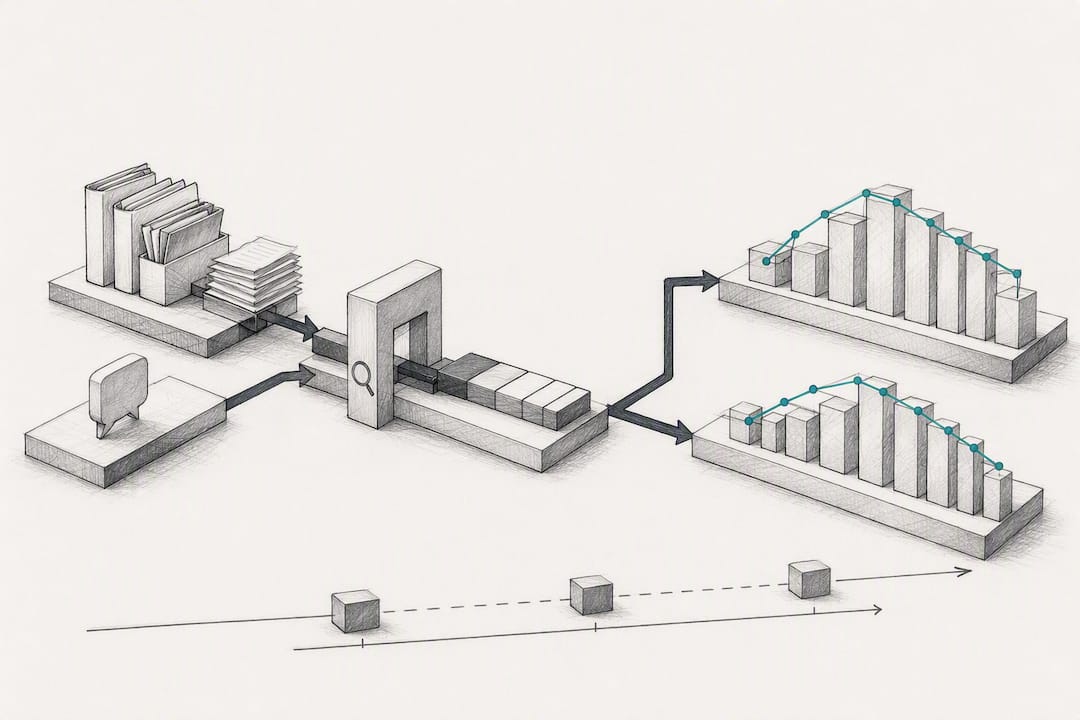
Every semantic search system, regardless of scale, follows roughly the same pipeline: an encoder turns text into vectors, a vector database stores them, an ANN index makes retrieval fast, and a ranking layer decides what actually gets shown. The encoder is usually the piece teams spend the least time thinking about and the piece that determines the ceiling on relevance quality more than anything else downstream.
Where you host each layer changes the cost and risk profile substantially:
- Cloud-managed vector databases hand you indexing, scaling, and backups, trading control for speed of setup.
- Self-hosted vector databases on your own infrastructure give you full data residency control, at the cost of running the operational load yourself.
- Hosted LLM APIs for embedding generation are fast to integrate but send your data to a third party for encoding.
- Local or open-weight embedding models keep data in-house entirely, useful when compliance rules forbid sending text externally.
The trade-offs rarely resolve cleanly. A cloud-managed stack gets you to production in days, but you’re paying per query and accepting someone else’s uptime guarantees. A self-hosted stack costs more engineering time upfront and needs someone watching index health, but it can be cheaper at high volume and keeps sensitive data inside your perimeter. Latency also shifts: a well-tuned self-hosted HNSW index on local infrastructure can return results in single-digit milliseconds, while a managed service adds network round trips that push you into the tens of milliseconds, usually still fine for most applications, but worth measuring before you commit.
Pro Tip: Match your index type to your query pattern before you match it to your budget. If your data changes constantly, an index that rebuilds slowly will fight you every day; if it’s mostly static reference material, you can optimize hard for read speed and rebuild rarely.
How Do You Actually Build and Launch Semantic Search?
Most semantic search projects fail not at the model selection stage but at data preparation, because a poorly chunked document set makes even the best embedding model return garbage. Here’s the sequence that tends to hold up in production:
- Prepare your data. Break documents into chunks small enough to be semantically coherent but large enough to carry context, typically 200 to 500 tokens. Attach metadata (source, date, author, category) to every chunk, deduplicate near-identical passages, and identify canonical versions where the same information exists in multiple places.
- Choose your embedding approach. Off-the-shelf models work for general content and get you moving fast. Fine-tuning on your own labeled query-document pairs helps when your domain uses specialized vocabulary, legal or medical text being the classic case.
- Index the vectors. Decide on index parameters (graph connectivity for HNSW, cluster count for IVF), plan for sharding if your corpus is large, and set a refresh strategy so new or updated content doesn’t sit stale for weeks.
- Build the query-time flow. Encode the incoming query with the same model used for indexing, retrieve a candidate set (often the top 50 to 100 nearest vectors), then rerank that set using a combination of lexical signals and a second, more precise semantic model. For RAG applications, the reranked top passages get inserted directly into the LLM prompt as grounding context.
- Test before you ship, and keep testing after. Build a relevance evaluation set with real queries and human-labeled correct answers. Run A/B tests comparing your new semantic layer against the existing keyword search, and keep a human-in-the-loop labeling process running so the evaluation set stays current as usage patterns shift.
A detail that catches teams off guard: Shopify explicitly runs semantic search and predictive/autocomplete search as separate systems that both need independent configuration. Don’t assume turning on semantic retrieval automatically fixes autocomplete behavior. It won’t. They’re parallel systems that need to be reconciled in the interface, not one system that replaces the other.
What Metrics Actually Tell You the System Is Working?
Relevance metrics come first, because a fast system returning wrong answers is worse than a slow one returning right answers. Track recall@k (did the correct passage appear in the top k results), MRR (Mean Reciprocal Rank, rewarding correct answers that appear near the top), nDCG (Normalized Discounted Cumulative Gain, which weighs ranking order), and plain precision on your labeled evaluation set. Stanford’s Introduction to Information Retrieval remains the reference text most engineering teams cite for how these metrics are defined and why each one catches a different failure mode.
Performance metrics matter just as much once you’re in production:
- p95 latency, not average latency, since a handful of slow queries wreck user trust even when the mean looks fine.
- Throughput under peak concurrent load, not just single-query benchmarks.
- Cold start behavior, especially for serverless deployments where the first query after idle time can be dramatically slower.
Cost tends to come from three places: embedding compute (charged per token on hosted APIs, or amortized as compute time if self-hosted), vector storage (which scales with both corpus size and embedding dimensionality), and index replicas needed for redundancy and read throughput. Monitoring should include drift detection, since embeddings trained on last year’s language patterns can quietly lose accuracy as your content or user queries evolve, alongside regular regression tests any time you swap or update the underlying model.
Where Semantic Search Actually Pays Off
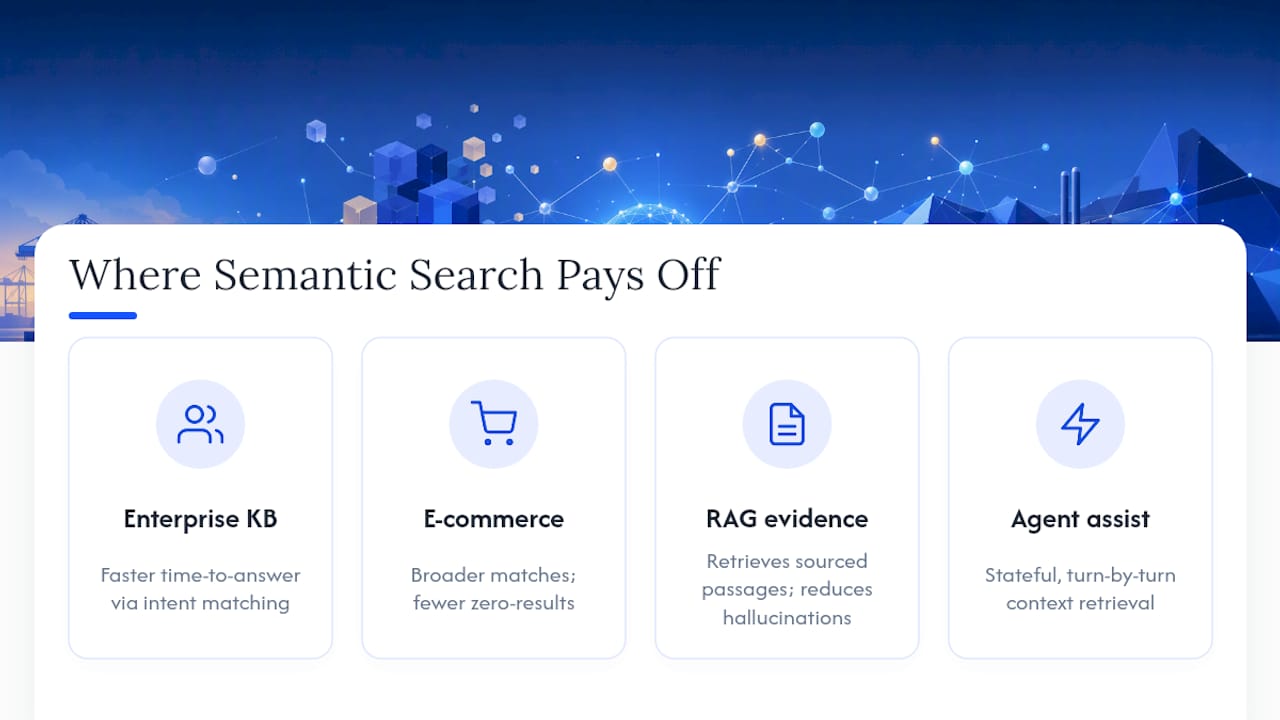
Enterprise knowledge retrieval is the clearest win. Support and internal help desk teams that switch from keyword search to semantic retrieval typically see faster time-to-answer, because employees searching “how do I expense a client dinner” finally surface a policy document titled “meal reimbursement guidelines” without needing to guess the exact phrase.
E-commerce search benefits differently. Shoppers type conversational queries like “waterproof jacket for hiking in the rain,” and Shopify’s Search & Discovery documentation notes that semantic understanding expands these queries against product attributes and synonyms, catching matches that literal keyword search would drop entirely. That directly affects conversion, since a shopper who gets zero results abandons faster than one who gets a slightly imperfect but relevant list.
RAG-based systems use semantic search as their evidence layer. Instead of an LLM answering from memory alone, the retrieval step pulls specific, sourced passages and feeds them into the prompt, which cuts down on hallucinated answers when the retrieval quality is high. Botiqueai’s Acolad chatbot deployment illustrates this pattern in practice, where grounding a conversational agent in retrieved passages kept answers tied to actual source material rather than generated guesses.
Chatbots and agent-assist tools layer stateful retrieval on top of this same mechanism, pulling relevant context into a limited context window turn by turn, so a support agent or customer-facing bot doesn’t need the entire knowledge base loaded at once.
Making Your Content Discoverable by Semantic Systems
Content built for semantic retrieval looks different from content built for keyword SEO. Instead of optimizing a page around one exact phrase, you organize it around a concept cluster, related terms, synonyms, and adjacent questions all pointing to the same underlying topic. Coursera’s overview of semantic search frames this as the shift from isolated keyword targeting toward content that reflects context, intent, and relationships between ideas.
A few concrete adjustments make a measurable difference:
- Structure pages around canonical passages, self-contained chunks of 200 to 400 words that answer one specific question completely.
- Add structured metadata and entity markup (schema.org, explicit product attributes, author and date fields) so retrieval systems can filter and rank with more precision than text alone allows.
- Write headings that mirror actual phrasing users search with, including question forms, rather than terse keyword fragments.
- Keep snippet boundaries clean, meaning each paragraph should make sense if it’s pulled out and shown alone, since that’s exactly what happens when a RAG system cites it.
Pro Tip: If you want your content cited by an AI answer engine or surfaced in a RAG pipeline, write the way you’d want a snippet to read in isolation. A paragraph that only makes sense with three paragraphs of setup rarely gets picked up cleanly.
Botiqueai’s own guide to GEO and LLM optimization covers this content restructuring in more depth for teams trying to get cited inside AI-generated answers specifically.
What Are the Real Limitations of Semantic Search?
Semantic search inherits the biases of whatever data trained its embedding model, and those biases can quietly skew which results rank higher for certain demographic or cultural phrasing. Regular auditing against a diverse query set catches this before it becomes a user complaint.
RAG systems carry their own risk: hallucination doesn’t disappear just because retrieval is involved, it just moves. If the retrieved passages are irrelevant or stale, the LLM can still generate a confident, wrong answer. Mitigations that actually work include showing users the source passages alongside the answer and setting conservative similarity thresholds that reject low-confidence retrievals rather than forcing an answer.
- Privacy and data residency require encryption at rest and in transit, plus access controls scoped to who can query which indexes.
- Embedding models need periodic refreshes as language and content evolve, and that refresh cycle carries real ongoing engineering cost.
- Keyword search is still the right call for exact-match lookups: order numbers, legal citations, part numbers, anything where “close enough” isn’t good enough.
How Botiqueai Approaches Semantic Search and RAG Projects
Building a production-grade semantic search system means making dozens of small architecture decisions correctly, chunk size, index type, reranking strategy, and getting most of them wrong is easy on a first attempt. Botiqueai designs and deploys these systems for businesses that need retrieval and conversational AI working together rather than bolted on separately, drawing on deployments like the Acolad case study and products like the Aria chatbot.
A few decision points worth weighing before you commit resources internally:
- Build in-house if you have dedicated ML engineering capacity and the query volume to justify ongoing tuning.
- Bring in outside help when you need a working system in weeks rather than quarters, or when nobody on your team has shipped a vector search pipeline before.
- Either path benefits from starting with a narrow, well-scoped use case rather than trying to index everything at once.
What Most Teams Get Wrong About Semantic Search
The conventional pitch treats semantic search as a drop-in upgrade: swap keyword matching for embeddings, and relevance improves automatically. That’s not what the evidence here supports. The teams that see real gains are the ones who treat retrieval quality as an ongoing measurement problem, not a one-time integration. Recall@k and nDCG numbers drift as content and query patterns change, and skipping that monitoring is the most common reason a promising pilot quietly degrades six months after launch.
The other place conventional advice falls short: treating semantic and lexical search as competitors rather than partners. Every credible production system pairs them. If you’re evaluating vendors or building in-house and someone tells you pure semantic search will replace keyword matching entirely, that’s a signal to ask harder questions.
Prioritize data preparation before model selection. Chunk size and metadata quality shape retrieval accuracy more than which embedding model you pick, and no amount of reranking sophistication fixes badly prepared source content.
— Botiqueai
Get Semantic Search Built Right the First Time
Some firms build the retrieval infrastructure and chatbot layer together instead of treating them as separate projects, so the RAG grounding, the vector database, and the conversational interface are designed to work as one system rather than three vendors stitched together after the fact. That matters most for the reader here: the difference between a semantic search pilot that stalls and one that ships is usually the architecture decisions covered above, and getting those right without a dedicated ML team is the exact gap Botiqueai fills.
Whether you need a customer-facing chatbot grounded in your own documentation, an internal knowledge retrieval system for support teams, or custom automation connecting search to your existing CRM and workflow tools, projects should be scoped around actual query volume and data constraints rather than using a generic template. The Aria chatbot shows what a deployed conversational agent looks like in practice, and the custom AI automation service covers bespoke pipelines built around your specific data. You can request a discovery call to scope what a semantic search or RAG deployment would actually take for your data and your team.
Sources
- Qu’est-ce que la recherche sémantique ? | Elastic
- Modifying search with Shopify Search & Discovery
- What is an AI search engine? | IBM
- What is semantic search? | Coursera