
Post-Implementation AI Audit Process: 2026 Best Practices
Post-Implementation AI Audit Process: 2026 Best Practices
A post-implementation AI audit is a structured evaluation conducted after an AI system goes live to verify it delivers the business outcomes it was built for, not just to check a compliance box. Once your model is in production, the real questions begin: Is it still accurate? Has it drifted? Are the humans reviewing its outputs actually doing so? The audit answers all of these.
Core dimensions every post-implementation AI audit must cover:
- Performance and accuracy against the original objectives
- Bias and fairness in live, production conditions
- Data quality and distribution shifts since deployment
- Security controls protecting model inputs and outputs
- Human oversight mechanisms and whether they function as documented
- Documentation currency, including model cards and risk assessments
Regulations like NYC Local Law 144 and the EU AI Act have made these checks legally consequential for U.S. businesses operating across borders. But the audit’s real value is internal: it tells you whether your AI investment is working.
Table of Contents
- Why governance and independence define a credible AI audit
- What a post-implementation AI audit actually tries to accomplish
- How to run a thorough post-implementation AI audit, step by step
- Common pitfalls that undermine AI audit effectiveness
- Key Takeaways
Why governance and independence define a credible AI audit
The IIA’s updated AI auditing framework is direct on this point: auditors must not report to the AI development team, and external auditors cannot hold financial ties to the organization beyond the audit engagement itself. Without that separation, findings are suspect before anyone reads them.
Structural independence matters because the people who built the system have every incentive to interpret ambiguous results favorably. An auditor embedded in the same reporting line faces the same pressure.
The 2026 AI Auditing Framework recommends building a cross-functional AI Leadership Team that includes risk management, internal audit, compliance, and legal. Early involvement of this team in AI projects improves how risks get framed before they become audit findings.
Governance principles that hold the structure together:
- Transparency: audit scope, methodology, and criteria documented before work begins
- Traceability: every finding linked to evidence, not inference
- Accountability: remediation owners named, not just departments
- Conflict avoidance: clear reporting lines that bypass the development chain
Pro Tip: Set up your AI governance board before the first audit, not after. A board that only convenes to review findings has no authority to prevent the problems those findings describe.
What a post-implementation AI audit actually tries to accomplish
The primary goal is benefit realization: confirming the AI system achieves what the business case promised, not simply generating a compliance report. A system that passes every documentation check but underperforms on accuracy or fairness has failed the audit’s real purpose.
Key evaluation areas:
- Ongoing performance: Does accuracy, precision, or recall still meet the thresholds set at deployment?
- Bias assessment in production: Fairness metrics measured at training time often shift once real-world data flows through the model. The audit tests for that shift.
- Data quality validation: Input distributions change. The audit checks whether the data feeding the model today still matches what it was trained on.
- Human oversight effectiveness: Are reviewers actually overriding bad outputs, or rubber-stamping them? Override rates tell you.
- Incident response readiness: Has the team documented and resolved every anomaly the system flagged?
- Documentation completeness: Model cards, risk assessments, and change logs must reflect the system as it currently operates, not as it was designed.
For businesses exploring real-world AI outcomes, the gap between projected and actual performance is where most post-deployment surprises live.
How to run a thorough post-implementation AI audit, step by step
A credible AI compliance assessment follows a defined sequence. Skipping steps, particularly the operational ones, is where most audits fall short.
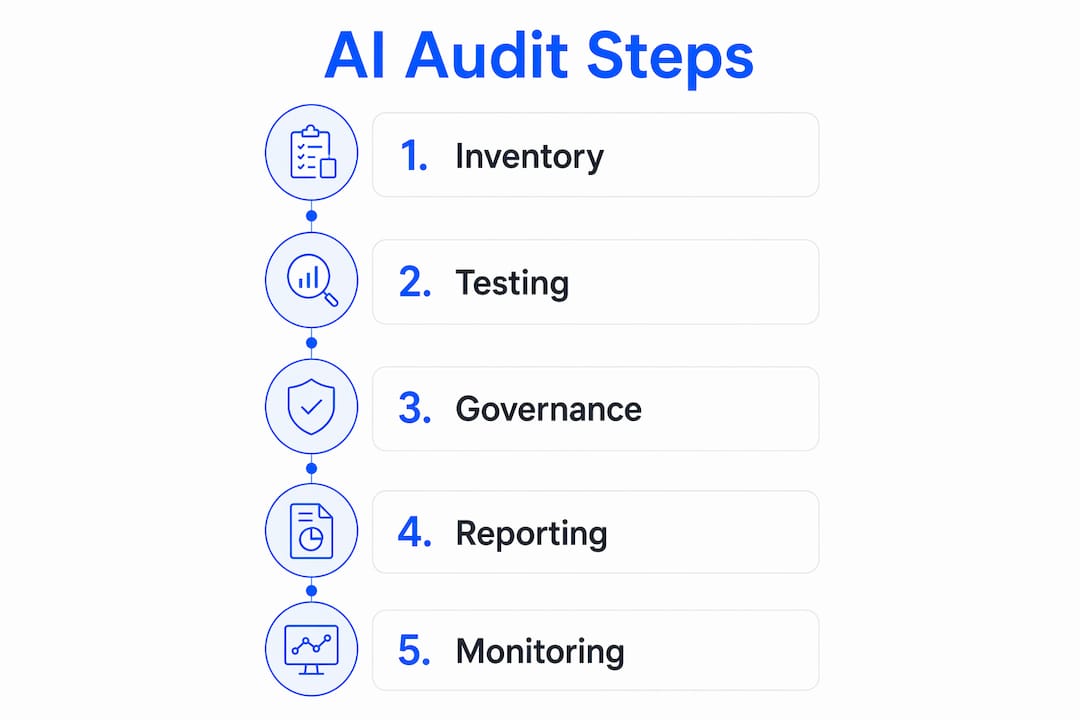
- Build your AI system inventory. Catalog every model in production: name, version, owner, use case, and data sources. You cannot audit what you have not mapped.
- Classify systems by risk tier. Use a governance framework like the NIST AI RMF or ISO 42001 to prioritize audit depth by risk level. A hiring algorithm warrants more scrutiny than an internal scheduling tool.
- Review the documentation package. Pull model cards, training data documentation, risk assessments, and change logs. Flag anything outdated or missing before the technical work begins.
- Run technical assessments. This covers performance testing against current benchmarks, bias detection across demographic slices, explainability checks, and a security evaluation of model inputs and outputs.
- Conduct operational assessments. Interview the humans in the loop. Review monitoring dashboards and decision logs. Check override rates. The AI Governance Institute outlines this step specifically: verify that human oversight mechanisms function as documented, not just as designed.
- Assess the full audit scope. A comprehensive AI system evaluation covers performance, bias drift, data distribution shifts, security controls, human oversight, and documentation currency together, not as isolated checks.
- Document findings with severity ratings. Each finding gets a severity level, supporting evidence, an assigned remediation owner, and a follow-up deadline. Vague findings with no owner get ignored.
- Deliver the audit report. Findings go to the governance board, not just the development team. The report should include an executive summary, a detailed findings section, and a remediation roadmap.
- Schedule re-audits by risk tier. High-risk systems warrant quarterly reviews; lower-risk systems can run annually. Build this cadence into your governance calendar before the first audit closes.
Pro Tip: Treat your AI inventory as a living document. Every new model deployment should trigger an update, so your next audit starts with accurate scope rather than a discovery exercise.
Common pitfalls that undermine AI audit effectiveness

The most common mistake is conflating a standard post-implementation review with an AI audit. A traditional project review asks whether the system was delivered on time and on budget. An AI audit asks whether the system’s probabilistic behavior, including drift, fairness shifts, and bias, is still acceptable in production. Those are different questions requiring different methods.
Severity inflation is the second major failure mode. When every finding is rated high, stakeholders stop treating any of them as urgent. Reserve high severity for material risks: unmitigated bias, unauthorized model deployment, or a security gap with direct exposure. Minor documentation gaps are not the same category.
Other pitfalls worth avoiding:
- Documentation-only audits: reviewing paperwork without testing the live system tells you almost nothing about how it actually behaves
- No remediation ownership: findings assigned to a team rather than a named individual rarely get resolved
- Reactive evidence gathering: scrambling to pull logs and bias reports during an audit signals the system lacks ongoing controls
The fix for that last one is straightforward. Proactive audit readiness means logs, override rates, and bias assessments are continuously available, not assembled on request. That shift turns the audit from a periodic event into a property of the system itself.
Businesses preparing for their first AI system evaluation can start with Botiqueai’s practical AI integration guide to understand how governance considerations fit into the deployment process from the start.
If your organization is deploying custom AI or automation solutions and needs them to hold up under scrutiny, Botiqueai builds systems with auditability in mind from day one. Whether that means a customer-facing AI assistant or custom workflow automations, the architecture supports the oversight your audit will require.
Key Takeaways
A credible post-implementation AI audit requires independent governance, operational testing, and continuous monitoring, not just documentation review.
| Point | Details |
|---|---|
| Independence is non-optional | Auditors must not report to the AI development team, per IIA guidance. |
| Benefit realization is the primary goal | The audit verifies whether the AI system achieves its intended business outcomes. |
| Operational checks matter most | Override rates, decision logs, and human oversight interviews reveal what documentation cannot. |
| Severity ratings must be calibrated | Reserve high severity for material risks to keep stakeholder attention focused. |
| Continuous readiness beats periodic scrambles | Logs and bias reports should be available at all times, not assembled only when an audit begins. |