
Predictive Lead Scoring: A 2026 Guide for Sales Teams
Predictive Lead Scoring: A 2026 Guide for Sales Teams
Predictive lead scoring is defined as an AI-driven method that calculates the probability a lead will convert into a customer, using historical outcome data and machine learning instead of manually assigned rules. Sales and marketing teams that adopt this approach report 38% higher lead-to-opportunity conversion and 28% shorter sales cycles. The industry term for this practice is “predictive lead scoring,” though you may also encounter it labeled as AI lead scoring or machine learning lead scoring. Understanding what is predictive lead scoring, and how it differs from older methods, is the first step toward building a more efficient pipeline.
What is predictive lead scoring and how does it work?
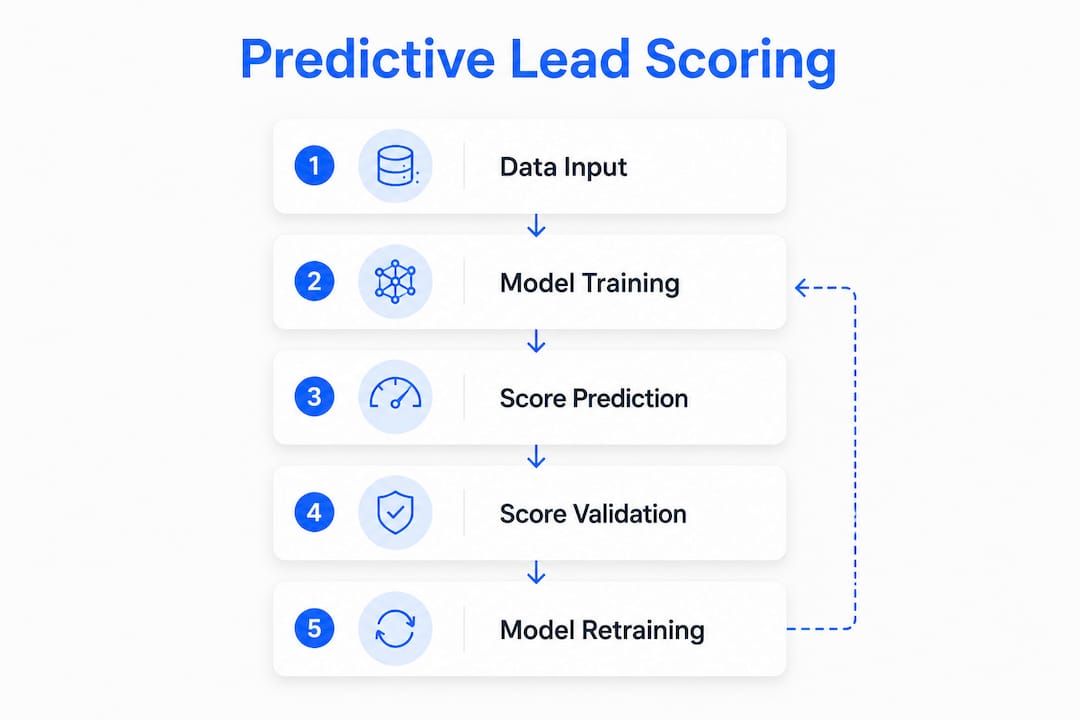
Predictive lead scoring works by training a machine learning model on your historical CRM data, then applying that model to new leads as they enter your pipeline. The model analyzes patterns across leads that converted and leads that did not, then assigns each new lead a probability score, typically on a 0–100 scale. A score of 85 means the model estimates an 85% likelihood that the lead will close. That number is a probability, not a guarantee.
Data inputs that feed the model
The model draws from several data categories. Firmographic data covers company size, industry, and revenue. Behavioral data captures website visits, email opens, content downloads, and demo requests. CRM history includes past deal stages, response times, and previous purchases. Third-party signals add technographic data, intent signals from review sites, and job change alerts. The richer and cleaner these inputs, the more accurate the output score.

Machine learning models used in predictive scoring
Two model types dominate this field: Random Forest and Gradient Boosting. Random Forest builds hundreds of decision trees and averages their outputs, which reduces overfitting. Gradient Boosting builds trees sequentially, with each tree correcting the errors of the previous one. Both approaches produce a probability score and dynamically adapt weights from real historical outcomes, unlike traditional scoring that uses fixed manual points.
Data volume and training requirements
The model needs enough historical data to find statistically valid patterns. Effective model training requires at least 40–200 qualified and disqualified leads across 6–24 months. More specifically, at least 200 closed-won deals are needed to produce operationally meaningful scores. Insufficient data yields scores that are mathematically precise but practically useless.
Pro Tip: Before investing in a predictive scoring platform, audit your CRM for data completeness. If fewer than 30% of your lead records have filled firmographic fields, clean the data first. A model trained on incomplete records will score new leads incorrectly from day one.
Models also require periodic retraining, often quarterly, to stay accurate as buyer behavior and market conditions shift. Without retraining, predictive accuracy degrades significantly over time.
How does predictive scoring compare to traditional lead scoring?
Traditional lead scoring assigns fixed point values to lead attributes. A job title of “VP” earns 10 points. A whitepaper download earns 5 points. The problem is that these weights are based on human assumptions, not actual conversion data. When buyer behavior changes, the model does not update unless a human manually adjusts it.
Predictive scoring replaces those assumptions with data-derived weights. The model learns which combinations of attributes and behaviors actually predict closed deals in your specific market. This distinction matters because sales teams waste 71% of their time on leads that never convert. Predictive intelligence reduces that wasted effort by 60%.
| Dimension | Traditional scoring | Predictive scoring |
|---|---|---|
| Weight source | Manual rules set by humans | Derived from historical closed deals |
| Adaptability | Static until manually updated | Updates automatically with new data |
| Accuracy at scale | Degrades with lead volume | Improves with more data |
| Explainability | Transparent point logic | Probability output, less transparent |
| Best fit | Small teams, simple personas | 500+ leads/month, complex buyer journeys |
“Predictive models dynamically adapt weights from real historical outcomes, whereas traditional scoring uses fixed manual points. This automatic adaptation allows better responsiveness to shifts in buyer behavior and market conditions.”
Organizations that switch to predictive models report 20–40% conversion improvement and 47% qualified pipeline growth within 12–18 months. That pipeline growth is not accidental. It comes from routing the right leads to the right reps at the right time, rather than treating all leads as equally worthy of sales attention.
One common misconception is that predictive scoring is a black box that nobody can explain. Predictive models do produce probability scores without plain English explanations, but that does not make them untrustworthy. It means sales and marketing teams must learn to interpret scores as probabilistic likelihoods, not as definitive verdicts. A score of 72 means “this lead looks like our past winners.” It does not mean “close this deal immediately.”
Best practices for implementing predictive lead scoring
Getting predictive scoring right requires more than buying a platform. The operational decisions you make before and after deployment determine whether the model helps or misleads your team.
- Prioritize data quality over data volume. A CRM with 10,000 messy records performs worse than one with 3,000 clean records. Standardize field formats, remove duplicates, and fill in missing firmographic data before model training begins.
- Set realistic timelines. Model training typically takes 3 months to 2 years depending on your data volume and platform. Plan for a warm-up period before relying on scores for routing decisions.
- Retrain quarterly. Regular retraining on recent closed and lost deals is the single most important maintenance task. Buyer behavior shifts, and a model trained on 2023 data will misread 2026 leads.
- Integrate scores into routing logic. A score sitting in a dashboard does nothing. Connect it to your CRM so high-scoring leads automatically route to senior closers and low-scoring leads enter nurture sequences.
- Do not replace rep judgment. Predictive scoring complements human judgment by automating routing, but experienced reps often catch context the model misses, such as a champion leaving a target account.
Pro Tip: Build a score validation review into your monthly sales meeting. Ask reps to flag leads where the score felt wrong. Those cases are your best source of training data for the next model update.
Predictive scoring is also not suitable for every organization. It works best for teams processing 500+ leads per month with complex buyer journeys. Smaller teams or those with simple, uniform buyer personas often see no measurable benefit because there is not enough variation in the data for the model to find meaningful patterns.
How to apply predictive scores in daily sales and marketing workflows
Knowing the score is only half the job. The other half is building workflows that act on it consistently.
- Segment leads into tiers. Assign high (70–100), medium (40–69), and low (0–39) tiers based on your score distribution. Each tier gets a different follow-up sequence, not just a different priority level.
- Automate routing by tier. High-tier leads go directly to your best closers with a same-day SLA. Medium-tier leads enter a structured nurture track with periodic rep touchpoints. Low-tier leads receive automated email sequences only, freeing reps entirely.
- Align marketing spend with score data. Use score distributions to identify which lead sources produce the highest average scores. Shift paid budget toward those channels and reduce spend on sources that consistently produce low-scoring leads.
- Monitor score-to-outcome correlation monthly. Track whether high-scoring leads actually close at higher rates. If they do not, the model needs retraining or the scoring thresholds need adjustment. This is your primary feedback loop.
- Build RevOps into the process. Marketing, sales, and Revenue Operations must agree on score thresholds, routing rules, and retraining schedules. When these three functions operate in silos, the model becomes a tool that nobody trusts.
The AI-powered lead qualification process that high-performing teams use in 2026 treats predictive scores as a shared language between marketing and sales, not as a marketing-only metric. When both teams see the same score and agree on what it means, handoff friction drops and conversion rates rise. Predictive scoring also pairs well with AI lead qualification automation, where the score triggers automated actions rather than waiting for a human to review each record.
Predictive scoring works best when you treat it as a process, not a product
Working with marketing and sales teams across different maturity levels, the pattern is consistent: organizations that buy predictive scoring software and expect it to work out of the box are disappointed within six months. The ones that succeed treat it as an ongoing process with defined owners, regular reviews, and a feedback loop between reps and the model.
The most common mistake is deploying predictive scoring before the data foundation is ready. A model trained on incomplete CRM records will confidently score leads incorrectly. That erodes trust faster than any technical limitation. The second most common mistake is treating the score as a final answer. A score of 85 does not mean a rep should skip discovery. It means the rep should prioritize that call above the score-40 lead sitting in the same queue.
Predictive scoring also changes how sales leaders should think about pipeline reviews. Instead of asking “how many leads do we have,” the better question becomes “what is the score distribution of our current pipeline?” A pipeline full of low-scoring leads is a revenue problem that shows up weeks before it hits the forecast. That early warning is one of the most underrated benefits of the method.
The future of this field points toward real-time scoring that updates as a lead takes each new action, rather than batch scoring that runs overnight. Teams that build the operational habits now, around interpreting and acting on scores, will be positioned to use those real-time signals effectively when they become standard.
— Botiqueai
Botiqueai’s AI tools for lead scoring and qualification
Botiqueai builds custom AI agents and automation workflows designed for B2B marketing and sales teams that need more than off-the-shelf scoring. Its tools connect directly to CRM platforms, including HubSpot and Pipedrive, to surface lead scoring signals in the systems your team already uses. The Aria AI assistant, available through Botiqueai’s product suite, can qualify inbound leads in real time, capture behavioral signals, and feed enriched data back into your scoring model. For teams building or refining their lead management process, Botiqueai’s custom approach means the solution fits your data structure and sales workflow, not the other way around.
FAQ
What is predictive lead scoring in simple terms?
Predictive lead scoring is a method that uses machine learning to assign each lead a probability score, based on how similar that lead is to past customers who converted. It replaces manual point systems with data-driven weights.
How many leads do you need to start predictive scoring?
Effective predictive scoring requires at least 200 closed-won deals and typically works best for organizations processing 500 or more leads per month. Below that volume, the model lacks enough variation to find reliable patterns.
How often should a predictive scoring model be retrained?
Models should be retrained at least quarterly to account for shifts in buyer behavior and market conditions. Without regular retraining, predictive accuracy degrades and conversion impact drops.
Can predictive scoring replace sales rep judgment?
Predictive scoring automates lead routing and prioritization, but it does not replace rep judgment. Experienced reps catch contextual signals, such as a key contact leaving an account, that no model currently captures.
What is the difference between predictive and traditional lead scoring?
Traditional lead scoring uses fixed, manually assigned point values. Predictive scoring derives weights automatically from historical closed deals and updates as new data arrives, making it more accurate at scale.
Key Takeaways
Predictive lead scoring delivers its strongest results when data quality, model maintenance, and sales workflows are aligned from the start.
| Point | Details |
|---|---|
| Data volume threshold | You need at least 200 closed-won deals before predictive scores become operationally meaningful. |
| Conversion impact | Organizations report 20–40% conversion improvement and 47% pipeline growth within 12–18 months of adoption. |
| Retraining is mandatory | Quarterly retraining on recent closed and lost deals prevents accuracy drift as buyer behavior changes. |
| Scores are probabilities | A score of 85 signals high likelihood, not certainty. Reps must still apply judgment to each lead. |
| Workflow integration wins | Connecting scores to routing logic and nurture tracks is what turns a model into measurable revenue impact. |