
AI Product Recommendation Systems: Your 2026 Implementation Guide
AI Product Recommendation Systems: Your 2026 Implementation Guide
Start a focused pilot using a hybrid recommendation engine on your product and cart pages, with business rules layered in for margins and inventory. That single move tends to deliver the fastest, most measurable lift for most e-commerce teams.
Why that specific combination? Hybrid engines cover both new and returning visitors. Product and cart pages carry the highest purchase intent on your site. Business rules keep the ML from surfacing out-of-stock items or low-margin products. Together, they protect revenue while the model learns.
Readiness checklist — copy this into your project brief:
- Data quality: Do you have clean behavioral event data (clicks, add-to-cart, purchases) tied to product IDs for a sufficient period?
- Key placement: Can your front-end team deploy a widget on product detail pages and the cart within two weeks?
- Measurement plan: Have you defined a primary metric such as conversion lift or average order value and set up a holdout group before launch?
Pro Tip: If you can only answer “yes” to one of those three, start with data quality. A recommendation engine fed dirty or sparse data will underperform any simple rule-based display you already have.
Key Takeaways
AI recommendation systems deliver the most consistent lift when you combine a hybrid algorithm, clean behavioral data, and a business-rules layer, measured from day one with a proper holdout group.
| Point | Details |
|---|---|
| Start with a focused pilot | Deploy on product and cart pages first; these placements carry the highest purchase intent. |
| Hybrid models outperform single-algorithm approaches | Combining collaborative and content-based filtering covers new products, new visitors, and dense catalogs. |
| Data quality beats model sophistication | Clean behavioral events and a synced catalog feed matter more than the algorithm choice. |
| Measure with a holdout group from day one | Define your primary metric and minimum detectable effect before launch, not after. |
| Botiqueai delivers pilot-to-production engagements | Data audit, POC integration, A/B framework, and business-rule layer in a 30-day pilot model. |
Next actions:
- Draft a one-page pilot brief using the readiness checklist at the top of this article
- Define your primary metric (conversion lift or AOV) and set up a holdout group
- Contact Botiqueai to scope a custom or hybrid recommendation engagement for your store
Pro Tip: Run your pilot for at least two full business cycles before reading results. A single week of data, especially around a promotion or seasonal event, will give you a misleading signal.
Table of Contents
- What is an AI recommendation engine and how do the core algorithms work?
- What business impact should you expect, and which metrics matter?
- What data do you need, and where should recommendations appear?
- How do you choose between SaaS plugins, packaged integrations, and a custom build?
- How do you roll out from pilot to production?
- What privacy and compliance steps do U.S. retailers need to take?
- How does Botiqueai implement recommendation systems?
- What most teams get wrong about AI recommendations
- Botiqueai builds recommendation systems that are ready to measure from day one
- Sources
What is an AI recommendation engine and how do the core algorithms work?
An AI product recommendation engine is software that analyzes behavioral and product signals to rank and surface items a specific visitor is most likely to buy, right now. According to Shopify’s guide on AI recommendation systems, these engines pull together demographic data, past behavior (clicks, searches, purchases), and item attributes to convert browsing patterns into revenue-driving product discovery.
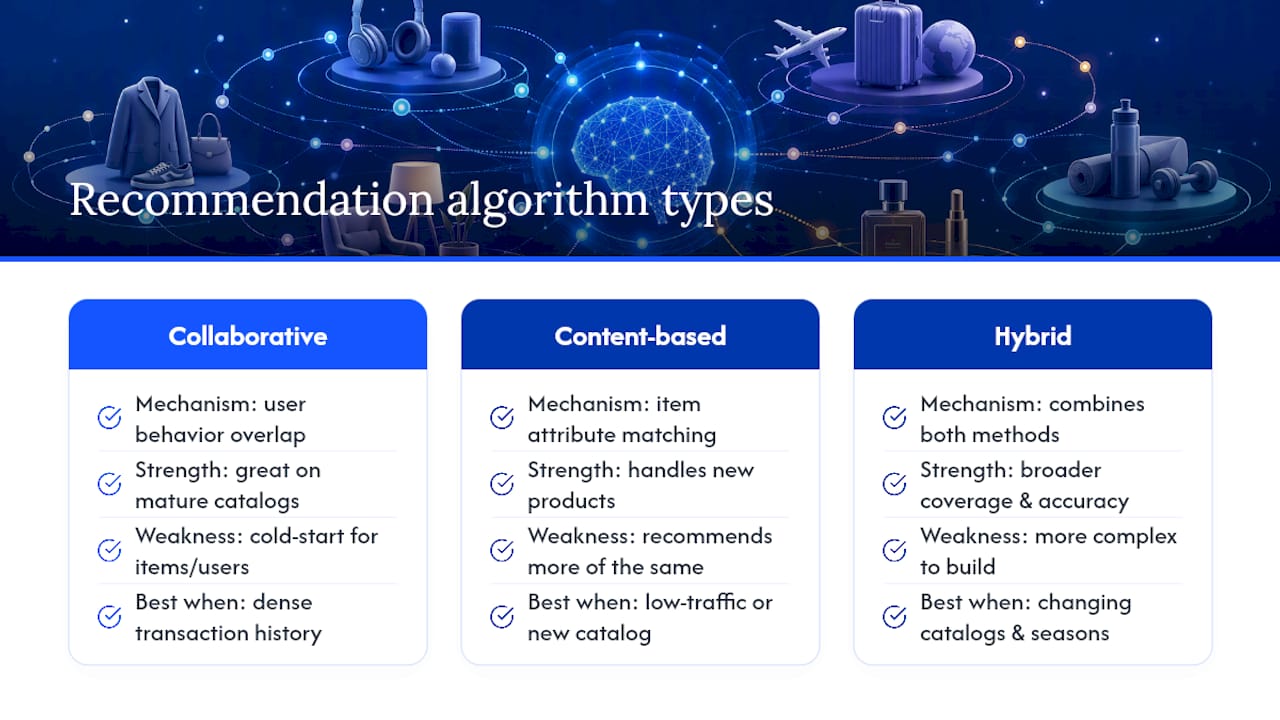
Three algorithm families power most production systems today.
Collaborative filtering looks at what users with similar behavior bought or clicked, then recommends items those users engaged with. It works well on mature stores with dense transaction histories. The weakness: it struggles with new products and new visitors because there is no behavioral overlap to draw from yet.
Content-based filtering matches item attributes (category, brand, material, price band) to the attributes of products a visitor has already viewed. It handles new products well and works on low-traffic stores. The trade-off is that it tends to recommend more of the same, limiting discovery.
Hybrid models combine both approaches, and they dominate production deployments for good reason. Adobe Commerce’s product recommendations documentation confirms that hybrid models deliver broader coverage and improved accuracy across catalog sizes and traffic levels.
Hybrid models are not just a technical compromise. They are the practical answer to a real business problem: your catalog keeps changing, your traffic mix shifts seasonally, and no single algorithm handles all of it cleanly. The stores that see the most consistent lift are the ones that treat the algorithm as one layer and human merchandising rules as another.
Pro Tip: Layer explicit business rules on top of your ML model. Suppress out-of-stock items, cap low-margin products, and pin new arrivals you want to push. Google Cloud’s Recommendations AI documentation confirms this hybrid of automation plus manual curation is now standard practice in production systems.
What business impact should you expect, and which metrics matter?
A well-implemented AI recommendation system typically lifts average order value, repeat purchase rate, and product discovery for items that would otherwise get buried in a large catalog. Shopify’s research ties these gains directly to clean product data and appropriate placement choices.
Statistic callout: Vendor case studies from Dynamic Yield document sizable revenue-per-user and conversion uplifts when recommendations are tuned and tested with proper A/B frameworks. Treat these as directional benchmarks rather than guaranteed outcomes — your results depend on traffic volume, catalog depth, and how well your data is structured.
The metrics worth tracking fall into two tiers.
Primary metrics (track from day one of your pilot):
- Click-through rate on recommendation widgets
- Add-to-cart lift from recommended items
- Conversion rate lift in the treatment group vs. holdout
- Average order value
Secondary metrics (evaluate at 60–90 days):
- Repeat purchase rate among users who clicked recommendations
- Incremental revenue attributed to the recommendation engine
- ROI against your platform or development cost
Which metric to prioritize depends on your goal:
- Revenue growth: lead with conversion lift and AOV
- Product discovery: track CTR and the share of catalog generating clicks
- Retention: watch repeat purchase rate and session depth among returning visitors
For a deeper look at how AI drives e-commerce sales across these metrics, Botiqueai’s own analysis covers the automation levers that move each one.
What data do you need, and where should recommendations appear?
The short answer: behavioral events are the foundation, item attributes are the multiplier, and contextual signals close the cold-start gap. Get all three in place before you run a pilot.
| Data input type | Why it matters | Implementation notes |
|---|---|---|
| Behavioral events (clicks, views, add-to-cart, purchases) | Core training signal for collaborative filtering | Required; pipe via pixel or server-side event API |
| Item attributes (category, brand, price, material, tags) | Enables content-based matching and cold-start fallback | Required; sync catalog feed daily at minimum |
| Session/contextual signals (device, referrer, geo, time) | Personalizes for anonymous visitors | Nice-to-have; available from most tag managers |
| CRM/loyalty data (purchase history, segment, LTV) | Improves returning-visitor relevance | Nice-to-have; requires CRM integration |
Adobe Commerce’s documentation flags catalog synchronization as a critical operational requirement: stale feeds reduce recommendation quality until the catalog is re-indexed, so daily sync is a floor, not a best practice.
Where to place recommendations for maximum impact:
- Product detail pages: highest-intent placement; “customers also viewed” and “frequently bought together” both perform here
- Cart page: cross-sell and upsell at the moment of commitment; this is where AOV lifts are most measurable
- Homepage: works best for returning visitors with purchase history; less effective for cold traffic
- Email (post-purchase, browse abandonment): extends personalization off-site; requires rendering integration with your ESP
- Search results: surfaces related items when the query returns few results
Google Cloud’s Recommendations AI highlights real-time cart events and session signals as particularly valuable for improving conversion at the cart stage.
Pro Tip: For cold-start, do not wait for behavioral data you do not have. Map product metadata to session-level signals (referrer category, device type, landing page intent) and use popularity or trending fallbacks. A visitor arriving from a “running shoes” paid search ad should see running-adjacent products, not your generic bestsellers list.
How do you choose between SaaS plugins, packaged integrations, and a custom build?
Start with time-to-value. If you need recommendations live within four weeks and your catalog is under 50,000 SKUs, a SaaS plugin or packaged integration is almost always the right first move. If you need deep CRM integration, proprietary merchandising logic, or data residency controls, a custom or agency-built solution earns its higher cost.
Decision checklist:
- Traffic threshold: Collaborative filtering needs transaction density. Under roughly 1,000 monthly orders, content-based or hybrid with strong metadata tends to outperform pure collaborative models.
- Catalog complexity: Large catalogs with frequent SKU turnover need automated feed sync and real-time indexing.
- Merchandising control: Do your buyers need to pin, suppress, or boost specific products? Not every SaaS tool exposes that level of control.
- Data residency: U.S. retailers with CCPA/CPRA obligations should confirm where behavioral data is stored and processed.
- Cost envelope: SaaS plugins typically run on monthly subscription pricing; custom builds carry upfront development cost with lower ongoing fees.
- Time-to-live: A pilot should be measurable within 30 days. If a vendor’s onboarding takes longer, that is a red flag.
Questions to ask vendors during demos:
- How does your system ingest behavioral events — pixel, server-side, or both?
- What is the typical latency for real-time recommendations at our traffic volume?
- Can we apply business rules (suppress, boost, pin) without engineering involvement?
- What A/B testing and holdout group capabilities are built in?
- How do you handle cold-start for new products and new visitors?
- What does your SLA cover for uptime and recommendation freshness?
Red flags to watch for:
- No built-in A/B testing or experimentation framework (you cannot prove impact)
- Black-box model with no explainability or business-rule layer
- Vague answers on data retention, deletion, and opt-out handling
- No documented case studies with measurable outcomes
Dynamic Yield’s platform documentation is a useful benchmark for what a mature vendor’s experimentation and multi-channel capabilities should look like.
How do you roll out from pilot to production?
A four-phase timeline works for most e-commerce teams. The phases are sequential but the total clock from kickoff to a validated, scaling system is typically 10–14 weeks.
- Pilot (weeks 1–4): Deploy one placement (product page or cart). Set up your holdout group. Define your primary metric and minimum detectable effect before you touch the data.
- Validate (weeks 5–8): Run the A/B test to statistical significance. Review CTR, conversion lift, and AOV in the treatment group. Check for catalog sync issues or stale data artifacts.
- Scale (weeks 9–11): Roll out to additional placements (homepage, email, search). Add business-rule overlays for inventory and margin. Expand to returning-visitor segments with CRM data.
- Optimize (week 12 onward): Monitor model drift, recommendation freshness, and latency. Run multi-armed bandit tests on widget placement and copy. Set rollback criteria before you need them.
A/B test checklist:
- Define the holdout group before launch (typically 20–30% of eligible traffic)
- Set the primary metric and minimum detectable effect in advance
- Run for at least two full business cycles before reading results
- Segment results by new vs. returning visitors — they often behave very differently
Monitoring and ops:
- Check model freshness daily; stale models drift toward popularity bias
- Set latency thresholds (most production systems target sub-100ms response)
- Monitor recommendation diversity — if the same 20 products dominate all widgets, your model has a popularity bias problem
- Define rollback criteria: if conversion in the treatment group drops below baseline for three consecutive days, revert
Academic research on recommender systems specifically flags popularity bias and the relevance/diversity trade-off as ongoing operational risks, not just launch-day concerns. Build diversity checks into your monitoring from day one.
What privacy and compliance steps do U.S. retailers need to take?
Treat AI product recommendations as behavioral personalization under U.S. privacy law. That framing triggers CCPA/CPRA obligations for California residents and shapes how you structure consent, data retention, and vendor contracts.
Compliance checklist:
- Consent and opt-out: CCPA/CPRA gives California residents the right to opt out of the “sale” or “sharing” of personal information, which can include behavioral data used for cross-context advertising. Confirm with legal counsel whether your recommendation data flows qualify.
- First-party vs. third-party data: First-party behavioral data (events you collect on your own domain) carries lower risk than third-party data. Minimize third-party signal dependencies.
- Data retention: Log only what the model needs. Set retention windows (90–180 days of behavioral events is typical) and enforce them programmatically.
- Access and deletion flows: Your recommendation vendor must support data deletion requests. Test this before you sign.
- Vendor contracts: Require a Data Processing Addendum (DPA) that covers anonymization, opt-out propagation, and sub-processor disclosure.
Vendor contract checklist:
- DPA covering CCPA/CPRA obligations
- Documented sub-processor list
- SLA for honoring deletion requests (typically 30 days)
- Anonymization standards for model training data
- Audit rights or SOC 2 Type II certification
Pro Tip: Map your recommendation data flows before you sign any vendor contract. A simple diagram showing what data leaves your domain, where it is processed, and how deletion requests propagate will surface compliance gaps faster than any legal review alone.
This is general information, not legal advice. Confirm your specific obligations with a qualified privacy attorney familiar with CCPA/CPRA.
How does Botiqueai implement recommendation systems?
Botiqueai’s approach starts with a data audit and a rapid proof-of-concept, not a six-month build. The goal is a measurable pilot within 30 days, with a hybrid recommendation layer that combines ML-driven personalization with a business-rules overlay your merchandising team can control.
A typical Botiqueai engagement delivers:
- Data audit: Review of behavioral event quality, catalog feed structure, and existing integration points
- POC integration: A working recommendation widget on one high-intent placement, connected to your Shopify or WordPress stack
- A/B testing framework: Holdout group setup, primary metric definition, and a reporting dashboard
- Business-rule layer: Suppression, boosting, and pinning controls for your merchandising team
- Knowledge transfer: Documentation and training so your team can manage and iterate without ongoing agency dependency
The stores that get the most out of AI recommendations are not the ones with the most sophisticated models. They are the ones with the cleanest data, the clearest measurement plan, and a merchandising team that stays in the loop. Technology is the easy part. Governance is where most projects either succeed or stall.
For real-world examples of how AI personalization has driven measurable outcomes across retail and e-commerce, Botiqueai’s AI transformation case studies and retail automation use cases show the patterns that repeat across successful deployments.
What most teams get wrong about AI recommendations
Most recommendation projects do not fail because of the algorithm. They fail because the behavioral data is too sparse, the catalog feed is stale, or no one defined what “success” means before launch.

The second most common failure: treating the recommendation engine as a set-and-forget tool. Production models drift. Popularity bias creeps in. A seasonal catalog shift makes last month’s recommendations irrelevant. The teams that sustain lift are the ones with a standing governance model: a merchandising owner, an analytics owner, and a scheduled model review cadence.
Team ownership matters more than most vendors will tell you. Assign three roles before you go live: a merchandising lead who manages business rules, an ML or platform lead who monitors model health, and an analytics lead who owns the measurement plan. Without all three, the project tends to collapse into whoever has the most bandwidth that week.
Botiqueai’s recommended governance model pairs a dedicated client-side analytics owner with Botiqueai’s technical team for the first 90 days, then transitions full operational control to the client with documented runbooks.
Botiqueai builds recommendation systems that are ready to measure from day one
Most e-commerce teams spend months evaluating vendors and still launch without a measurement plan. Botiqueai cuts that cycle by delivering a working pilot, a business-rules layer, and a reporting dashboard in 30 days, not a quarter.
The Aria assistant and Botiqueai’s broader e-commerce AI stack integrate directly with Shopify and WordPress, so your team is not waiting on custom API work to see results. You get a hybrid recommendation engine, a holdout-group A/B framework, and full control over merchandising rules from the first week of production.
For teams that need deeper CRM integration, multi-channel activation, or a custom model trained on proprietary catalog data, Botiqueai scopes those as project-based engagements with a clear deliverables list and a fixed handoff point.
Book a scoping call to see what a 30-day pilot looks like for your store.
Sources
- AI Recommendation Systems: A Complete Guide (2026) - Shopify
- What Are Product Recommendations? | Adobe Commerce
- AI-Based Product Recommendations Engine - Dynamic Yield
- Dl