
Automation's Role in Legacy Migration: A Practical Guide
Automation’s Role in Legacy Migration: A Practical Guide
Automation and AI have fundamentally changed what legacy migration means in practice. Where teams once spent months manually cataloging systems and years rewriting code, generative AI now cuts overall cloud migration timelines by a significant margin, and partners report substantial reductions in discovery timelines alone. The role of automation in legacy migration is no longer a nice supplement to manual effort. It is the mechanism that makes large-scale modernization repeatable, auditable, and executable without proportional headcount growth.
Three capabilities drive that shift:
- Automated discovery and dependency mapping replaces weeks of manual interviews and spreadsheet inventories with graph-based analysis that surfaces hidden dependencies and business rules.
- AI-driven code transformation and test generation converts legacy artifacts into target-platform equivalents while producing traceable, reviewable outputs that SMEs can validate rather than rebuild from scratch.
- Orchestrated wave execution templates the repetitive steps across every migration wave, so your team scales to hundreds of workloads without scaling the team proportionally.
The immediate implication: if you are planning a migration program, your first investment should be in automated discovery, traceable transformation pipelines, and orchestration. Everything else follows from those three.
Table of Contents
- What is legacy migration, and why does modernization matter now?
- How does automation apply across the migration lifecycle?
- What are the concrete benefits of automating legacy migration?
- A practitioner blueprint for an automated migration pipeline
- What are the real risks, and how do you mitigate them?
- Key Takeaways
- What teams consistently get wrong about automated migration
- Botiqueai’s automation services for legacy migration programs
- Useful sources and further reading
What is legacy migration, and why does modernization matter now?
Legacy migration, in the context IT decision-makers actually care about, means moving applications, data, and business logic from systems that can no longer support current operational or strategic requirements to platforms that can. That covers a spectrum from simple rehosting to full rewrites, and the terminology matters because each approach carries a different automation profile.
The five standard strategies are:
- Refactor — restructure code to improve maintainability or cloud-native fit without changing external behavior.
What is in scope goes beyond source code. A complete migration program covers data stores, integration points, scheduled jobs, business rules embedded in procedural code, and infrastructure configuration. Functional equivalence across all of those artifacts is what stakeholders actually need, not just a running application on a new server.
Operational improvement and risk mitigation are the leading drivers for modernization projects. Automation changes the economics of achieving those outcomes: instead of a one-off project that consumes years of SME time, you build a transformation pipeline that can be re-run, audited, and extended as the estate evolves.
How does automation apply across the migration lifecycle?
The role of automation in legacy migration spans every phase, but the specific capabilities differ at each stage. Here is how they map in practice.
Phase-by-phase automation breakdown
-
Discovery and inventory: Automated agents scan source repositories, runtime environments, and configuration stores to produce a complete inventory of applications, dependencies, and data flows. Partners using tools like AWS Transform report 50% reductions in discovery timelines compared to manual approaches.
-
Business rule extraction: Agentic AI reads procedural code, COBOL copybooks, or stored procedures and produces structured, human-readable requirement artifacts. AWS Transform for mainframe does exactly this, generating traceable outputs that link source logic to generated code so reviewers can verify equivalence without reading raw legacy code.
-
Code transformation: AI models convert source code to target languages or frameworks. Vendor-reported automation rates vary, but some transformation engines claim high automation rates for certain application stacks, shifting developer effort from writing to reviewing.
-
Orchestration and cutover: A migration factory engine sequences agent installation, replication monitoring, validation gates, DNS updates, and cutover steps across hundreds of servers in parallel. AI-driven orchestration converts what was a serial, SME-dependent process into a governed, parallel execution model.
Where human review stays in the loop
Fully automated steps include agent deployment, replication monitoring, schema mapping, IaC generation, and test execution. Human-in-the-loop review applies to business rule validation, edge-case test coverage decisions, approval gates before cutover, and post-migration anomaly triage. The goal is not to remove humans but to ensure they spend time on judgment, not on mechanical tasks.
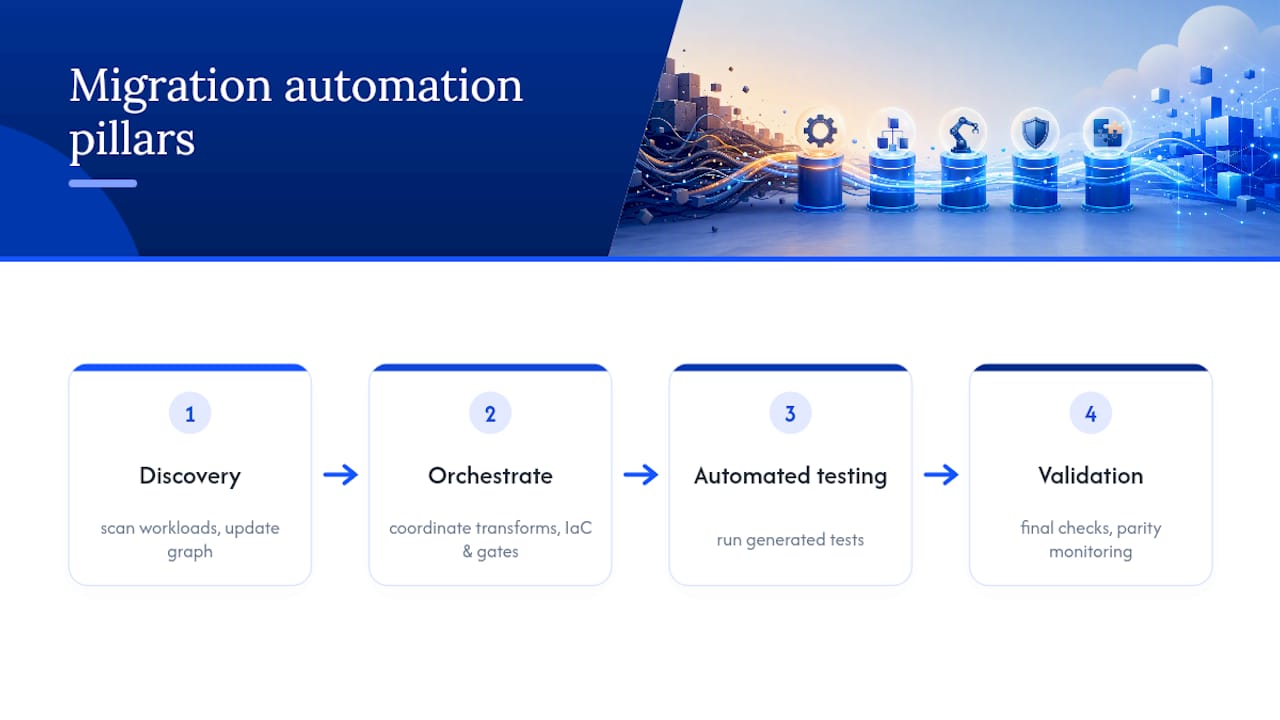
A representative wave flows like this: discovery agents scan the wave’s workload set → dependency graph is updated → business rules are extracted and packaged as reviewable artifacts → code transformation runs → generated tests execute against the transformed application → IaC is applied to provision target infrastructure → a gated approval triggers replication → final validation runs → cutover executes with automated DNS and load-balancer updates → post-cutover monitoring confirms parity.
A comprehensive migration automation framework requires all four pillars to work together: discovery, orchestration, automated testing, and validation. Missing any one of them creates a gap that manual effort cannot reliably fill at scale.
What are the concrete benefits of automating legacy migration?
The business case for automated legacy system upgrades rests on four categories of measurable value.
Time compression is the most visible benefit. Generative AI reduces overall migration timelines by roughly 30–40%, and discovery automation alone cuts that phase by half. For a program that would otherwise run 18–24 months, that is a material reduction in dual-running costs and organizational disruption.
Cost and TCO impact follows directly from time savings, but also from reduced SME dependency. When AI generates IaC, test suites, and transformation artifacts, you need fewer specialists per wave. Orchestration templates mean a small platform team can govern a large migration factory rather than staffing each wave individually.
Risk reduction is where automation’s value is least obvious but most significant:
- Traceable requirement-to-code mapping means auditors and compliance teams can verify that business logic was preserved, not just that the application runs.
- Automated test suites catch functional regressions before cutover, not after.
- Gated approvals and rollback automation reduce the blast radius of any single wave failure.
- Dual-run validation, running production workloads on both legacy and target systems simultaneously, provides the functional equivalence evidence that regulated industries require.
Repeatability and scale are what separate a migration program from a migration project. Migration factories and AI-driven orchestration enable templated pipelines that execute across waves without proportional headcount increases. Once a wave template is validated, it applies to every subsequent wave with configuration changes only.
Some AI/ML transformation engines report automating 70–90% of conversion work for specific application types, which fundamentally changes the developer’s role from building to validating. That shift matters for staffing plans and for the realistic timeline you present to your board.
A practitioner blueprint for an automated migration pipeline
Here is a concrete architecture you can adapt. It reflects patterns from AI-driven migration factory implementations and agentic AI modernization approaches.
Wave execution flow
- Orchestration engine pulls the wave’s workload list from the metadata store.
- Discovery agents confirm current-state inventory for the wave’s scope.
- Business rule extraction runs; output is packaged as reviewable artifacts and routed to SME reviewers.
- SME approval gate: reviewers validate extracted rules and flag exceptions.
- Code transformation executes against approved rule artifacts.
- Test harness generates and runs functional parity tests against the transformed code.
- IaC generator produces infrastructure templates; platform owner reviews and approves.
- Replication service initializes data sync between source and target.
- Final validation gate: automated test pass rate and data reconciliation results reviewed by approval stakeholders.
- Orchestration engine executes cutover: DNS updates, load-balancer reconfiguration, legacy traffic drain.
- Post-cutover monitoring runs for the defined dual-run period; anomalies trigger automated alerts.
For enterprise AI agent types and responsibilities within this architecture, the discovery, extraction, and failure-diagnosis roles map to reactive and proactive agent patterns that are well-documented in the agentic AI literature.
Pro Tip: Structure SME review artifacts so reviewers answer yes/no questions with evidence, not open-ended questions that require them to re-read source code. A well-formatted artifact with source line references, extracted rule statements, and a transformation preview cuts review time by more than half and removes the bottleneck that stalls most migration programs.
What are the real risks, and how do you mitigate them?
Automation reduces risk but does not eliminate it. These are the failure modes that consistently appear in migration programs, along with the mitigations that work.
Top risks:
- Dependency blind spots: Automated discovery misses runtime dependencies not visible in static analysis, such as undocumented API calls or environment-specific configuration.
- Data integrity loss: Schema mapping errors or transformation bugs corrupt data in ways that pass row-count checks but fail business logic validation.
- SME bottlenecks: Review queues back up when artifact volume exceeds reviewer capacity, stalling wave execution.
- Auditability gaps: Generated code lacks traceable links to source requirements, making compliance sign-off difficult.
- Incomplete test coverage: Automated test generation covers observed paths but misses edge cases that only surface under production load.
- Overtrusting generated code: Teams accept AI-generated transformation output without adequate review, shipping functional regressions.
Mitigation checklist:
- Supplement static discovery with runtime dependency tracing during a pre-migration observation period.
- Implement dual-run validation for all data-intensive workloads; compare business-critical aggregates, not just row counts.
- Size SME review capacity before each wave; use structured, evidence-rich artifacts to maximize reviewer throughput.
- Require traceable requirement-to-code mapping as a non-negotiable output of the transformation service.
- Combine automated test generation with manual exploratory testing for high-risk business flows.
- Enforce gated approvals before cutover; no wave proceeds without a signed-off validation report.
- Maintain a documented rollback plan for every wave, with automated rollback scripts tested before cutover day.
Continuous automation and dual-run strategies are the practitioner standard for validating equivalence and reducing cutover risk, particularly for regulated workloads where functional equivalence must be demonstrated to auditors.
Post-cutover, keep legacy infrastructure available for at least the dual-run window. Decommission only after monitoring confirms no anomalies and business stakeholders have signed off.
Key Takeaways
Automation and AI make legacy migration a repeatable, auditable capability rather than a one-off project, with generative AI cutting timelines by roughly 30–40% and discovery automation alone reducing that phase by 50%.
| Point | Details |
|---|---|
| Start with automated discovery | Discovery accuracy above 95% is the prerequisite for every downstream automation step. |
| Build reusable wave templates | Pipeline templates applied across waves scale execution without proportional headcount growth. |
| Enforce traceability from day one | Requirement-to-code mapping is non-negotiable for compliance sign-off and SME review efficiency. |
| Gate every cutover on validation | A 98%+ functional parity pass rate and dual-run confirmation reduce rollback rates below 5%. |
| Botiqueai delivers the pipeline | Botiqueai builds custom discovery, orchestration, and validation pipelines tailored to your estate and compliance requirements. |
What teams consistently get wrong about automated migration
The most common mistake is treating automation as a cost-cutting exercise rather than a capability investment. Teams that frame the program as “we will need fewer people” tend to underinvest in the governance layer, skip the pilot, and then discover that the automation produces outputs no one trusts because there is no review process to validate them. The result is a pipeline that runs but does not land.
The second mistake is ignoring traceability until compliance asks for it. Retrofitting audit trails into a pipeline that was not designed for them is expensive and slow. Build traceability in from the first wave template, even if no one asks for it yet.
SME review workload is almost always underestimated. The automation generates artifacts faster than reviewers can process them if you have not structured the review workflow. The fix is not more reviewers. It is better artifacts: structured, evidence-rich outputs that reduce each review to a verification task rather than an analysis task.
What consistently works: multi-agent pipelines where each agent has a narrow, well-defined responsibility; evidence-first review artifacts that give SMEs everything they need without requiring them to re-read source code; wave templates that encode the pilot’s lessons and apply them automatically; and automated validation embedded in CI/CD so that post-cutover monitoring is continuous, not a one-time check. Real-world AI transformation programs that follow this pattern compress timelines and maintain the governance discipline that regulated industries require.
The teams that get the most out of legacy migration automation treat it as an ongoing strategic capability. They run the pipeline continuously, feed new workloads into it as the estate evolves, and improve the wave templates with each cohort. That is the difference between a migration program and a migration factory.
Botiqueai’s automation services for legacy migration programs
If the blueprint above describes where you want to go, the gap is usually not strategy. It is the engineering work of building and integrating the pipeline components: discovery agents, orchestration logic, transformation rules, test harnesses, and approval gate workflows.
Botiqueai builds custom automation and AI pipelines for enterprise migration programs, covering discovery agent development, orchestration engine integration, agentic workflow design, and CI/CD-embedded validation. The starting point is a proof-of-transformation engagement: Botiqueai takes three to five representative flows from your estate, runs them through a purpose-built pipeline, and delivers measurable output, including automation rate, SME review hours, and defect escape rate, before any long-term commitment. That gives your team the evidence it needs to size the program and present a credible business case to stakeholders.
To scope a proof-of-transformation for your migration program, visit Botiqueai’s automation services page or contact the team directly.
Useful sources and further reading
Migration automation frameworks and metrics:
- Accelerating cloud migration with AWS Transform and generative AI | Migration & Modernization
- Streamlining Enterprise Migrations through Process Automation
- Mainframe modernization with agentic AI — AWS Transform for mainframe – AWS
- Accelerate large-scale server migrations with AI-driven orchestration
- Mainframe migration and modernization with AI | Google Cloud blog
- Main drivers for modernizing legacy applications — Statista
- Modernizing legacy software with the Thinkwise Upcycler
- IONATE™ APPDATE — AI/ML Application Modernization Engine
Generative AI and agentic approaches:
Orchestration and migration factory patterns:
Transformation engine examples: