
The Role of NLP in Customer Feedback Analysis
The Role of NLP in Customer Feedback Analysis
Natural language processing turns unstructured customer feedback into structured signals your team can route, prioritize, and act on. Instead of a spreadsheet full of survey comments nobody reads past row 40, NLP extracts the themes, sentiment intensity, intent, entities, and urgency hiding inside that text, and pushes them straight into the workflows where decisions get made.
The outputs that matter most in practice:
- Themes and aspects: what customers are actually talking about, broken down by product feature or service touchpoint
- Sentiment and emotional intensity: not just positive/negative, but how strongly someone feels it
- Intent: whether the customer wants a refund, a fix, information, or is threatening to churn
- Named entities: product names, SKUs, competitor mentions, locations
- Urgency and priority: which comments need a human in the next hour versus the next sprint
Regulatory frameworks like GDPR shape how this text can be processed and stored, and the technical backbone typically runs on transformer models such as BERT or generative models like GPT‑4. Done right, the payoff is concrete: faster ticket routing, prioritized escalations, and measurable movement in CSAT, NPS, and time-to-resolution. Botiqueai has built these pipelines for enterprise clients precisely because the gap between “we collect feedback” and “we act on feedback” is almost always a pipeline problem, not a data problem.
Key Takeaways
NLP works because it converts unstructured customer text into structured, routable signals that combine sentiment, intent, and urgency into a prioritized action queue.
| Point | Details |
|---|---|
| Match technique to constraint | Use rule-based for narrow high-precision patterns, BERT for labeled-data classification, GPT‑4 for zero-shot and summarization. |
| Combine supervised and unsupervised methods | Pair fine-tuned classifiers for known categories with BERTopic or Top2Vec to catch emerging themes. |
| Validate before automating | Hand-check at least 100 to 300 outputs and track precision, recall, and F1 per category before trusting automated routing. |
| Build in privacy from the start | Anonymize PII before text reaches any model and set clear retention rules under GDPR. |
| Start narrow, then scale | Botiqueai recommends beginning with one high-volume channel and human review, then expanding once resolution-time or CSAT gains are proven. |
Table of Contents
- What Is the Taxonomy of NLP Tasks for Customer Feedback?
- How Do Core NLP Techniques Compare for Feedback Analysis?
- What Data and Preprocessing Does a Feedback Pipeline Need?
- Should You Build Batch or Real-Time Feedback Architecture?
- How Do You Evaluate Whether Your NLP Models Are Working?
- Which Implementation Approach Fits Your Constraints?
- What Tools and Libraries Power a Feedback NLP Stack?
- How Do You Handle Privacy and GDPR Compliance?
- What Are the Common Failure Modes in Feedback NLP?
- How Do You Build a Starter NLP Feedback Pipeline?
- What Business Outcomes Should You Expect from Feedback NLP?
- What Should You Actually Expect from Adoption?
- Get Help Building Your NLP Feedback Pipeline
- Where to Read More on NLP and Feedback Analysis
- Frequently Asked Questions
- Sources
What Is the Taxonomy of NLP Tasks for Customer Feedback?
Analysts often lump “sentiment analysis” and “NLP for feedback” together, but that undersells what’s actually available. A published taxonomy covering 154 studies on review analysis groups the field into five buckets: sentiment analysis, review management, customer experience and satisfaction, user profiling, and marketing. Each maps to a distinct task, a distinct model choice, and a distinct business action.
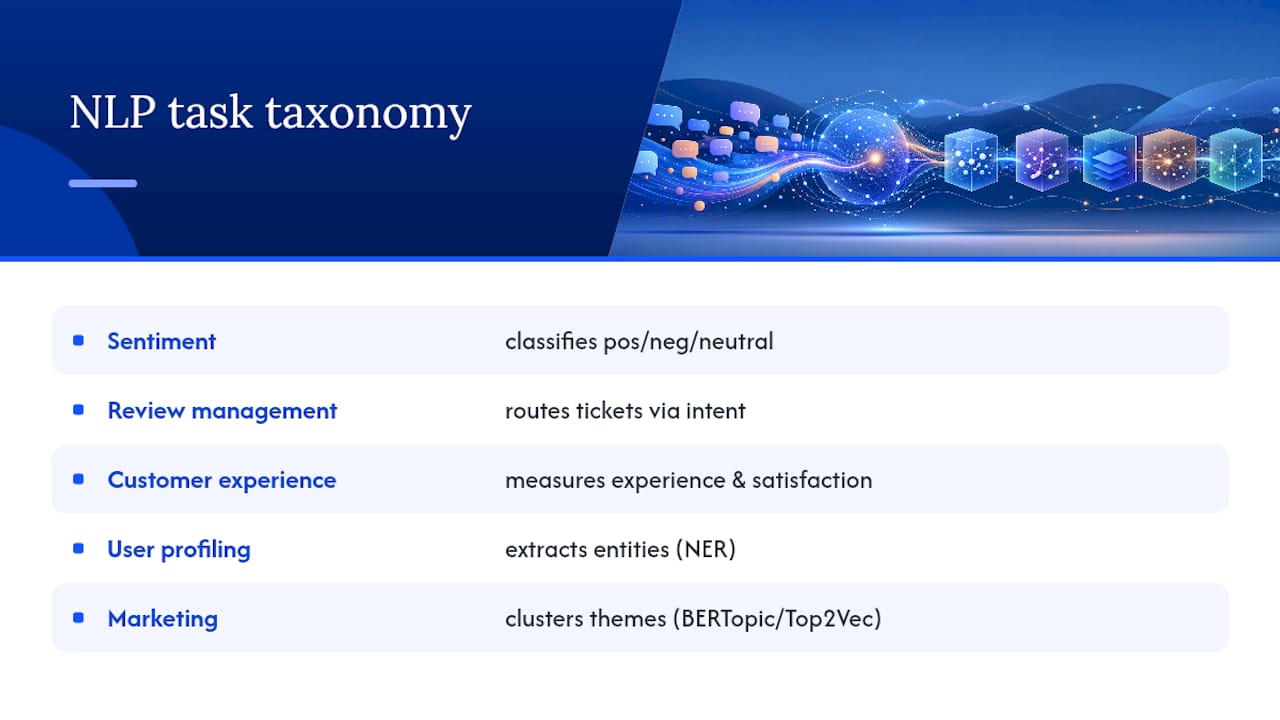
Sentiment analysis classifies whether a piece of text is positive, negative, or neutral. It’s the entry point, but on its own it’s blunt. A comment like “the app works but crashes constantly on checkout” scores as mixed sentiment and tells you almost nothing actionable.
Aspect-based sentiment analysis (ABSA) fixes that by attaching sentiment to specific aspects. That same comment becomes: checkout (negative, high intensity), general functionality (positive). Now product teams have a routable signal instead of a shrug.
Intent detection figures out what the customer wants done. Refund request, cancellation threat, feature request, general praise. This is the task that decides whether a ticket goes to billing, retention, or nowhere.
Topic modeling clusters feedback into emergent themes without predefined labels, useful when you don’t know what customers will complain about next. BERTopic and Top2Vec are the two dominant unsupervised approaches here, both building on embedding models to group semantically similar text without manual labeling.
Summarization condenses hundreds or thousands of comments into a digestible brief, which matters enormously once feedback volume exceeds what any human can read weekly.
Named entity recognition (NER) pulls out product names, locations, competitor mentions, and other structured facts embedded in free text. spaCy remains the standard toolkit for production NER pipelines because it’s fast, well-documented, and easy to fine-tune on domain vocabulary.
Emotion detection goes a layer deeper than sentiment, distinguishing frustration from disappointment from anger, which changes how urgently and how a response should be worded.
Urgency scoring combines several of the above (negative sentiment, churn intent, high emotional intensity) into a single priority score that determines queue position.
Open-text feedback carries signals a star rating never captures, such as emotional intensity, operational detail, and emerging themes before they appear elsewhere. That’s the argument for running NLP on the comment field, not just averaging the number next to it.
BERT, Hugging Face Transformers, BERTopic, Top2Vec, and spaCy aren’t competing products so much as complementary layers. Most production pipelines use several at once, one for classification, one for clustering, one for entity extraction.
How Do Core NLP Techniques Compare for Feedback Analysis?
Choosing a technique isn’t about picking “the best model.” It’s about matching the technique’s trade-offs to your constraints: how much labeled data you have, how fast you need results, and how much a wrong classification costs you.
Fine-tuned BERT classifiers take labeled examples (this comment is “billing complaint,” this one is “praise”) and learn to sort new text into those categories. They’re accurate once trained, typically hitting strong F1 scores on well-defined categories, but they need hundreds to thousands of labeled examples per category and retraining when your taxonomy changes.
Unsupervised topic models like BERTopic and Top2Vec skip labeling entirely. They embed each piece of feedback into vector space and cluster similar ones together, surfacing themes you didn’t know to look for. The trade-off is interpretability: a cluster might need a human to name it, and cluster boundaries can shift as new data arrives.
LLM zero-shot and few-shot approaches using GPT‑4 or similar models classify, extract, and summarize with just a prompt, no training data required. Evaluations applying large language models to survey and course feedback found they can reach performance comparable to human annotation on many tasks when the prompts are carefully constructed and outputs are spot-checked. That’s a genuine shift: teams that used to need months of annotation can now prototype a classifier in an afternoon.
Here’s how the major approaches stack up across the dimensions that actually drive a build decision:
| Dimension | Fine-tuned BERT | BERTopic / Top2Vec | GPT‑4 zero/few-shot |
|---|---|---|---|
| Accuracy / F1 vs throughput | High accuracy on fixed categories, moderate throughput per GPU | Good for discovery, throughput scales with embedding speed | Strong accuracy on many tasks, throughput limited by API cost and rate limits |
| Learning paradigm | Supervised (needs labeled data) | Unsupervised (no labels needed) | Zero/few-shot (prompt-driven) |
| Real-time vs batch | Both, fast inference once deployed | Typically batch, re-clustering is compute-heavy | Both, but per-call latency and cost favor batch for high volume |
| Multilingual support | Strong with multilingual BERT variants | Depends on embedding model chosen | Strong out of the box across major languages |
| Operational cost | Moderate: hosting plus initial training | Low to moderate: mostly compute at run time | Higher per-unit cost at scale, no training cost |
| Interpretability | Moderate: attention weights help, not transparent | Lower: clusters need human labeling | Lower: reasoning is opaque, but outputs are easy to spot-check |
A few practical notes worth internalizing:
- BERTopic and Top2Vec are best treated as discovery tools, not final classifiers. Run them monthly to catch new complaint categories before they show up in your fixed taxonomy.
- Hugging Face Transformers is where most teams actually deploy fine-tuned BERT models. It handles the tokenization, training loop, and inference serving that you’d otherwise build from scratch.
- GPT‑4 shines for ad-hoc questions (“summarize this week’s complaints about the mobile app”) where building a dedicated classifier would be overkill.
- spaCy remains the workhorse for lightweight, fast NER and preprocessing when you don’t need transformer-level nuance.
The honest answer for most mid-size feedback operations is a hybrid: BERT-based classifiers for the categories you know matter, BERTopic running quietly in the background to catch what’s new, and GPT‑4 for summarization and one-off analysis. None of these techniques replaces the others; they cover different failure modes.
What Data and Preprocessing Does a Feedback Pipeline Need?
Feedback data rarely arrives clean, and the preprocessing step is where most pipelines quietly fail before the modeling even starts. The common sources worth pulling into a unified pipeline include surveys, product reviews, support tickets, chat transcripts, social mentions, app store reviews, and CRM notes.
Each source has its own quirks. Support tickets are often multi-turn and context-dependent. App store reviews are short, emoji-heavy, and full of platform-specific slang. Survey open-text tends to be the cleanest but also the sparsest.
A workable preprocessing sequence looks like this:
- Deduplication: strip repeated submissions, especially from automated survey retries
- Normalization: lowercase, standardize punctuation, expand common contractions
- Language detection: route non-English (or non-primary-language) text to the right pipeline before classification
- Tokenization: split text into model-ready units, typically handled automatically by whichever transformer library you’re using
- Emoji and special character handling: emojis often carry sentiment signal and shouldn’t just be stripped; map them to sentiment scores or preserve them as tokens
- Anonymization and PII removal: strip names, emails, phone numbers, and account numbers before the text touches any model, especially one hosted by a third party
- Enrichment: attach metadata like SKU, customer cohort, subscription tier, or region so downstream analysis can segment results
Multilingual feedback deserves its own line of thought. Running a single multilingual BERT variant across languages is simpler to maintain than juggling separate models per language, but accuracy on lower-resource languages will lag behind English or Spanish. For supervised tasks, a workable minimum is somewhere around 200 to 500 labeled examples per category to get a fine-tuned classifier off the ground, though scalable distillation frameworks that combine LLMs with semantic grouping can reduce that labeling burden substantially by using the LLM to bootstrap initial labels for human review.
Short texts (think app store reviews under 20 words) are notoriously hard for topic models, which rely on enough word co-occurrence to form meaningful clusters. If your feedback skews short, lean more heavily on classification and NER, and treat topic modeling results with a skeptical eye.
Should You Build Batch or Real-Time Feedback Architecture?
The batch versus streaming decision comes down to one question: does anyone need to act on this feedback within the hour, or is daily/weekly aggregation good enough?
Batch pipelines run on a schedule, pulling accumulated feedback, processing it in bulk, and pushing results into a dashboard or report. They’re cheaper to run, simpler to debug, and fine for trend analysis, weekly product reviews, or NPS tracking.
Streaming architectures ingest feedback as it arrives and classify it in near real time, which matters when a comment signals an angry customer about to cancel or a safety issue that needs immediate escalation. A streaming architecture integrating multi-tier sentiment and intent models with domain-specific moderation has demonstrated measurably reduced resolution times and better escalation efficiency across e-commerce and SaaS deployments.
A modular architecture that supports both looks roughly like this: ingest (webhook or API pull from your feedback sources) feeds a message queue, which routes to a preprocessing worker, then to a model inference layer (running your classifiers, NER, and urgency scoring), then to a routing engine that maps themes and urgency scores to specific owners and creates tickets in your CRM, with a human-in-the-loop review step for anything above a confidence or risk threshold, finally landing in an analytics layer for trend reporting.

Routing rules should be explicit and boring. Billing complaints with negative sentiment above a set intensity threshold go to billing within an hour. Churn-intent language triggers a retention workflow. Product bugs mentioned by more than a handful of customers in a week get flagged for the product team’s weekly digest.
Pro Tip: Cache embeddings and classification results for repeated or near-duplicate feedback text. A huge share of support messages and reviews are near-identical restatements of the same three or four complaints, and caching cuts your LLM and transformer inference costs substantially without losing signal quality.
How Do You Evaluate Whether Your NLP Models Are Working?
A model that looks good in a demo and a model you can trust in production are different things, and the gap between them is measurement.
For classification tasks (sentiment, intent, urgency), track precision, recall, and F1 per category, not just an overall accuracy number. A model can hit 90% overall accuracy while completely failing on the rare but critical “safety complaint” category, and an aggregate score will hide that.
For topic models, coherence scores and cluster purity give a sense of whether the groupings are meaningful rather than noise. For summarization, ROUGE and BERTScore give automated proxies, but human rating on a sample remains the gold standard because these metrics don’t fully capture whether a summary is actually useful.
A validation checklist worth running on any production model:
- Manually annotate a random sample (100 to 300 items) and compare against model output
- Check inter-annotator agreement if multiple people are labeling, since disagreement often reveals an ambiguous taxonomy, not a bad model
- Review the confusion matrix, not just the aggregate score, to find which categories get confused with which
- Monitor for drift: language, slang, and product terminology shift over months, and a model trained last year degrades quietly
- Re-label and retrain on a regular cadence, quarterly is a reasonable default for most feedback volumes
The metric that actually matters to leadership isn’t F1, it’s whether CSAT moved, NPS moved, or time-to-resolution dropped. Run these as proper before/after or A/B comparisons where a routing change or new classifier rolls out to one segment first, so you can attribute the metric shift to the model rather than seasonal noise.
Which Implementation Approach Fits Your Constraints?
There’s no universally correct choice between rule-based systems, classical machine learning, transformer fine-tuning, and LLM prompting. The right one depends on four constraints: how much labeled data you have, how fast you need an answer, how much interpretability matters, and your budget.
Rule-based systems (keyword matching, regex patterns) work well when you need high precision on a narrow, well-defined pattern and have almost no labeled data. “Flag anything containing ‘lawsuit’ or ‘lawyer’” is a rule, not a model, and it’s the right call for that specific case.
Classical ML (logistic regression, SVM on TF-IDF or bag-of-words features) is underrated. It needs less data than a transformer, trains in minutes, and is fully interpretable. It’s a solid baseline before you invest in anything heavier.
Transformer fine-tuning (BERT via Hugging Face Transformers) is the right call once you have enough labeled data (typically a few hundred examples per category minimum) and need accuracy that classical ML can’t match, especially for nuanced categories like aspect-based sentiment.
LLM zero/few-shot (GPT‑4) wins when you have no labeled data, need to move fast, or the task changes too often to justify training a dedicated model. It’s also the strongest option for summarization and ad-hoc analysis where flexibility matters more than raw throughput.
| Constraint | Best fit |
|---|---|
| Almost no labeled data, narrow pattern | Rule-based |
| Small labeled dataset, need interpretability | Classical ML |
| Sizeable labeled data, need accuracy at scale | Fine-tuned BERT |
| No labeled data, task changes often, need speed | GPT‑4 zero/few-shot |
Pro Tip: Chain approaches instead of picking one. Use lightweight rules to catch the small number of truly urgent cases (safety, legal, explicit churn threats) before anything else runs, route steady-state volume through a fine-tuned transformer classifier, and reserve LLM calls for summarization and the ad-hoc questions nobody thought to build a dashboard for. This keeps your expensive model calls reserved for the tasks that actually need them.
What Tools and Libraries Power a Feedback NLP Stack?
The open-source ecosystem for this work is mature enough that most teams don’t need to build models from scratch, just assemble the right pieces.
spaCy handles fast, production-grade NER and general text preprocessing (tokenization, part-of-speech tagging, dependency parsing). It’s the tool most teams reach for first because it’s fast and easy to customize for domain vocabulary like product names or internal jargon.
Hugging Face Transformers is the library most fine-tuned BERT deployments run on. It handles model loading, training loops, and inference serving, and gives access to thousands of pretrained models beyond BERT itself.
BERTopic and Top2Vec cover unsupervised topic discovery, both built for teams who want to surface emerging themes without a labeling effort.
Beyond libraries, managed API access to models like GPT‑4 removes the infrastructure burden entirely for teams that don’t want to host inference themselves, at the cost of per-call pricing and dependency on an external provider’s uptime and rate limits.
Integration is where a lot of this either pays off or falls flat. Classified and enriched feedback needs to land in the tools your teams already use: tickets created in a CRM, urgent flags posted to a team channel, weekly summaries pushed into a BI dashboard. Botiqueai builds these connective layers as part of custom automation work, because a brilliant classifier that dumps output into a spreadsheet nobody opens delivers zero business value.
How Do You Handle Privacy and GDPR Compliance?
Customer feedback text is personal data the moment it contains a name, an email, or anything tying it to an identifiable person, and GDPR treats it accordingly.
A working compliance checklist:
- Establish a lawful basis for processing feedback text before any model touches it
- Apply data minimization: don’t retain more fields or more history than the analysis actually requires
- Respect purpose limitation: feedback collected for service quality shouldn’t silently get repurposed for marketing without disclosure
- Anonymize or pseudonymize text before it reaches third-party model APIs where feasible
- Set explicit retention periods and actually enforce deletion
- Build a process to honor data subject access and deletion requests that touch feedback records
Ethically, bias in training data deserves real attention. A sentiment classifier trained mostly on English-language, US-centric complaints will misread tone in feedback from other regions or dialects. Be transparent with customers that feedback may be processed automatically, and keep sensitive content (health, legal, financial disclosures) routed to stricter handling than routine product complaints.
Pro Tip: Run a PII scrubber as the very first step in your pipeline, before text reaches any external API. Retrofitting anonymization after data has already left your infrastructure is a much harder compliance conversation.
What Are the Common Failure Modes in Feedback NLP?
Every team that’s run NLP on real customer text long enough hits the same handful of walls.
Sarcasm and irony confuse sentiment models reliably. “Great, another update that breaks everything” reads as positive to a naive classifier. Mixed sentiment in short texts, praise and complaint in the same sentence, splits models that expect one label per document. Domain jargon and abbreviations (internal product codenames, industry shorthand) get misclassified by models trained on general text. Sparse negative signals in overwhelmingly positive corpora mean the few genuine complaints get statistically drowned out unless you weight for them. Hallucination risk is real with generative models: GPT‑4 can summarize feedback confidently and inaccurately if not grounded and checked.
Mitigations that actually work:
- Keep a human reviewing a sample of automated classifications, especially for anything that triggers an automated action
- Build targeted annotation sets specifically for sarcasm and mixed-sentiment cases rather than assuming general training data covers them
- Fine-tune on your own domain’s language rather than relying purely on a general-purpose model
- Set conservative confidence thresholds before letting a model trigger an automated response
- Run post-hoc spot checks on LLM-generated summaries against the source text
How Do You Build a Starter NLP Feedback Pipeline?
A reasonable first pipeline doesn’t need every technique described above running on day one. Start narrow, prove the value, then expand.
The starter architecture: ingest feedback from your single highest-volume channel (support tickets are usually the best starting point), enrich with metadata (customer tier, product line), run it through lightweight rule-based filters to catch true emergencies, pass everything else through a fine-tuned or zero-shot classifier for sentiment and intent, use GPT‑4 for weekly distillation and summarization, route flagged items into your existing CRM as tickets, and log everything into an analytics layer for trend tracking.
A sample zero-shot extraction prompt template you can adapt:
“Analyze the following customer feedback. Return: (1) primary sentiment [positive/negative/neutral/mixed], (2) sentiment intensity [1 to 5], (3) intent [complaint, question, praise, cancellation-risk, feature-request], (4) any product or feature names mentioned, (5) urgency [low/medium/high] with one-sentence justification. Feedback: [text]”
For your first 1,000 processed responses, validate by hand-checking a random sample of at least 100, tracking agreement rate between the model and a human reviewer, and adjusting the prompt or fine-tuning data based on where they diverge most.
A rollout checklist worth following before scaling further:
- Confirm data governance: who owns the feedback data, retention rules, and access controls
- Set up monitoring for model drift and cost per processed item
- Establish cost controls, particularly around LLM API usage as volume grows
- Assign clear owners and SLAs for each routing category before the first ticket auto-routes anywhere
Pro Tip: Botiqueai’s work on AI customer support automation consistently shows the same pattern: the pipeline that survives contact with real volume is the one where a human reviewed the first thousand outputs before anyone trusted the model unsupervised.
What Business Outcomes Should You Expect from Feedback NLP?
The use cases with the clearest ROI tend to cluster around five patterns: routing urgent support tickets before they escalate, surfacing recurring product issues to the teams that can fix them, measuring sentiment differences across customer cohorts, feeding churn-prediction models with intent signals, and distilling pros and cons for product roadmap planning.
Each connects to a metric leadership already tracks. Faster ticket routing shows up as reduced time-to-resolution. Better-targeted responses to negative sentiment show up in CSAT. Catching churn-intent language early feeds directly into retention numbers and, downstream, NPS. Weekly automated summarization turns a task that used to take an analyst days into something available the same afternoon, freeing that person for the interpretation work a model can’t do.
The AI-augmented voice-of-customer research makes a point worth sitting with: combining sentiment, topic modeling, and emotion detection doesn’t just speed up analysis, it changes the precision of the decisions made from it. A product team acting on “23 customers mentioned checkout latency this week, sentiment intensity trending up” makes a sharper call than one acting on a general sense that “reviews seem worse lately.”
None of this replaces judgment. NLP scales the reading, not the deciding. The teams that get the most value treat model output as a prioritized worklist for humans, not an autopilot for customer relationships.
What Should You Actually Expect from Adoption?
The honest take: most feedback NLP rollouts fail not because the models underperform, but because organizations try to boil the ocean on day one, deploying sentiment, topic modeling, and intent detection across every channel simultaneously with no owner for the output.
Start with one channel, one clear use case (usually urgent ticket routing), and human review on every automated decision for the first few weeks. Prove the resolution-time or CSAT improvement there before expanding to reviews, surveys, or social mentions.
NLP scales human judgment, it doesn’t substitute for it. The models get you from ten thousand comments to a prioritized list of forty things worth a person’s attention. Someone still has to decide what to do about those forty things, and organizations that skip assigning real owners and SLAs to that step end up with a very accurate model and no change in outcomes at all.
Get Help Building Your NLP Feedback Pipeline
Reading about BERT, BERTopic, and GPT‑4 zero-shot prompting is one thing. Standing up a pipeline that reliably routes real customer feedback into your CRM without breaking under Friday-afternoon volume is another. Botiqueai builds custom NLP pipelines, chatbot integrations, and automation workflows using tools like n8n and Make, connecting the classification and routing logic described above directly into the systems your team already works in.
If your team is sitting on months of unread survey comments or a support queue nobody’s mining for signal, that’s usually the highest-leverage place to start. Botiqueai’s Aria chatbot can capture and pre-classify feedback at the point of conversation, while custom automation workflows handle the routing logic once feedback is scored. Past projects, including enterprise deployments like the AXA integration, show what this looks like connected to existing CRM and workflow systems at scale.
The next step is a discovery call or a lightweight audit of your current feedback volume and channels, enough to scope a pipeline that fits your actual data, not a generic template. Get in touch with Botiqueai to start that conversation.
Where to Read More on NLP and Feedback Analysis
For deeper theory, the survey and taxonomy of NLP applications for review analysis covers 154 studies and remains the most complete academic map of the field. For architecture patterns, the real-time feedback signal processing paper details streaming designs used in production. For hands-on LLM workflows, RevieWeaver shows how to control cost when distilling reviews at scale, and the LLM survey-evaluation study benchmarks zero-shot performance against human annotators. Practitioner-oriented reading includes the voice-of-customer analytics research and the AI text analytics blog from Resonate CX for framing signal types in plain language.
Frequently Asked Questions
What is the main role of NLP in customer feedback?
The role of NLP in customer feedback is converting unstructured text, reviews, tickets, survey responses, into structured signals like sentiment, topic, intent, and urgency that teams can route and act on quickly, rather than reading every comment manually.
Do I need labeled data to start using NLP on feedback?
Not necessarily. GPT‑4 and similar LLMs can classify and extract information in zero-shot mode with no labeled training data, though accuracy on nuanced or domain-specific categories generally improves once you fine-tune a model like BERT on labeled examples.
How is aspect-based sentiment different from regular sentiment analysis?
Regular sentiment analysis gives one label per document. Aspect-based sentiment analysis breaks a single comment into multiple aspects (price, support, checkout, delivery) and scores sentiment for each one separately, which is far more actionable for product teams.
Can NLP handle sarcasm and mixed feelings in feedback?
Imperfectly. Sarcasm and mixed sentiment remain genuine weak points for most models, including large language models. The practical mitigation is targeted annotation for these cases and keeping a human in the loop for anything that triggers an automated action.
What’s a reasonable first NLP use case for customer feedback?
Urgent ticket routing from your highest-volume support channel, combined with human review for the first few weeks. It has a clear, measurable metric (time-to-resolution) and lower risk than automating sentiment analysis across every channel at once.
Sources
- A survey and taxonomy of NLP applications for online customer review analysis
- RevieWeaver: Weaving Together Review Insights by Leveraging LLMs and Semantic Similarity
- Real-Time Feedback Signal Processing: Transforming Customer Surveys into Actionable Intelligence Through NLP-Driven Architectures
- Evaluating large language models for survey and feedback analysis