
How to Run an AI Pilot Project at Your Company
How to Run an AI Pilot Project at Your Company
Run a tightly scoped pilot that tests one use case with one tool and one primary KPI over a 6-week window. Most pilots can deliver a working prototype in 2–4 weeks, followed by validation and a decision phase. The pilot ends with a clear decision: stop, iterate, or scale. That is the whole playbook. Everything below is the execution detail.
Your next 48–72 hours:
- Name the use case. Pick one specific workflow where AI could move a metric you already track.
- Appoint a business sponsor and a small cross-functional team. You need someone with budget authority and someone who owns the data.
- Set one primary success metric and a decision date. Write both down before you build anything.
If the pilot hits the KPI threshold and clears operational requirements at week six, expand. If it doesn’t, stop, document what you learned, and move to the next candidate.
Table of Contents
- Why run an AI pilot project — and why most fail
- How do you choose the right use case for an AI pilot?
- Who should be on your AI pilot team?
- Is your data ready to run the pilot?
- How to pick the right tool or model for your pilot
- What experiment methodology should you use for an AI pilot?
- What does a 6-week AI pilot timeline look like?
- How do you measure success in an AI pilot project?
- How do you keep a pilot on track while it’s running?
- How do you make the go/no-go decision and scale to production?
- What risks and compliance issues should you address during the pilot?
- How Botiqueai helps you run your AI pilot faster
- Key Takeaways
- What running multiple pilots actually teaches you
- Useful sources and templates for your pilot
Why run an AI pilot project — and why most fail
A pilot is the cheapest way to find out whether an AI idea actually works in your environment, with your data, for your users. It limits financial exposure, generates real evidence for leadership, and builds the internal muscle your team needs to operate AI in production. Those three things, risk-limited learning, measured ROI proof, and capability building, are what separate a pilot from a proof-of-concept slide deck.
The problem is that most pilots never make it to production. Industry guidance consistently points to three root causes: poor data quality, vague objectives, and insufficient stakeholder engagement. In practice, these show up as teams that spend weeks cleaning data nobody scoped in advance, pilots with no agreed success metric so nobody can declare a winner, and executives who weren’t involved early enough to champion the result. Any one of those three will kill a pilot. All three together are nearly guaranteed to.
A concrete example of what success looks like: a mid-size logistics company ran a 4-week pilot using a natural language processing model to auto-classify inbound customer service emails by issue type. The baseline was 12 minutes of manual triage per ticket. The pilot target was under 2 minutes with 90% classification accuracy. At week four, the model hit 93% accuracy and cut triage time to 90 seconds. The team had clean labeled data from their CRM, a single PM owner, and a VP of Operations who had signed off on the success criteria before day one. The pilot passed, and the company rolled it into production within six weeks of the decision.
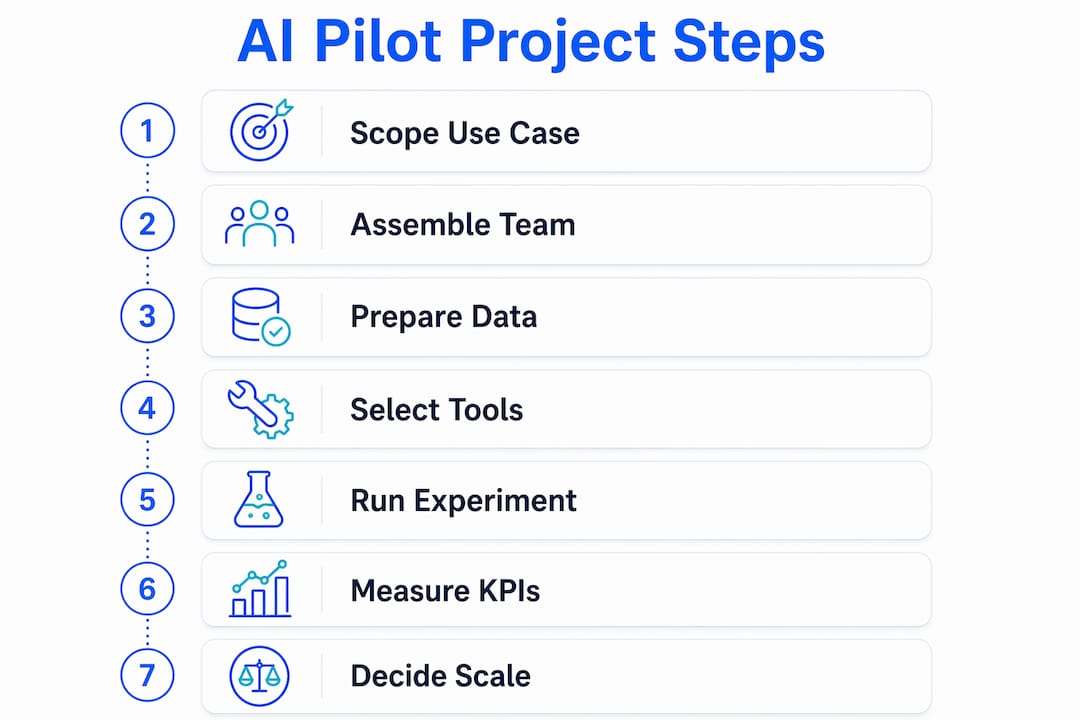
That story is repeatable. The ingredients are not exotic. They are scope, metrics, and sponsorship.
How do you choose the right use case for an AI pilot?
The use case you pick determines everything downstream. A poor choice wastes six weeks and poisons appetite for the next attempt. A good choice proves value fast and creates internal advocates.
Selection criteria to apply to every candidate:
- Business impact: Does improving this metric move revenue, cost, or risk in a way leadership cares about?
- Measurability: Can you define a clear before/after metric you already track or can easily instrument?
- Volume and frequency: Does this task happen often enough to generate statistically meaningful results in a pilot window of 2–4 weeks?
- Data availability: Do you have labeled historical data, or can you get it quickly?
- Low reputational risk: If the model makes a mistake during the pilot, is the blast radius small?
- Time-to-result: Can you see signal within the pilot window, or does the outcome take months to manifest?
Executives should prioritize use cases that align with corporate objectives, not just the ones that are technically interesting. A pilot that solves a problem the CFO already complains about is far easier to fund and scale than one that solves a problem only the data team cares about. Connecting your pilot to your company’s AI corporate strategy before you start is worth the hour it takes.
Impact vs. feasibility matrix: Plot candidate ideas on a 2x2. High impact, high feasibility goes first. High impact, low feasibility is a future-state project, not a pilot. Low impact, high feasibility is a demo, not a business case. Low impact, low feasibility is a no.
Examples by function:
| Function | Good pilot candidate | Poor choice |
|---|---|---|
| Sales | AI-assisted lead scoring on existing CRM data | Full pipeline forecasting from scratch |
| Support | Email/ticket auto-classification | End-to-end autonomous resolution |
| Finance | Invoice anomaly detection | Real-time fraud prevention at scale |
| Operations | Predictive maintenance on one machine type | Fleet-wide scheduling optimization |
Pro Tip: Ask frontline team members what they do repeatedly that feels like “copy-paste thinking.” Those tasks, the ones that follow a pattern but require judgment, are almost always the best pilot candidates. Quantify the expected benefit by multiplying time per task by weekly volume and hourly cost. A 10-minute task done 200 times a week at $35/hour is worth $1,167 per week in recovered capacity. That number gets executive attention.
Who should be on your AI pilot team?
The minimal viable team for a pilot is smaller than most people expect, but every role has to be filled. A gap in any one of them is a predictable failure point.

Early involvement from Legal, IT, and compliance functions prevents the most common late-stage blockers: a security review that kills the timeline, a data access issue that surfaces at week three, or a compliance flag that invalidates the test results. Bring them in at kickoff, not at the decision gate.
Core team roles and responsibilities:
| Role | Primary duties | Decision authority |
|---|---|---|
| Business sponsor | Owns budget, removes blockers, champions the result | Go/no-go at decision gate |
| PM/product owner | Runs the pilot cadence, owns documentation | Scope changes, timeline |
| Data lead | Data access, quality, labeling, privacy review | Data sourcing decisions |
| ML engineer or vendor lead | Model selection, experiment design, prototype build | Technical architecture |
| MLOps/infra contact | Environment setup, monitoring, deployment readiness | Infrastructure choices |
| Security/compliance | PII review, access controls, audit trail | Data handling approvals |
| End-user SME | Workflow knowledge, user testing, feedback | Acceptance criteria input |
Governance checkpoints:
- Kickoff gate (Day 1): Business sponsor, PM, and data lead sign off on the use case definition, success metric, decision date, and data access plan.
- Mid-pilot review (Week 3): PM presents experiment results to date, flags any data or scope issues, and gets a green/yellow/red status from the sponsor.
- Pre-decision review (Week 5): Full team reviews KPI performance, operational readiness, and compliance sign-off before the formal decision meeting.
For stakeholder buy-in to hold through the decision gate, the acceptance criteria need to be written down and agreed before the pilot starts, not negotiated after the results are in.
Is your data ready to run the pilot?
Data readiness is the single most underestimated risk in AI project implementation. Teams routinely discover at week two that the data they planned to use is incomplete, inconsistently labeled, or locked behind an access approval that takes three weeks to clear.
Data readiness checklist:
- Access: Who owns the data, and do you have written approval to use it for this pilot?
- Quality: What is the error rate, missing-value rate, and duplicate rate in the relevant dataset?
- Labeling: Do you have labeled examples for supervised learning, or do you need to create them?
- Sample size: Is the dataset large enough to train and validate a model within the pilot window?
- Schema stability: Will the data structure change during the six weeks?
- Refresh cadence: How often does the data update, and does that cadence match the pilot’s measurement needs?
Sample data request template fields to include in your kickoff document:
- Data owner name and team
- Dataset name and system of record
- Estimated sample size and date range
- Sensitive or PII fields present
- Anonymization or masking requirements
- Retention and deletion policy
- Approval status and expected access date
For U.S.-based pilots, data minimization is not optional. Collect only the fields the model actually needs. If the dataset contains personally identifiable information, get written sign-off from Legal before ingestion, document the handling procedure, and confirm it aligns with any sector-specific rules (HIPAA for health data, GLBA for financial data). An AI data strategy document that maps data sources to use cases before the pilot starts saves significant time.
Pro Tip: If you can’t get clean production data in time, don’t stall the pilot. Use a sanitized sample with PII masked, or generate synthetic data that mirrors the statistical properties of the real dataset. Tools like Gretel.ai and Mostly AI can produce synthetic tabular data that is good enough to validate model architecture and experiment design. Swap in real data for the final validation sprint.
How to pick the right tool or model for your pilot
The goal at this stage is not to find the perfect tool. It is to find a tool that is good enough to test the hypothesis in six weeks without creating procurement, security, or integration problems that outlast the pilot itself.
Quick vendor/tool evaluation checklist:
- Fit to use case: Does the tool handle the specific task type (classification, generation, prediction, extraction)?
- Data handling: Where does data go, and who can access it? Does it meet your internal security policy?
- Integration friction: Can it connect to your existing systems via API or a standard connector, or does it require custom engineering?
- Cost shape: Is pricing per API call, per seat, or flat? Can you run the pilot without a long-term contract?
- SLA and uptime: What happens if the tool goes down during a critical test window?
- Explainability: Can the model explain its outputs in a way that satisfies your compliance team and end users?
Build vs. buy for pilots: Buy first, almost always. A pre-built model or API lets you test the hypothesis in days rather than weeks. Build only when the use case is genuinely proprietary, the data is too sensitive to send to a third-party API, or the long-term scaling plan requires owning the model. For most pilots, the question is not “which model architecture” but “which API or platform lets us run the experiment fastest.”
Contract and ownership checklist: Before signing any pilot agreement, confirm who owns the model weights trained on your data, whether the vendor can use your data to improve their general model, what the exit terms are if you decide not to scale, and whether you can export your data and configurations at any time.
Pro Tip: Run a one-experiment validation before committing to a tool. Feed it 50–100 real examples from your dataset, measure accuracy or output quality against your primary KPI, and compare two candidate tools side by side. That single experiment, which takes a day or two, eliminates most of the uncertainty before you build anything. Integrating AI without heavy engineering effort is more achievable than most teams expect when you start with a constrained test like this.
What experiment methodology should you use for an AI pilot?
AI project management differs fundamentally from standard software delivery. In a normal software sprint, you know what you’re building. In an AI pilot, you’re running experiments to find out whether a hypothesis is true. That distinction changes how you plan, how you measure, and how you decide.
The methodology that works is a short, iterative learning cycle: hypothesis → experiment → measure → learn → decide. Each cycle should take one to two weeks. You run two or three cycles inside the six-week pilot window.
How to structure each cycle:
- Hypothesis: State the business claim you’re testing. “If we apply model X to workflow Y, metric Z will improve by N%.”
- Experiment: Define the test. What data, what model version, what comparison baseline?
- Measure: Collect the results against the primary KPI and any secondary signals.
- Learn: What did the results tell you? Did the hypothesis hold? What changed?
- Decide: Run another cycle with a refined hypothesis, or move to the decision gate.
Sample hypothesis template:
Short, hypothesis-driven iterations are what distinguish AI pilots that learn fast from ones that drift for weeks without producing a decision. The key difference from a standard Scrum sprint is that the “done” condition is not a feature shipped. It is a hypothesis confirmed or refuted. For teams new to this approach, lean AI development methodologies provide a practical framework to adapt.
What does a 6-week AI pilot timeline look like?
Most pilots can deliver a working prototype in 2–4 weeks given adequate data readiness and a scoped use case. The full six-week window adds user validation and a structured decision process on top of the prototype.

Week-by-week deliverables:
| Week | Focus | Key deliverables | Owner |
|---|---|---|---|
| 1 | Discovery and scoping | Pilot charter, KPI definition, data access plan, team RACI | PM + Business sponsor |
| 2 | Data preparation | Cleaned dataset, labeled sample, data quality report | Data lead |
| 3 | Prototype build | Working model or API integration, baseline measurement | ML engineer |
| 4 | Initial testing | Experiment results vs. KPI, hypothesis log, issue list | ML engineer + PM |
| 5 | User validation | End-user feedback, edge case testing, refined model | End-user SME + ML engineer |
| 6 | Decision | Decision report, go/no-go recommendation, scale plan draft | PM + Business sponsor |
Decision-deadline template: Set the decision meeting on Day 42. The PM presents the KPI results, the operational readiness checklist, and a recommendation. The business sponsor makes the call. No extensions without a written rationale and a new decision date.
Primary vs. secondary KPIs: Pick one primary KPI that determines the go/no-go. Secondary KPIs (user satisfaction, error rate, latency) inform the scale plan but do not override the primary. If you let secondary metrics muddy the primary decision, you will never get a clean answer.
Running the pilot in a sandbox or isolated environment keeps the test clean and prevents the pilot from interfering with production systems. That isolation also makes measurement more reliable because you’re not trying to separate pilot effects from background noise.
How do you measure success in an AI pilot project?
Measurement is where most pilots get vague at exactly the wrong moment. The KPIs need to be defined before the pilot starts, not reverse-engineered from whatever the model happened to do well.
Sample KPIs mapped to common pilot types:
- Classification/NLP: Accuracy, precision, recall, F1 score vs. human baseline
- Process automation: Time per task (before vs. after), error rate reduction, throughput increase
- Predictive analytics: Forecast accuracy (MAPE or RMSE), decision quality improvement
- Customer-facing AI: Conversion lift, containment rate, customer satisfaction score (CSAT)
- Document processing: Extraction accuracy, processing time, exception rate
Experiment design checklist:
- Define a control group (business-as-usual) and a test group (AI-assisted).
- Ensure the sample is large enough to detect the effect size you care about. For a 10% improvement, you generally need at least 100–200 observations per group.
- Run the experiment for long enough to cover natural variation (day-of-week effects, seasonal spikes).
- Collect qualitative feedback from end users alongside the quantitative metrics.
- Document every experiment run, including failed ones.
ROI estimation template for leadership:
- Pilot cost: Engineering hours + tool/API cost + PM time
- Expected annual benefit: (Time saved per task × volume × hourly cost) + (error reduction × cost per error)
- Break-even horizon: Pilot cost ÷ monthly benefit
- Confidence level: State the assumptions explicitly. A 90% accuracy model on 200 test cases is not the same as a 90% accuracy model on 50,000 production cases.
Qualitative signals matter too. If end users say the tool makes their job harder even when the numbers look good, that is a scaling risk you need to address before production. Combine the quantitative KPI result with a structured user feedback session at week five.
How do you keep a pilot on track while it’s running?
Execution drift is the quiet killer of pilots that started well. The team gets busy, the weekly sync gets skipped, and by week four nobody is sure what the current hypothesis is or whether the data has changed.
Recommended operating cadence:
- Daily stand-up (15 minutes): Core team only. What ran yesterday, what’s running today, what’s blocked.
- Weekly stakeholder sync (30 minutes): PM presents status to the business sponsor and any control functions. Red/yellow/green on KPI trajectory, data quality, and timeline.
- Mid-pilot health check (Week 3): A structured review of experiment results to date, data quality issues, and any scope creep. This is the moment to course-correct before the final sprint.
Monitoring and logging essentials:
- Track model performance metrics daily against the primary KPI baseline.
- Log every prediction or output the model makes during the pilot, with timestamps.
- Monitor for data drift: if the input data distribution shifts during the pilot, your results may not generalize.
- Capture user feedback systematically, not just anecdotally.
Required documentation during the pilot: experiment log (hypothesis, setup, results, learnings), dataset snapshot (version, date, schema), model card (model version, training data, known limitations), and a decision rationale document that captures why each scope or methodology change was made.
Pro Tip: Assign one person to own the experiment log and update it after every test run. It takes 10 minutes per run. Without it, the team will spend the entire Week 6 decision meeting reconstructing what actually happened instead of making a decision.
How do you make the go/no-go decision and scale to production?
The decision meeting should take 30 minutes if the pilot was run well. The PM presents the KPI results against the pre-agreed threshold, the operational readiness checklist, and a recommendation. The business sponsor decides.
Go/no-go checklist:
- Primary KPI met at or above the agreed threshold? (Yes/No)
- Data pipeline stable and reproducible in production? (Yes/No)
- Monitoring and alerting in place for production? (Yes/No)
- Security and compliance sign-off received? (Yes/No)
- End-user acceptance confirmed? (Yes/No)
- Infrastructure capacity confirmed for production load? (Yes/No)
- Support model and escalation path defined? (Yes/No)
If any of those is “No,” you have a conditional go: the pilot passed, but production requires specific remediation before launch. Document the conditions and assign owners.
Phased rollout template:
- Phase 1 (Weeks 7–10): Limited production. One team or one region. Real data, real users, monitored closely. Gate: KPI holds at production scale.
- Phase 2 (Weeks 11–18): Wider rollout. Expand to additional teams or regions. Gate: No significant performance degradation, support model validated.
- Phase 3 (Week 19+): Full deployment. Standard MLOps monitoring, quarterly model review cadence.
Budget and resource allocation for scaling: The pilot cost is typically 10–20% of the full production build cost. Budget for engineering hours to harden the prototype, infrastructure costs for production-grade hosting, and ongoing model maintenance (retraining, monitoring, drift correction). For companies investing in AI at scale, the production handoff is where the real engineering investment begins.
What risks and compliance issues should you address during the pilot?
Running an AI pilot inside a U.S. company means operating under a patchwork of sector-specific rules and general consumer protection principles. The Cloud Security Alliance’s guidance on AI pilot programs emphasizes that data governance and risk controls need to be built into the pilot design, not bolted on afterward.
Risk checklist and mitigations:
| Risk | Mitigation |
|---|---|
| Model bias (disparate outcomes by demographic) | Run a bias audit on test outputs before user validation; document findings |
| PII leakage | Anonymize or mask PII before ingestion; log all data access |
| Data retention violations | Confirm retention policy with Legal; delete pilot data per schedule |
| Incorrect outputs causing reputational harm | Implement human-in-the-loop review for high-stakes outputs during the pilot |
| Vendor data misuse | Confirm data ownership and usage terms in the pilot contract |
U.S.-specific compliance checkpoints:
- FTC guidance: The FTC has issued guidance on AI transparency and deceptive practices. If the pilot involves consumer-facing outputs, confirm they are not misleading.
- HIPAA: Any pilot touching protected health information requires a Business Associate Agreement with any vendor and strict access controls.
- GLBA: Financial data used in pilots must comply with Gramm-Leach-Bliley safeguard requirements.
- State-level AI laws: Several U.S. states have enacted or are enacting AI-specific requirements (Colorado, Illinois, Texas). Check applicability to your use case.
Document the ethical review as a formal pilot artifact. This means a written record of who reviewed the model outputs for bias, what the findings were, and what mitigations were applied. An AI governance framework that covers these checkpoints before the pilot starts prevents the compliance review from becoming a last-minute blocker.
Pro Tip: Schedule a 30-minute “red team” session at week four where two people who were not involved in building the model try to make it produce a wrong, biased, or harmful output. This is not a formal audit. It is a fast, practical stress test that surfaces issues before they reach users.
How Botiqueai helps you run your AI pilot faster
Most companies have the business problem identified and the executive appetite. What slows them down is the gap between “we want to run a pilot” and “we have a working prototype with real results.” That gap is exactly where Botiqueai operates.
Botiqueai delivers scoped proof-of-concept builds, rapid prototyping for chatbot and workflow automation use cases, and a full MLOps handoff so your engineering team inherits something production-ready, not a notebook. The engagement follows the same six-week structure this guide describes: a discovery session to lock the use case and KPIs, a scoped prototype sprint, a validation phase with your end users, and a scale plan with architecture specs your team can execute. For companies that want a packaged starting point, the Aria AI assistant is a deployable chatbot solution for web and e-commerce that can be live in days rather than weeks.
The practical difference: you get a team that has run this process before, which means fewer surprises at the data readiness stage and a faster path to the decision gate. To start, send a discovery request that includes your use case candidate, the metric you want to move, your data situation in one sentence, and your target decision date. That is enough to scope a pilot engagement. Reach out to Botiqueai to schedule a discovery session.
Key Takeaways
A successful AI pilot requires one scoped use case, one primary KPI, a cross-functional team with executive sponsorship, and a hard decision date set before the first experiment runs.
| Point | Details |
|---|---|
| Scope tightly from day one | One use case, one tool, one primary KPI prevents the drift that kills most pilots. |
| Data readiness decides the timeline | Audit data access, quality, and PII handling before week one, not during it. |
| Governance gates are non-negotiable | Kickoff, mid-pilot, and pre-decision reviews keep the sponsor aligned and unblock the go/no-go. |
| Measure with a pre-agreed threshold | Set the KPI threshold before the pilot starts; never negotiate it after results are in. |
| Botiqueai accelerates the path to results | Botiqueai provides scoped PoC builds, rapid prototyping, and MLOps handoff to move from idea to decision faster. |
What running multiple pilots actually teaches you
The playbook in this guide is correct. What it cannot fully convey is how often the bottleneck is not technical.
The most consistent pattern across AI pilots that stall is a business sponsor who agreed to the project but never cleared the calendar for the mid-pilot review. By week four, the team has results but no one with authority has seen them. The pilot drifts past its decision date, the ML engineer moves to another project, and the results sit in a shared drive. The model was fine. The governance wasn’t.
The second pattern is teams that pick a use case based on what the data team finds interesting rather than what the business sponsor loses sleep over. A technically elegant pilot that solves a problem nobody is measuring will not get funded for production. The selection criteria in this guide exist precisely to prevent that.
The non-obvious pro tip on stakeholder management: send a one-paragraph written update to the business sponsor every Friday during the pilot. Not a Slack message. A short, written summary with three lines: what ran this week, what the current KPI reading is, and what you need from them. Sponsors who feel informed do not cancel decision meetings. Sponsors who feel out of the loop do.
The core decision rule holds regardless of industry or use case: define the threshold before you start, measure against it honestly, and make the call on the date you set. Pilots that extend indefinitely are not pilots. They are expensive experiments with no exit.
Useful sources and templates for your pilot
The resources below are the most directly useful for teams running their first or second AI pilot. Each one addresses a specific gap in the process.
| Source | What it offers | Best used for |
|---|---|---|
| Deel: How to Start an AI Pilot Program | Step-by-step pilot setup guidance, sandbox scoping, failure mode analysis | BLUF planning, scope definition |
| ScottMadden: AI Pilot Guide for Executives | Executive-facing use case selection, stakeholder engagement, control function involvement | Sponsor alignment, use case prioritization |
| Pilotcore: AI/ML Proof of Concept | POC timeline benchmarks, prototype delivery expectations | Timeline planning, week-by-week scoping |
| Data Science PM: Managing AI Projects | Data-Driven Scrum methodology, hypothesis templates, AI vs. software PM differences | Experiment design, sprint planning |
| Cloud Security Alliance: AI Pilot Programs | Enterprise adoption framework, KPI guidance, scaling roadmap | Governance, metrics, scaling decisions |
| Kanerika: AI Pilot Projects | Definitional clarity, feasibility assessment, pre-pilot checklist | Early scoping, stakeholder education |
| NCSC: Implementing Your First AI Project | Build vs. buy decision framework, vendor procurement, change management | Vendor selection, change management |
| ai-project-blueprint (GitHub) | Modular RACI templates, gate review checklists, 90-day roadmap | Team setup, governance documentation |
Downloadable templates to build for your pilot kit:
- Pilot charter: Use case definition, KPI, team RACI, decision date, and data access plan on one page.
- Hypothesis template: Business hypothesis, metric, success threshold, test plan, and results log.
- KPI worksheet: Primary KPI, baseline measurement, target threshold, measurement method, and data source.
- Decision checklist: Go/no-go criteria with Yes/No fields, owner for each item, and conditional approval notes.
Each of these can be built from the templates and frameworks in the sources above. The RACI and gate review templates from the ai-project-blueprint repository are a practical starting point that most teams can adapt in under an hour.