
Stakeholder Buy-In for AI Projects: A 2026 Guide
Stakeholder Buy-In for AI Projects: A 2026 Guide
Stakeholder buy-in for AI projects is defined as the committed support of key decision-makers, secured by aligning AI initiatives with measurable business outcomes and structured governance. Without it, even technically sound AI programs stall at the budget stage or collapse during rollout. The term “stakeholder buy-in” is widely used in project management circles, but the formal discipline behind it is stakeholder engagement management, as defined in the PMBOK Guide. For AI initiatives specifically, that discipline must extend beyond approval gates to cover governance, risk communication, and continuous alignment across the project lifecycle. The stakes are real: executives respond to outcome clarity over vague capability claims, which means your framing determines your funding.
What sets the stage for stakeholder buy-in in AI projects?
The groundwork you lay before your first stakeholder meeting determines whether you get a yes or a polite delay. Three elements are non-negotiable: a defined business outcome, a stakeholder map with accountability layers, and a proactive governance plan.
Define outcomes before technology. The most common mistake leaders make is leading with the AI tool rather than the business problem it solves. Presenting AI projects with specific use cases and measurable outcomes is what earns executive approval. “We want to deploy a large language model” loses to “We want to cut customer escalation time by 30% in Q3.” The second framing gives stakeholders something concrete to approve or challenge.

Build an accountability map, not just a stakeholder list. Traditional stakeholder maps identify who is involved. Modern accountability maps go further: they name decision owners, define responsibilities, and specify escalation paths for AI-assisted decisions. This matters because AI workflows often automate decisions that humans previously owned. Without clear accountability, compliance gaps and ownership disputes surface mid-project. Your AI data strategy should feed directly into this map, since data access decisions require named owners.
Prepare governance before you need it. Stakeholder engagement in AI projects is a control environment element, sitting alongside architecture, model validation, and data governance. Raising governance concerns after a pilot fails is too late. Prepare a one-page risk register that covers compliance exposure, data privacy, and model bias before your first approval meeting. Stakeholders who see proactive risk thinking trust the project team more.
| Element | Traditional approach | AI-specific requirement |
|---|---|---|
| Stakeholder map | Lists names and roles | Names decision owners per AI workflow |
| Risk plan | Covers schedule and budget | Adds model bias, data privacy, and compliance |
| Success metrics | Project milestones | Business KPIs tied to AI output |
| Governance | Post-launch review | Pre-launch accountability and escalation paths |
Pro Tip: Build your accountability map in a shared document and review it with legal and compliance before your stakeholder presentation. Showing that governance is already in motion signals organizational maturity.
How do you engage stakeholders effectively throughout the AI project lifecycle?
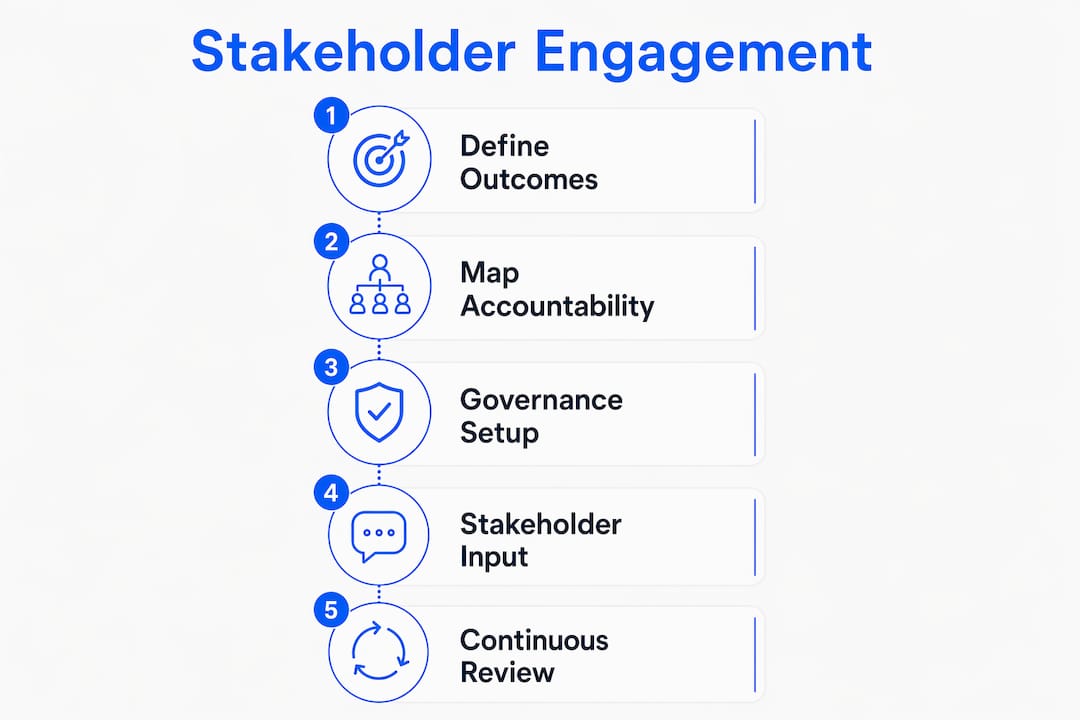
Engaging stakeholders in AI is not a kickoff meeting followed by status emails. Effective engagement attaches stakeholder feedback to specific decision points: model selection, training data boundaries, pilot scope, and escalation workflows. Treat each major decision as a structured engagement event, not a formality.
A practical engagement sequence looks like this:
- Map influence and interest. Categorize stakeholders by their authority to block or accelerate the project and by how directly the AI output affects their work. A CFO and a frontline operations manager need different conversations.
- Open with a sticky story. Research with 29 practitioners showed that concrete narratives emphasizing AI harms increase engagement time and expand the range of risks stakeholders identify. A brief, specific story about a comparable AI failure in your industry activates attention faster than a slide deck of capabilities.
- Tailor your message by stakeholder type. Executives want ROI and risk containment. Operations managers want workflow clarity. Legal and compliance teams want audit trails and override controls. Each group needs a different one-page summary, not the same deck with different logos.
- Embed feedback loops at decision gates. Before finalizing model selection or launching a pilot, schedule a structured input session. Document what stakeholders said and how it changed the plan. This creates a record of collaboration that protects the project team and builds trust.
- Move stakeholders from awareness to advocacy. The goal is not passive approval. Stakeholders who understand the project well enough to explain it to their own teams become internal advocates. That advocacy is what sustains funding through the inevitable mid-project complications.
Pro Tip: Time your stakeholder input sessions to land two weeks before major decisions, not the day before. Stakeholders who feel rushed give defensive answers. Stakeholders who have time to consult their teams give useful ones.
What common mistakes hinder stakeholder buy-in for AI projects?
Most failed AI buy-in efforts share the same four errors. Recognizing them early saves months of rework.
- Leading with technology features. Describing your AI system’s architecture to a CFO is the fastest way to lose the room. Frame every capability as a business outcome. “Our model processes 10,000 records per hour” becomes “Our model cuts the monthly close process from five days to two.”
- Ignoring governance until it becomes a crisis. Teams that skip proactive risk conversations face stakeholder panic when the first model error surfaces. Build governance into the proposal, not the post-mortem.
- Presenting broad, unfocused budgets. Asking for a large, open-ended AI budget signals that the team has not done the work. Staged investment requests tied to pilot milestones are far more persuasive.
- Using accountability-free stakeholder maps. A list of names without decision ownership is a political document, not a governance tool. Every AI workflow that touches a business decision needs a named owner.
“The shift from ‘should we use AI?’ to ‘how do we use AI responsibly?’ only happens when stakeholders see a governance plan before they see a price tag. Without that sequence, every budget conversation becomes a risk conversation you are not prepared for.”
The corrective action for all four mistakes is the same: anchor every conversation in a specific business outcome, a named decision owner, and a clear next step. That structure turns skeptical stakeholders into informed participants.
How do you design a pilot to build incremental buy-in?
A pilot is a bounded experiment with measurable outcomes, not a scaled-down version of the full project. Smaller targeted implementations reduce executive hesitation and build organizational confidence through successive validated successes. This approach, sometimes called micro-buy-in, mirrors how organizations build trust in any new process: one verified result at a time.
Design your pilot in five steps:
- Select a single, high-visibility use case. Choose a problem that stakeholders already recognize as painful and that has a clear before/after measurement.
- Define success metrics before launch. Metrics must tie to business goals, not model performance. “Accuracy above 90%” means nothing to a VP of Sales. “Reduction in quote errors from 12% to under 3%” does.
- Set a fixed time boundary. A 60-day pilot with a defined endpoint is easier to approve than an open-ended proof of concept. Stakeholders can commit to a finite experiment.
- Plan the scale decision in advance. Specify in writing what results will trigger a full rollout, a redesign, or a stop. This removes ambiguity and shows that the team has thought past the demo.
- Report results in business language. Your pilot readout should lead with business impact, not technical metrics. Save model performance data for the appendix.
A concise buy-in proposal of 2–3 pages covering problem, solution, governance, pilot plan, and success metrics is the most effective format for gaining approval. It shifts the conversation from “should we?” to “how do we?”
| Pilot component | What to include |
|---|---|
| Problem statement | One paragraph, quantified business pain |
| Proposed solution | Specific AI approach tied to the use case |
| Governance summary | Decision owner, escalation path, override controls |
| Success metrics | 2–3 business KPIs with baseline and target values |
| Timeline and budget | Fixed duration, staged cost tied to milestones |
Companies that prioritize structured AI readiness, including training and governance preparation, report an average ROI of 171% on those investments. That figure reflects the compounding effect of getting the organizational foundation right before scaling.
Key Takeaways
Securing stakeholder buy-in for AI projects requires outcome-focused framing, accountability mapping, continuous engagement at decision points, and a bounded pilot that proves value before scaling.
| Point | Details |
|---|---|
| Lead with outcomes, not technology | Frame every AI capability as a measurable business result to earn executive approval. |
| Build accountability maps | Name decision owners and escalation paths for every AI-assisted workflow before launch. |
| Engage at decision gates | Attach stakeholder feedback to model selection, pilot scope, and escalation design. |
| Use sticky stories | Concrete narratives about AI risks increase stakeholder engagement and broaden risk identification. |
| Design bounded pilots | A fixed-scope pilot with clear success metrics shifts the conversation from doubt to execution. |
What working with complex organizations taught me about AI buy-in
The most common failure pattern we see at Botiqueai is not technical. It is organizational. Teams spend months building a model and two weeks preparing the stakeholder conversation. That ratio needs to flip.
The shift that changes everything is moving from technology push to outcome pull. When you walk into a stakeholder meeting with a specific business problem, a named decision owner, and a 60-day pilot plan, you are not asking for permission. You are offering a controlled experiment with a defined exit. That framing removes most of the fear that blocks AI adoption.
Accountability mapping is the tool that most organizations skip and most regret skipping. The moment an AI system makes a consequential decision and no one knows who owns the outcome, trust collapses. We have seen this happen in customer service automation, in financial reporting tools, and in HR screening workflows. The fix is always the same: name the owner before the system goes live, not after the incident.
Continuous engagement is harder to sell internally than a kickoff meeting, but it is the only model that works. Stakeholders who are consulted once at the start and then informed at the end feel managed, not involved. Stakeholders who are consulted at each decision gate feel accountable for the outcome. That accountability is what sustains support when the project hits its first real obstacle, and every AI project hits one.
The organizations that build lasting AI capability are the ones that treat AI integration as an organizational practice, not a technology project. The buy-in conversation is where that practice either takes root or dies.
— Botiqueai
How Botiqueai supports your AI stakeholder engagement
Botiqueai works with business leaders and project managers to design AI initiatives that earn stakeholder support from the first conversation. From custom chatbots like Aria that demonstrate immediate, measurable value to governance frameworks that satisfy compliance and legal teams, Botiqueai builds solutions around your specific business outcomes. The team brings structured pilot design, accountability mapping, and stakeholder communication support to every engagement. If you are preparing to present an AI initiative to your leadership team or board, Botiqueai’s AI solutions for business give you the tools and the evidence to make that conversation count.
FAQ
What is stakeholder buy-in in AI projects?
Stakeholder buy-in in AI projects is the committed support of key decision-makers, secured by aligning AI initiatives with specific business outcomes and governance structures. It goes beyond approval to include active collaboration throughout the project lifecycle.
Why do AI projects fail to get stakeholder support?
AI projects most often lose stakeholder support when they lead with technology features instead of business outcomes, skip proactive governance planning, or present unfocused budgets without staged milestones.
What is an accountability map in AI project management?
An accountability map names the decision owner, defines responsibilities, and specifies escalation paths for every AI-assisted decision. It replaces the traditional stakeholder list, which identifies participants but does not assign governance ownership.
How long should an AI pilot be to build stakeholder confidence?
A 60-day pilot with a fixed scope and pre-defined success metrics is the most effective format. Concise, bounded proposals shift the stakeholder conversation from “should we?” to “how do we?”
What are sticky stories and why do they matter for AI engagement?
Sticky stories are concrete, surprising narratives about AI risks or failures used to increase stakeholder attention. Research shows they expand the range of risks stakeholders identify and increase the time they invest in responsible AI conversations.