
The Real Role of AI in B2B Startups in 2026
The Real Role of AI in B2B Startups in 2026
Artificial intelligence is the primary growth driver for B2B startups that want to compete without the headcount of an enterprise. The role of AI in B2B startups goes far beyond chatbots and dashboards. Tools like IBM Watson Studio, GPT-4, and Claude now power everything from automated sales pipelines to personalized onboarding flows. AI-embedded companies grow 2.5x faster than their peers. That number reflects a structural shift, not a trend. Startups that treat AI as a core operating layer, not a feature, are the ones pulling ahead.
How does AI in b2b startups optimize operations?
The biggest operational win AI delivers is time recovery. Sales reps, customer success managers, and ops teams spend enormous chunks of their week on work that produces no direct revenue. AI changes that math fast.

87% of sales organizations use AI in some form, but only 24% effectively replace manual work with it. That gap reveals the real problem: most teams adopt AI tools without fixing the underlying processes those tools are supposed to support.
Here is where AI delivers measurable operational value in B2B startups:
- CRM automation: AI tools transcribe sales calls, extract action items, and update pipeline records automatically. 64% of sales professionals save up to half a selling day per week using AI-assisted CRM systems.
- Document processing: Contract review, invoice matching, and proposal generation that once took hours now run in minutes with large language model integrations.
- Meeting intelligence: Platforms that summarize calls and flag next steps free reps from note-taking entirely.
- Internal knowledge retrieval: AI agents connected to tools like Notion, Confluence, or Slack surface answers to internal questions without requiring a human to respond.
The time recovered from these tasks is not trivial. A five-person startup with the right AI stack can match the customer experience of a team of 20. That is not a marketing claim. It is the new competitive baseline.
Pro Tip: Before layering AI onto any workflow, map the process manually first. AI amplifies what is already there. Flawed manual processes produce worse outcomes at scale when AI accelerates them, not better ones.
How does AI personalize the b2b customer experience?
B2B buyers are not monolithic. A CFO evaluating your product has different concerns than the VP of Engineering who will implement it. AI makes it possible to address both simultaneously, at scale, without doubling your headcount.
AI-driven onboarding adapts the user experience based on behavior patterns, reducing churn by guiding each user toward the features most relevant to their role. SaaS startups using this approach see meaningful improvements in activation rates because the product feels tailored from day one.
On the sales side, AI mapping of buying committees is changing outreach results dramatically:
- Single-threaded outreach (one contact per account) averages a 4% reply rate.
- Multi-threaded outreach enabled by AI mapping of the full buying committee reaches a 14% reply rate.
- AI identifies the right stakeholders, their likely concerns, and the optimal sequence for engagement.
The challenge worth naming is quality control. AI-generated outreach can feel generic when it is not trained on specific customer context. The startups winning with AI personalization are the ones feeding their models with real customer data, call transcripts, and product usage signals, not just firmographic data from a third-party list.
The net effect is that your sales and customer success teams spend less time on research and sequencing. They spend more time on the conversations that actually close deals and retain accounts.
What role does proprietary data play in AI startup value?
Data is not just an input for AI. For B2B startups, it is a balance sheet asset. The role of data in an AI startup determines how defensible the business is and how much it is worth to acquirers or investors.
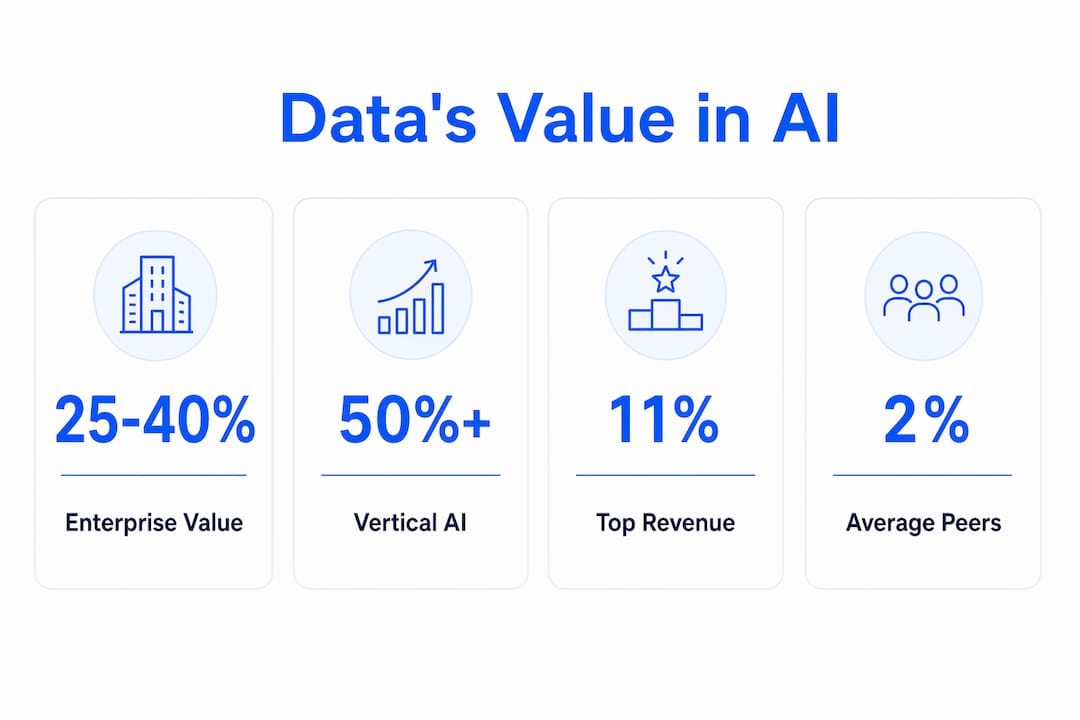
Proprietary data accounts for 25–40% of enterprise value in AI startups overall. For vertical AI companies serving specific industries like legal tech, healthcare, or logistics, that figure climbs above 50%. The reason is simple: a model trained on your unique data cannot be replicated by a competitor who buys the same foundation model from OpenAI.
| Data Strategy | Revenue from Data Assets | Valuation Impact |
|---|---|---|
| Top-quartile AI startups | 11% of total revenue | Significant valuation premium |
| Average AI startup peers | 2% of total revenue | Standard market multiple |
| Vertical AI companies | Proprietary data 50%+ of value | Highest defensibility |
Top-quartile AI startups earn 11% of revenue from data licensing and data-enhanced products. The average peer earns 2%. That gap represents a deliberate strategy, not luck.
The practical implication for B2B founders is to treat every customer interaction, every support ticket, every product usage log as a data asset worth capturing and structuring. Startups that build clean data pipelines early create a compounding advantage. Those that ignore data hygiene until Series A spend that capital cleaning up technical debt instead of building product.
Pro Tip: Explore AI data strategies to understand how vertical-specific startups structure and monetize their proprietary data before competitors commoditize the same foundation models.
How should b2b startups approach AI implementation?
Most failed AI projects fail before a single line of model code is written. The failure happens in the data layer, the process layer, or the expectations layer. Getting implementation right requires discipline in all three.
A structured approach looks like this:
- Run a 14-day data audit first. Identify where your data lives across tools like Salesforce, HubSpot, Slack, Notion, and internal databases. Consolidating siloed data upfront prevents the costly technical debt that comes from retrofitting data pipelines after development starts.
- Decide: build, buy, or integrate. Most B2B startups should integrate before they build. Connecting GPT-4 or Claude to existing workflows via API delivers value in weeks. Custom model training is a later-stage investment.
- Assign clear AI ownership. Someone on your team needs to own the AI roadmap. If you do not have that person internally, a fractional CTO with AI expertise can compress your learning curve significantly by guiding model selection, data strategy, and architecture decisions from day one.
- Set realistic timelines. A well-scoped AI feature goes from concept to production in 60–90 days. Anything faster usually skips the data readiness phase. Anything slower usually signals unclear requirements.
- Measure recovery, not just output. The best metric for early AI implementation is time recovered per team member per week, not volume of AI-generated content or actions.
“AI is best viewed as a tool to recover human time for strategic tasks rather than merely increasing output volume, to avoid amplifying ineffective processes.” — Field Guide to AI in B2B Sales, 2026
The role of machine learning in startups at this stage is not to replace judgment. It is to remove the low-judgment work that consumes the hours your best people should spend on strategy, relationships, and product decisions.
Key takeaways
AI-embedded B2B startups grow 2.5x faster than peers because they treat artificial intelligence as a core operating layer, not an add-on feature.
| Point | Details |
|---|---|
| AI drives measurable growth | Companies embedding AI grow 2.5x faster than peers who treat it as a peripheral tool. |
| Operations win comes from time recovery | AI-assisted CRM and workflow tools save sales reps up to half a selling day per week. |
| Proprietary data multiplies AI value | Top AI startups earn 11% of revenue from data assets versus 2% for average peers. |
| Data readiness determines success | A 14-day data audit before implementation prevents costly technical debt and failed features. |
| Personalization lifts engagement | AI-mapped multi-threaded outreach delivers a 14% reply rate versus 4% for single-contact approaches. |
The shift that most founders are not ready for
The most underappreciated AI impact on B2B startups is not operational. It is organizational. McKinsey research shows that founders of AI-native startups shift from hands-on execution to orchestrating autonomous AI agents that run entire business processes. That is a fundamentally different job.
At Botiqueai, we see this play out with clients regularly. Founders who adapt to this shift build faster. Those who resist it become bottlenecks in their own companies. The ones who struggle most are the ones who want AI to do more of what they already do, rather than asking what becomes possible when AI handles the execution layer entirely.
The honest caution is this: AI also accelerates failure cycles. A bad go-to-market strategy executed by AI at scale fails faster and more expensively than the same strategy executed manually. Domain expertise is not optional. The startups building defensible positions are the ones embedding specific, hard-to-replicate knowledge into their AI systems, not just connecting generic models to generic data.
Small teams can now compete with larger departments in ways that were not structurally possible three years ago. That is genuinely exciting. But the competitive advantage goes to founders who understand what they are orchestrating, not just that they are orchestrating it.
— Botiqueai
How Botiqueai helps b2b startups deploy AI that actually ships
B2B startups do not need more AI demos. They need AI that works in production, connects to real data, and recovers measurable time for their teams.
Botiqueai builds custom AI agents, intelligent chatbots, and workflow automations designed specifically for B2B operations. Every engagement starts with a data readiness assessment and a clear build plan, not a generic technology pitch. Whether you need to automate customer onboarding, build a proprietary data pipeline, or deploy an AI-powered sales assistant, Botiqueai delivers solutions built around your specific processes and customer context. Explore Botiqueai’s AI solutions to see how B2B startups are moving from AI experimentation to AI execution.
FAQ
How does AI benefit b2b companies specifically?
AI benefits B2B companies by automating repetitive sales and operations tasks, personalizing buyer outreach, and surfacing data-driven insights that improve decision-making. Companies that embed AI into core workflows grow 2.5x faster than peers who do not.
What is the role of data in an AI startup’s valuation?
Proprietary data accounts for 25–40% of enterprise value in AI startups, and over 50% for vertical AI companies. Startups that structure and monetize their data assets earn significantly higher revenue multiples than those treating data as a byproduct.
How long does it take to implement AI in a b2b startup?
A well-scoped AI feature typically moves from concept to production in 60–90 days when data readiness is addressed upfront. Skipping the data audit phase is the most common cause of delays and cost overruns.
Should b2b startups build custom AI models or use existing ones?
Most B2B startups should integrate existing models like GPT-4 or Claude via API before investing in custom model training. Custom training becomes worthwhile once you have sufficient proprietary data and a clear monetization strategy for it.
What is the biggest mistake b2b startups make with AI?
The most common mistake is layering AI onto broken manual processes. AI amplifies existing system performance in both directions, so flawed workflows produce worse outcomes at scale when AI accelerates them.