
The Role of AI in Customer Acquisition: 2026 Guide
The Role of AI in Customer Acquisition: 2026 Guide
The role of AI in customer acquisition is defined by its ability to predict, personalize, and automate targeting at a scale no human team can match. Where traditional marketing relies on static segments and manual rules, AI-driven acquisition uses predictive analytics, machine learning, and real-time data to identify and convert the right prospects at the right moment. According to Salesforce research, high-performing marketers who fully implement AI are 2.5x more likely to outperform their peers. That gap is not a coincidence. It reflects a structural advantage in how AI processes signals, allocates budget, and personalizes outreach across every stage of the funnel.
What AI technologies are transforming customer acquisition?
Three core AI technologies drive the biggest gains in acquisition: propensity scoring, predictive bidding, and real-time segmentation. Understanding how each works helps you decide where to deploy resources first.
Propensity scoring and predictive analytics
Propensity scoring is the practice of assigning each prospect a probability score for a specific behavior within a defined time window. AI models predict outcomes like “likelihood of purchase in the next 14 days” or “likely to churn in the next 30 days,” outputting percentile scores that marketing and sales teams use to prioritize outreach. This shifts budget toward prospects who are genuinely close to converting, rather than spreading spend evenly across a cold list.

Uplift modeling goes one step further. Where propensity models identify who is likely to convert, uplift models identify who is persuadable: prospects who will convert because of your marketing, not in spite of it. Predictive personalization combines both approaches to protect margin by avoiding discounts to customers who would have bought anyway. That distinction matters enormously when you are managing paid acquisition at scale.
Ai-driven bidding with google smart bidding
Google Smart Bidding is the most widely deployed AI bidding system in paid search. Its standard configuration optimizes for conversion value, but the real advantage comes from feeding it customer-level predictions. Uploading GCLID and predicted lifetime value (pLTV) scores within 24–48 hours after a purchase trains the algorithm on long-term customer value rather than transaction amounts. The result is a bidding strategy aligned with business outcomes, not just clicks.
Pro Tip: Before investing in model sophistication, audit your data pipeline. Capturing and persisting click IDs end-to-end through your CRM is more critical than the complexity of the AI model itself.
Contextual bandits vs. traditional a/b testing
Contextual bandit algorithms and A/B tests serve different purposes in acquisition optimization. A/B tests provide clean causal evidence by splitting traffic equally. Bandit algorithms reduce cumulative regret by 30–60% compared to equal-split A/B testing on stationary problems. That means fewer wasted impressions during the learning phase. The trade-off is that bandits can obscure causal interpretation, which is why the two methods work best in combination rather than as substitutes.
| Method | Best Use Case | Key Limitation |
|---|---|---|
| Propensity scoring | Prioritizing leads by conversion likelihood | Requires clean historical data |
| Uplift modeling | Targeting persuadable prospects only | More complex to build and validate |
| Google Smart Bidding + pLTV | Aligning paid spend with customer lifetime value | Depends on reliable GCLID mapping |
| Contextual bandits | Ongoing offer and content optimization | Weaker causal inference than A/B tests |
How does AI improve performance across the acquisition funnel?
AI does not improve one stage of the funnel. It reshapes every stage simultaneously, from first impression to closed deal.
At the top of the funnel, AI-powered audience modeling identifies lookalike segments based on your best existing customers. Platforms like Google and Meta use machine learning to find prospects who share behavioral and demographic patterns with high-value converters. This replaces the manual process of building audience lists from static demographic filters.
At the middle of the funnel, lead scoring and qualification automation separate serious prospects from browsers. AI-driven segmentation delivers limited value unless it is connected directly to revenue operations. Scores must trigger routing rules, qualification workflows, and sales follow-up, not just populate a dashboard. When AI outputs are wired into your CRM and sales process, conversion rates improve measurably. You can explore how AI automates lead qualification in practice to see this in action.
At the bottom of the funnel, dynamic bid optimization and personalized outreach close the gap between intent and conversion. AI-generated email sequences, chatbot conversations, and personalized landing pages adapt in real time based on prospect behavior. Salesforce research confirms that AI use cases now span content generation, performance analysis, data integration, and real-time offer optimization across the full funnel.
Pro Tip: Connect your AI lead scores directly to your CRM routing logic. A score sitting in a spreadsheet changes nothing. A score that automatically assigns a lead to the right sales rep changes your pipeline.
The table below maps AI applications to funnel stages and their primary impact:
| Funnel Stage | AI Application | Primary Impact |
|---|---|---|
| Awareness | Lookalike audience modeling | Broader reach among high-fit prospects |
| Consideration | Predictive content personalization | Higher engagement and time-on-site |
| Qualification | Automated lead scoring | Faster routing to sales |
| Conversion | Dynamic bidding with pLTV signals | Higher return on ad spend |
| Retention | Churn prediction models | Reduced customer loss post-acquisition |
How does AI compare to traditional marketing approaches?
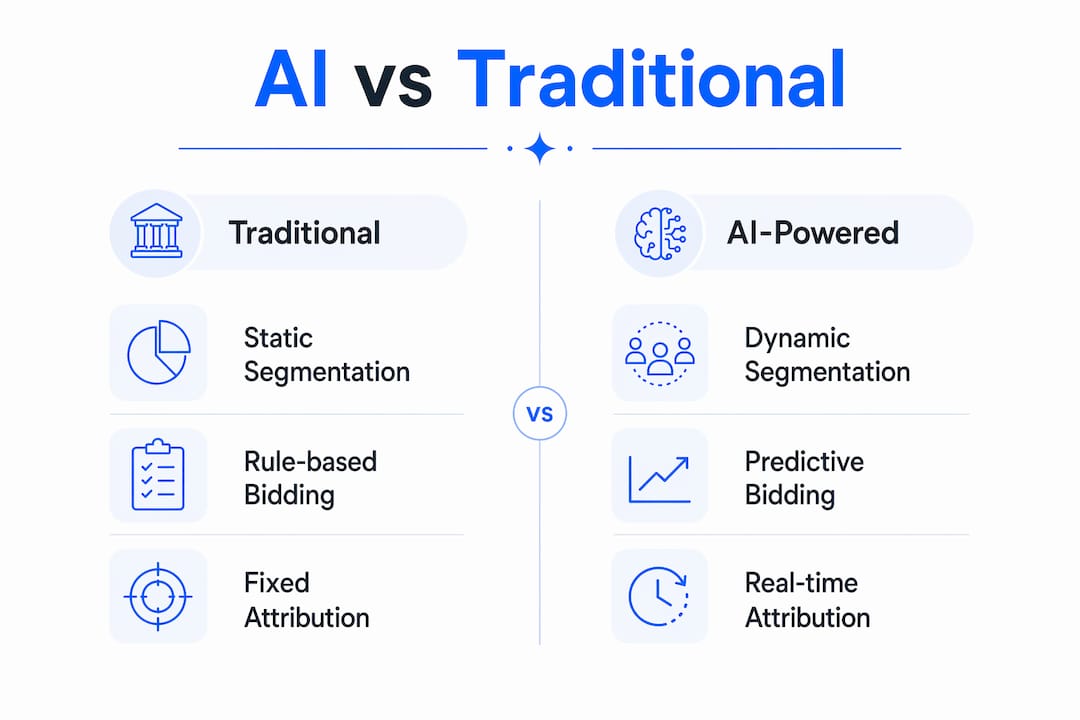
Traditional marketing relies on rules you write in advance. AI marketing relies on patterns the model discovers from data. That difference has compounding consequences across every campaign you run.
Manual segmentation groups customers by static attributes: industry, company size, job title. AI-powered segmentation updates continuously based on behavioral signals, purchase history, and engagement data. A prospect who visited your pricing page three times in two days gets a different score than one who opened a single email six weeks ago. Static rules cannot capture that nuance. AI can.
“The most common mistake I see is teams that build impressive AI models and then leave the outputs in a reporting tool. The model is not the product. The workflow it triggers is the product.”
Rule-based bidding sets fixed bids by keyword or audience. AI predictive bidding adjusts bids in real time based on dozens of signals simultaneously, including device, location, time of day, and predicted customer value. The performance gap between the two approaches widens as campaign scale increases.
| Dimension | Traditional Approach | AI-Powered Approach |
|---|---|---|
| Segmentation | Static demographic filters | Dynamic behavioral and predictive segments |
| Bidding | Fixed rules by keyword | Real-time value-based optimization |
| Personalization | Batch email campaigns | Real-time individual content adaptation |
| Attribution | Last-click or first-click | Multi-touch AI attribution modeling |
| Speed to insight | Weekly or monthly reports | Continuous model updates |
The honest limitation of AI approaches is that they require data quality and integration work that traditional methods do not. A propensity model trained on incomplete or biased data produces worse results than a well-maintained manual segment. AI amplifies the quality of your data infrastructure, for better or worse. You can read more about the difference between marketing automation and AI to clarify which tools fit which problems.
What are best practices for implementing AI in customer acquisition?
Successful AI implementation in acquisition follows a specific sequence. Skipping steps creates the data and measurement problems that undermine results.
-
Fix your data plumbing first. Accurate value-based bidding depends more on data architecture than model sophistication. Capture click IDs at the point of ad interaction and persist them through your CRM and order management system. Without reliable GCLID mapping, predicted value signals cannot inform bidding decisions.
-
Define what you are optimizing before you model. Propensity to purchase, propensity to churn, and predicted lifetime value are three different targets requiring three different models. Align your AI objective with the business metric that actually matters to your acquisition team.
-
Combine bandit learning with A/B testing. Use bandit algorithms for ongoing offer optimization and A/B tests for decisions that require clean causal evidence. Neither method alone gives you the full picture.
-
Maintain a persistent holdback group. A control group of roughly 20% is necessary to measure true incremental lift from AI-driven targeting. Without it, you cannot distinguish genuine performance improvement from selection bias introduced by the model itself.
-
Wire AI outputs into operational decisions. Scores and predictions that live only in analytics tools do not improve acquisition. Connect model outputs to lead routing, bid adjustments, and qualification workflows. Operationalizing AI insights within business processes is what separates teams that see measurable gains from those that run expensive experiments with no revenue impact.
Pro Tip: Run your first AI acquisition experiment on a single channel with a clear holdback group before scaling. Clean measurement on a small test beats noisy data at full budget.
Data privacy is a real constraint, not a footnote. Any model trained on personal behavioral data must comply with applicable regulations, including GDPR and CCPA. Build consent and data governance into your architecture from the start, not as an afterthought.
Key takeaways
AI-driven customer acquisition outperforms traditional methods only when predictive models are connected directly to operational decisions like bidding, routing, and qualification.
| Point | Details |
|---|---|
| Propensity scoring drives prioritization | Score prospects by conversion likelihood to focus budget on the highest-value opportunities. |
| Data plumbing beats model complexity | Reliable GCLID capture and CRM integration matter more than sophisticated algorithms. |
| AI works across the full funnel | From lookalike audiences at the top to churn prediction at the bottom, AI reshapes every stage. |
| Holdback groups are non-negotiable | Maintain a 20% control group to measure true incremental lift from AI-driven targeting. |
| Operationalize outputs or lose value | AI scores must trigger routing, bidding, and qualification actions to produce revenue impact. |
Where AI in acquisition is actually heading
I have worked with enough marketing and revenue teams to say this plainly: the biggest barrier to AI-driven acquisition is not the technology. It is the data infrastructure and the willingness to connect model outputs to real business decisions.
Most teams I see invest heavily in building propensity models and then route the scores to a dashboard that nobody checks before making a call. The model is technically correct. The workflow is broken. That is where the value disappears.
The teams that consistently outperform are the ones who treat data plumbing as a first-class project. They capture click IDs correctly. They map predictions back to auctions. They build holdback groups before they launch, not after they notice the numbers look off.
What I find genuinely interesting about where this is heading is the convergence of real-time personalization and ethical AI constraints. Regulators are tightening rules on behavioral data use, and that pressure is actually forcing better model design. Teams that build consent-first data architectures now will have a structural advantage when compliance requirements tighten further.
The role of machine learning in marketing is shifting from a specialist function to a core operational capability. If your acquisition team is not already treating AI model outputs as inputs to your CRM and bidding systems, you are not behind on technology. You are behind on process.
— BotiqueAI
How Botiqueai can accelerate your AI acquisition strategy
Botiqueai specializes in building custom AI and automation solutions that connect directly to the business processes where acquisition performance is won or lost.
Whether you need a lead scoring system wired into your CRM, a personalized chatbot that qualifies prospects before they reach sales, or a bidding automation layer that feeds predicted lifetime value into Google Smart Bidding, Botiqueai builds it to fit your specific data architecture and revenue goals. The team has delivered AI-driven solutions for brands including L’Oréal and Pernod Ricard, with measurable impact on engagement and conversion. Explore Botiqueai’s AI solutions to see how custom automation can sharpen your acquisition results.
FAQ
What is the role of AI in customer acquisition?
AI in customer acquisition is the use of predictive models, automated bidding, and real-time personalization to identify, target, and convert prospects more efficiently than manual methods allow. Salesforce research shows that fully implemented AI gives high-performing marketers a 2.5x performance advantage over peers.
How does AI improve customer segmentation?
AI-powered segmentation updates continuously based on behavioral signals and purchase history, replacing static demographic filters with dynamic, predictive groups. This allows marketers to target persuadable prospects specifically, rather than broad audiences that include people who would convert regardless of outreach.
What is propensity scoring in marketing?
Propensity scoring assigns each prospect a probability score for a specific action, such as purchasing within 14 days or churning within 30 days. These scores are used to prioritize sales outreach, personalize content, and allocate paid media budget toward the highest-value opportunities.
How does AI attribution differ from traditional attribution?
Traditional attribution models like last-click or first-click assign credit to a single touchpoint. AI attribution uses multi-touch modeling to distribute credit across the full customer journey, giving marketers a more accurate picture of which channels and messages actually drive conversion.
What is the biggest implementation risk for AI in acquisition?
The most common failure point is disconnecting AI outputs from operational decisions. Propensity scores and predictions that live only in reporting tools do not change acquisition performance. Connecting model outputs directly to CRM routing, bid management, and qualification workflows is what produces measurable revenue impact.