
The Role of AI in Digital Transformation: 2026 Guide
The Role of AI in Digital Transformation: 2026 Guide
Artificial intelligence is defined as the central engine of digital transformation, moving organizations beyond rule-based automation into adaptive, judgment-capable workflows. Where traditional digital transformation digitized existing processes, AI fundamentally redesigns how work gets done, how decisions are made, and what outcomes are possible. IBM and the Deloitte AI Institute both frame this shift not as a technology upgrade but as an operational redesign. The Promethium AI roadmap adds a critical nuance: governance and workflow architecture must precede tool selection. Understanding this distinction is what separates leaders who extract real value from those who accumulate AI licenses without results.
How AI differs from traditional digital transformation
Traditional digital transformation is deterministic. You configure a system, it executes a rule, and the output is predictable every time. The role of AI in digital transformation breaks that model entirely. AI systems produce probabilistic outputs with confidence levels, meaning the same input can yield different outputs depending on model state, training data, and context. That shift introduces governance complexity that traditional IT projects never faced.
The ACE Framework captures what AI actually does in enterprise workflows: AI can Ingest, Analyze, Predict, Generate, and Execute tasks with human review reserved for edge cases. This is categorically different from a CRM workflow or an ERP rule set. A traditional system routes an invoice. An AI system reads the invoice, flags anomalies, predicts approval likelihood, drafts a response, and routes it, all without a human touching it unless the confidence score drops below a set threshold.

This capability shift creates new accountability questions. Who is responsible when an AI recommendation causes a bad outcome? The answer requires audit trails and drift monitoring built into the architecture from day one, not added later as a compliance checkbox.
Pro Tip: Before selecting any AI platform, map every workflow the tool will touch. Identify where human review is legally or operationally required. Build those thresholds into your governance framework before deployment begins.
Key governance elements that distinguish AI transformation from traditional digital projects include:
- Human review thresholds: Define confidence score cutoffs that trigger human escalation
- Model training documentation: Maintain records of what data trained each model version
- Drift monitoring: Track when model outputs begin diverging from expected performance
- Audit trails: Log every AI decision for accountability and regulatory review
What does an enterprise AI transformation roadmap look like?
A structured 12-month AI roadmap delivers staged efficiency and ROI gains across three distinct phases. Most organizations that fail at AI do so because they skip phase one entirely and jump straight to deployment.
The three phases break down as follows:
- Foundation and Pilot (months 1–3): Select one high-value, low-risk workflow. Define KPIs before you write a single line of code. Establish your governance framework and data access protocols.
- Production Deployment (months 4–6): Move the pilot to live operations. Target a 20% efficiency gain in the piloted workflow. Introduce MLOps practices to monitor model performance continuously.
- Enterprise Scaling (months 7–12): Expand to additional workflows. Target 15%+ ROI across the portfolio. Stand up a Center of Excellence to own governance, training, and cross-functional coordination.
| Phase | Timeline | Primary Goal | Success Metric |
|---|---|---|---|
| Foundation and Pilot | Months 1–3 | Validate use case and governance | Pilot KPIs defined and baselined |
| Production Deployment | Months 4–6 | Operationalize the pilot | 20% efficiency gain in target workflow |
| Enterprise Scaling | Months 7–12 | Expand and measure portfolio ROI | 15%+ ROI across AI initiatives |
Organizations that embed governance gates at each phase transition succeed far more often than those that treat governance as a post-deployment task. The gate forces a structured review: Is the model performing as expected? Are KPIs being tracked? Has the team identified failure modes?
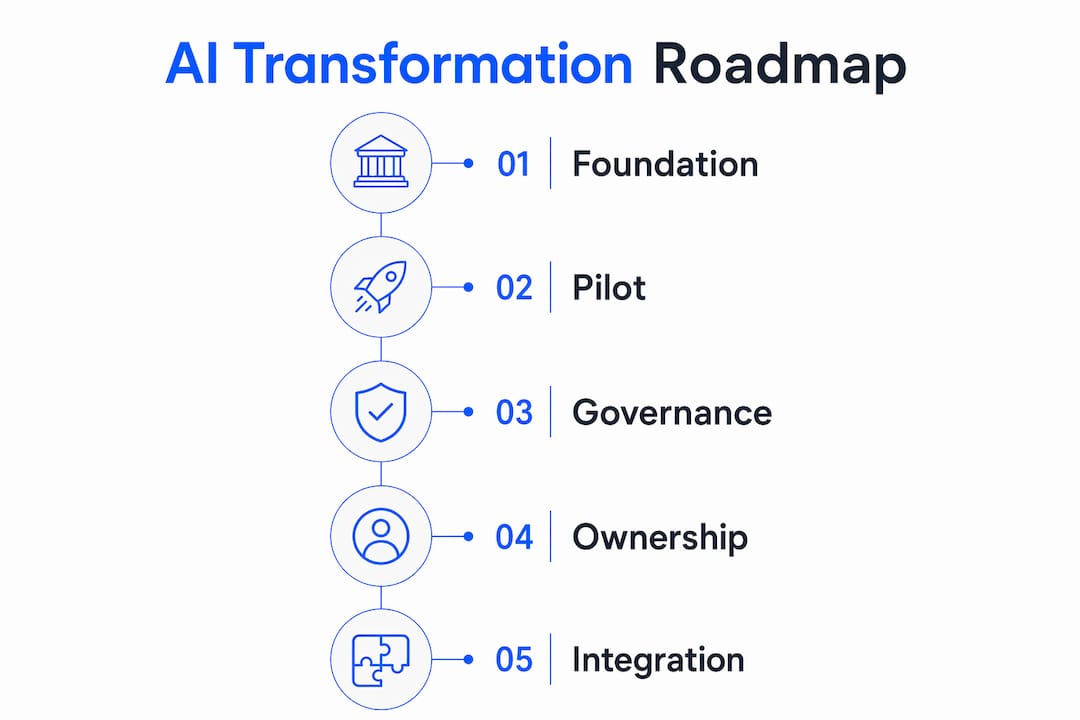
Pro Tip: Assign a named owner for each AI initiative before the pilot launches. Ownership without authority fails. Give that person budget authority and a direct line to the executive sponsor.
The most common failure causes in enterprise AI adoption are not technical. Poor integration, missing KPIs, and governance bolted on after deployment account for the majority of stalled AI programs. Fix those three structural problems first, and your technology choices become far less critical.
How does AI actually improve operational efficiency?
AI improves operational efficiency by shortening cycle times, reducing error rates, and enabling decisions at a scale no human team can match. The more important distinction is between speeding up an existing process and reimagining it entirely. These are not the same outcome.
AI accelerates existing workflows but does not fix broken ones. If your procurement process has three redundant approval steps, AI will surface that redundancy faster and more visibly than any audit. That is useful, but only if leadership acts on what AI reveals. Organizations that layer AI onto broken processes do not get transformation. They get faster failure.
The capabilities AI adds to enterprise operations that traditional digital tools cannot replicate include:
- Autonomous decision-making: AI approves routine transactions, flags exceptions, and escalates edge cases without human queuing
- Personalization at scale: Customer-facing AI tailors content, pricing, and recommendations to individual behavior in real time
- Workflow coordination: AI agents sequence multi-step processes across systems, replacing manual handoffs between departments
- Predictive risk management: Models score credit, fraud, churn, and supply chain risk before problems materialize
Measuring AI value through workflow performance and decision quality produces more accurate ROI assessments than counting user adoption rates. The Deloitte AI Institute makes this point explicitly: adoption metrics tell you how many people logged in. Transformation metrics tell you whether work is fundamentally better.
Why does digital culture matter for AI adoption?
Culture is the most underestimated variable in enterprise AI adoption. Technology teams often assume that deploying a capable model solves the problem. It does not. Governance failures in AI stem from culture and people issues more often than from technical limitations. A model can be technically sound and still fail because the team using it does not trust its outputs, does not understand its limitations, or actively works around it.
The fix is not a training program. It is a framing shift. Governance succeeds when framed around business outcomes rather than compliance requirements. When a sales team understands that the AI governance framework protects their commission accuracy and customer data, they participate. When they see it as an IT audit, they ignore it.
“Framing governance as supporting business priorities rather than a separate compliance task improves stakeholder buy-in and operational adherence.” — Computer Weekly
Building a data-driven culture around AI requires three structural commitments from leadership:
- Visible accountability: Executives must own AI outcomes publicly, not delegate them entirely to technology teams
- Human-in-the-loop design: Processes must be designed so that human review is a meaningful checkpoint, not a rubber stamp
- Continuous measurement: Teams must track AI performance metrics weekly, not quarterly, to catch drift before it causes damage
The role of AI in a data-driven culture is to make good decisions the default, not the exception. That only happens when governance is embedded in how work is designed, not appended after the fact.
Key takeaways
Successful AI-driven digital transformation requires workflow redesign, embedded governance, and phased implementation measured by decision quality rather than adoption numbers.
| Point | Details |
|---|---|
| AI differs from traditional automation | AI produces probabilistic outputs requiring governance structures that deterministic systems never needed. |
| Roadmap phasing determines ROI | A structured 12-month roadmap targeting 20% efficiency gains in production and 15%+ ROI at scale outperforms ad hoc deployment. |
| Broken processes block AI value | AI accelerates what exists; redesign workflows before deploying models or risk faster failure. |
| Culture drives governance success | Framing AI governance around business outcomes increases stakeholder engagement and operational adherence. |
| Measure transformation, not adoption | Track workflow performance and decision quality, not user logins, to assess real AI impact. |
The uncomfortable truth about AI transformation
Most organizations I observe are not doing AI transformation. They are doing AI decoration. They deploy a chatbot on the customer service portal, add a copilot to their email client, and report to the board that they are “AI-enabled.” The adoption numbers look good. The transformation metrics do not exist because nobody defined them.
The leaders who get this right share one habit: they redesign the workflow before they select the tool. They ask what the process should look like if it worked perfectly, then they find the AI capability that closes the gap. That sequence matters enormously. Buying a model and then figuring out where it fits is how you end up with expensive pilots that never reach production.
Governance is the other place where I see consistent failure. Teams treat it as a legal requirement to satisfy before launch, then forget about it. Effective governance is a live operational function. It monitors model drift, reviews edge case escalations, and updates thresholds as business conditions change. The operational muscle to move from pilot to production with governance embedded is what separates leading companies from those still running the same three pilots they launched two years ago.
My honest recommendation: stop measuring AI success by the number of tools deployed. Start measuring it by how many decisions your organization makes better, faster, and with greater accountability than it did before AI. That reframe changes everything about how you build, govern, and scale your AI program.
— Martin
How Botiqueai helps you build AI transformation that sticks
Botiqueai specializes in custom AI solutions designed for exactly the challenges this article describes: workflow redesign, governance integration, and phased deployment that delivers measurable ROI. The team at Botiqueai builds intelligent agents, custom chatbots, and automated workflows tailored to your specific operational context, not generic off-the-shelf tools. For enterprise leaders ready to move from AI pilots to production at scale, Botiqueai’s custom AI automation services provide the architecture and governance frameworks that make scaling possible. You can also explore the full range of AI solutions for business to find the right starting point for your transformation roadmap.
FAQ
What is the role of AI in digital transformation?
AI’s role is to move organizations beyond rule-based automation into adaptive workflows that ingest data, generate predictions, and execute decisions with human oversight on edge cases. This fundamentally redesigns how work gets done rather than simply digitizing existing steps.
How does AI differ from traditional digital transformation?
Traditional digital transformation uses deterministic systems that follow fixed rules. AI introduces probabilistic outputs with confidence levels, requiring governance structures including drift monitoring, audit trails, and human review thresholds that traditional IT projects never needed.
What are the biggest risks in enterprise AI adoption?
The biggest risks are poor process design, missing KPIs, and governance added after deployment rather than embedded from the start. Organizations with structured phased implementation and governance gates at each phase transition succeed significantly more often.
How should leaders measure AI transformation success?
Leaders should measure workflow performance and decision quality rather than adoption rates or user counts. True transformation shows up in faster cycle times, fewer errors, and better outcomes, not in how many employees logged into an AI tool.
Why does AI governance fail so often?
AI governance fails because it is treated as a compliance task rather than a business function. Governance framed around business outcomes generates higher stakeholder engagement and better operational adherence than governance framed as an IT or legal requirement.