
Agentic AI Framework for Enterprise: A Practical Guide
Agentic AI Framework for Enterprise: A Practical Guide
An agentic AI framework is a platform for building, orchestrating, and governing multi-agent autonomous workflows that use large language models (LLMs) and external tools to pursue defined goals with minimal human intervention. For enterprises, this is the infrastructure layer that turns a capable AI model into a reliable business system.
Here is what you need to know before reading further:
- Planning and tool use are the core differentiators from standard generative AI. Agentic systems set goals, plan multi-step workflows, select tools, and act on results.
- Memory, observability, and policy controls separate production-ready frameworks from research demos.
- Who benefits most: automation owners, platform engineers, and enterprise architects replacing brittle RPA pipelines or manual knowledge-work processes.
- Standards to watch: OECD.AI is the leading international body framing agentic AI governance; Google Cloud’s Gemini Enterprise Agent Platform and Botiqueai both offer enterprise-grade deployment paths.
- The GOV.UK AI Insights series describes agentic systems as capability registries: the framework picks which registered tool to invoke, enabling flexibility without hard-wiring every behavior.
Table of Contents
- What is an agentic AI framework, exactly?
- What capabilities must a mature agentic AI framework support?
- How do the core engineering components actually work?
- Which agentic AI frameworks should you actually consider?
- How are enterprises actually using agentic AI today?
- What does a realistic implementation plan look like?
- When should you not use agentic AI?
- How to run your first agentic AI pilot
- Key Takeaways
- The governance gap nobody talks about
- Botiqueai can help you move from pilot to production
- Authoritative sources and further reading
What is an agentic AI framework, exactly?
Generative AI answers a prompt. Agentic AI pursues a goal. That one sentence captures the architectural shift that makes this category worth understanding.
A generative model takes a request and returns content. An agentic system takes a high-level objective, breaks it into steps, selects and calls tools (APIs, databases, browsers, code interpreters), evaluates the results, and loops until the goal is met or a human is needed. Stanford HAI describes agentic AI as systems that “can set or interpret goals, plan and sequence actions, use tools, make decisions based on feedback, and adapt over time.” That is a fundamentally different runtime contract than a chatbot.
The architecture has five layers worth naming. The orchestration engine decides which agents run in what order, whether centrally (a supervisor agent) or via choreography (agents reacting to shared events). The agent runtime hosts individual agents, each with its own prompt context, tool access, and memory scope. The tool and integration layer connects agents to real systems: CRMs, ERPs, ticketing platforms, external APIs. The memory and state store persists context across steps and sessions, which is what lets an agent remember that it already checked inventory before placing an order. Finally, observability and policy enforcement provide the audit trail and the guardrails that make the whole thing auditable and safe to run in production.
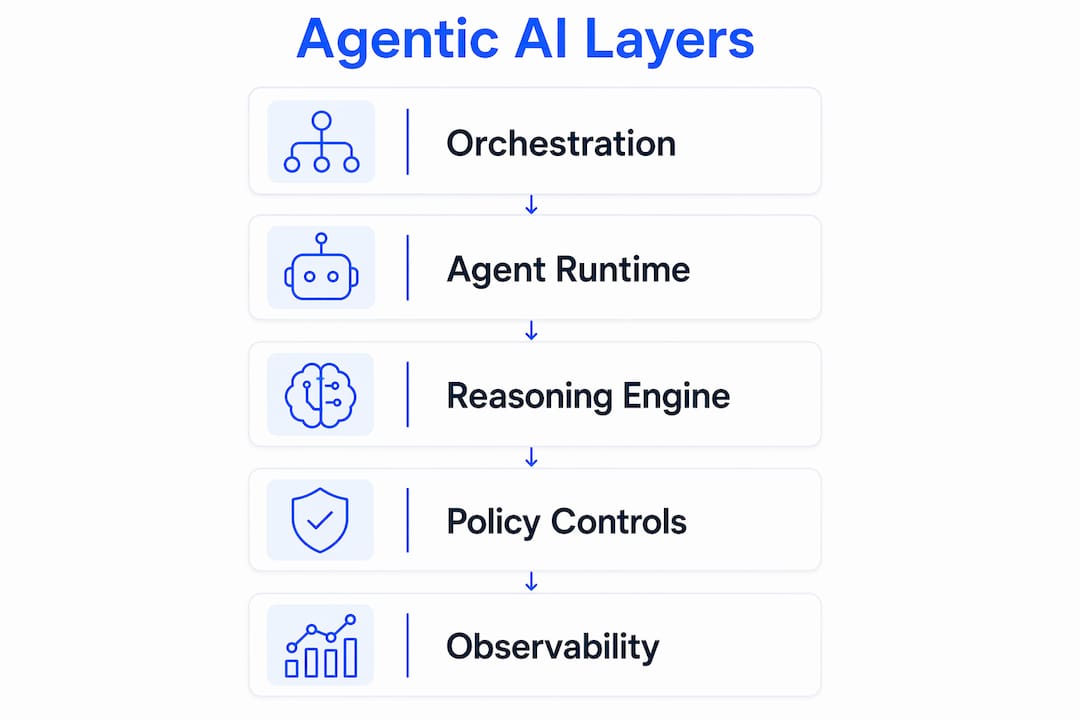
The LLM sits inside the agent runtime as the reasoning engine. It does not own the workflow. The framework does. That distinction matters for reliability: when an agent fails, the failure is usually in the connector contract or the orchestration logic, not in the model itself.
What capabilities must a mature agentic AI framework support?
OECD.AI defines four core characteristics of agentic systems: perception, reasoning, memory, and action. A fifth, communication and coordination, becomes critical the moment you run more than one agent.
- Perception: The agent interprets context from its environment, including structured data, documents, API responses, and prior conversation state. Enterprise implication: the quality of perception depends on your retrieval and grounding layer, not just the model.
- Reasoning: The agent decomposes objectives into executable sub-tasks. Poor reasoning surfaces as plans that reference unavailable APIs or skip prerequisite steps.
- Memory: Persistent context across steps and sessions. Without it, every agent call is stateless, and multi-step workflows collapse.
- Action: Purposeful invocation of tools, APIs, and external systems to produce real-world effects. This is where governance becomes non-negotiable.
- Communication and coordination: Agents must hand off tasks, share state, and resolve conflicts. Orchestration (a central controller) and choreography (event-driven peer communication) are the two dominant patterns. Neither is universally better; the choice depends on workflow complexity and fault-tolerance requirements.
Observability and policy controls are not optional add-ons. They are first-class framework features. An agent that can book flights, update a database, or send a payment needs an audit trail and a kill switch before it goes near production data.
Pro Tip: Embed governance into action paths at design time, not as a post-deployment wrapper. Every tool registration should carry a permission scope and a reversibility flag. Irreversible actions (deletes, financial transactions, external communications) should require an explicit HITL gate in the orchestration logic, not a manual review process bolted on afterward.
How do the core engineering components actually work?
The building blocks of an agentic system each carry tradeoffs that matter at scale.

Orchestration centralization vs. decentralized agents is the first decision. A centralized supervisor agent gives you a single point of control and easier debugging, but it becomes a bottleneck under load. Decentralized choreography scales better but makes root-cause analysis harder when something goes wrong across five agents simultaneously.
State management and persistence determine whether your agent can resume a workflow after a failure or must restart from scratch. In-memory state is fast but fragile. Durable state stores (Redis, a vector database, or a relational store) add latency but are required for any workflow that spans more than a few seconds or involves human approval steps.
Tool verification and connector contracts are where most production failures originate. Agents can produce logically coherent plans that assume API capabilities that do not exist. Formally verifying connector contracts before deployment, and running contract tests on every tool registration, prevents the class of failures where an agent confidently calls an endpoint that returns a 404.
Testing agentic systems requires a different approach than standard software QA. Plan validation (does the agent’s proposed sequence of steps make sense before execution?), simulated runs against mock tool responses, and staged live runs with HITL gates for irreversible actions are all necessary. Standard MLOps metrics like accuracy and latency are insufficient. Agent-trace observability — a causal chain linking prompts, intermediate reasoning, tool calls, returned results, and final actions — is what makes multi-agent failures diagnosable without decoding raw distributed logs.
Pro Tip: Run your first production agents in “shadow mode” alongside the existing manual process. Compare outputs before granting write access to any live system. This gives you a real-world baseline and catches connector failures before they affect customers or data.
Which agentic AI frameworks should you actually consider?
The table below covers the major frameworks and platforms across the dimensions that matter for enterprise selection. Open protocols like Model Context Protocol and Agent2Agent are emerging to standardize agent interactions; frameworks that support them reduce long-term vendor lock-in.
| Framework / Platform | Best For | Learning Curve | Integrations | Scalability | Security & Governance | License / Cost | Community / Maturity |
|---|---|---|---|---|---|---|---|
| Botiqueai | Enterprises needing managed pilots, governance-first rollouts, existing workflow integration | Low (managed service) | Prebuilt enterprise connectors | Managed, scales with service tier | Governance-first design, HITL support | Commercial / contact for pricing | Growing; enterprise-focused |
| Gemini Enterprise Agent Platform | Google Cloud enterprises needing managed orchestration and platform governance | Low–Medium | Native GCP connectors, enterprise data | Fully managed, cloud-native | Managed governance, IAM integration | Commercial (GCP pricing) | High; Google Cloud ecosystem |
| LangGraph | Graph-based orchestration, flexible connector models | Medium | LangChain ecosystem, custom connectors | High; graph model supports complex flows | Community-dependent | Open source (MIT) | High; active LangChain community |
| LangChain | Retrieval-augmented agents, LLM call orchestration | Medium | Large connector library | Medium–High | Community-dependent | Open source (MIT) | Very high; large ecosystem |
| CrewAI | Multi-agent orchestration in complex workflows | Medium | Python ecosystem | Medium | Limited built-in governance | Open source | High; growing fast |
| CrewAI Enterprise | Large orgs needing centralized governance and enterprise SLAs | Medium | Enterprise connectors | High | Centralized governance controls | Commercial | Medium; enterprise tier |
| AutoGen | Rapid prototyping, research teams | Low–Medium | Python, Azure integrations | Medium | Limited | Open source (MIT) | High; Microsoft-backed |
| OpenAI Agents SDK | Teams using OpenAI models | Low | OpenAI ecosystem, tool use primitives | Medium | Model-level safety features | Open source / OpenAI terms | High; OpenAI-backed |
| Semantic Kernel | Microsoft Azure / .NET enterprises | Medium | Microsoft stack, plugin connectors | High in Azure | Azure AD, enterprise identity | Open source (MIT) | High; Microsoft-backed |
| Microsoft Agent Framework | Microsoft and Azure organizations | Medium | Deep Microsoft service integration | High in Azure | Enterprise-grade, Azure identity | Commercial / Azure pricing | High |
| LlamaIndex | Retrieval-augmented grounding for agents | Medium | Flexible data connectors, many sources | Medium | Community-dependent | Open source (MIT) | High |
| Haystack | Knowledge-centric agents, search and retrieval | Medium | Document stores, search backends | Medium | Community-dependent | Open source (Apache) | High |
| DSPy | Python-first data pipeline control | Medium–High | Python ecosystem | Medium | Community-dependent | Open source (MIT) | Medium |
| PydanticAI | Strict contract validation between agents and tools | Medium | Python, schema-validated connectors | Medium | Schema enforcement reduces runtime errors | Open source | Medium; growing |
| Mastra | Modular enterprise connectors and adapters | Medium | Enterprise adapters, modular design | Medium–High | Modular governance options | Open source / commercial | Medium |
| Agno | Hybrid cloud and on-prem deployments | Medium–High | Hybrid deployment connectors | High; on-prem support | Strong for sensitive workloads | Commercial | Low–Medium |
| Akka Agentic AI Platform | High-throughput distributed, resilient systems | High | JVM ecosystem, distributed connectors | Very high; actor model | Production-grade fault tolerance | Commercial | Medium; Lightbend ecosystem |
| SuperAGI | Agent delegation and chain-of-command experiments | Medium | Python ecosystem | Medium | Limited | Open source | Medium |
| AutoAgent | Small teams prototyping multi-step agents | Low | Lightweight connectors | Low–Medium | Minimal | Open source | Low–Medium |
| Claude Agent SDK | Teams using Anthropic Claude models | Low–Medium | Anthropic tool-use patterns | Medium | Model-tailored safety practices | Open source / Anthropic terms | Medium; Anthropic-backed |
| SmolAgents | Academic and small-scale research | Low | Minimal | Low | Minimal | Open source | Low–Medium |
| Atomic Agents | Composable multi-agent workflows from primitives | Medium | Python, composable connectors | Medium | Community-dependent | Open source | Medium |
| OpenAI Swarm | Model ensemble coordination | Medium | OpenAI ecosystem | Medium | Model-level | Open source (experimental) | Low–Medium |
| Ray RLlib / Ray | Distributed orchestration, reinforcement learning | High | Distributed compute, Python | Very high; distributed | Community-dependent | Open source (Apache) | High |
| MAgent | Many-agent simulation and emergent behavior research | High | Research environments | High for simulation | Research-grade | Open source | Low–Medium |
| JADE | Java-first agent systems, academic patterns | High | JVM, legacy enterprise systems | Medium | Established agent patterns | Open source (LGPL) | Medium; long heritage |
| FIPA | Standardized agent communication semantics | N/A (standards body) | Interoperability protocols | N/A | Interoperability standards | Open standard | Established; historical |
| ARCADE | Resource scheduling among agents | High | Resource management connectors | Medium–High | Resource-aware coordination | Research / limited | Low |
| Maestro (UiPath) / BOAT (UiPath) | Enterprises using UiPath RPA adding agentic behaviors | Low (for UiPath users) | Deep RPA and business process connectors | High; enterprise RPA scale | Enterprise-grade, UiPath governance | Commercial (UiPath licensing) | High; UiPath ecosystem |
Pick-this-if guidance for three common archetypes:
- Quick prototype: AutoGen or SmolAgents get you a working multi-agent loop in an afternoon. Neither is production-ready without significant governance work added on top.
- Enterprise framework (managed): Botiqueai for governance-first managed rollouts, Gemini Enterprise Agent Platform for Google Cloud shops, or Microsoft Agent Framework / Semantic Kernel for organizations deep in the Azure ecosystem.
- Extensible open-source: LangGraph or LangChain for teams that want maximum connector flexibility and are willing to build their own observability and governance layers. LlamaIndex is the right addition when retrieval quality is the primary risk.
How are enterprises actually using agentic AI today?
The most credible enterprise use cases share a common pattern: they replace a multi-step human workflow that was already partially automated but still required a person to coordinate the steps.
Automated procurement and ordering is one of the clearest wins. An agent monitors inventory levels, checks supplier APIs for pricing and availability, drafts purchase orders, routes them for approval, and submits confirmed orders to the ERP. The human approves the order; the agent handles everything else. The operational outcome is a reduction in procurement cycle time and near-elimination of manual data entry errors.

Customer support that executes actions goes beyond answering questions. An agent that can look up an order, check warehouse status, issue a refund, and send a confirmation email resolves a support ticket end-to-end. Automating customer support this way typically cuts average handle time significantly and frees human agents for escalations that genuinely require judgment.
Intelligent RPA replacement is where frameworks like Maestro (UiPath) and BOAT (UiPath) are gaining traction. Traditional RPA breaks when a UI changes. An agentic layer that understands intent, not just screen coordinates, is more resilient to system changes and can handle exceptions by reasoning about them rather than throwing an error.
Autonomous monitoring and remediation in IT operations is another high-value pattern. An agent monitors system health metrics, identifies anomalies, cross-references runbooks, attempts standard remediations, and escalates to an on-call engineer only when automated fixes fail. Mean time to resolution drops; alert fatigue decreases.
Knowledge-work assistants that update CRM and ERP records automatically are a fifth pattern worth watching. A sales agent that listens to a call transcript, extracts action items, updates Salesforce, and schedules follow-up tasks removes a category of administrative work that consumes a meaningful portion of a sales team’s day.
What does a realistic implementation plan look like?
Getting from “we want to try agentic AI” to a production system that your compliance team will sign off on takes longer than most vendors suggest. Here is a realistic sequence.
Governance and HITL design come first
Policy-as-code means encoding your approval rules, data access scopes, and escalation conditions into the framework configuration before any agent touches a live system. Every irreversible action (a payment, a deletion, an external communication) needs an explicit approval gate. Audit trail requirements for regulated industries typically mean every agent action must be logged with its reasoning context, not just its output.
Treating autonomy as a controlled iterative process rather than a binary switch is the single most important mindset shift for enterprise teams. Start with agents that recommend and humans that approve. Expand autonomy only after you have validated the agent’s decision quality against a real baseline.
Timeline and phases
- Pilot: Define one well-scoped workflow, register tools, build a minimal orchestrator, enforce HITL gates on all actions, run closed-loop tests against mock data, then shadow-mode against live data.
- Expanded pilot: Add more workflows, integrate with production systems in read-only mode first, implement agent-trace observability, establish escalation procedures, and measure against defined success metrics.
- Initial production: Grant write access to validated workflows, expand tool coverage, onboard additional business units, and formalize governance review cycles.
Cost drivers
- LLM inference compute: The largest variable cost. Token volume scales with workflow complexity and the number of reasoning steps per task.
- Connector engineering: Often underestimated. Each enterprise system integration requires authentication, schema mapping, error handling, and contract testing.
- Observability and logging: Agent-trace infrastructure adds storage and processing costs that standard application logging budgets do not cover.
- Security and compliance review: Regulated industries (finance, healthcare) require formal security assessments of every tool connector and data access path.
- Staffing: Plan for at least one ML engineer and one SRE with agent-systems experience per production workflow cluster.
Roles and responsibilities
| Role | Owns |
|---|---|
| Agent designer (ML engineer) | Agent prompts, reasoning logic, tool registration |
| Connector engineer | Tool integrations, API contracts, schema validation |
| Policy owner (compliance / legal) | HITL gate definitions, data access scopes, audit requirements |
| Observability engineer (SRE) | Agent-trace infrastructure, alerting, incident response |
| Business validator (process owner) | Success metrics, acceptance testing, escalation procedures |
When should you not use agentic AI?
Agentic AI is not the right answer for every automation problem. Knowing when to hold back is as important as knowing when to move forward.
High-stakes safety-critical control loops without rigorous formal validation are the clearest no-go. An agent controlling physical infrastructure, medical device parameters, or financial settlement systems needs a level of formal verification that current frameworks do not provide out of the box. The risk of agent hallucination in planning — logically coherent plans that assume unavailable capabilities — is unacceptable in these contexts without extensive mitigation.
Small-scale one-off tasks where the integration cost outweighs the automation benefit are another poor fit. If a workflow runs once a month and takes a human 20 minutes, building and maintaining an agentic pipeline for it is not a good use of engineering time.
Environments lacking reliable real-time data will produce agents that make decisions on stale or incomplete information. Garbage in, confident wrong action out.
The key risks to mitigate when you do proceed:
- Permission creep: Agents accumulate tool access over time. Audit and prune scopes regularly.
- Data leakage via connectors: Every tool connector is a potential data exfiltration path. Vet connectors with the same rigor as third-party software.
- Compliance exposure: Regulated data (PII, PHI, financial records) flowing through agent memory stores requires the same controls as any other data processing system.
Pro Tip: Define a “blast radius” for every agent before deployment: the maximum scope of damage if the agent executes a flawed plan without human review. If the blast radius is unacceptable, the HITL gate is not optional.
For a deeper look at reliability-focused agent design, the tradeoffs between autonomy and safety are worth examining before you finalize your governance model.
How to run your first agentic AI pilot
A pilot that produces a real decision is worth more than a demo that impresses a room. Here is a checklist that enterprise AI teams can adapt for their first deployment.
Pilot checklist
- Define the goal and success metrics before writing a single line of agent code. Time-to-resolution, automation coverage rate, error rate, and cost per transaction are the four metrics worth tracking from day one.
- Register capabilities and tools with explicit permission scopes and reversibility flags. Document what each tool can and cannot do.
- Build a minimal orchestrator that handles the happy path and at least two common failure modes.
- Enforce HITL gates on every irreversible action. No exceptions in the pilot phase.
- Run closed-loop tests against mock tool responses before touching any live system.
- Implement agent-trace observability from the first day of live testing. You cannot debug what you cannot see.
- Define escalation procedures for when the agent reaches a decision point it cannot resolve. Who gets paged? What is the SLA?
- Conduct a shadow-mode run alongside the existing process for at least two weeks before granting write access.
Success metrics
- Time-to-resolution: How long does the agent take to complete the workflow versus the manual baseline?
- Automation coverage: What percentage of workflow instances complete without human intervention?
- Error rate: How often does the agent take an incorrect action or require rollback?
- Cost per transaction: Total compute plus engineering cost divided by completed workflow instances.
- ROI timeframe: At current volumes, when does the automation cost break even against the manual process cost?
Architecture narrative
A minimal pilot architecture maps to five components in your existing enterprise stack. The orchestration layer (LangGraph, CrewAI, or a managed service like Botiqueai) sits above your existing systems. The agent runtime connects to your tool layer via authenticated API connectors to CRM, ERP, ticketing, or communication systems. A state store (Redis or a vector database) persists workflow context. An observability layer captures agent traces and routes alerts to your existing monitoring platform (Datadog, Grafana, or equivalent). Botiqueai’s enterprise integration services provide prebuilt connectors for common enterprise systems and can accelerate the connector engineering phase that typically consumes the most pilot time.
Pro Tip: Assign a single business process owner to every pilot workflow. Technical success without business validation is not success. The process owner signs off on acceptance criteria, reviews escalation logs weekly, and owns the decision to expand autonomy at each phase gate.
For practical guidance on iterative AI development and keeping pilot scope tight, the lean AI development approach is worth reviewing before you start.
Key Takeaways
An agentic AI framework is the orchestration, governance, and integration infrastructure that turns LLM reasoning into reliable, auditable enterprise automation — and choosing the right one depends far more on your governance requirements and connector landscape than on model quality alone.
| Point | Details |
|---|---|
| Definition and enterprise value | Agentic AI frameworks orchestrate multi-agent, goal-driven workflows using LLMs and tools — replacing brittle manual coordination with governed automation. |
| Governance before autonomy | Embed HITL gates and policy-as-code into action paths at design time; expand autonomy only after validating decision quality against a real baseline. |
| Observability is non-negotiable | Agent-trace infrastructure — not standard MLOps metrics — is required to diagnose multi-agent failures in production. |
| Pilot timeline | Plan for an initial pilot phase, followed by an expanded pilot, and then a period to reach initial production with governance sign-off. |
| Botiqueai for managed rollouts | Botiqueai offers governance-first pilot support, prebuilt enterprise connectors, and integration services for teams that need a managed path from prototype to production. |
The governance gap nobody talks about
Most agentic AI conversations focus on model selection and framework features. The harder problem is organizational: who owns the agent when it fails?
In most enterprise pilots, the answer is nobody, or everybody, which amounts to the same thing. The ML engineer built the prompt. The connector engineer wired the API. The business analyst defined the workflow. When the agent books the wrong flight or sends the wrong email, the incident falls into a gap between three teams that each own a piece of the system but none of the outcome.
The frameworks covered in this guide are genuinely capable. LangGraph, CrewAI Enterprise, and the managed platforms from Google Cloud and Microsoft have matured significantly. But a capable framework deployed without clear ownership, observability, and escalation procedures will underperform a simpler system that has all three. The socio-technical framing from OECD.AI is not academic hedging. It is a practical warning: the value of agentic AI comes from reliable interactions between agents, humans, and institutional processes. Get the human and institutional side right first, and the technology will follow.
Botiqueai can help you move from pilot to production
Building an agentic AI system from scratch is an engineering project. Getting it to production in a regulated enterprise environment is an integration, governance, and change-management project. Those are different problems.
Botiqueai’s enterprise services cover the full path: pilot scoping and architecture design, connector engineering for your existing CRM, ERP, and communication systems, observability setup, and governance framework configuration. The Aria conversational agent handles customer-facing automation, while n8n and Make workflow automation services connect your internal systems without requiring custom API development for every integration. For teams that need a proof point before committing, Botiqueai’s pilot program starts with a defined workflow, a fixed scope, and measurable success criteria. Contact Botiqueai to scope your first governed agentic workflow.
Authoritative sources and further reading
These are the primary sources cited in this guide, organized by what they are most useful for.
- What is Agentic AI? — Stanford HAI: The clearest academic definition of agentic AI, covering goal interpretation, tool use, and the distinction from reactive systems. Start here for definitional grounding.
- Can we create a clear understanding of what agentic AI is and does? — OECD.AI: The authoritative international policy framing. Covers the four core characteristics (perception, reasoning, memory, action) and the socio-technical governance perspective. Essential for policy and compliance teams.
- What is agentic AI? — Google Cloud: Practical enterprise framing from Google Cloud, covering the generative vs. agentic distinction and the Gemini Enterprise Agent Platform. Useful for teams evaluating managed cloud options.
- AI Insights: Agentic AI — GOV.UK: UK government guidance on capability registration, orchestration vs. choreography, and agentic AI deployment considerations. Useful for governance and public-sector teams.
- Agentic AI Frameworks: Building Custom Agents — Mirantis: Practitioner-level coverage of framework selection, HITL design, and the iterative autonomy model. Best for engineering teams planning a production deployment.
- Agentic AI frameworks, platforms, protocols, and tools — AWS Prescriptive Guidance: AWS’s prescriptive guidance on open protocols (Model Context Protocol, Agent2Agent), agent-trace observability, and framework selection. Best for teams building on AWS or evaluating interoperability standards.
- Agentic AI, explained — MIT Sloan Management Review: Executive-level framing of agentic AI for business leaders. Useful for building internal alignment and communicating the business case.
- BotiqueAI insights and guides: Practical implementation guides, agent type breakdowns, and enterprise automation case studies from Botiqueai’s editorial team.