
What Is AI API Integration? A 2026 Enterprise Guide
What Is AI API Integration? A 2026 Enterprise Guide
AI API integration is defined as the process of connecting pre-built AI services to business applications and workflows through programmatic interfaces called APIs, enabling intelligent automation without building AI models from scratch. For developers and businesses, this approach removes the need to manage GPU infrastructure, training pipelines, or deep machine learning expertise. Instead, you call an endpoint, send data, and receive AI-driven outputs: predictions, classifications, generated text, or automation triggers. The result is faster deployment, lower cost, and AI capabilities embedded directly into the systems your teams already use. Understanding this process is the foundation for any serious automation strategy in 2026.
What is AI API integration and how does it work?
AI API integration works by placing an API layer between your application and an AI model hosted in the cloud. APIs provide mechanisms allowing different systems to communicate, connecting applications to AI models and returning outputs like predictions, recommendations, or automation triggers. That communication layer is what makes AI accessible to any developer with an HTTP client, regardless of their machine learning background.
The technical flow follows a consistent pattern:
- Client request: Your application sends data to an API endpoint in a standardized format, typically JSON or XML.
- Authentication: The request passes through an authentication layer using an API key or OAuth token to verify identity and enforce access controls.
- Model inference: The AI provider’s infrastructure processes the request, runs the model, and generates a result.
- Response handling: Your application receives the structured response and routes it into the appropriate workflow, database, or user interface.
- Middleware processing: In enterprise environments, a middleware layer often sits between your app and the API to enforce data consistency, log requests, and handle errors before they reach production systems.
An AI API acts as a messenger, allowing applications to access pre-trained models through specific endpoints, with authentication and request-response protocols standardized across providers. Integration platforms as a service (iPaaS) extend this further by linking AI models directly to ERP, CRM, and business workflows.
Pro Tip: Design your middleware layer to normalize API responses before they touch your core business logic. This single decision prevents cascading failures when a provider changes its response schema.

What is AI interoperability and why does it matter?
AI interoperability is defined as the ability of different AI systems, agents, and tools to exchange data and coordinate actions without manual transformation or custom connectors for every pair of systems. The industry term for this capability is semantic interoperability, and it is becoming the defining challenge for enterprises running multiple AI services simultaneously.
Most early AI integrations relied on simple 1-to-1 API connectors: one application talks to one AI service through a custom-built bridge. This approach breaks down fast. Add a third service, a fourth provider, or a new data format, and the number of custom connectors multiplies. The engineering overhead grows faster than the business value.
Relying on AI-mediated transformation to fix data format mismatches is inefficient, prone to errors, and token-expensive for production. Middleware enforcing semantic compatibility is a more sustainable approach. Native semantic interoperability reduces technical debt and improves long-term scalability.
The industry response to this problem is the emergence of protocols like the Model Context Protocol (MCP), which standardizes how AI agents share context and coordinate tasks. By 2026, AI interoperability using protocols like MCP enables AI agents to autonomously collaborate across organizational silos, reducing engineering overhead compared to simple 1-to-1 API integrations. That shift matters because it moves AI from isolated tools to coordinated systems that can handle complex, cross-functional workflows.
Key risks of ignoring interoperability:
- Fragmented ecosystems: Each AI tool operates in isolation, preventing cross-functional automation.
- Data format conflicts: Incompatible schemas force manual transformation or expensive AI-mediated fixes.
- Vendor lock-in: Bespoke connectors tie your architecture to a single provider’s conventions.
- Scaling failure: Without minimal interoperability standards, enterprise AI risks fragmentation that blocks autonomous cross-functional workflows entirely.
For teams building enterprise AI agents, interoperability is not optional. It is the architectural decision that determines whether your AI investments compound or stagnate.
What are the best methods for integrating AI APIs?
The method you choose for AI API integration determines your maintenance burden, your flexibility, and your cost at scale. Three primary approaches dominate enterprise deployments.
SDK vs. raw HTTP calls
Software development kits (SDKs) provided by AI vendors wrap the raw HTTP calls in language-native libraries, handling authentication, retries, and response parsing automatically. Raw HTTP calls give you more control but require you to manage every detail manually. For most production systems, SDKs reduce boilerplate and speed up initial deployment. Raw HTTP calls make sense when you need fine-grained control over request headers, timeouts, or custom retry logic that the SDK does not expose.
Unified API platforms
Unified API platforms provide a standardized interface to multiple AI models and providers, simplifying authentication, data formatting, and routing for multi-model workflows. These platforms optimize latency and cost through intelligent request routing and automatic failover when a provider goes down. For teams working with CRM integrations like HubSpot or Pipedrive, unified platforms eliminate the need to maintain separate authentication flows for each AI service.
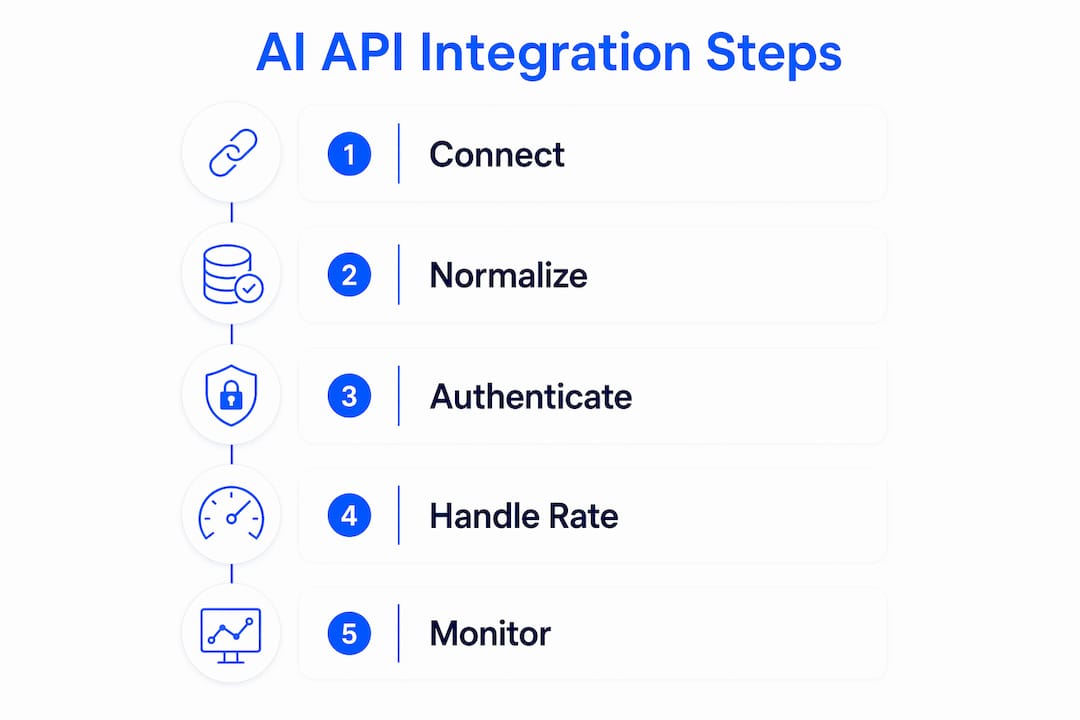
Multi-model orchestration in single API calls reduces the complexity of stitching together multiple SDKs, enabling more powerful and efficient AI-driven application workflows. Some platforms support image, video, audio, and text generation through a single unified endpoint with granular authentication controls.
Middleware strategies
Middleware sits between your application and the AI API to enforce data consistency, manage rate limits, and handle errors before they cascade. LLM API providers host AI models through APIs, allowing developers to outsource GPU management, scaling, and inference. Middleware complements this by adding the business logic layer that raw API calls cannot provide on their own.
Pro Tip: Build rate limit handling into your middleware from day one. Most AI APIs enforce strict request quotas, and a production outage caused by a 429 error is entirely preventable with a simple exponential backoff strategy.
The comparison below summarizes the trade-offs:
| Method | Best for | Main trade-off |
|---|---|---|
| SDK | Fast prototyping, standard use cases | Less control over low-level behavior |
| Raw HTTP | Custom retry logic, non-standard headers | Higher maintenance burden |
| Unified API platform | Multi-provider workflows, cost optimization | Adds a dependency on the platform layer |
| Middleware layer | Enterprise production systems | Requires upfront architecture investment |
How can organizations implement AI API integration effectively?
Effective implementation starts before you write a single line of code. The most common failure mode is connecting an AI API to a process that was not clearly defined to begin with.
Follow these steps to build a production-grade integration:
- Assess your processes. Map the business workflows where AI can add measurable value. Customer support triage, document classification, and sales forecasting are high-return starting points.
- Select your AI API providers. Match provider capabilities to your use case. Cloud providers and aggregator platforms offer multi-provider access and enterprise security features that simplify compliance.
- Manage authentication and security. Store API keys in a secrets manager, never in source code. Rotate credentials on a defined schedule and apply the principle of least privilege to every integration.
- Design for failure. Build fallback logic into every API call. If the primary model is unavailable, route to a backup or return a graceful degradation response instead of an error.
- Monitor performance and costs. Track token consumption, latency, and error rates from the first deployment. AI API costs scale with usage, and unmonitored integrations routinely exceed budget projections.
The actual challenge in AI API integration lies beyond the API call itself. Managing context state, prompt consistency, and robust error handling separates a working prototype from a production-grade system. Teams that treat the API call as the finish line consistently encounter failures at scale.
Practical considerations that most guides skip:
- Context window management: Long conversations or large documents can exceed model limits. Implement chunking or summarization strategies before hitting the API.
- Prompt versioning: Treat prompts like code. Version them, test changes, and roll back when a new prompt degrades output quality.
- Compliance logging: Regulated industries require audit trails of AI inputs and outputs. Build logging into the middleware layer, not as an afterthought.
For teams without deep technical resources, a no-code AI integration guide can reduce the barrier to entry significantly while still following sound architectural principles.
Key Takeaways
Successful AI API integration requires architectural discipline from the start, not just a working API call.
| Point | Details |
|---|---|
| Define integration clearly | AI API integration connects pre-built AI services to applications via programmatic interfaces, enabling automation without building models. |
| Prioritize semantic interoperability | Native semantic compatibility between systems reduces technical debt far more than AI-mediated data fixes. |
| Choose the right method | Match your integration method (SDK, raw HTTP, unified platform, or middleware) to your production requirements and team capacity. |
| Build for failure from day one | Fallback logic, rate limit handling, and error management separate prototypes from production-grade systems. |
| Monitor costs and context | Track token usage, latency, and context window limits continuously to avoid budget overruns and quality degradation. |
The uncomfortable truth about AI API integration
Most teams underestimate what “integrated” actually means. Connecting to an API endpoint takes an afternoon. Building a system that stays connected reliably, handles edge cases, manages context across sessions, and does not silently degrade over time takes months of deliberate engineering.
The pattern I see most often: a team ships a proof of concept that works beautifully in a demo, then spends the next quarter firefighting production failures that were entirely predictable. The root cause is almost always the same. The team optimized for speed to first response and ignored everything that happens after the API call returns.
The interoperability conversation is where this gets interesting. The industry is moving toward multi-agent systems where AI components coordinate autonomously. That future only works if the underlying integrations are built on semantic standards, not bespoke connectors. Teams that invest in proper middleware and interoperability protocols now will compound those returns as their AI architectures grow. Teams that patch format mismatches with AI-mediated fixes are building technical debt that compounds just as fast, in the wrong direction.
My honest advice: treat your integration layer as a first-class product. Give it the same engineering rigor you give your core application. The API call is the easy part.
— Botiqueai
Botiqueai’s approach to AI API integration for your business
Building a reliable AI API integration from scratch demands significant engineering time, especially when you factor in middleware, error handling, and interoperability requirements.
Botiqueai designs custom AI agents, chatbots, and automation workflows built on sound integration architecture from the ground up. The Aria AI chatbot connects directly to your existing business systems through well-structured API integrations, handling customer communication automation without the overhead of managing model infrastructure yourself. For e-commerce teams, Botiqueai’s Shopify AI solution brings the same integration depth to cart recovery and customer engagement. Every solution Botiqueai delivers is built to production standards, not demo standards.
FAQ
What is an AI API?
An AI API is a programmatic interface that gives applications access to pre-trained AI models hosted in the cloud, returning outputs like predictions, generated text, or classifications in response to structured requests.
What is the difference between an API and an AI API?
A standard API connects software systems to exchange data or trigger actions. An AI API specifically connects applications to machine learning models, returning intelligent outputs rather than simple data retrieval.
What is AI interoperability in the context of API integration?
AI interoperability is the ability of different AI systems and agents to exchange data and coordinate actions using shared standards, reducing the need for custom connectors between every pair of tools.
How do I handle rate limits in AI API integration?
Implement exponential backoff in your middleware layer so that failed requests retry automatically with increasing delays. Production-grade AI API integration requires this handling from the first deployment, not as a later fix.
What are the main benefits of using a unified AI API platform?
Unified platforms simplify authentication, normalize data formats across providers, and enable intelligent request routing that reduces latency and cost compared to managing separate SDK integrations for each AI service.