
AI Center of Excellence: The 2026 Guide for Business Leaders
AI Center of Excellence: The 2026 Guide for Business Leaders
An AI Center of Excellence (AI CoE) is a dedicated, cross-functional unit that centralizes AI expertise, governance, and resources across an organization to drive consistent, measurable business value from AI investments. Think of it as the connective tissue between executive vision and the teams actually shipping AI products. Without one, AI adoption tends to fracture: different departments run duplicate experiments, governance gaps widen, and the organization ends up with a patchwork of models nobody fully owns or trusts.
37% of large US companies have already established an AI or ML Center of Excellence, a figure that reflects how quickly this structure has moved from a forward-thinking experiment to a standard operating practice for serious enterprise AI programs.
An effective AI CoE does several things at once:
- Sets AI strategy aligned to business priorities, not just technical curiosity
- Standardizes tools, frameworks, and processes so teams aren’t reinventing the wheel
- Enforces governance covering data privacy, model risk, and ethical guidelines
- Manages the full model lifecycle, from development through deployment and monitoring
- Provides training and enablement so business units can use AI confidently
- Measures impact through defined KPIs tied to operational and financial outcomes
- Prevents shadow AI, the uncontrolled proliferation of unapproved models and tools
The team typically includes an executive sponsor (often a Chief AI Officer or Chief Data Officer), AI architects, data engineers, an ethics officer, and business liaisons who translate domain needs into AI requirements. That last role is often underestimated. A CoE without strong business representation tends to build technically impressive solutions that solve the wrong problems.
Why your organization needs an AI Center of Excellence
Without a coordinating structure, AI adoption inside large organizations tends to go sideways in predictable ways. One business unit builds a customer churn model; another builds a nearly identical one six months later. Neither team knows the other exists. Both models use different data definitions, produce conflicting outputs, and neither gets properly monitored after launch. That’s not a hypothetical. It’s the default outcome when AI scales without governance.
An AI CoE fixes this by creating a single source of truth for AI standards, approved tools, and deployment practices. The organizational benefits stack up quickly:
- Reduced duplication: shared model libraries and an internal AI marketplace prevent teams from rebuilding what already exists
- Faster time to value: standardized MLOps pipelines and pre-approved frameworks cut the setup time for new AI projects
- Risk mitigation: centralized oversight catches compliance issues, data privacy violations, and model bias before they reach production
- Stronger ROI accountability: CoEs tie AI investments to measurable business outcomes rather than letting projects drift without clear success criteria
- Cross-functional collaboration: a CoE creates a forum where IT, legal, finance, and operations actually talk to each other about AI before problems surface
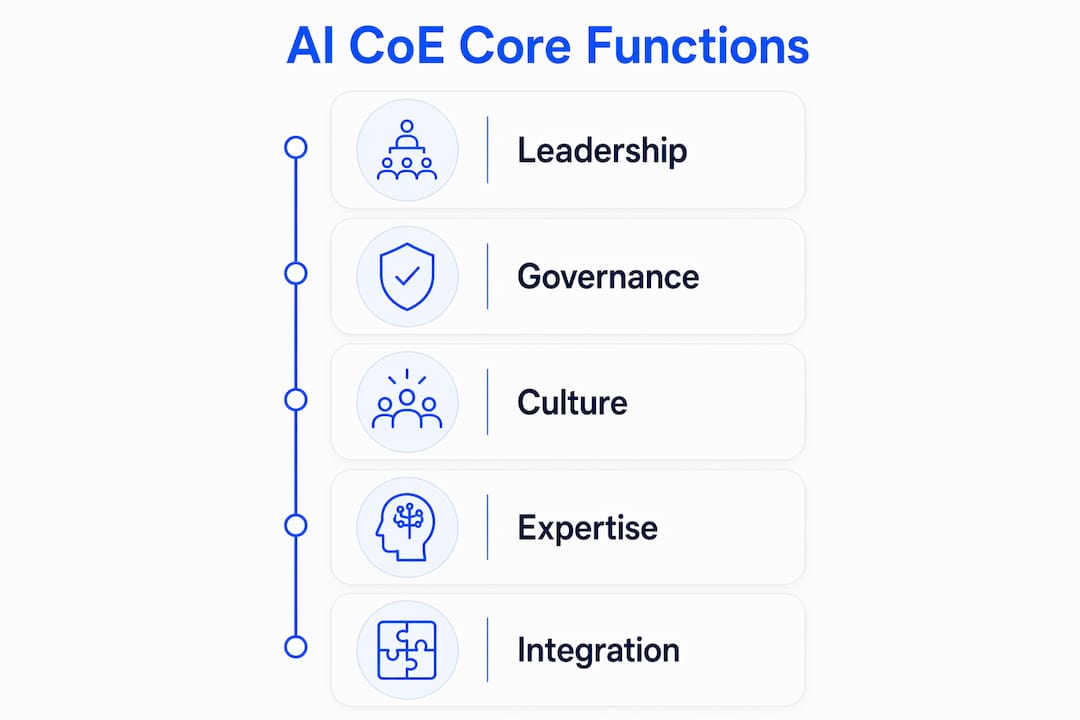
The Global AI Excellence Model (GAIEM) frames AI excellence as a discipline that integrates leadership, governance, culture, and technology together, not as separate workstreams. That framing matters because organizations that treat AI governance as a purely technical problem consistently underperform those that treat it as an organizational one.
One underappreciated benefit: an AI CoE builds institutional trust. When employees, regulators, and customers see that an organization has a structured, accountable process for AI decisions, they engage with AI-powered products differently. That trust is hard to quantify but easy to lose.
What an AI CoE actually does: core functions and team structure
The CoE’s responsibilities span strategy, architecture, governance, and enablement. Here’s how those functions break down in practice:
-
Define and maintain AI strategy: The CoE translates executive priorities into a concrete AI roadmap, identifying high-value use cases, sequencing investments, and setting the criteria for what gets funded and what doesn’t.
-
Set standards and architecture guidelines: This includes selecting approved model frameworks, data platforms, and cloud infrastructure. Microsoft Azure, IBM, and Oracle each publish reference architectures that mature CoEs adapt to their specific environments rather than building from scratch.
-
Govern the model lifecycle: From data sourcing and model training through deployment, monitoring, and eventual retirement, the CoE owns the process that keeps models accurate, compliant, and auditable.
-
Manage vendor and tool evaluation: The CoE vets third-party AI tools and platforms before they enter the organization, preventing the security and compliance risks that come with ungoverned procurement.
-
Enforce ethical guidelines: Ethics must be integrated during development, not retrofitted after a model is already in production. The CoE owns bias testing, explainability standards, and the escalation path when a model produces a harmful outcome.
-
Enable business units: The CoE runs training programs, maintains documentation, and provides consulting support so that product and operations teams can build AI solutions without needing to become AI experts themselves.
-
Measure and report impact: Regular KPI reviews covering deployment velocity, cost per model, and reliability metrics give leadership a clear picture of whether the AI program is delivering.
-
Prevent and manage technical debt: The CoE monitors the portfolio for models that have drifted, become outdated, or were never properly documented, and it sets the remediation priority.
The team structure supporting these functions typically looks like this: a CAIO or CDO provides executive sponsorship and strategic direction. AI architects design the technical infrastructure. Data engineers build and maintain the pipelines. An ethics and compliance officer handles risk and regulatory alignment. Business liaisons sit between the CoE and individual departments, translating domain requirements into AI specifications. Depending on the organization’s size, this core team might be five people or fifty.

How to build an AI Center of Excellence that actually works
Building a CoE that delivers real value rather than becoming an internal bureaucracy requires getting a few foundational decisions right from the start.
-
Define the mission before hiring anyone: The CoE’s mandate needs to be specific. “Drive AI adoption” is not a mission. “Reduce customer service resolution time by 30% through AI-assisted tooling by Q4 2026” is. Specificity creates accountability.
-
Secure executive sponsorship early: Executive alignment is foundational for connecting AI strategy to business outcomes. A CoE without a C-suite champion will lose budget battles and struggle to get cross-functional cooperation.
-
Assemble a cross-functional team from day one: Resist the temptation to staff the CoE entirely with data scientists. You need legal, finance, and operations representation from the beginning, not as an afterthought when a compliance issue surfaces.
-
Establish governance frameworks before scaling: Write the AI ethics policy, the model risk management process, and the data governance standards before you have dozens of models in production. Retrofitting governance is far more expensive than building it in.
-
Implement MLOps infrastructure early: MLOps and LLMOps pipelines enable consistent, repeatable model deployment and reduce technical debt before it accumulates. This is one of the highest-leverage early investments a CoE can make.
-
Create an internal AI marketplace: A centralized repository of approved AI assets prevents shadow AI and promotes reuse of models, datasets, and tools that have already cleared governance review.
-
Set communication rhythms: Monthly steering committee reviews, quarterly roadmap updates, and a clear escalation path for ethical concerns keep the CoE connected to the business rather than operating as an isolated technical team.
-
Define success metrics upfront: Agree on the KPIs before the first project launches. Cost savings, cycle time reduction, model accuracy thresholds, and adoption rates across business units are all measurable. Vague success criteria are how CoEs lose credibility.
Pro Tip: Avoid the “approval bottleneck” trap. If every AI experiment requires CoE sign-off before it can start, teams will route around you. Build a tiered review process: low-risk experiments get a lightweight checklist, high-stakes production deployments get the full governance review. Speed and rigor aren’t mutually exclusive.
How successful AI CoEs evolve over time
The CoE you build in year one should not look like the CoE you run in year three. Organizations that treat the CoE as a fixed structure tend to hit a ceiling; those that deliberately evolve it tend to accelerate.
The typical progression moves from a centralized control model to a federated advisory model. Early on, centralization makes sense. You’re consolidating expertise, establishing standards, and building the infrastructure that doesn’t exist yet. Centralized control accelerates adoption in that phase by giving teams a clear place to go for guidance and approved tools.
As AI adoption matures, that same centralized structure becomes a bottleneck. Product teams are moving fast; waiting for CoE approval on every decision slows them down and creates frustration on both sides. The shift from controlling AI projects to enabling governed autonomy allows teams to innovate faster without risking compliance or security. The CoE stops being the gatekeeper and becomes the standard-setter, distributing AI expertise into product teams and platform teams while retaining oversight through policy and forums rather than direct control.
| Operating model | Best for | CoE role | Risk profile |
|---|---|---|---|
| Centralized control | Early-stage AI programs | Direct ownership of all AI projects | Low autonomy, slower delivery |
| Hybrid | Mid-maturity organizations | Shared ownership with business units | Balanced governance and speed |
| Federated advisory | Mature AI programs | Policy, standards, and escalation support | High autonomy, requires strong culture |
“Shifting the CoE to an advisory role helps teams innovate faster while maintaining standards and security. The CoE focuses on guidance and policy rather than direct control, distributing AI expertise into product teams, platform teams, and enabling teams.” — Microsoft Azure Cloud Adoption Framework
The GAIEM framework reinforces this by treating leadership alignment, culture, and governance as equally weighted pillars alongside technology. Organizations that skip the culture dimension, assuming that good tooling is enough, consistently struggle with adoption even when their technical infrastructure is solid.
Shadow AI is one of the clearest signals that a CoE has stayed in gatekeeper mode too long. When business units start building and deploying models outside the CoE’s visibility, it usually means the CoE’s approval process is too slow or too opaque, not that the teams are reckless. The fix is structural: move toward the advisory model, publish clear self-service guidelines, and make the compliant path easier than the workaround.
Pro Tip: Track shadow AI proactively by auditing cloud spend for AI-related services that weren’t procured through the CoE. Unexpected usage of third-party model APIs or unmanaged notebook environments in cloud accounts are the most common signals. Catching these early is far less expensive than discovering a compliance issue after deployment.
Real-world AI CoE examples from US organizations
The US General Services Administration (GSA) runs one of the most publicly documented AI CoE programs in the country. The GSA’s AI Center of Excellence was established to help federal agencies adopt AI in a structured, responsible way, focusing on use-case identification, data readiness assessments, and governance frameworks tailored to public-sector requirements. Their work on natural language processing for contact center automation demonstrated how a CoE model can accelerate deployment timelines while keeping human oversight intact.
IBM has built its AI CoE practice around what it calls the AI Ladder, a framework that sequences data collection, organization, analysis, and infusion as distinct maturity stages. Enterprise clients using this approach have used the CoE structure to move from isolated AI pilots to production deployments at scale, with the CoE serving as the institutional memory that prevents each new project from starting from zero.
Microsoft Azure’s Cloud Adoption Framework provides one of the most detailed public blueprints for building an enterprise AI CoE, covering operating model design, governance integration, and the transition from centralized to advisory structures. Organizations using Azure as their primary AI infrastructure often use this framework as the starting point, then customize it based on their industry’s regulatory requirements.
Oracle’s AI CoE guidance emphasizes the connector role: the CoE as the unit that links executive strategy to frontline execution. Oracle’s enterprise customers, particularly in manufacturing and financial services, have used this model to standardize AI deployment across business units that previously operated entirely independently, reducing model duplication and improving data consistency across the portfolio.
For a closer look at how real-world AI transformations play out beyond the CoE structure itself, the patterns across these organizations share a common thread: the CoE’s value compounds over time as the institutional knowledge it builds becomes harder for competitors to replicate quickly.
Key Takeaways
An AI Center of Excellence is the organizational structure that separates companies with a coherent AI program from those with a collection of disconnected experiments, and building it right from the start determines how fast it can scale.
| Point | Details |
|---|---|
| Start with mission clarity | Define specific, measurable outcomes before staffing or tooling decisions are made. |
| Executive sponsorship is foundational | A CoE without C-suite alignment loses budget battles and cross-functional cooperation. |
| Ethics belongs in development | Integrate bias testing and explainability standards during model building, not after deployment. |
| Evolve from centralized to advisory | As AI adoption matures, shift from direct control to policy-setting and distributed expertise. |
| MLOps infrastructure reduces debt | Early investment in model versioning and monitoring pipelines prevents costly technical debt at scale. |
Ready to move from AI experiments to a structured program that delivers consistent results? Botiqueai’s AI solutions help organizations build the infrastructure, governance, and automation capabilities that make an AI CoE work in practice, not just on paper. Whether you need a custom AI agent, an automated workflow, or a full deployment framework, the team at Botiqueai builds it to fit your specific environment.
Explore how Botiqueai’s custom automation services can accelerate the operational side of your AI program from day one.