
What Is AI Content Generation? A 2026 Guide
What Is AI Content Generation? A 2026 Guide
AI content generation is defined as the use of large language models (LLMs) to produce text, images, audio, video, or code from human prompts. Tools like ChatGPT, Claude, and Grammarly have made this technology accessible to millions, with over 40 million people using AI-assisted writing tools as of early 2026. The industry term for this field is generative AI, and understanding what it does, how it works, and where it fits in your content workflow is now a baseline skill for any marketer or business professional.
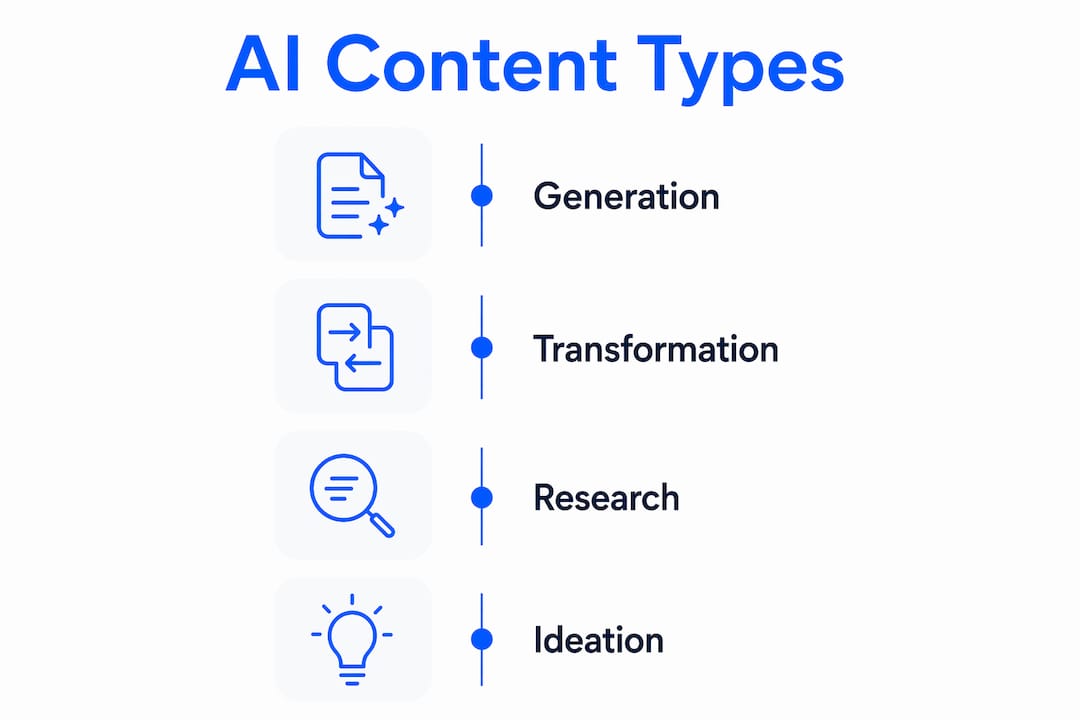
What is AI content generation, and what are its four core categories?
AI content generation uses LLMs to create diverse content types across four distinct categories: generation, transformation, research, and ideation. Each category serves a different purpose, carries a different risk profile, and requires a different level of human involvement.

| Category | What it does | Human effort required | Hallucination risk |
|---|---|---|---|
| Generation | Creates original content from scratch | High editing needed | High |
| Transformation | Rewrites or repurposes existing content | Low to moderate | Low |
| Research | Summarizes and synthesizes data | Moderate verification | Moderate |
| Ideation | Generates options, angles, and creative ideas | Light review | Low |
Generation is the most visible category. You give an AI a brief, and it produces a blog post, product description, or email from nothing. The output can be fast, but it requires the most human editing. Brand voice, factual accuracy, and originality all need review before publication.
Transformation is the most reliable category for business use. You feed the AI existing content, such as a transcript, a white paper, or a product spec sheet, and it rewrites, summarizes, or reformats it. Because the source material anchors the output, the risk of fabricated information drops significantly.
Research sits in the middle. AI can synthesize large volumes of text and surface patterns quickly, but it does not retrieve facts from a database. It generates statistically probable summaries, which means human verification remains necessary before any research output goes into published work.
Ideation is where AI delivers the fastest return on investment with the least risk. Generating 20 headline variations, five campaign angles, or a list of blog topics takes seconds. The AI is not writing your final copy. It is expanding your creative options before you make decisions.
Pro Tip: Start with transformation tasks when introducing AI to your content team. The lower hallucination risk and clear source material make it the easiest category to trust and verify.
How does AI generate content behind the scenes?
The technical process behind AI content creation is simpler to understand than most people expect. LLMs generate text token by token, where each token is roughly a word or word fragment. The model predicts the most statistically probable next token based on everything that came before it in the conversation.
This process is called autoregressive generation. The model does not plan the full article before writing it. It generates one token, then the next, then the next, each time looking backward at what it already produced. That architecture explains a lot about both its strengths and its weaknesses.
Here is how a single piece of content moves from your prompt to finished output:
- Tokenization. Your prompt is broken into tokens and converted into numerical representations the model can process.
- Attention scoring. The transformer architecture assigns attention weights across all tokens in the context window, determining which earlier words most influence the next prediction.
- Probability sampling. The model calculates a probability distribution over its entire vocabulary and selects the next token, either by picking the highest-probability option or by sampling with some randomness for variety.
- Iteration. Steps 2 and 3 repeat until the model reaches a stopping point or your specified length.
The critical insight here is that AI models do not retrieve facts. They generate text that looks like facts because factual-sounding sentences appeared frequently in their training data. This is why hallucinations happen. A model can confidently produce a statistic, a quote, or a company name that does not exist, because the pattern fits the context even if the content is false.
Prompt quality directly controls output quality. Generic prompts produce generic outputs. A prompt that includes your audience, the content format, the desired tone, specific constraints, and relevant context will consistently outperform a one-sentence request.
Pro Tip: Treat your prompt like a creative brief. Include the audience, the goal, the format, the word count, and at least one example of the tone you want. That single habit will improve your AI outputs more than any other change.
What are the real benefits and challenges of AI content in business?
The speed benefit of AI content creation is not incremental. A blog post that would take hours to draft manually can be generated in seconds. That is not a 20% productivity gain. It is a structural change in how content teams operate.
The most effective business use of AI follows a hybrid model. AI handles the speed-intensive, repetitive, and structural tasks. Humans provide brand context, editorial judgment, and factual verification. Neither replaces the other.
Where AI delivers clear value in business workflows:
- Structured, repetitive content. Product descriptions, meta tags, email subject line variations, and social media captions are ideal AI tasks. The format is predictable, the stakes per piece are low, and volume is high.
- First drafts. AI removes the blank-page problem. A rough draft, even an imperfect one, is faster to edit than to write from scratch.
- Content repurposing. Turning a 3,000-word report into a LinkedIn post, a FAQ page, and an email sequence is exactly the kind of transformation task where AI excels.
- Scaling localization. Adapting content across markets, formats, or audience segments becomes manageable at scale.
The challenges are real and should not be minimized. Without brand-specific context and style guides, AI outputs trend toward generic, interchangeable copy. Professionals in the industry call this “AI slop.” It reads as technically correct but lacks the specificity, voice, and authority that builds audience trust. Tone consistency across a content library is another persistent challenge, particularly when multiple team members use different prompts for similar tasks.
Factual accuracy requires a dedicated verification step. AI does not flag its own errors. A confident, well-structured paragraph containing a fabricated statistic looks identical to one containing a real one.
How are agentic AI workflows changing content pipelines?
The current shift in AI content tools goes well beyond chat interfaces. The industry is moving toward agentic workflows that automate entire content pipelines, from keyword research and competitive analysis through outlining, drafting, and formatting, with minimal manual input at each stage.
A chat-based AI interaction requires a human at every step. You prompt, review, prompt again, and edit. An agentic workflow chains those steps together. The system receives a goal, such as “produce five SEO-optimized blog posts on this topic cluster,” and executes the research, structure, and drafting autonomously before presenting a finished draft for human review.
| Workflow type | Human touchpoints | Output speed | Best for |
|---|---|---|---|
| Chat-based AI | Every step | Moderate | One-off tasks, creative work |
| Semi-automated | Brief and final review | Fast | Regular content series |
| Fully agentic | Final review only | Very fast | High-volume, structured content |
For content teams and marketers, this shift has two major implications. First, the role of the human moves from writer to editor and strategist. Second, the quality ceiling rises only when the human review step is taken seriously. Agentic systems can produce volume at speed, but they amplify both good inputs and bad ones. A weak brief fed into an agentic workflow produces a large volume of weak content quickly.
Businesses exploring AI-driven automation for content tasks are finding that the biggest gains come from mapping their existing content processes first, then identifying which steps are repetitive and rule-based enough to hand off to an agent.
Key Takeaways
AI content generation delivers maximum value when human expertise directs the process, brand context shapes the inputs, and factual verification closes the loop.
| Point | Details |
|---|---|
| Four core categories | Generation, transformation, research, and ideation each carry different risk levels and require different human effort. |
| Transformation is safest | Repurposing existing content with AI carries the lowest hallucination risk and suits most business teams starting out. |
| Prompts determine quality | Specific, structured prompts with audience, format, and tone constraints consistently outperform generic requests. |
| Hybrid workflows win | AI handles speed and volume; humans provide brand voice, accuracy checks, and editorial judgment. |
| Agentic workflows are next | Automated content pipelines reduce manual touchpoints but require strong briefs and rigorous final review to maintain quality. |
Why most teams get AI content wrong from the start
Working directly with businesses adopting AI content tools, I see the same mistake repeated: teams treat AI as a finished-output machine rather than a drafting accelerator. They prompt once, publish fast, and wonder why the content underperforms.
The reality is that AI is a force multiplier for human creativity, not a replacement for it. The teams getting the best results are the ones investing in prompt engineering as a real skill, building style guides that get fed into every AI interaction, and treating the AI output as a first draft that earns its place through editing.
The other misconception I encounter constantly is that more AI means less expertise needed. The opposite is true. The better your subject matter knowledge, the better your prompts, and the better your ability to catch what the AI gets wrong. A marketer who deeply understands their audience will write prompts that produce usable first drafts. A marketer who does not will produce generic copy at scale.
The professionals winning with AI content right now are not the ones using it the most. They are the ones using it most deliberately, with clear briefs, consistent brand inputs, and a verification habit that catches errors before they reach the audience. That combination is what separates effective AI content creation from noise.
— Botiqueai
How Botiqueai helps businesses build smarter content workflows
Botiqueai designs AI content and automation solutions built around your specific business context, not generic templates. Whether you are scaling marketing content, automating customer-facing copy, or building agentic pipelines for high-volume content needs, Botiqueai’s custom AI agents and intelligent workflows are built to fit your processes. The Pernod Ricard case study and the L’Oréal Consumer Loop project both demonstrate how enterprise-level content workflows can be transformed when AI is integrated with the right brand context and human oversight. Explore Botiqueai’s AI solutions to see how a tailored approach can improve your content output without sacrificing quality or brand consistency.
FAQ
What is AI content generation in simple terms?
AI content generation is the process of using large language models to produce written, visual, or audio content from a human prompt. Tools like ChatGPT and Claude are the most widely recognized examples.
How does AI generate content without knowing facts?
AI models predict the next most probable token based on patterns in their training data. They do not retrieve facts from a database, which is why outputs can sound accurate but contain fabricated information.
What types of content can AI generate?
AI can generate text, images, audio, video, and code. For business use, the most common applications are blog posts, product descriptions, email copy, social media content, and content repurposing.
Is AI-generated content effective for SEO?
AI-generated content can rank well when it is edited for accuracy, originality, and brand voice. Generic, unedited AI output tends to underperform because it lacks the specificity and authority that search engines and readers reward.
What is the difference between AI generation and AI transformation?
Generation creates original content from a prompt with no source material. Transformation rewrites or repurposes existing content, which carries a lower hallucination risk and is generally more reliable for business use.