
What Is AI Data Strategy? A Guide for Decision-Makers
What Is AI Data Strategy? A Guide for Decision-Makers

An AI data strategy is a formal plan that governs how an organization sources, manages, and retires data to power reliable and compliant artificial intelligence. The industry term for this practice is AI data lifecycle management, and it covers every stage from raw data collection through model training, deployment, and eventual data retirement. Without a defined strategy, AI systems produce outputs that are difficult to audit, defend, or trust. Microsoft’s Cloud Adoption Framework identifies comprehensive lifecycle management as the foundation for AI readiness across cloud and hybrid environments. For business decision-makers, this is not a technical detail. It is the difference between AI that creates competitive advantage and AI that creates liability.
What is AI data strategy and what does it include?
An AI data strategy is defined as the end-to-end framework that controls how data moves through an organization to support AI systems. It answers three questions every executive should ask: Where does our data come from? How is it governed? And when does it stop being useful?
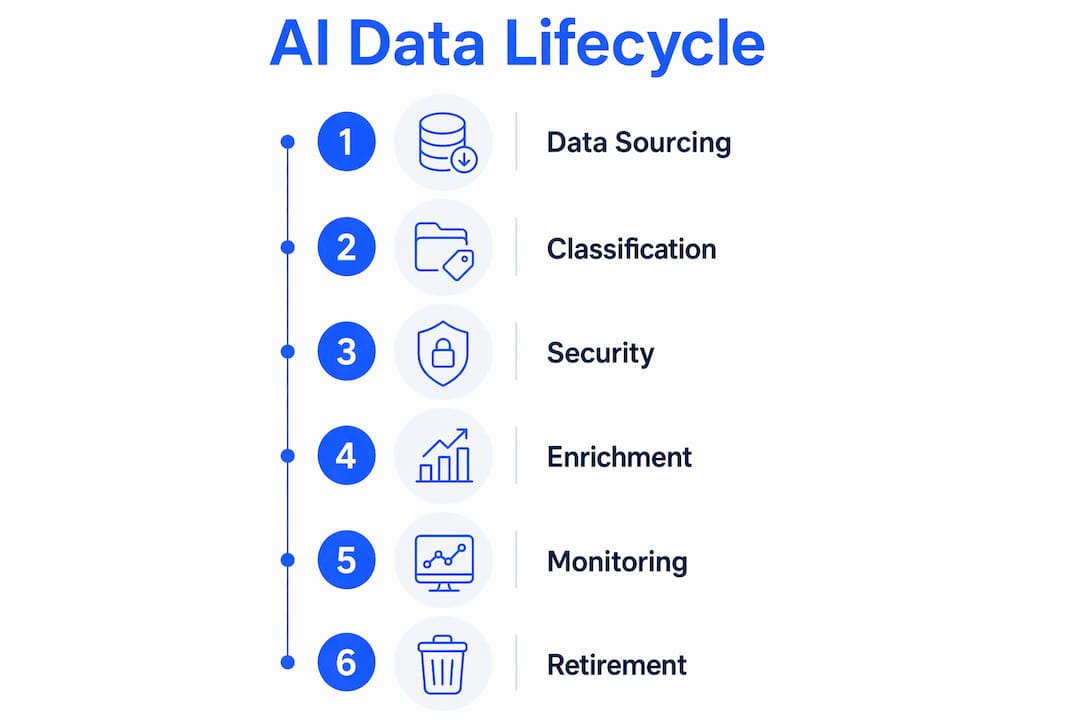
The lifecycle has six distinct stages, each with its own risks and requirements:
- Data sourcing: Organizations draw from internal systems such as ERP databases and CRM records, as well as external feeds including third-party APIs, public datasets, and purchased data. The mix of structured data (tables, records) and unstructured data (documents, audio, images) determines which AI models are viable.
- Data classification: Every dataset needs a sensitivity label. Personal data, financial records, and proprietary information each carry different regulatory obligations under frameworks like GDPR and CCPA. Classification drives access controls and retention rules.
- Security and compliance: Encryption, role-based access, and audit logging protect data at rest and in transit. Compliance is not a one-time checkpoint. It is a continuous control applied at every stage.
- Data enrichment: Raw data rarely meets AI quality standards. Enrichment includes deduplication, normalization, feature engineering, and labeling. Poor enrichment is the leading cause of model underperformance.
- Monitoring: AI systems degrade over time as real-world data drifts away from training data. Real-time monitoring for training-serving skew and model drift is a core operational requirement, not an optional add-on.
- Data retirement: Outdated or legally expired data must be removed from active use. Neglecting retirement increases AI risk as data sources evolve and regulatory exposure grows.
Pro Tip: Build your data classification schema before you build your first AI model. Retrofitting sensitivity labels onto an existing data estate costs far more time and money than starting with a clean taxonomy.
How does AI traceability and governance ensure trustworthy AI?

AI traceability is defined as the ability to reconstruct the complete history of an AI output by linking data lineage, model lineage, prompt logs, inference outputs, and access events into a single auditable record. Snowflake describes AI traceability as connecting multiple records to reconstruct AI system history and behavior for compliance purposes. That definition matters because regulators and executives ask the same question: “Can you prove why the AI made this decision?”
Traceability answers that question with evidence, not assertions. A model registry records which version of a model produced which output. Prompt logs capture the exact input a user or system sent to the AI. Incident records document when outputs were flagged, reviewed, or overridden. Together, these components form the audit trail that regulated industries require to adopt AI responsibly.
NIST’s AI Standards work prioritizes governance and risk frameworks for AI data, performance, and accountability. That standard treats governance not as a compliance checkbox but as an operational discipline embedded in every stage of the AI lifecycle. The practical implication is that governance must be designed into your data architecture from day one.
| Traceability component | What it records | Why it matters |
|---|---|---|
| Data lineage | Origin, transformations, and movement of each dataset | Proves data quality and regulatory compliance |
| Model registry | Version, training data, and deployment history of each model | Enables rollback and performance comparison |
| Prompt and output logs | Exact inputs and outputs for each AI interaction | Supports audit readiness and incident review |
| Access event records | Who accessed data or model outputs and when | Satisfies security and privacy requirements |
| Incident records | Flagged outputs, human overrides, and corrective actions | Documents accountability and continuous improvement |
Pro Tip: Treat your model registry like source control for software. Every model version that touches production data should have a commit-style record with training data references, evaluation metrics, and a deployment timestamp.
How do you integrate an AI data strategy into existing business systems?
Integrating an AI data strategy into existing business software requires an AI-ready architecture that supports governance and traceability from the start. Most organizations already operate a mixed data estate: on-premises ERP systems, cloud data warehouses, and hybrid environments that connect both. Microsoft guidance emphasizes architecting durable AI data environments for priority use cases rather than attempting to modernize everything at once.
The practical path forward has four components:
- Governance baseline: Define data ownership, access policies, and quality standards before connecting any AI model to production data. Without a baseline, AI systems inherit every existing data quality problem at scale.
- Lifecycle instrumentation: Deploy monitoring tools that track data freshness, model performance, and pipeline health in real time. Databricks identifies AI-specific pipeline monitoring for training-serving skew as a requirement distinct from traditional data quality monitoring.
- ERP and business software integration: When you integrate AI with ERP systems, the highest-value starting point is usually transactional data: purchase orders, inventory records, and financial ledgers. These datasets are structured, well-labeled, and directly tied to business outcomes. Map data flows from your ERP to your AI feature store before writing a single model.
- Responsible AI dashboards: Executives need visibility into AI behavior without reading log files. A responsible AI dashboard surfaces model accuracy trends, data drift alerts, and compliance status in a format that supports decision-making.
The common mistake is treating integration as a one-time project. AI data management requires continuous adjustment as business processes change, new data sources come online, and regulatory requirements evolve. Organizations that embed governance as a continuous lifecycle capability rather than a one-time compliance step sustain AI performance far longer than those that do not.
For decision-makers exploring AI governance strategies aligned with 2026 standards, the architecture question is not whether to integrate AI with existing systems. It is how to do so without creating new compliance gaps.
What are the common pitfalls and best practices for AI data strategy?
Most AI data strategy failures share a common root cause: governance treated as paperwork rather than as an operational capability. Microsoft observes that governance-as-lifecycle is the pivotal factor in sustaining compliance and reducing risk over time. The organizations that fail are those that complete a governance document at project launch and never revisit it.
The five most damaging pitfalls are:
- Skipping data retirement planning. Data that was accurate two years ago may be misleading today. AI models trained on stale data produce stale outputs. Build retirement triggers into your data contracts from the start.
- Treating traceability as optional. Without linked audit trails, you cannot answer a regulator’s question, a customer’s complaint, or an executive’s concern about a specific AI decision. Traceability is the operational foundation for trustworthy AI outputs.
- Underestimating data quality debt. Enrichment and normalization take longer than most teams budget. A model is only as good as the data it trains on. Allocate at least as much time to data preparation as to model development.
- Siloing data strategy from business strategy. AI data management decisions made by IT without executive input produce technically sound systems that solve the wrong problems. Cross-functional ownership is not optional.
- Ignoring model drift until it causes a visible failure. By the time a model’s errors become obvious to end users, the underlying data drift has usually been accumulating for weeks or months. Proactive monitoring catches problems before they reach customers.
The best practice that separates high-performing organizations is a lifecycle mindset. Data strategy is not a project with a completion date. It is an ongoing discipline that evolves as data sources, AI capabilities, and regulatory requirements change. Executive sponsorship and cross-team collaboration are the organizational conditions that make that discipline sustainable. Teams exploring how to build this culture can find practical frameworks in Botiqueai’s AI insights library.
Key Takeaways
An effective AI data strategy requires lifecycle governance, traceability, and continuous monitoring to produce AI outputs that are trustworthy, compliant, and defensible.
| Point | Details |
|---|---|
| Lifecycle covers six stages | Sourcing, classification, security, enrichment, monitoring, and retirement each require distinct controls. |
| Traceability is non-negotiable | Linked records of data, models, prompts, and outputs are the foundation for audit readiness and executive trust. |
| Integration starts with governance | Connect AI to ERP and business systems only after defining data ownership, access policies, and quality standards. |
| Retirement planning prevents risk | Outdated data increases AI risk; build retirement triggers into data contracts from the beginning. |
| Governance is a continuous practice | Organizations that treat governance as a one-time step lose compliance and model performance over time. |
Why AI data strategy is the real competitive moat
Working with organizations at various stages of AI adoption, the pattern is consistent. The companies that gain durable advantage from AI are not the ones with the most sophisticated models. They are the ones with the most disciplined data practices.
The uncomfortable truth is that most AI projects fail quietly. Not because the technology does not work, but because the data feeding the technology was never properly governed, traced, or maintained. Executives approve AI initiatives based on model demos, then discover six months later that the model’s outputs cannot be audited, the training data has expired, or the integration with the ERP system created a compliance gap no one planned for.
The organizations that get this right share one trait: they treat data strategy as a business function, not an IT function. They assign data ownership at the executive level. They build traceability into their architecture before the first model goes to production. They review data retirement schedules the same way they review financial forecasts.
The future of AI data strategy will be shaped by tightening regulation, more capable AI systems, and increasing pressure from customers and partners to prove that AI outputs are trustworthy. The organizations building that proof now, through lineage tracking, model registries, and lifecycle instrumentation, will be the ones that can move fastest when the regulatory environment hardens. The ones that skipped governance to ship faster will spend that same period rebuilding trust they never established.
— Botiqueai
Botiqueai’s approach to AI data strategy in practice
Building a sound AI data strategy is one thing. Deploying AI that actually performs within that strategy is another challenge entirely.
Botiqueai designs AI agents and chatbots that are built for production environments where governance and traceability matter. The Aria Chatbot is a practical example: a customer-facing AI assistant that integrates with existing business workflows, operates on governed data, and produces interactions that can be logged, reviewed, and audited. For decision-makers who want AI that fits their data strategy rather than working around it, Botiqueai’s tailored AI solutions are built with lifecycle management and accountability in mind from the first line of configuration.
FAQ
What is an AI data strategy in simple terms?
An AI data strategy is a formal plan for managing data through its full lifecycle, from sourcing and classification to monitoring and retirement, so that AI systems produce reliable and compliant outputs.
How does AI traceability support data governance?
AI traceability links data lineage, model versions, prompt logs, and audit trails into a single record. That record allows organizations to reconstruct any AI decision for regulatory review or internal accountability.
What is the first step to integrate AI with existing business software?
The first step is establishing a governance baseline: defining data ownership, access controls, and quality standards before connecting any AI model to production systems such as ERP databases or CRM platforms.
Why does data retirement matter in an AI data strategy?
Outdated data fed into AI models produces inaccurate outputs. Data retirement policies remove legally expired or stale data from active use, reducing both model error rates and regulatory exposure.
How does NIST’s AI Standards work relate to data strategy?
NIST’s AI Standards framework prioritizes governance, risk management, and documentation as core requirements for responsible AI. Organizations align their data strategy with NIST guidance to meet emerging regulatory expectations and build auditable AI systems.