
What Is AI-Driven Decision Making for Business?
What Is AI-Driven Decision Making for Business?
AI-driven decision making is defined as the strategic integration of artificial intelligence, machine learning, and contextual business rules to automate or assist enterprise-wide choices. In practice, this means AI systems analyze raw data, apply governed logic, and generate recommendations that decision-makers can act on immediately. The industry term for this discipline is decision intelligence, and it sits at the intersection of data science, behavioral science, and management practice. For business professionals, understanding AI decision making is no longer optional. It is the foundation of competitive operations in 2026.
What is AI-driven decision making and how does it work?
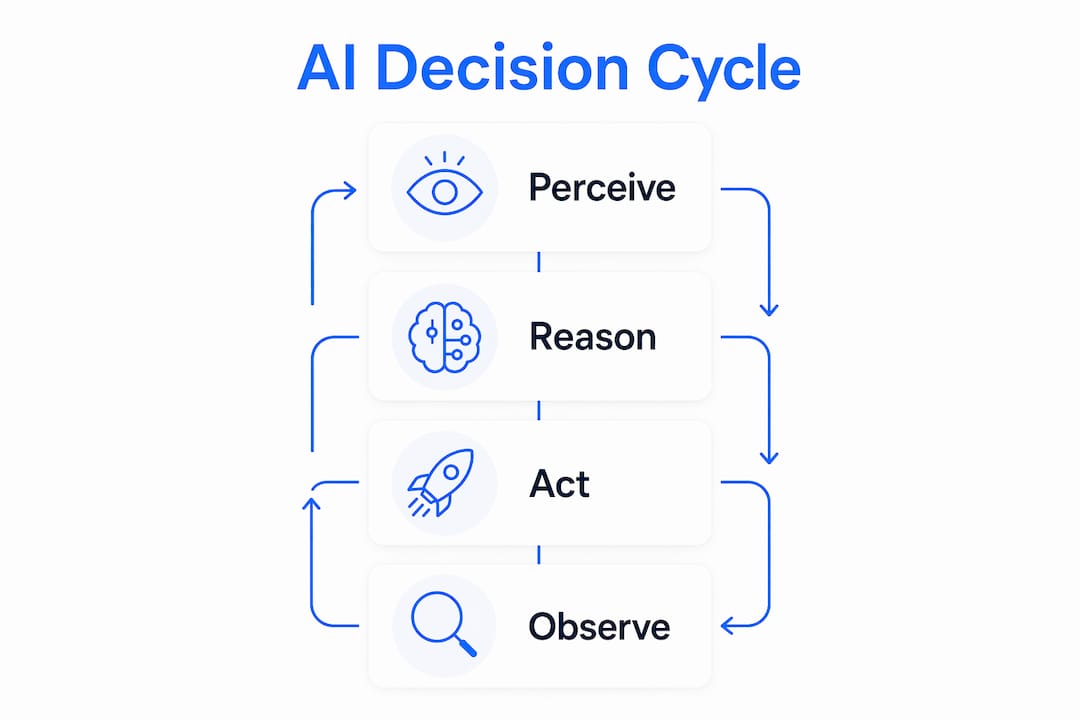
AI-driven decision making operates through a continuous loop: Perceive, Reason, Act, and Observe. The system first perceives its environment by ingesting structured and unstructured data. It then reasons over that data using machine learning models and business rules. Next, it acts by generating a recommendation or executing a task. Finally, it observes the outcome and feeds that result back into the next cycle.
This loop is not a metaphor. It is the literal architecture of intelligent agent systems, where each agent observes its environment, updates an internal state, evaluates possible actions, selects the best one, and executes it. The loop repeats continuously, which is what makes AI decisioning faster and more consistent than human-only processes.

Decision intelligence also relies on semantic layers, which are governed data definitions that unify metrics across business intelligence and AI systems. Without a semantic layer, two departments can query the same database and get different numbers. With one, every AI recommendation draws from a single, consistent source of truth.
What are the key components behind AI decision architectures?
Modern AI decision systems are built from several distinct components working together. Understanding each one helps you evaluate whether a proposed AI solution will actually hold up under real business conditions.
Core components of an AI decision architecture:
- Perception layer. The system ingests data from sensors, databases, APIs, and user inputs. Data quality at this stage determines everything downstream.
- Internal representation. The agent builds a model of the current state of the world. This is where context is stored and updated between decision cycles.
- Reasoning engine. Chain-of-thought reasoning and causal decision-making methods allow the system to move beyond simple correlation. The agent evaluates “if X, then Y” logic rather than just pattern matching.
- Action selection. The system chooses the best action from a defined set of options, constrained by business rules and risk thresholds.
- Fallback protocols. Mature AI agents include fallback strategies for high-uncertainty scenarios, such as escalating to a human reviewer or requesting additional data before acting.
Multi-agent frameworks extend this architecture for complex tasks. One agent might handle data interpretation while another executes a formal calculation. This separation keeps each agent focused and auditable. You can read more about how these systems are classified in this guide to enterprise AI agent types.
Pro Tip: When evaluating an AI decision system, ask the vendor specifically how fallback protocols are triggered. A system with no defined escalation path will eventually make a high-stakes error with no human checkpoint in place.
How do human-AI hybrid decision systems work?
The most common misconception about AI in business decision making is that it replaces human judgment. The evidence points in the opposite direction. Effective AI-driven systems shift organizations from simple automation to human-AI hybrid architectures where humans and machines share decision authority in structured ways.
A hybrid decision system defines three dimensions for every decision:
- Stage. At which point in the workflow does the AI act, and at which point does a human review or override?
- Authority. Who or what has the power to make the final call? Is the AI advisory, or does it execute autonomously within defined limits?
- Accountability. Who is responsible for the outcome? Accountability must always rest with a human or a clearly governed process, not with the model itself.
Research shows a “digital legitimation effect,” where stakeholder support increases when AI governance is made explicit. Transparency about how decisions are made builds trust faster than any performance metric alone.
The risk of getting this wrong is automation bias. When humans trust AI outputs without scrutiny, they stop applying their own judgment. The result is that the AI’s errors become organizational errors, with no human checkpoint to catch them. Structured human-in-the-loop validation at interpretative stages is the primary defense against this failure mode.
Pro Tip: Map every decision in your workflow to one of three modes: AI decides, AI recommends and human approves, or human decides with AI support. Ambiguity between these modes is where most AI adoption failures begin.
What are the benefits and practical applications of AI decision making?
The business case for AI-assisted decision processes is clearest in environments where decisions are high-volume, time-sensitive, and data-rich. Three domains show the strongest results.
Fraud detection. AI systems process thousands of transactions per second and flag anomalies in real time. A human analyst reviewing the same volume would take hours. The AI does not replace the analyst. It filters the signal so the analyst focuses only on genuine risks.
Supply chain optimization. AI models ingest demand forecasts, supplier lead times, and inventory data to recommend reorder points and routing decisions. The consistency of these recommendations eliminates the variability that comes from different managers applying different rules.
Financial planning. AI-driven insights allow finance teams to run scenario analyses in minutes rather than days. The speed advantage compounds over time as teams make more decisions with better information.
| Application area | Primary benefit | Human role |
|---|---|---|
| Fraud detection | Real-time anomaly identification | Review flagged cases and approve action |
| Supply chain | Consistent reorder and routing logic | Set thresholds and approve exceptions |
| Financial planning | Rapid scenario modeling | Interpret outputs and set strategy |
| Customer service | Automated query resolution | Handle escalations and edge cases |
Decision intelligence ties these applications together by ensuring that semantic layers unify metrics across all systems. Without that consistency, AI recommendations in one department can contradict those in another. You can see how this plays out in practice through real-world AI transformation cases across industries.
What challenges and misconceptions surround AI decision making?
The biggest misconception in AI-driven decision making is that AI predicts the future. It does not. AI is a pattern matcher governed by business logic, not a crystal ball. When the patterns in historical data do not reflect current conditions, AI recommendations degrade. Decision-makers who treat AI outputs as certainties make worse decisions than those who treat them as informed estimates.
Transparency is the second major challenge. Many AI systems cannot explain why they produced a specific recommendation. This opacity creates legal, regulatory, and operational risk. The solution is architectural: separating generative agents from logical agents keeps interpretative tasks and formal computations in distinct, auditable components.
“Effective AI systems quantify uncertainty to enable nuanced human-in-the-loop assessments. Communicating confidence levels is not a nice-to-have. It is the mechanism that prevents AI outputs from misleading the humans who rely on them.”
A third challenge is decision architecture design itself. Most AI adoption failures occur because organizations overlook the complexity of designing workflows with clear authority and accountability. Business leaders frequently underestimate how much structural work is required before a single AI model goes live. The model is rarely the problem. The workflow around it usually is.
For a deeper look at how transparency tools address these gaps, the field of explainable AI offers practical frameworks that business teams can apply without deep technical expertise.
How can business leaders implement AI decision making effectively?
Implementation success depends on architecture before algorithms. The sequence below reflects what works in practice.
- Audit your current decision workflows. Identify which decisions are high-volume, rule-based, and data-rich. These are your best candidates for AI assistance. Decisions that require political judgment or novel context are poor candidates.
- Define authority and accountability explicitly. For every AI-assisted decision, document who can override the AI, under what conditions, and who owns the outcome. Ambiguity here creates liability.
- Build or adopt a semantic layer. Consistent metric definitions across your BI and AI systems prevent contradictory recommendations. This is a data governance task, not an AI task.
- Design your human-in-the-loop touchpoints. Determine which decision stages require human review before action. Structured validation at interpretative stages preserves accountability and catches model errors before they propagate.
- Version and record all interactions. Every AI recommendation and every human override should be logged. This creates the audit trail that regulators, auditors, and your own teams will need.
A strong AI data strategy underpins all five steps. Without clean, governed data flowing into your decision systems, even the best architecture produces unreliable outputs.
Pro Tip: Run a tabletop exercise before deploying any AI decision system. Walk through three failure scenarios: the AI recommends the wrong action, the AI produces no recommendation, and the AI produces a recommendation that conflicts with a human expert. If your team cannot answer what happens next in each case, your architecture is not ready.
Key Takeaways
AI-driven decision making succeeds when decision architecture, governed data, and structured human oversight are designed together before any model is deployed.
| Point | Details |
|---|---|
| Core decision loop | AI systems operate through a Perceive, Reason, Act, Observe cycle that runs continuously. |
| Human-AI hybrid design | Every AI-assisted decision needs defined stages, authority, and accountability to prevent automation bias. |
| Semantic layers matter | Unified metric definitions across BI and AI systems prevent contradictory recommendations across departments. |
| Transparency is structural | Separating generative and logical agents keeps AI decisions auditable and explainable. |
| Architecture before algorithms | Most AI adoption failures trace back to unclear decision workflows, not model performance. |
The uncomfortable truth about AI decision making
Working with organizations on AI decision workflows, the pattern I see most often is this: the AI model performs well in testing and fails in production. Not because the model is wrong, but because the decision architecture around it was never designed.
Business leaders focus on the algorithm. They ask about accuracy rates, model types, and training data. Those are the wrong first questions. The right first question is: who owns the outcome when the AI is wrong? If no one can answer that clearly, the system is not ready to go live.
The cultural shift required for effective AI-assisted decision processes is harder than the technical one. Teams need to stop treating AI recommendations as answers and start treating them as inputs. That distinction sounds simple. In practice, under time pressure and with a confident-looking AI output on screen, it is genuinely difficult to maintain.
The organizations that get this right build AI into their decision workflows the same way they build compliance into their financial processes. It is not a feature. It is a structural layer with defined roles, review points, and escalation paths. The future of AI in decision making belongs to organizations that treat decision architecture as a core competency, not an IT project.
— Botiqueai
How Botiqueai supports AI-driven decision making
Botiqueai builds AI decision systems that are designed around your actual workflows, not generic templates. Every solution starts with a decision architecture review to map authority, accountability, and human oversight before a single model is configured.
The Aria AI assistant handles high-volume, rule-based interactions with governed logic and full audit trails, so your team focuses on decisions that require human judgment. For broader workflow automation, Botiqueai’s business automation services integrate AI decision logic directly into your operational processes. If you want AI that your organization can actually trust and audit, Botiqueai builds it that way from the start.
FAQ
What is AI-driven decision making in simple terms?
AI-driven decision making is the process where AI systems analyze data, apply business rules, and generate recommendations or actions to support enterprise choices. The industry term for this discipline is decision intelligence.
How is AI decision making different from traditional automation?
Traditional automation follows fixed rules. AI decision making uses machine learning to reason over data, adapt to new patterns, and handle decisions that involve uncertainty or multiple competing factors.
What is the Perceive-Reason-Act-Observe loop?
It is the core operating cycle of an intelligent AI agent, where the system ingests data, reasons over it, takes an action, and then observes the outcome to inform the next cycle.
Why do most AI decision-making implementations fail?
Most failures trace back to unclear decision architecture, specifically overlapping or undefined authority and accountability at each stage of the workflow, not to model performance issues.
How do you keep AI decisions transparent and auditable?
Separating generative agents from logical agents keeps interpretative and computational tasks in distinct, auditable components. Versioning all AI recommendations and human overrides creates the audit trail needed for accountability.