
AI Governance Framework: A 2026 Guide for Decision-Makers
AI Governance Framework: A 2026 Guide for Decision-Makers
An AI governance framework is a structured system of policies, ethical guidelines, standards, and technical controls that direct how an organization develops, deploys, and manages artificial intelligence. It is not a single document or a compliance checklist. Think of it as the operating constitution for your AI program, one that aligns every AI initiative with your organizational values, legal obligations, and risk tolerance.
The framework addresses four core areas: internal governance structures, human involvement in AI-assisted decisions, operations management, and stakeholder communication. According to the NIST AI Risk Management Framework, the goal is to build trustworthiness into AI products and services from design through deployment. Bodies like the National Institute of Standards and Technology (NIST) and the Organisation for Economic Co-operation and Development (OECD) have established the foundational principles most organizations now reference when building their own programs.
A well-built governance framework typically includes:
- Policies and principles: Written rules governing acceptable AI use, data handling, and ethical boundaries
- Risk management processes: Methods for identifying, assessing, and mitigating AI-related risks such as bias, privacy violations, and security gaps
- Organizational structures: Defined roles, committees, and accountability chains for AI oversight
- Technical controls: Enforceable safeguards embedded directly into AI development pipelines
- Compliance monitoring: Ongoing review against legal requirements and internal standards
- Stakeholder communication protocols: Processes for transparency with employees, customers, and regulators
Why AI governance frameworks matter for your organization
The core objective of an AI governance framework is to make AI use ethical, accountable, and legally defensible. That sounds abstract until you consider what happens without one: a hiring algorithm that discriminates by age, a credit model that redlines certain zip codes, or a customer-facing chatbot that leaks personal data. Each of those scenarios has already produced real regulatory action in the United States.
Governance frameworks address these risks directly. The NIST AI RMF was built specifically to help organizations manage risks to individuals, organizations, and society associated with AI, covering bias, privacy, and security as primary concerns. The framework is voluntary at the federal level, but regulators and courts increasingly treat it as the de facto standard of care.
The business case goes beyond risk avoidance. Organizations with mature AI governance programs tend to move faster, not slower, because their teams spend less time relitigating ethical questions on every new project. Governance creates a reusable decision-making infrastructure. Key benefits include:
- Reputation protection: Documented governance demonstrates accountability to customers, partners, and regulators
- Operational resilience: Clear policies reduce the chance of a model failure cascading into a business crisis
- Faster innovation cycles: Pre-approved ethical guardrails let development teams build without stopping for ad hoc reviews
- Regulatory readiness: Alignment with NIST and OECD standards positions organizations well ahead of emerging U.S. federal AI legislation
- Stakeholder trust: Transparency about how AI decisions are made builds confidence among employees and customers alike
The Singapore Model AI Governance Framework describes this dynamic well: governance frameworks integrate ethical principles into existing corporate governance and risk management structures, rather than creating a parallel bureaucracy. That integration is what makes governance sustainable.
Core principles and components that define effective AI governance
Effective AI governance rests on a set of principles that most major frameworks, from NIST to the OECD AI Principles, converge on. These are not aspirational slogans. Each one maps to specific operational requirements.
Transparency means that AI systems can explain their outputs in terms stakeholders can understand. A loan denial generated by a black-box model is not transparent. Explainability features and confidence-level reporting are the technical mechanisms that make transparency real.

Fairness requires active work to detect and reduce bias in training data and model outputs. The Singapore Model Framework is direct on this point: virtually no dataset is completely unbiased, so organizations must understand the ways their data may be skewed and address this in their safety measures and deployment strategies.
Accountability assigns clear ownership for AI outcomes. Someone in the organization must be responsible when a model causes harm, and governance structures make that assignment explicit before deployment, not after an incident.
Safety and privacy round out the ethical core. Safety covers both technical reliability and protection from misuse. Privacy governs how personal data is collected, used, and protected throughout the AI project lifecycle.
The operational components that bring these principles to life include:
- Governance structures: Ethics review boards, AI steering committees, and risk management integration
- Policies and procedures: Written standards covering model selection, data sourcing, deployment criteria, and incident response
- Risk management: Systematic assessment of probability and severity of harm for each AI application
- Data management: Controls over data quality, lineage, bias assessment, and access rights
- Human oversight mechanisms: Defined points in the decision process where human judgment is required before an AI output is acted upon
- Model validation and monitoring: Ongoing testing to confirm models perform as intended after deployment
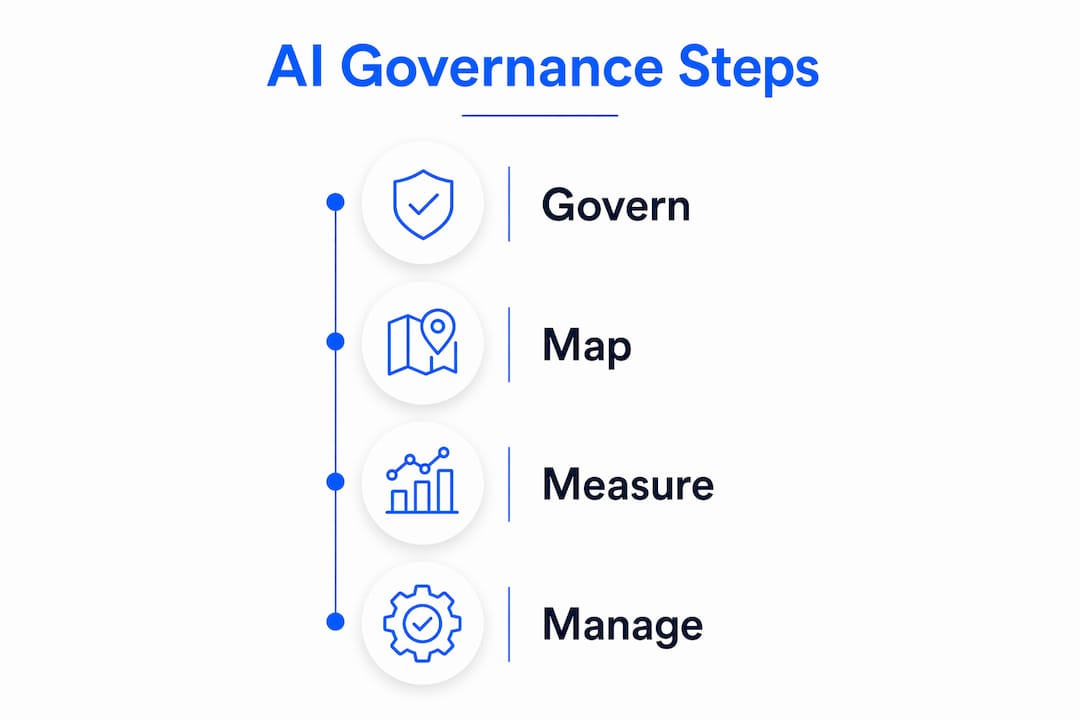
The NIST AI RMF organizes these components around four core functions: Govern, Map, Measure, and Manage. NIST released a specialized profile for generative AI in July 2024 and a concept note for critical infrastructure in April 2026, reflecting how rapidly the framework is evolving to address new AI categories.
How to implement an AI governance framework in your organization
Implementation is where most organizations stall. The gap between publishing an AI ethics policy and actually enforcing it is wide, and the Singapore Model Framework is explicit about this: effective governance distinguishes the policy rulebook from technical AI frameworks and emphasizes enforceable safety boundaries embedded in operations.
Here is a practical sequence for getting there:
- Assess your current state. Inventory all AI systems in use, including third-party tools. Identify which ones make or influence decisions affecting people.
- Define your risk appetite. Not every AI application carries the same risk. A content recommendation engine and a fraud detection model require very different levels of oversight. Calibrate your governance intensity accordingly.
- Establish governance structures. Assign an AI Ethics Committee or equivalent body. Define who owns AI risk at the executive level. Connect AI governance to your existing enterprise risk management structure.
- Write policies that can be enforced. Abstract principles do not stop a biased model from going live. Translate each principle into a specific control: a required bias audit before deployment, a mandatory human review for high-stakes decisions, a defined escalation path for model anomalies.
- Embed governance into the AI development lifecycle. Governance checkpoints belong at every phase: pre-development (data sourcing and use case approval), development (model training, validation, and bias testing), and post-deployment (monitoring, retraining triggers, and incident response).
- Build human-in-the-loop processes. For decisions with significant impact on individuals, design the system so a human reviews and approves the AI output before it is acted upon. The Singapore Model Framework provides a matrix for determining the required level of human involvement based on the probability and severity of potential harm.
- Train your teams. Staff who interact with AI outputs need to understand their limitations. A customer service agent using an AI recommendation tool should know when to escalate rather than defer to the model.
- Monitor continuously and audit periodically. Deploy autonomous monitoring to track model performance at scale. Schedule formal audits to review whether governance controls are working as intended.
Pro Tip: When writing technical controls, tie each one to a specific policy requirement. If your fairness policy requires bias testing, the control should name the testing method, the threshold for acceptable bias, and the person responsible for sign-off. Vague controls get skipped under deadline pressure.
Who does what: stakeholder roles in AI governance
Governance only works when accountability is assigned before a problem occurs. The Singapore Model Framework outlines a set of roles that most organizations can adapt to their own structures.
- Board of Directors / Executive Leadership: Sets the organization’s risk appetite for AI, approves the governance policy, and holds ultimate accountability for AI-related outcomes. This is not a ceremonial role. Boards that treat AI governance as an IT matter rather than a business risk tend to discover the difference the hard way.
- AI Ethics Committee: Reviews proposed AI applications against ethical principles, approves high-risk deployments, and monitors ongoing compliance. Membership should be multidisciplinary, including legal, compliance, data science, and business representation.
- Chief Risk Officer / Risk Management Function: Integrates AI risk into the enterprise risk framework, maintains the AI risk register, and escalates material risks to leadership.
- Data Scientists and ML Engineers: Responsible for implementing technical controls, conducting bias and performance testing, documenting model behavior, and flagging anomalies. They are the first line of defense against governance failures.
- Legal and Compliance Teams: Monitor regulatory developments, assess the legal implications of specific AI applications, and maintain alignment with laws like the Equal Credit Opportunity Act, the Fair Housing Act, and emerging federal AI legislation.
- Business Unit Owners: Own the AI applications within their domains, define the business requirements, and are accountable for outcomes in their area.
- Affected Stakeholders: Customers, employees, and communities affected by AI decisions. Governance frameworks should include feedback channels so these groups can report concerns and receive explanations.
Transparency with affected parties is not just an ethical obligation. The stakeholder buy-in that makes AI projects succeed long-term depends on people trusting that the organization takes their interests seriously.

What AI governance looks like in 2026 and where it is heading
The regulatory environment around AI shifted materially in recent years with new NIST profiles for generative AI and critical infrastructure. The European Union’s AI Act began phased enforcement, and U.S. federal agencies, including the Federal Reserve, issued supervisory guidance on AI use in financial services. The direction is clear: voluntary frameworks are becoming the baseline expectation, and mandatory requirements are building on top of them.
Several trends are shaping where AI governance goes from here:
- Generative AI governance: Large language models introduce risks that traditional governance frameworks were not designed for, including hallucination, prompt injection, and intellectual property exposure. NIST’s generative AI profile addresses these directly.
- Real-time monitoring infrastructure: Organizations are moving from periodic audits to continuous monitoring of model behavior in production. AI observatories, proposed at the international level by bodies like the Carnegie Council on Ethics in International Affairs, would provide shared data and analysis to support policymaking across borders.
- International regulatory convergence: The OECD AI Principles and the EU AI Act are pushing toward common standards. U.S. organizations with global operations need governance frameworks that can satisfy multiple regulatory regimes simultaneously.
- Third-party AI risk: As organizations rely more heavily on AI from vendors and cloud providers, governance frameworks must extend to cover how third-party models are evaluated, monitored, and replaced.
- AI in critical infrastructure: The April 2026 NIST concept note signals that AI governance for power grids, financial systems, and healthcare will face heightened scrutiny and more prescriptive requirements.
The Carnegie Council emphasizes that multidisciplinary governance structures and international observatories are critical to future-proofing AI governance, balancing innovation with public safety and inclusivity. That balance is the central challenge for every organization building a governance program right now.
What recent research reveals about AI governance gaps
A systematic literature review published in Springer Nature found that AI governance operates across multiple levels simultaneously: team, organization, national, and international. Governance actions occur in pre-development, development, and post-deployment stages, aligned with standards from NIST and the OECD. The review also identified a persistent gap between governance as a concept and governance as a practice.
The most common failure mode is treating governance as a documentation exercise. Organizations publish AI ethics principles, check the box, and move on. The Singapore Model Framework addresses this directly, urging organizations to integrate governance as actionable controls embedded within AI development operations rather than abstract policy statements.
Key findings from recent research include:
- One-size-fits-all governance fails. Organizations with diverse AI portfolios need tiered governance, with lighter-touch oversight for low-risk applications and rigorous controls for high-stakes ones.
- Technical and governance frameworks serve different functions. A technical AI framework tells engineers how to build models. A governance framework tells the organization which models it is allowed to build and under what conditions. Conflating the two leads to gaps in both.
- Lifecycle coverage is uneven. Most organizations have stronger governance at the deployment stage than at the data sourcing or model design stage. Pre-development governance, including use case approval and data ethics review, is where the most preventable harms originate.
- Monitoring is underinvested. Post-deployment monitoring is often manual, infrequent, and disconnected from the governance structure. Automated monitoring tied to defined performance thresholds is the standard organizations should be moving toward.
- Practitioner expertise matters. Governance frameworks designed without input from data scientists and ML engineers tend to produce controls that are technically unenforceable. Effective governance is built collaboratively.
Legal and regulatory compliance considerations in AI governance
U.S. organizations face a layered compliance environment for AI. No single federal AI law currently governs all sectors, but existing laws apply directly to AI systems in ways that many organizations underestimate.
The Equal Employment Opportunity Commission (EEOC) has taken enforcement action against employers whose AI-driven hiring tools produced discriminatory outcomes. The Federal Trade Commission (FTC) has authority over deceptive AI practices under Section 5 of the FTC Act. The Federal Reserve and other financial regulators have issued guidance on model risk management that applies to AI models used in credit, fraud detection, and customer service. The Federal Reserve’s supervisory guidance makes clear that AI models in financial services are subject to the same model risk management expectations as traditional statistical models.
At the state level, Colorado, Illinois, and California have enacted or proposed AI-specific legislation covering automated decision-making in employment and insurance. Organizations operating across multiple states need governance frameworks that can accommodate this patchwork.
For organizations with European operations, the EU AI Act introduces a risk-based classification system with mandatory requirements for high-risk AI applications. The EU Ethics Guidelines for Trustworthy AI provide the ethical foundation that the Act’s requirements build on.
Practical compliance steps include:
- Map each AI application to the legal frameworks that apply to it by sector, jurisdiction, and use case
- Maintain documentation of model development decisions, training data sources, and validation results
- Establish a process for responding to regulatory inquiries and individual rights requests (such as explanations for automated decisions)
- Review third-party AI vendor contracts for compliance representations and audit rights
- Monitor legislative developments at both the federal and state levels, as the U.S. regulatory landscape is evolving quickly
How to measure whether your AI governance program is working
Governance without measurement is just policy. Organizations need specific metrics to know whether their framework is producing the outcomes it was designed for.
The right metrics depend on what your governance program is trying to achieve, but a core set applies across most organizations:
| KPI | What it measures |
|---|---|
| Model bias audit pass rate | Percentage of models that clear bias testing before deployment |
| Human override rate | How often human reviewers override AI recommendations in high-stakes decisions |
| Incident response time | Average time from AI-related incident detection to resolution |
| Policy compliance rate | Percentage of AI projects that completed required governance checkpoints |
| Stakeholder complaint volume | Number of complaints received about AI-driven decisions, tracked over time |
| Model drift detection rate | Percentage of deployed models with active performance monitoring in place |
Beyond these operational metrics, governance programs should track leading indicators. How many AI use cases are in the pipeline? What percentage have completed a pre-development ethics review? How many staff have completed AI governance training? These upstream measures tell you whether governance is being applied early enough to prevent problems, rather than just catching them after the fact.
Periodic governance audits, conducted at least annually, should assess whether the framework itself remains fit for purpose as the organization’s AI portfolio and the regulatory environment evolve. The AI data strategy underpinning your models also warrants regular review, since data quality and lineage issues are among the most common sources of model failure.
AI governance in practice: what real programs look like
Abstract frameworks become clearer when you see how they translate into organizational practice.
Financial services: A major U.S. bank deploying an AI model for credit underwriting would typically subject it to the Federal Reserve’s model risk management guidance, conduct independent validation before deployment, assign a model owner accountable for ongoing performance, and document the model’s assumptions and limitations. Human review is required for any application the model declines, and the model is retested quarterly against current data.
Healthcare: A hospital system using AI to prioritize patient outreach for preventive care would conduct a bias audit to confirm the model does not systematically deprioritize certain demographic groups. Clinical staff review AI-generated patient lists before any outreach occurs. The governance committee reviews the model’s performance against health outcome metrics annually.
Technology and product development: A software company deploying a generative AI feature in its product would apply NIST’s generative AI profile to assess risks including hallucination, data leakage, and misuse. The product team completes a pre-launch ethics review, documents the model’s known limitations in user-facing disclosures, and monitors user feedback for signs of harmful outputs.
These examples share a common structure: governance is embedded in the workflow, not bolted on afterward. The people building and deploying the AI are also the people executing the governance controls, with oversight from a dedicated governance function. That integration is what separates programs that work from programs that exist only on paper.
Botiqueai works with organizations at exactly this stage, helping teams translate governance principles into AI solutions that are both effective and accountable. Whether you are building a customer-facing AI assistant or automating internal workflows, the governance architecture you put in place now determines how much trust that system earns over time.
Key Takeaways
An effective AI governance framework embeds enforceable controls across the full AI lifecycle, from data sourcing through post-deployment monitoring, aligned with NIST, OECD, and applicable legal requirements.
| Point | Details |
|---|---|
| Governance is operational, not just policy | Translate ethical principles into specific technical controls embedded in AI development pipelines. |
| NIST AI RMF is the U.S. baseline | NIST’s framework, including its 2024 generative AI profile, is the de facto standard of care for U.S. organizations. |
| Roles must be assigned before deployment | Accountability for AI outcomes requires named owners at the board, committee, and team level before a model goes live. |
| Lifecycle coverage must be complete | Pre-development governance, including use case approval and data ethics review, prevents the most common and costly failures. |
| Measurement drives improvement | Track bias audit pass rates, policy compliance rates, and model drift detection to confirm governance is working in practice. |