
What Is an AI Vertical Solution? A Business Guide
What Is an AI Vertical Solution? A Business Guide
An AI vertical solution is an AI system purpose-built for one industry or workflow, combining domain-trained models, proprietary data, and workflow integrations to deliver production-grade outcomes. If your team is evaluating AI for a regulated, language-heavy, or high-accuracy process, this is the architecture worth understanding.
Quick-check: vertical AI is the right fit when:
- Your workflow operates under regulatory constraints (healthcare, finance, legal) where generic outputs create liability
- Your processes depend on domain-specific language, ontologies, or document types that general models misread
- You need a system that acts autonomously across multiple steps, not just answers questions
Botiqueai’s implementation work and the sources below ground every claim in this guide.
Table of Contents
- How vertical AI differs from horizontal AI and why it matters
- What the technical stack of a vertical AI solution looks like
- What vertical AI can actually do in production
- The business case: benefits, ROI signals, and cost factors
- Where vertical AI is already producing results by industry
- A practical roadmap from pilot to production
- Key risks and how to mitigate them
- How to evaluate vendors and what to ask in an RFP
- How Botiqueai implements vertical AI for clients
- Key Takeaways
- The part most organizations get wrong about vertical AI
- What Botiqueai can build for your organization
- Useful sources and further reading
How vertical AI differs from horizontal AI and why it matters
The core distinction is scope versus depth. Horizontal AI, think general-purpose large language models, is built to handle a wide range of tasks across many domains. Vertical AI is engineered to go deep in one: it carries domain ontologies, compliance rules, and industry-specific training data that a general model simply does not have.
| Capability | Horizontal AI | Vertical AI |
|---|---|---|
| Domain coverage | Broad, cross-industry | Single industry or workflow |
| Accuracy on domain tasks | Moderate | High, production-grade |
| Regulatory alignment | Manual configuration | Built-in by design |
| Deployment effort | Lower upfront, higher tuning | Higher upfront, lower ongoing debt |
| Typical use case | General Q&A, drafting | Clinical notes, claims processing, demand forecasting |
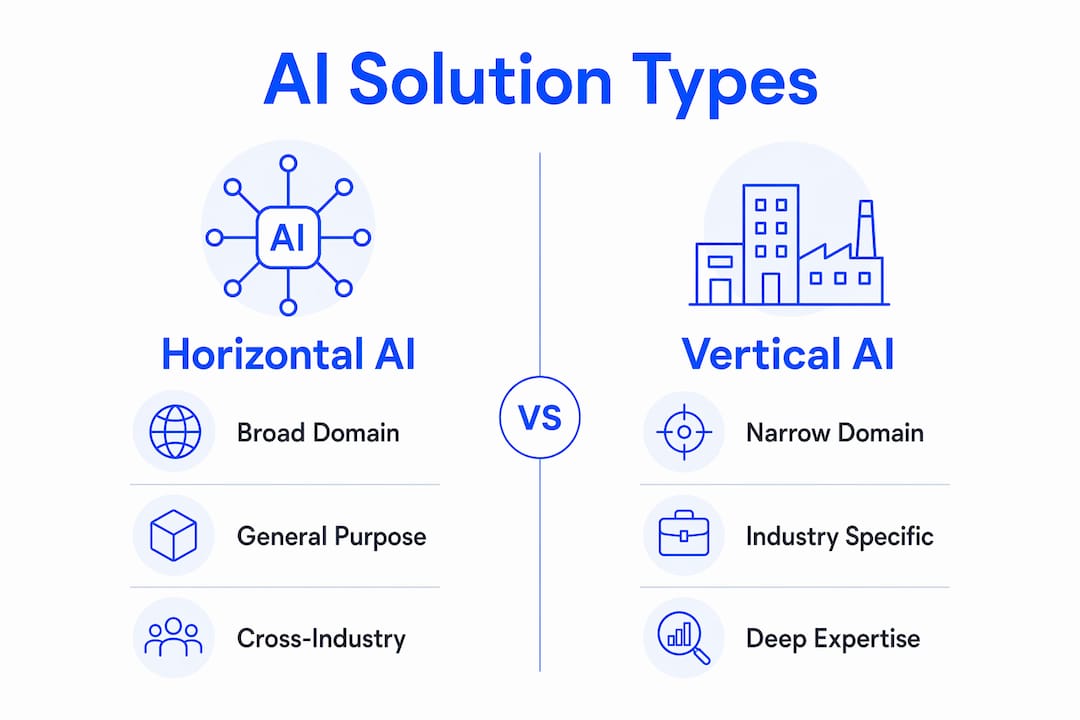
For procurement teams, the practical implication is this: horizontal tools look impressive in demos but rarely hold up in regulated or complex workflows. INSEAD strategy experts argue that vertical applications create sustainable competitive advantage precisely because they embed the industry context generic models lack.
What the technical stack of a vertical AI solution looks like
A canonical vertical AI stack runs through several layers, each doing specific work:
- Foundation model: A general-purpose LLM (GPT-class or open-source equivalent) provides the base language capability.
- Industry fine-tuning: The model is retrained on domain-specific corpora, clinical literature, financial filings, legal contracts, or manufacturing logs.
- Domain ontologies and knowledge graphs: These map sector-specific entities and relationships, parts hierarchies, regulatory clauses, product taxonomies, enabling reasoning that fine-tuning alone cannot produce.
- Proprietary data layer: Your organization’s internal data grounds the model in your specific context, not just the industry’s.
- Retrieval-augmented generation (RAG): Real-time retrieval pulls current documents, records, or policies into the model’s context window at inference time.
- API connectors and workflow orchestration: The agent reads from and writes to your ERP, CRM, or claims system, completing tasks rather than just generating text.
- MLOps and monitoring: Model lifecycle management, retraining cadence, validation pipelines, and rollback processes keep the system accurate over time.
Integration patterns matter here. Event-driven connectors work well for real-time decisioning (fraud alerts, routing). Batch connectors suit scheduled workflows (nightly reconciliation, weekly demand forecasts).
Pro Tip: Index your RAG data by the same canonical identifiers your operational systems use, such as product SKUs, patient IDs, or contract numbers. Mismatched identifiers are the single most common cause of retrieval failures in early pilots.

What vertical AI can actually do in production
Vertical AI agents are purpose-built to perform multi-step tasks, make autonomous decisions, and interact with APIs to complete end-to-end business processes. That is a meaningful upgrade from a chatbot that answers questions.
Capability categories you should expect from a production-ready system:
- Predictive forecasting: Demand signals, churn risk, equipment failure probability
- Automated document review: Contract clause extraction, clinical note coding, invoice validation
- Intelligent routing: Claims triage, support ticket escalation, order exception handling
- Diagnostic suggestion: Differential diagnosis support, fraud pattern flagging, quality defect classification
Example: a vertical agent handling an insurance claim
- Claimant submits a document via portal; the agent extracts structured fields using domain NLP.
- Agent queries the policy database via API to verify coverage and deductibles.
- Agent applies jurisdiction-specific rules to flag eligible versus excluded items.
- If the claim falls within pre-approved parameters, the agent triggers payment; otherwise it routes to a human adjuster with a pre-populated summary.
- The decision and rationale are logged to the audit trail automatically.
That five-step flow replaces what typically takes two to three days of manual processing.
The business case: benefits, ROI signals, and cost factors
Vertical AI unlocks workflows previously out of reach for legacy software by automating language- and knowledge-heavy tasks in regulated industries. The business benefits that show up most consistently in production deployments:
- Higher out-of-the-box accuracy on domain tasks versus a general model prompted ad hoc
- Faster deployment to value because domain context is pre-built, not configured from scratch
- Lower long-term technical debt from a purpose-built architecture versus a patched general tool
- Compliance alignment embedded in the model’s rules and guardrails, not bolted on afterward
- New revenue capture in language-heavy workflows that were previously too expensive to automate
KPIs worth tracking: accuracy lift on document classification, time saved per processed transaction, cost per transaction versus the manual baseline, error rate reduction, and revenue-related metrics like faster claims settlement or higher quote conversion.
On costs, budget for four main drivers: data preparation and labeling, integration engineering, licensing or compute, and ongoing model maintenance including retraining.
Where vertical AI is already producing results by industry
- Supply chain: Demand forecasting agents that combine POS data, weather signals, and supplier lead times to generate replenishment orders with minimal human review
- Healthcare: Clinical documentation agents that convert physician dictation into structured notes and ICD codes, cutting documentation time significantly; diagnostic suggestion tools that surface differential diagnoses from lab results and imaging metadata
- Finance: Risk analysis agents that screen transactions against regulatory watchlists and flag anomalies in real time; compliance agents that map new regulations to existing policy libraries
- Retail: Assortment and promotion agents that optimize SKU mix by store cluster using local demand signals; retail automation tools that personalize offers at the individual customer level
- Customer support: Intent-routing agents that classify inbound contacts and resolve tier-one issues autonomously, escalating only the exceptions that need a human
The distinction that matters for ROI: vertical AI delivers the most when it targets core workflows, the ones that directly affect revenue, cost, or compliance, rather than supporting workflows like internal search or knowledge bases. Supporting workflows are a fine starting point, but the payback is smaller.
A practical roadmap from pilot to production
- Discovery and value scoping: Map candidate workflows, estimate manual cost and error rates, and rank by potential impact and data availability.
- Data readiness audit: Confirm data availability, assess labeling needs, run privacy and compliance checks, and verify canonical identifiers align across systems.
- Pilot design and KPIs: Define success criteria before you start. Pick one workflow, set a baseline, and agree on the metrics that will determine whether you proceed.
- Integration and ops handoff: Connect the agent to live systems via APIs, run parallel operations with the existing process, and train the team that will own it.
- Production rollout: Expand scope incrementally. Monitor accuracy, latency, and exception rates from day one.
- Continuous improvement: Schedule retraining reviews quarterly, track model drift, and build a feedback loop from human reviewers into the training pipeline.
Executives frequently cite data-readiness as the top barrier to applying generative AI. A data readiness checklist should cover: labeled training examples, privacy and consent compliance, data freshness standards, and canonical entity mapping.
Pro Tip: Run a parallel control during the pilot: let the agent process a sample of real cases while your existing process handles the same cases independently. Compare outcomes on accuracy and time. This gives you defensible evidence for the production decision.
Key risks and how to mitigate them
- Data quality and availability: Poor or incomplete training data produces unreliable outputs. Mitigate with a structured data audit before any model work begins.
- Regulatory and privacy compliance: Domain-specific regulations (HIPAA, SOC 2, GDPR for US companies with EU data) require compliance to be designed in, not added later. Require documented compliance architecture from vendors.
- Model bias and explainability: Biased training data produces biased decisions. Require fairness testing, explainability outputs, and human-in-the-loop checkpoints for high-stakes decisions.
- Integration complexity: Connecting to legacy systems often takes longer than the model work. Budget integration engineering time separately.
- Hidden operational costs: Retraining, monitoring, and model governance are ongoing costs that vendors sometimes understate. Get them in the SLA.
On ethics: require that vendor contracts specify auditability standards, bias testing cadence, and accountability for model decisions, especially in regulated workflows.
How to evaluate vendors and what to ask in an RFP
Selection criteria:
- Demonstrated domain expertise with references in your industry
- Pre-built data connectors for your core systems
- Ontology and knowledge graph support, not just fine-tuning
- MLOps infrastructure: monitoring, retraining, rollback
- Security and compliance certifications relevant to your sector
- Documented, measurable outcomes from prior deployments
Sample vendor questions:
- What foundation model does your solution use, and who owns the fine-tuned weights?
- How do you handle proprietary training data, and what are the data residency options?
- What is your retraining cadence, and who initiates it?
- How do you monitor for model drift in production?
- What does your SLA cover for accuracy degradation?
- Can you show a live demo on data similar to ours?
- What integration patterns do you support (event-driven, batch, REST API)?
- How do you handle human-in-the-loop escalation?
- What compliance certifications does your platform hold?
- Can you provide two client references in our industry with measurable outcomes?
Red flags: opaque training data provenance, no post-deployment monitoring plan, unclear ownership of fine-tuned models, and zero domain-specific references or case studies.
How Botiqueai implements vertical AI for clients
Botiqueai’s approach follows a structured methodology that mirrors the roadmap above, with a few specific emphases:
- Discovery and value scoping: Every engagement starts by mapping the workflows with the highest manual cost or error exposure, not the ones that look easiest to automate.
- Data grounding and ontology mapping: Botiqueai builds or adapts domain ontologies before model work begins, because retrieval quality depends on how well the knowledge graph matches your operational data.
- Pilot execution with parallel controls: Pilots run against live data with a control group, so the production decision is based on evidence, not vendor claims.
- Production rollout and observability: Botiqueai deploys with monitoring dashboards from day one, tracking accuracy, latency, and exception rates in real time.
For a concrete example of what this looks like in practice, the Pernod Ricard case study on Botiqueai’s portfolio page shows how a domain-specific AI implementation was scoped, built, and measured. Additional real-world AI transformation examples are available on the Botiqueai blog for teams preparing business cases.
Key Takeaways
Vertical AI solutions deliver production-grade outcomes in regulated and language-heavy workflows because they combine domain models, proprietary data, and workflow integrations that general-purpose AI cannot replicate.
| Point | Details |
|---|---|
| When to choose vertical AI | Pick it for regulated, high-accuracy, or language-heavy workflows where generic models create liability or underperform. |
| Architecture non-negotiables | Require a foundation model, industry fine-tuning, a proprietary data layer, RAG, and API connectors in any vendor RFP. |
| Data readiness first | Data quality and canonical identifier alignment are the top barriers; audit before any model work begins. |
| Time-to-value drivers | Pilot-to-production timelines depend on integration complexity and data readiness, not just model capability. |
| Botiqueai’s approach | Botiqueai scopes, builds, and monitors vertical AI implementations with parallel-control pilots and domain ontology mapping. |
The part most organizations get wrong about vertical AI
The dominant mistake is treating “vertical AI” as a product category you can buy off a shelf. It is not. An industry label on a vendor’s marketing page does not mean the system is actually grounded in your data, your workflows, or your regulatory context. INSEAD’s analysis makes this point clearly: organizational change, governance, and operational integration are required before an autonomous agent can act reliably inside a regulated workflow.
The second mistake is starting with the technology and working backward to a use case. The organizations that see real returns start with a specific, measurable workflow problem, then ask whether vertical AI is the right tool. Usually it is, but the framing matters. A system scoped to solve a defined problem with clear success criteria will outperform a broader “AI transformation” initiative every time, because the team knows what winning looks like.
Governance and ethics are not optional add-ons. Auditability, bias testing, and human-in-the-loop design should be in the contract before the first line of code is written.
What Botiqueai can build for your organization
Most organizations evaluating vertical AI face the same gap: they understand the concept but lack the domain-specific implementation expertise to move from pilot to production without accumulating technical debt. Botiqueai closes that gap directly, building custom AI agents and workflow automations that are grounded in your data, connected to your systems, and monitored from day one.
The work spans intelligent chatbots like Aria for customer-facing workflows, to back-office automation covering document processing, routing, and compliance checks. Every engagement starts with a discovery call to scope the highest-value workflow and define the metrics that will determine success. If you are preparing an RFP or building a business case for vertical AI, that conversation is the fastest way to pressure-test your assumptions with a team that has built these systems in production.
Useful sources and further reading
- INSEAD Knowledge: The Future Isn’t Horizontal — Strategy-level argument for why vertical AI creates durable competitive advantage; essential reading before any board-level AI investment discussion.
- Google Cloud: Vertical AI Agents — Technical overview of agentic capabilities and multi-step task architecture; useful when writing RFP requirements.
- SymphonyAI: What Is Vertical AI? — Covers the canonical stack and data-readiness barriers; good reference for technical teams evaluating architecture options.
- Bessemer Venture Partners: The Future of AI Is Vertical — Investor perspective on market opportunity and why language-heavy regulated workflows are the highest-value targets.
- Domo: Horizontal vs. Vertical AI — Practical comparison framework for procurement teams choosing between agent types.
- Botiqueai case studies and resources — Client implementations with measured outcomes; useful when benchmarking expected results for your own pilot.