
What Is an AI Co-Founder Tool? A 2026 Guide
What Is an AI Co-Founder Tool? A 2026 Guide
An AI co-founder tool is a software platform that automates key startup workflows, including research, planning, and execution, to help solo founders scale without adding headcount. The term “AI co-founder” is a marketing label. The accurate industry term is an AI startup assistant or AI operational partner. These platforms simulate the functional roles of a CTO, CMO, or CFO but hold no equity and carry no fiduciary duties. For entrepreneurs building lean teams in 2026, understanding what this category of tool actually does, and what it does not do, is the difference between a useful investment and a costly distraction.
What is an AI co-founder tool and how does it work?
An AI co-founder tool is a platform that takes over repeatable, high-effort startup tasks so founders can focus on decisions that require human judgment. Think of it as an AI business partner that handles the operational layer of running a company. It does not replace a human co-founder in the legal or relational sense. It replaces the hours you spend on tasks that do not require your unique expertise.
The AI co-founder category emerged because team composition is the top startup failure factor, and hiring human co-founders or senior operators is prohibitively expensive for most early-stage companies. AI tools reached a tipping point in utility that made them a credible alternative for operational support. That shift is now reshaping how solo founders build and run companies.
These platforms work by connecting to your existing tech stack, learning your startup’s context, and executing tasks within defined workflows. The best ones use persistent memory to retain information across sessions. Without persistent memory, an AI tool behaves like an advanced calculator: useful for a single task but unable to build on prior context.

Core functions these platforms cover
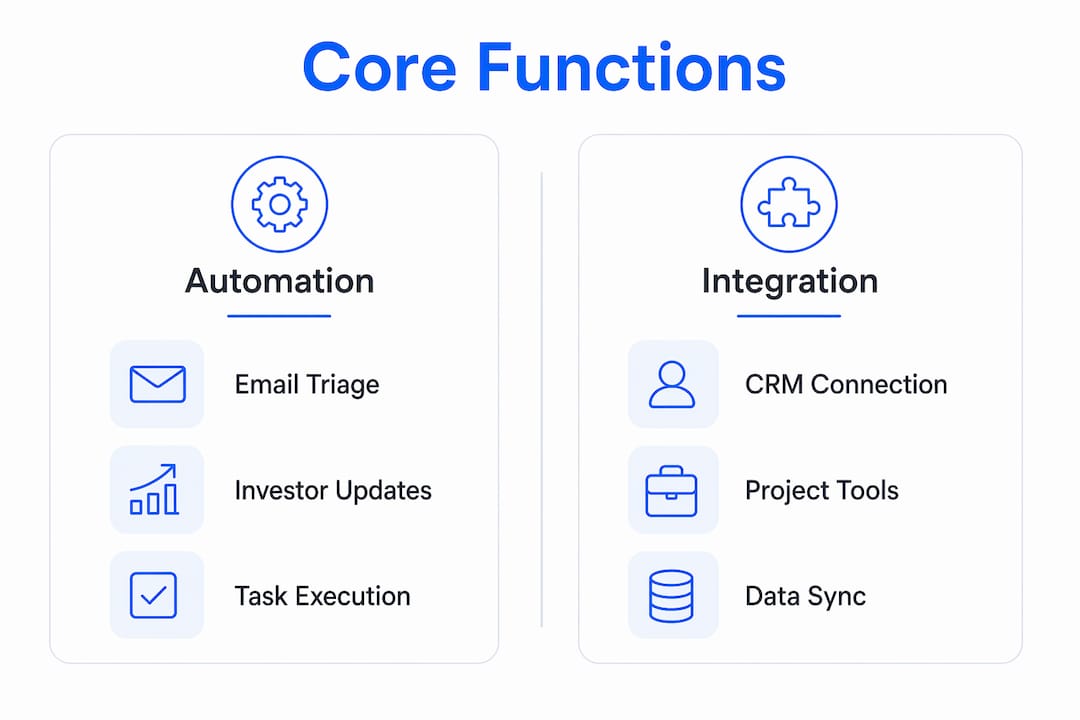
AI startup assistants cover a wide range of operational functions. The most capable platforms handle all of the following:
- Research automation: Competitive analysis, market sizing, and customer research compiled on demand
- Ideation and planning: Business model validation, go-to-market planning, and product roadmap drafting
- MVP support: Technical scoping, feature prioritization, and vendor sourcing
- Marketing execution: Email campaigns, social content drafts, and SEO briefs
- Operations coordination: Workflow management, team updates, and project tracking
- Investor relations: Automated investor updates, pitch deck drafts, and data room organization
One of the most time-saving applications is email triage. Startups that automate 80% of email triage and investor updates after setup report user retention rates of 99% over two months. That figure reflects how quickly founders become dependent on the time savings once they experience them.
Pro Tip: Prioritize platforms that execute tasks inside your actual tech stack over platforms that only generate text-based recommendations. Doing tools deliver higher ROI than thinking tools because they act on your systems, not just advise you about them.
Integration depth matters more than feature count. A platform that connects to your CRM, email, project management tool, and calendar delivers compounding value. One that only generates documents adds limited operational impact.
How do AI co-founder tools compare to human co-founders?
The cost difference between an AI operational partner and a human one is substantial. A world-class human COO costs $10,000–$17,000 monthly, while AI operational platforms deliver structured intelligence starting at approximately $48 per month. That gap makes AI tools the only realistic option for pre-revenue founders.
| Dimension | Human co-founder or COO | AI operational partner |
|---|---|---|
| Monthly cost | $10,000–$17,000+ | From ~$48/month |
| Availability | Business hours | 24/7 |
| Legal status | Equity holder, fiduciary duties | No equity, no legal duties |
| Memory and context | Continuous | Requires persistent memory feature |
| Decision authority | Shared | Advisory and executional only |
| Emotional intelligence | High | Limited |
Beyond cost, AI tools act as thinking partners that challenge assumptions and organize structured founder thinking under pressure. That function matters more than most founders expect. When you are building alone, you have no one to pressure-test your reasoning. An AI business partner fills that gap by surfacing counterarguments and structuring your decision process.
“The primary value of an AI co-founder tool is not task automation. It is the reduction of blind spots that every solo founder carries when making decisions without a sounding board.”
The productivity gains are real, but they require setup. Founders who define clear workflows before deploying these tools see the strongest results. Those who treat the tool as a general-purpose assistant without structure see inconsistent output.
Limitations and best practices for using these tools
AI co-founder tools do not hold equity or fiduciary duties, and they require human oversight to be effective and legally compliant. That distinction matters when you are making decisions that affect investors, customers, or employees. The AI drafts and executes. You approve and own the outcome.
The most common failure mode is expecting full autonomy. Best outcomes require founders to define strict workflow boundaries and maintain final decision authority. Founders who hand over entire decision categories to AI without review create compliance risks and strategic drift.
Common pitfalls to avoid:
- No defined workflows: Deploying AI without specifying which tasks it owns and which require approval leads to inconsistent output
- No approval gates: Letting AI send external communications without human review creates reputational risk
- Ignoring memory features: Failing to use persistent memory means the AI restarts context with every session, losing compounding value
- Over-reliance on text output: Using AI only for document generation misses the higher-value execution functions
Persistent memory across sessions allows the AI to continuously improve its context, enabling compound intelligence over time. A platform that remembers your pricing strategy, your investor preferences, and your product roadmap delivers fundamentally better output than one that starts fresh each session.
Pro Tip: Before deploying any AI startup assistant, map your weekly recurring tasks and classify each one as AI-owned, AI-assisted, or human-only. That map becomes your workflow boundary document and prevents the most common integration failures.
How to choose and integrate AI entrepreneurship tools
Choosing the right platform requires evaluating five criteria before committing to any tool.
- Operational scope: Does the platform execute tasks or only generate recommendations? Execution tools deliver more value.
- Persistent memory: Can the platform retain context across sessions? Without this, you rebuild context every time.
- Integration capabilities: Does it connect to your CRM, email, calendar, and project management tools?
- Cost structure: Does pricing scale with your usage, or does it lock you into a flat tier regardless of output?
- Support and onboarding: Does the vendor provide workflow templates or setup guidance for founders?
Once you select a platform, embed it into your daily routine through a structured pilot. Spend the first two weeks assigning only low-stakes, repeatable tasks. Review the output daily. Adjust prompts and workflow boundaries based on what you observe. Expand scope only after you trust the output quality.
Guided workflow tools give founders pre-built templates for common startup tasks like investor updates and competitive research. Autonomous AI executors take broader ownership of task categories and act with less per-task direction. Early-stage founders benefit most from guided workflow tools because they maintain tighter oversight while building confidence in the platform.
For a deeper look at how AI agents fit into B2B startup operations, the range of agent types available in 2026 covers everything from customer-facing assistants to internal operations coordinators. Understanding the types of enterprise AI agents helps founders match the right architecture to their specific operational gaps.
A practical example workflow: every monday morning, your AI platform pulls the previous week’s sales data, drafts an investor update, flags overdue tasks, and queues three content pieces for review. You spend 20 minutes approving or editing. That workflow alone replaces several hours of manual coordination each week.
Key Takeaways
AI co-founder tools deliver the most value when founders treat them as structured operational partners, not autonomous decision-makers.
| Point | Details |
|---|---|
| Definition clarity | An AI co-founder tool is a software platform, not a legal partner. It holds no equity and carries no fiduciary duties. |
| Cost advantage | AI operational platforms start at approximately $48/month versus $10,000–$17,000/month for a human COO. |
| Persistent memory matters | Tools with persistent memory build compounding context over time. Without it, every session starts from scratch. |
| Execution over advice | Platforms that execute tasks inside your tech stack deliver higher ROI than those that only generate text recommendations. |
| Human oversight is required | Define workflow boundaries and approval gates before deploying. Final decision authority must stay with the founder. |
The real shift AI co-founder tools represent
At Botiqueai, we work with founders and business leaders who are building with lean teams and high ambitions. What we see consistently is that the founders who get the most from AI operational tools are not the ones who automate the most. They are the ones who define the clearest boundaries.
The category label “AI co-founder” oversells the relationship and undersells the actual utility. These are not partners. They are high-capacity operational systems that execute within the boundaries you set. The founders who treat them that way get compounding returns. The ones who expect autonomous co-founder behavior get frustration and inconsistent output.
The more interesting shift is what these tools reveal about founder behavior. When you map your weekly tasks to assign AI ownership, you quickly discover how much of your time goes to low-value coordination work. That mapping exercise alone changes how you build. You stop hiring for coordination and start hiring for judgment.
The future of AI entrepreneurship tools is not about replacing human decision-making. It is about removing the operational noise that prevents founders from making good decisions in the first place. The best AI startup assistants are not the ones that do the most. They are the ones that free you to do what only you can do.
— Botiqueai
Botiqueai’s AI tools for startup operations
Botiqueai builds custom AI agents and automation systems for businesses that need more than off-the-shelf software. For startups and growing companies, that means AI tools designed around your actual workflows, not generic templates.
The Aria AI assistant handles customer service, lead qualification, and operational queries around the clock, freeing your team to focus on higher-value work. Botiqueai’s broader suite of AI business solutions covers everything from intelligent chatbots to full workflow automation, built specifically for the operational realities of B2B companies. If you are evaluating AI tools for your startup, Botiqueai offers the depth of customization that generic platforms cannot match.
FAQ
What is an AI co-founder tool exactly?
An AI co-founder tool is a software platform that automates startup workflows like research, planning, and task execution. It simulates operational roles such as CTO or CMO but holds no equity and carries no legal responsibilities.
Is an AI co-founder a legal business partner?
No. An AI co-founder tool is a marketing term for an AI operational platform. It has no equity stake, no fiduciary duties, and no legal standing in your company.
How much does an AI co-founder tool cost?
AI operational platforms start at approximately $48 per month, compared to $10,000–$17,000 per month for a human COO. Pricing scales with features and agent capabilities.
What makes persistent memory important in these tools?
Persistent memory allows the AI to retain your startup’s context across sessions, building compounding intelligence over time. Without it, the tool loses all prior context and restarts from scratch each session.
What is the biggest mistake founders make with AI co-founder tools?
The most common mistake is expecting full autonomy without defining workflow boundaries. Best results come from founders who specify which tasks the AI owns, which require approval, and which stay human-only.