
What Is Business Intelligence AI? A 2026 Guide
What Is Business Intelligence AI? A 2026 Guide
Business intelligence AI is the integration of machine learning, natural language processing, and predictive analytics into traditional BI platforms to turn raw data into forward-looking business decisions. The industry term for this evolution is augmented analytics, and it sits at the center of how companies like Microsoft, Salesforce, and ThoughtSpot are rebuilding their data tools. If you have used Microsoft Power BI Copilot to ask a question about last quarter’s revenue in plain English, you have already touched business intelligence AI. This guide explains what it is, how it works, and what it means for your organization.
What is business intelligence AI, and how does it differ from traditional BI?
Business intelligence is an organizational capability for converting dispersed data into usable managerial insight. It integrates information infrastructure, analytical routines, and decision-oriented interpretation. Traditional BI does this job well, but it is fundamentally retrospective. It answers “what happened.”
AI-enhanced BI answers two harder questions: “what will happen” and “what should we do.” AI BI detects anomalies automatically, forecasts trends, responds to natural language questions, and recommends actions based on complex data patterns. That shift from descriptive to prescriptive is the core value proposition.
The practical differences are significant:
- Query method. Traditional BI requires a trained analyst to write SQL or configure a dashboard. AI BI accepts plain English questions from any employee.
- Speed. Traditional BI produces reports on a scheduled cycle. AI BI surfaces insights in real time as data changes.
- Scope. Traditional BI describes historical performance. AI BI predicts future outcomes and suggests corrective actions.
- Access. Traditional BI is gated by technical skill. AI BI democratizes data analysis by enabling natural language interfaces that any manager can use.
One misconception worth correcting: AI, BI, and business process management (BPM) have not merged into a single unified field. Integration is ongoing but requires layered orchestration and human judgment. Treating them as interchangeable leads to failed implementations.
Core AI features that power modern BI platforms
Modern AI BI platforms share a common set of capabilities. Each one addresses a specific gap that traditional BI left open.

Predictive forecasting uses historical data patterns to project future outcomes. A retail chain can forecast inventory demand by store location three months out, not just review what sold last month.
Natural language processing (NLP) lets users query data conversationally. NLP interfaces simplify the user experience, giving broader access to analytics beyond professional analysts. ThoughtSpot built its entire product around this capability. You can read more about how NLP works in enterprise settings to understand the underlying mechanics.
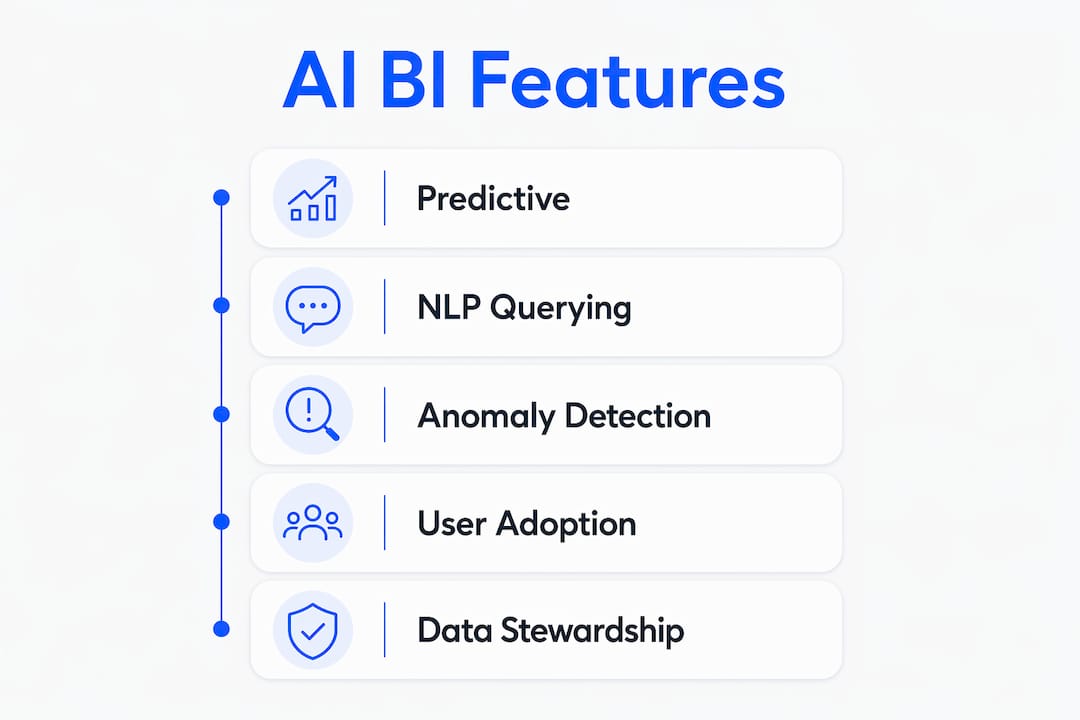
Automated anomaly detection monitors data streams continuously and flags unusual patterns without waiting for a human to notice. A finance team gets an alert when expense submissions spike 40% above the monthly baseline, before month-end close.
AI-generated narrative summaries translate complex data outputs into plain-language executive briefings. Microsoft Power BI Copilot and Tableau Einstein both generate written summaries alongside charts.
Machine learning model integration embeds predictive models directly into the BI workflow. Instead of a data scientist exporting a model and handing it to an analyst, the model runs inside the dashboard and updates as new data arrives.
- Agentic AI monitoring represents the newest frontier. AI applications now enable proactive recommendations and real-time data processing, with AI agents watching data streams and triggering alerts or workflows automatically.
Pro Tip: Start with one AI feature, not all of them. Deploy NLP querying first. It delivers visible value to non-technical managers within weeks and builds internal confidence before you tackle predictive modeling.
How to integrate AI into your existing BI systems
Integration is where most organizations stumble. The architecture matters more than the tool selection.
AI BI works as a layered system: AI sits as an augmentation layer on top of your existing big data infrastructure and BI platforms. Attempting to bypass this structure by dropping an AI tool onto a fragmented data environment risks integration failure. The AI has nothing reliable to work with.
Follow this sequence for a realistic implementation:
- Audit your data quality first. Data quality, not analytic capacity, is the bottleneck in realizing AI BI’s potential. Inconsistent formats, duplicate records, and missing fields produce unreliable AI outputs regardless of how sophisticated the model is.
- Consolidate your data infrastructure. AI BI tools need a single, accessible data layer. A data warehouse or lakehouse architecture, such as Snowflake or Databricks, gives AI tools clean, structured input.
- Select tools that fit your existing stack. Microsoft Power BI Copilot integrates naturally with Azure and Microsoft 365. Tableau Einstein connects to Salesforce CRM data. Forcing a tool into an incompatible environment creates maintenance debt.
- Define governance policies before deployment. Establish who can access AI-generated insights, how outputs are validated, and what human review is required before decisions are made.
- Measure outcomes, not activity. Track whether AI BI actually improves decision speed or forecast accuracy. Adoption rates and dashboard views are vanity metrics.
Human oversight remains non-negotiable. AI BI surfaces patterns and probabilities. A human still decides whether to act on them and bears accountability for the outcome.
Pro Tip: Assign a data steward to each AI BI deployment. This person owns data quality, monitors model drift, and serves as the escalation point when AI outputs conflict with business intuition.
Real-world applications and business benefits of AI-powered BI
The business case for AI-powered BI is clearest in three areas: forecasting, customer behavior, and operational efficiency.
Sales forecasting is the most common entry point. AI BI tools analyze historical sales data, seasonal patterns, pipeline velocity, and external signals like economic indicators to generate rolling forecasts. Sales leaders get a probability-weighted view of the quarter, not just a static spreadsheet updated once a week.
Customer behavior analysis uncovers patterns that no analyst would find manually. An e-commerce company running Qlik AutoML can identify which customer segments are most likely to churn 30 days before they cancel, then trigger a retention campaign automatically.
Operational efficiency gains come from anomaly detection and automated reporting. A logistics company using AI BI can detect route inefficiencies or supplier delays in real time and reroute before the problem compounds.
The broader benefits include:
- Faster decisions. AI BI transitions organizations from descriptive analytics to predictive and prescriptive analytics, cutting the time between data and action.
- Reduced manual workload. Automated report generation and anomaly alerts free analysts to focus on interpretation rather than data preparation.
- Wider access to insight. Non-technical managers make data-informed decisions without waiting for an analyst to build a custom report.
- Competitive advantage. Organizations that act on predictive signals faster than competitors capture market opportunities and avoid operational surprises.
AI BI represents the next major evolution in decision-making tools, transforming static reports into predictive, conversational, and automated insight engines. That transformation is not theoretical. It is already running inside the BI platforms most large organizations already own.
Leading AI-powered BI tools compared
The market for AI BI tools is mature enough that most large platforms now include AI features as standard. The differences lie in depth, integration, and target use case.
| Tool | Core AI strength | Best fit | Notable feature |
|---|---|---|---|
| Microsoft Power BI Copilot | Generative AI summaries, NLP queries | Microsoft 365 environments | Copilot integration with Azure OpenAI |
| Tableau Einstein | Predictive analytics, automated insights | Salesforce CRM users | Einstein Discovery for model-driven forecasting |
| ThoughtSpot | Natural language search, AI-driven answers | Self-service analytics teams | SpotIQ for automated insight generation |
| Qlik AutoML | Automated machine learning, anomaly detection | Mid-market and enterprise | No-code ML model building inside BI workflows |
These tools integrate AI features into traditional BI platforms to enhance data interaction and insight generation. Selecting the right one depends on your existing technology stack, your team’s technical maturity, and whether your priority is NLP access, predictive modeling, or automated reporting.
Regulated industries, such as financial services and healthcare, should prioritize tools with built-in governance features: audit trails, role-based access controls, and explainability outputs that document how the AI reached a conclusion.
Key Takeaways
Business intelligence AI delivers the most value when it is built as an augmentation layer on clean data infrastructure, not dropped onto fragmented systems as a quick fix.
| Point | Details |
|---|---|
| AI BI is augmented analytics | It adds prediction and prescription to traditional BI’s descriptive reporting. |
| Data quality is the real bottleneck | Clean, consolidated data determines AI output quality more than tool selection does. |
| NLP democratizes access | Natural language querying gives non-technical managers direct access to data insights. |
| Layered architecture is required | AI must sit on top of existing BI and data infrastructure to function reliably. |
| Human oversight stays essential | AI surfaces patterns; humans validate, interpret, and take accountability for decisions. |
Botiqueai’s take on where AI BI actually breaks down
The most common failure I see is organizations buying an AI BI tool and expecting it to fix a data problem. It never does. Garbage data produces confident-sounding garbage outputs. The AI does not know it is wrong. That is the dangerous part.
The second failure is treating AI BI as a replacement for analytical thinking. The tools are genuinely impressive. ThoughtSpot can surface a correlation in seconds that would take an analyst two days to find. But correlation is not causation, and the business context that determines whether a pattern matters still lives in a human brain.
What actually works is the layered approach. You build clean data infrastructure first. You add BI tooling second. You layer AI capabilities third. Each layer depends on the one below it. Organizations that skip steps one and two and go straight to step three are the ones writing frustrated LinkedIn posts about AI not delivering ROI.
The future direction is agentic AI: systems that do not just answer questions but monitor data streams continuously and act on triggers. That is genuinely new territory. But the organizations that will benefit most are the ones that already have disciplined data governance. The AI just makes good infrastructure more powerful. It does not substitute for it.
Explore AI insights and trends to stay current on how augmented analytics is evolving across industries.
— Botiqueai
Transform your BI strategy with Botiqueai
Botiqueai builds custom AI solutions that connect directly to your business data and decision workflows. The Aria AI chatbot gives your team a conversational interface to query business data, surface insights, and trigger automated responses without writing a single line of code. For organizations that need deeper integration, Botiqueai’s custom AI automations are built to fit your existing BI stack, not replace it. Whether you are starting with NLP querying or building toward full predictive analytics, Botiqueai designs the architecture around your specific operational needs. Discover how Botiqueai can accelerate your AI BI deployment at botiqueai.com.
FAQ
What is business intelligence AI in simple terms?
Business intelligence AI is the addition of machine learning and natural language processing to traditional BI tools so they can predict outcomes and answer plain-English questions, not just report on past data.
How does AI BI differ from standard business analytics?
Standard business analytics describes what happened using historical data. AI BI predicts what will happen and recommends what to do, using automated pattern recognition and predictive models.
Which AI BI tools are most widely used?
Microsoft Power BI Copilot, Tableau Einstein, ThoughtSpot, and Qlik AutoML are the leading platforms. Each integrates AI features into existing BI workflows for forecasting, anomaly detection, and natural language querying.
Is data quality really more important than the AI tool itself?
Data quality is the primary bottleneck in AI BI implementations. Even the most sophisticated AI model produces unreliable outputs when the underlying data is inconsistent, incomplete, or poorly structured.
Do you need a data scientist to use AI BI tools?
No. AI BI tools like ThoughtSpot and Power BI Copilot are designed for business users. Natural language interfaces let managers query data directly without SQL knowledge or data science training.