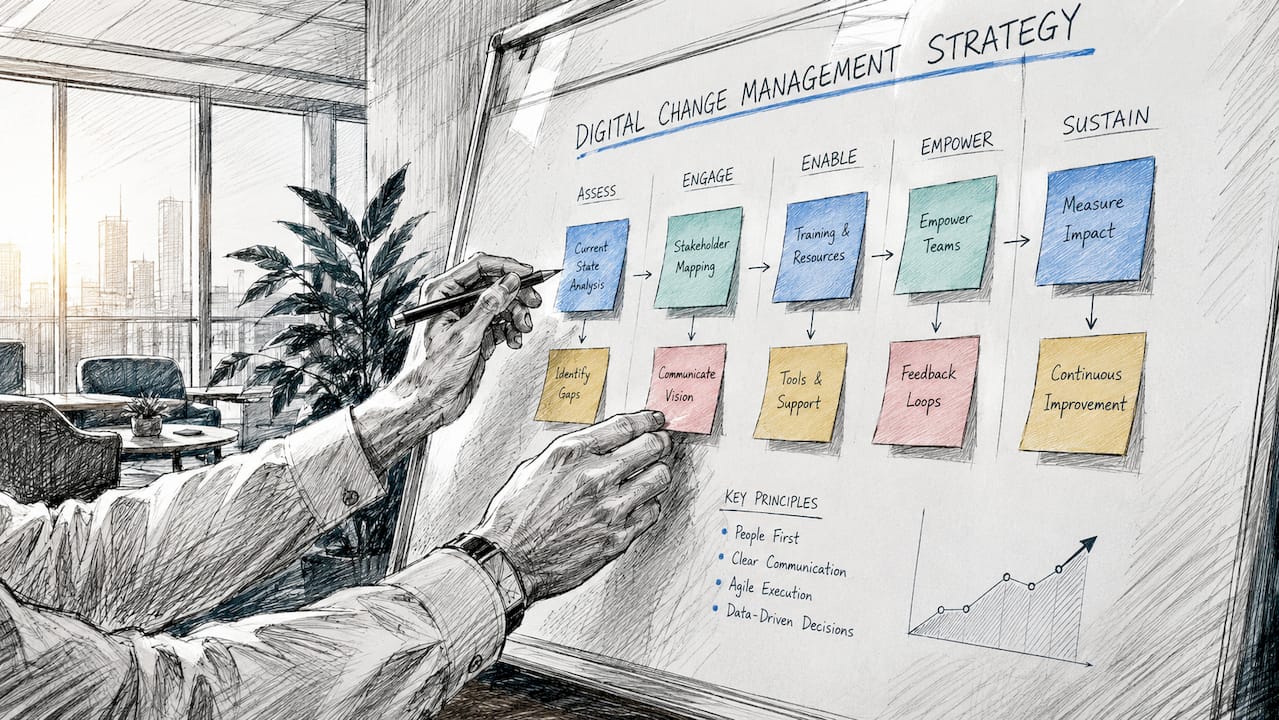
Digital Change Management: A Leader's Implementation Guide
Digital Change Management: A Leader’s Implementation Guide
Digital change management is the structured, people-focused discipline of guiding employees through the behavioral, process, and cultural shifts required for digital transformation to actually stick. It is not the same as deploying software. The technology is the easy part. Getting people to adopt it, sustain it, and build on it is where most programs succeed or fail.
Three benefits show up consistently when organizations invest in this discipline properly:
- Faster adoption: Structured change programs reduce the time employees need to reach full proficiency with new digital tools.
- Higher ROI: McKinsey’s guidance on digital transformation recommends planning to spend roughly an additional dollar on people and process activities for every dollar of digital development, because that investment is what converts technical capability into realized value.
- Lower operational disruption: Proactive impact assessments and communications plans prevent the productivity dips and support-ticket surges that follow poorly managed go-lives.
Frameworks you will encounter throughout this guide: Prosci’s ADKAR model, the AWS Change Acceleration 6-Point Framework, and the Digital Change Toolkit from the University of Sheffield.
Key Takeaways
Digital change management is the people-focused discipline that determines whether a digital transformation generates real value or just a working system nobody uses consistently.
| Point | Details |
|---|---|
| People side is the decisive factor | Technical delivery alone does not produce ROI; structured adoption programs are what convert deployed tools into changed behavior. |
| Invest equally in people and technology | McKinsey recommends planning to spend roughly an additional dollar on people and process activities for every dollar of digital development. |
| Six stages, not one go-live event | A complete program runs from readiness assessment through sustainment, with named artifacts and KPIs at each stage. |
| Measure adoption from day one | Track adoption rate, time to proficiency, and support ticket volume weekly for the first 90 days post-go-live. |
| Botiqueai accelerates adoption | Custom chatbots and workflow automations from Botiqueai instrument adoption signals and reduce support friction from the first day of deployment. |
Table of Contents
- What is digital change management, and how does it differ from IT projects?
- Why does change management determine whether digital initiatives succeed?
- Core components every leader must budget for and run
- What barriers will you hit, and how do you get past them?
- A practical 6-stage plan for running digital change management
- Digital-era specifics that change how you manage adoption
- How do you measure success in a digital change program?
- Who does what: roles, governance, and red flags
- Which frameworks and tools should you use?
- Three short examples of digital change programs in practice
- Your 30/60/90-day quick-start checklist
- What running digital change programs actually teaches you
- How an AI and automation partner can accelerate digital adoption
- Sources
What is digital change management, and how does it differ from IT projects?
Prosci defines digital transformation change management as an enabling framework for managing the people side of change, one that increases the effectiveness of enterprise digital initiatives. The scope covers people, processes, and behaviors. It asks: who is affected, what do they need to do differently, and how do we help them get there?
That is a fundamentally different question from what an IT project asks. An IT project delivers a technical outcome: a cloud migration is complete when the servers are running in AWS. A digital transformation is complete when the organization operates differently because of those servers. And digital change management is the program that closes the gap between “technically deployed” and “actually working differently.”
Digital transformation itself is broader still. Wikipedia’s synthesis of the academic literature describes it as socio-technical, demanding changes in management practices, collaboration, and supply chains, not just technical upgrades. Change management is the human-side engine inside that larger machine.
A concrete example: a company migrating its ERP to SAP S/4HANA on the cloud. The IT project ends when the system goes live. The digital transformation ends when finance, procurement, and operations have genuinely changed how they work. Digital change management is the program running in parallel the entire time: stakeholder mapping, communications, training, resistance management, and adoption measurement. Prosci’s PCT (Project Change Triangle) model formalizes this by treating leadership, project management, and change management as three equally weighted success factors, not a hierarchy where IT leads and change management follows.
Why does change management determine whether digital initiatives succeed?
The evidence is direct. Academic reviews published on ScienceDirect identify employee commitment to a company’s vision as a key determinant of sustainable digital transformation success. Leadership, communication, and inclusion are not soft considerations; they are the structural imperatives that determine whether employees buy into the vision or merely tolerate the new tools.
Industry analysis reinforces this. Treating digital efforts solely as IT projects is consistently cited as the primary reason many transformations fail. Human commitment and cross-functional alignment are what convert a working system into a productive one.
For sponsors, this has a direct budget implication. McKinsey’s guidance is explicit: plan to invest equally in adoption and change-management activities alongside technical development. A program that funds a $2M ERP implementation but allocates $50K to training and communications is not underfunded on the technology side. It is underfunded on the side that determines whether the $2M generates any return.
Core components every leader must budget for and run
AIHR’s practitioner guidance outlines the foundational elements of a digital change program. Every component below needs a named owner, a budget line, and a delivery timeline before the technical project starts.
- Leadership sponsorship: An active, visible executive sponsor who communicates the “why,” removes barriers, and holds the program accountable. Sponsorship is not a title; it is a set of behaviors.
- Stakeholder alignment: Mapping who is affected, how deeply, and what their concerns are. This feeds every other workstream.
- Communications: A planned, multi-channel communications program that runs from program launch through sustainment, not just a go-live announcement.
- Training and enablement: Role-based training designed around what people actually need to do differently, not a generic product walkthrough.
- Impact assessments: Structured analysis of process, role, and technology changes for each affected group. This is the input that makes communications and training specific rather than generic.
- Measurement and KPIs: Adoption metrics, proficiency indicators, and value-realization tracking built into the program from day one.
- Governance and Center of Excellence (CoE): A defined decision-making structure and, for larger programs, a CoE that centralizes expertise and accelerates replication across the organization.
Pro Tip: When budget or capacity is limited, fund sponsorship and impact assessments first. Everything else, communications, training, measurement, is only as good as the quality of those two inputs. A well-resourced training program built on a weak impact assessment trains people for the wrong things.
What barriers will you hit, and how do you get past them?
Resistance to change is the most predictable barrier and the one most often underestimated. Employees resist for rational reasons: fear of job loss, uncertainty about competence, distrust of leadership’s motives. The mitigation is not a town hall. It is early, honest communication about what is changing and what is not, combined with visible sponsor behavior that models the new way of working.

Legacy systems create technical debt that slows adoption. When a new platform depends on data from a 20-year-old system that was never designed for integration, every workflow that touches that interface becomes a friction point. The mitigation is an integration strategy that is part of the change program, not an afterthought handed to IT after go-live.
Siloed organizations mean that a change affecting three departments gets managed by three separate teams with no shared view of interdependencies. Cross-functional squads, with representatives from each affected group and a single program lead, are the structural fix. Without them, you will discover the interdependencies at go-live.
Skills gaps are often invisible until training begins. A workforce that has used the same system for a decade may lack the digital literacy to absorb a new platform quickly, regardless of how good the training is. Training pathway planning, starting with a skills baseline assessment, needs to happen during the design phase.
Unrealistic timelines are the red-line symptom that signals everything else is at risk. When a sponsor agrees to a go-live date before the impact assessment is complete, the program is already behind. Other red flags: no active sponsor engagement after kickoff, repeated missed adoption milestones with no escalation, and a change team that is reporting to IT rather than to the program sponsor.
A practical 6-stage plan for running digital change management
This sequence maps to Prosci’s methodology, the AWS Change Acceleration 6-Point Framework, and the Digital Change Toolkit from the University of Sheffield.
-
Prepare and assess. Define the scope of change, conduct a readiness assessment, and establish the change management team. The primary artifact is a Change Readiness Report. Success looks like: the sponsor can articulate the case for change in two sentences, and the program team knows which employee groups face the highest disruption. ADKAR alignment: builds Awareness and Desire foundations.
-
Define and sponsor. Formalize the sponsorship coalition, complete the stakeholder map, and draft the Change Management Strategy. The artifact is a Stakeholder Impact Assessment. Success looks like: every major affected group has a named change agent and a documented impact profile. AWS 6-point alignment: Leadership Alignment and Stakeholder Engagement.
-
Design and prototype. Build the communications plan, training curriculum, and resistance management approach. Run a pilot with one affected group and measure early adoption signals. The artifact is a Communications and Training Plan. Success looks like: pilot participants can complete core tasks without supervisor assistance within two weeks of training. Prosci PCT alignment: change management and project management plans are integrated.
-
Enable and deploy. Execute training, launch communications, and go live with the new system or process. The artifact is a Go-Live Readiness Checklist. Success looks like: day-one support ticket volume is within the projected range and adoption rates are tracking against the baseline target. Digital Change Toolkit alignment: readiness templates and impact assessment tools applied.
-
Embed and scale. Reinforce new behaviors through recognition, updated job descriptions, and performance metrics that reflect the new way of working. Expand to remaining groups. The artifact is a Reinforcement and Sustainment Plan. Success looks like: the new process is reflected in onboarding materials and manager scorecards. ADKAR alignment: Reinforcement stage.
-
Sustain and measure. Track adoption KPIs over a 90-day post-go-live window, close the change program formally, and transfer ownership to the CoE or business process owners. The artifact is a Benefits Realization Report. Success looks like: the program sponsor can present measurable productivity or efficiency gains to the executive team. AWS 6-point and Celonis continuous-change alignment: embed a culture of learning and adapt reward systems to sustain ongoing digital change.
Digital-era specifics that change how you manage adoption
Classic change management was designed for discrete, bounded projects. A new ERP goes live on a date; you train people; it is done. SaaS-era digital change does not work that way, and programs that ignore this get caught off guard.
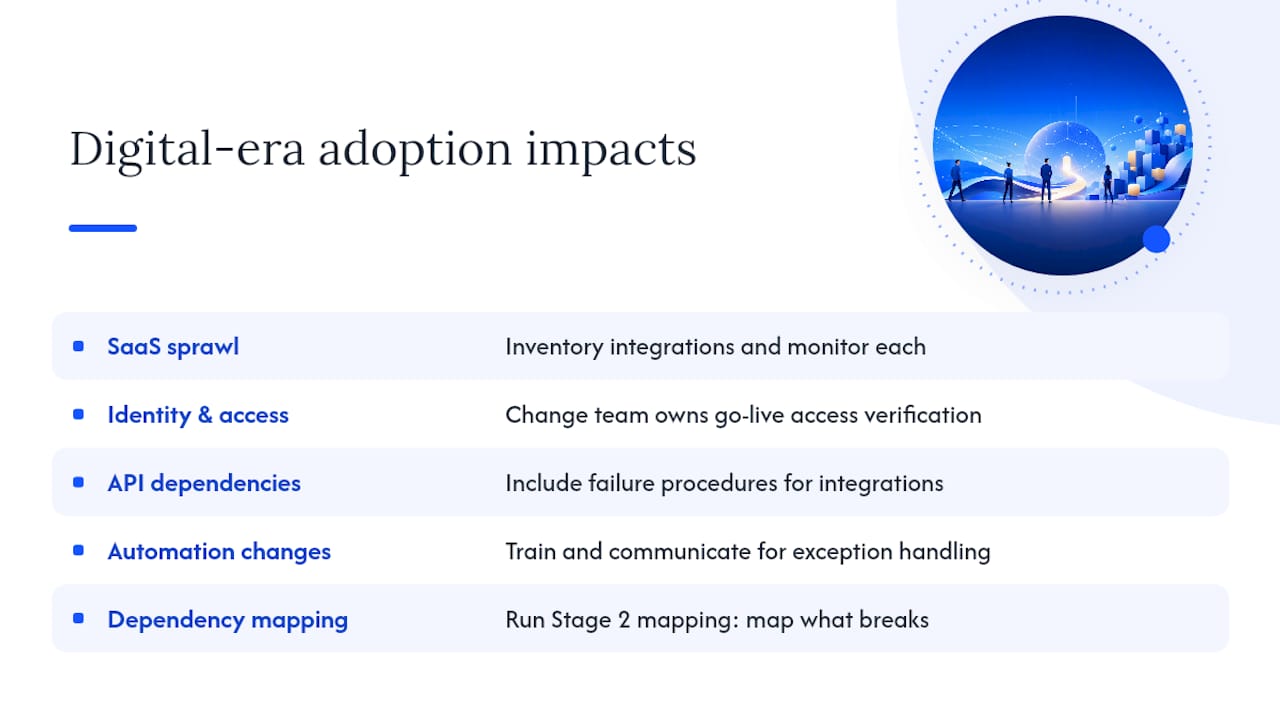
SaaS sprawl means the average enterprise employee now interacts with dozens of applications, many of which were adopted without a formal change program. When a new platform integrates with five of those tools, a change in any one of them can break the adoption experience overnight. Your change program needs an inventory of the integrations that matter and a monitoring plan for each.
Identity and access management is a change management issue, not just an IT security issue. When employees cannot access the tools they were trained on because provisioning was delayed or role-based permissions were misconfigured, adoption stalls immediately. The change team should own a go-live access verification step, not assume IT has it covered.
API dependencies and real-time workflows shift responsibility in ways that impact training design. When a process depends on a live API call to a third-party system, a failure in that system breaks the workflow for the employee, regardless of how well they were trained. Training needs to include what to do when the integration fails, not just how to use the tool when it works.
Automation changes who does what. When a workflow is automated, the human’s role shifts from execution to exception handling. That is a significant behavioral change that requires its own training and communications track, separate from the standard tool adoption program.
Pro Tip: Run a technical dependency mapping session in Stage 2 (Define and Sponsor) with IT, operations, and the change team in the same room. Ask one question: “What breaks for an end user if this integration goes down?” The answers will reshape your risk register and your training design. For context on how AI deployments introduce their own dependency layers, context engineering in AI systems is worth reviewing before you finalize your integration risk assessment.
How do you measure success in a digital change program?
Baseline vs. target: Before the program starts, document current-state performance on each metric. Adoption rate is meaningless without knowing what the starting point was. Time to proficiency on the old system is the benchmark against which you measure improvement.
Short-term ROI levers that sponsors can point to quickly: task completion rate (are people finishing workflows without errors?), decrease in support tickets (a proxy for proficiency), and time-to-productivity per new hire on the new system.
A sponsor-level dashboard needs six tiles: overall adoption rate, training completion rate, support ticket trend, employee confidence score, top three open risks, and a benefits realization tracker against the business case. Program-level reporting adds cohort-level breakdowns and a milestone tracker against the implementation plan.
Who does what: roles, governance, and red flags
Core role descriptions
Executive sponsor: Owns the business case, provides visible leadership, removes organizational barriers, and communicates the “why” to the workforce. This role cannot be delegated.
Program lead / change manager: Designs and executes the change program, owns the stakeholder map and communications plan, and reports directly to the sponsor.
Change network / change agents: Frontline representatives from each affected business unit who carry communications into their teams, surface resistance early, and provide feedback to the program lead.
PMO / IT partners: Own the technical delivery timeline and integration dependencies. Their job in the change program is to flag technical risks that affect the adoption plan and to ensure access provisioning is complete before training begins.
HR and L&D: Own training design, delivery, and the skills baseline assessment. Also responsible for updating job descriptions and performance metrics to reflect new ways of working.
Business process owners: Own the process redesign that accompanies the technology change. They sign off on the impact assessment and validate that training reflects actual post-go-live workflows.
Governance accountability (RACI-lite)
R = Responsible, A = Accountable, C = Consulted, I = Informed
Red flags that require immediate escalation: The sponsor has not communicated publicly about the program in more than three weeks. Adoption milestones are missed in two consecutive reporting cycles with no corrective action. The change team is reporting to the IT project manager rather than to the business sponsor. Any of these should trigger a steering committee conversation, not a status update email.
Why AI transformation needs champions to succeed covers the sponsorship behaviors that distinguish programs that sustain from those that stall.
Which frameworks and tools should you use?
Prosci ADKAR is the most widely used individual-change model in the world. It maps five sequential milestones every person must reach: Awareness of the need to change, Desire to participate, Knowledge of how to change, Ability to demonstrate the new behavior, and Reinforcement to sustain it. Use it to diagnose where individuals or groups are stuck and to design targeted interventions.
Prosci PCT (Project Change Triangle) frames the program level: leadership, project management, and change management must all be healthy for a transformation to succeed. Use it in steering committee conversations to make the case for resourcing all three.
AWS Change Acceleration 6-Point Framework provides a programmatic, evidence-based approach specifically designed for cloud and technology transformations. Its six points cover leadership alignment, stakeholder engagement, communications, training, reinforcement, and measurement. It is particularly useful for organizations running large-scale cloud migrations where the technical and human workstreams need to be tightly coordinated.
Digital Change Toolkit (University of Sheffield) offers practical templates: impact assessments, communications plans, and sponsorship coalition tools. These are free, academically grounded, and directly applicable to mid-size enterprise programs. Use them in Stages 1 through 3 of the implementation plan above.
Artifacts to request or create
- Stakeholder map and impact assessment (who is affected, how deeply, what their concerns are)
- Communications plan (audience, message, channel, timing, owner)
- Training curriculum (role-based, tied to impact assessment findings)
- Measurement plan (KPIs, baselines, collection method, reporting cadence)
- Resistance management log (tracked risks, mitigation actions, owners)
- Benefits realization report (post-go-live, tied to the original business case)
When to build a Center of Excellence
A CoE makes sense when the organization is running multiple concurrent digital programs or expects a continuous pipeline of transformation initiatives. Celonis’s guidance on continuous digital change recommends Centers of Excellence as the structural mechanism for embedding a learning culture and adapting reward systems across the enterprise. The CoE should own the methodology, templates, and capability-building program. Individual programs should own their own execution. Digital leadership research reinforces that without a clear program definition and coordinated governance, leaders cannot expect consistent results across the enterprise.
Three short examples of digital change programs in practice
Cloud ERP migration at a mid-size manufacturer
A 3,000-person manufacturer moved from an on-premise ERP to a cloud-based platform. The IT project was delivered on time, but six months post-go-live, finance and procurement teams were still running parallel processes in spreadsheets. The root cause: training had been generic product training, not role-based process training tied to the new workflows. The company restarted the change program with a proper impact assessment, rebuilt training around actual job tasks, and assigned change agents in each department. Adoption reached the target threshold within 90 days of the relaunch. The lesson: training that is not grounded in a process impact assessment is not change management; it is product demonstration.
SaaS platform rollout at a regional healthcare network
A healthcare network rolled out a new patient scheduling platform across 40 clinics. The change team used the ADKAR model to assess where staff were stuck and found that most resistance was at the Desire stage: staff did not understand why the old system was being replaced. The sponsor recorded a short video explaining the patient experience problems the new system solved, distributed it through the change agent network, and held Q&A sessions in each clinic. Desire scores in the next pulse survey moved significantly. The lesson: diagnosing which ADKAR milestone is blocking adoption tells you exactly what intervention to design, rather than defaulting to more training.
Automation deployment at a financial services firm
A financial services firm deployed an AI-driven workflow automation tool to its operations team. The change program included a dedicated communications track explaining that the automation was handling repetitive data entry, not replacing roles. It also included training on exception handling, the new skill the automation created demand for. Support ticket volume dropped within the first month post-go-live, and the operations team reported higher job satisfaction in the 90-day pulse survey. The lesson: when automation is involved, the change program must address the “what happens to my job” question directly and early, or resistance will be structural rather than individual. Real-world AI transformation examples show how instrumenting automated adoption signals, such as workflow completion rates and chatbot interaction data, gives program leads early visibility into where friction is building.
Your 30/60/90-day quick-start checklist
Days 1–30: Establish the foundation
- [ ] Confirm executive sponsor and schedule a 60-minute kickoff with the program lead
- [ ] Complete a high-level stakeholder map (who is affected, how deeply, and what their concerns are)
- [ ] Conduct a change readiness assessment with the top three affected groups.
- [ ] Draft the Change Management Strategy document (scope, approach, resourcing)
- [ ] Identify and brief change agents in each major affected business unit
- [ ] Establish a reporting cadence: weekly program team, bi-weekly sponsor update
First sponsor/program lead meeting agenda: (1) Confirm the business case and success metrics, (2) review the stakeholder map and identify the highest-risk groups, (3) agree on the sponsor’s visible communication commitments for the next 30 days, (4) confirm budget and resourcing for the change program.
Days 31–60: Design and validate
- [ ] Complete the detailed impact assessment for each affected group
- [ ] Draft the communications plan (audience, message, channel, timing)
- [ ] Design role-based training curriculum tied to impact assessment findings
- [ ] Run a pilot training session with one affected group and collect feedback
- [ ] Build the measurement plan: baseline current-state KPIs before any changes go live
- [ ] Conduct a technical dependency mapping session with IT and operations
Days 61–90: Enable and prepare for go-live
- [ ] Execute training for all target populations (track completion rates weekly)
- [ ] Launch pre-go-live communications (what is changing, when, what support is available)
- [ ] Complete go-live readiness checklist: access provisioning, integration testing, support coverage
- [ ] Activate the change agent network for day-one support
- [ ] Stand up the adoption dashboard and confirm data feeds are live
Minimum resourcing note: A program affecting more than 500 employees needs at least one dedicated change manager, a change agent in each major business unit, and a communications resource. Treating change management as a part-time addition to an IT project manager’s role is the single fastest way to guarantee the program will need to be rerun.
Immediate risk triage for urgent programs: If the go-live date is already set and the change program has not started, prioritize in this order: (1) get a sponsor communication out within 48 hours, (2) complete a rapid impact assessment in one week, (3) compress training into the minimum viable curriculum for the highest-risk groups.
What running digital change programs actually teaches you
The conventional wisdom says resistance is the biggest problem in digital change. After working through multiple AI and automation deployments, the more accurate diagnosis is that resistance is usually a symptom of something upstream: a sponsor who agreed to a timeline without understanding the change scope, a training program that was designed before the impact assessment was finished, or a communications plan that told people what was changing but not why it mattered to them.
The programs that sustain share one characteristic that rarely appears in framework documentation: the sponsor stays visibly engaged after go-live. Most sponsors treat the go-live date as the finish line. The employees who are still struggling three weeks later, the ones who reverted to the old process because the new one broke twice in the first week, those people need to see that the sponsor still cares. That sustained engagement is what converts a technically successful deployment into an organizationally embedded change.
One tactical test for your next steering meeting: ask the program lead to present the ADKAR stage distribution for the three highest-risk groups. If they cannot answer that question, the program does not have a measurement plan. If they can, you will immediately know where to focus the next 30 days.
How an AI and automation partner can accelerate digital adoption
Most digital change programs hit the same friction points: employees have routine questions that flood the support desk, adoption data is scattered across systems that nobody is monitoring in real time, and the change team is spending its time answering the same five questions instead of managing resistance.
Botiqueai builds custom AI solutions, including intelligent chatbots and workflow automations, that address exactly these friction points. A custom chatbot deployed on your intranet or in your change communications channel can handle routine “how do I do X in the new system” questions at scale, freeing your change agents for higher-value conversations. Workflow automations can instrument adoption signals automatically, pulling completion rates, support ticket trends, and training data into a single dashboard your program lead can act on. Botiqueai’s Aria chatbot and n8n/Make automation services are built to integrate with the CRMs, ERPs, and cloud platforms your transformation is deploying, so the adoption infrastructure is live from day one, not bolted on after go-live.
If your program is entering the Enable and Deploy stage and you need adoption instrumentation or AI-enabled support coverage, talk to Botiqueai about what a custom deployment looks like for your program.
Sources
- Digital Transformation Change Management
- Importance of Change Management in Digital Transformation Sustainability
- What is digital transformation? | McKinsey
- AWS Change Acceleration 6-Point Framework and Organizational Change Management Toolkit
- HR’s Guide to Digital Change Management