
AI Transformation Governance: A Guide for Decision-Makers
AI Transformation Governance: A Guide for Decision-Makers
Transformation governance for AI is the set of structures, roles, and processes that embed oversight directly into an organization’s AI-driven change program so that AI becomes a repeatable, audited capability rather than a collection of disconnected pilots. If you are a decision-maker in France, three actions matter most right now: build a complete inventory of every AI system in use (including shadow deployments), assign an executive sponsor paired with a PMO translation role, and run a risk-proportionate tiering of current pilots against the EU AI Act’s risk categories. Those three steps are the difference between a governance program and a governance document.
Why does this matter urgently? French organizations face converging pressure: board accountability expectations are rising even as many boards still have gaps in AI oversight, the EU AI Act is imposing enforceable obligations by risk tier, and CNIL is actively scrutinizing AI-driven data processing. Getting governance right from the start is not a compliance exercise. It is the condition under which AI delivers durable business value.
- Immediate action 1: Create a system inventory listing every AI tool, model, and automated decision process, including vendor-supplied ones embedded in existing software.
- Immediate action 2: Assign an executive sponsor with budget authority and a PMO lead who can translate between technical teams and business stakeholders.
- Immediate action 3: Tier each current pilot by EU AI Act risk category (unacceptable, high, limited, minimal) and apply proportionate controls before scaling.
Key Takeaways
Effective AI transformation governance is the structured combination of board-level accountability, proportionate risk controls, and an operational roadmap that converts pilots into audited, production-scale capabilities aligned with EU AI Act and CNIL requirements.
| Point | Details |
|---|---|
| Governance is a delivery enabler | Organizations that embed governance from the first sprint convert pilots to production faster than those that audit after the fact. |
| Board accountability is the top predictor | Research shows leadership accountability and strategic alignment predict AI governance effectiveness more than any technical tool. |
| Risk-proportionate controls are required | Apply EU AI Act risk tiers to every system; high-risk systems need DPIAs, model cards, red-team testing, and active monitoring. |
| The PMO must run a dual-track model | Phase-gate oversight for the program, checkpoint-driven reviews for AI workstreams; a single waterfall gate stalls agile delivery. |
| Botiqueai delivers governance-ready AI | Botiqueai’s assessments, CoE design, and production deployments are built to meet EU AI Act and CNIL requirements from day one. |
Table of Contents
- Why AI transformation is primarily a governance problem
- What are the core pillars of AI transformation governance?
- Who does what in an AI governance operating model?
- How do you move from pilots to governed, production-scale AI?
- What are the regulatory touchpoints for organizations in France?
- How do you make governance operational day to day?
- What are the most common governance pitfalls to watch for?
- How do you measure whether governance is actually working?
- Botiqueai’s governance-first AI transformation services
- Sources
Why AI transformation is primarily a governance problem
Most organizations treat AI deployment as an engineering challenge. The real constraint is organizational. AI agents are probabilistic rather than deterministic: their outputs can shift after deployment due to data drift, model updates, or changes in the environment they operate in. That means the risks are not fixed at launch. They evolve, and they scale with adoption.
Governance provides the standardization and accountability that allow multiple teams to deploy AI consistently without each team reinventing risk controls from scratch. Without it, you get fragmentation: different evaluation criteria across business units, no shared model of what “good” looks like, and no mechanism to catch a drifting model before it causes a compliance incident or a customer-facing failure.
The evidence supports this framing. Peer-reviewed research on large-scale enterprise AI programs shows that strong leadership accountability and strategic alignment are the most influential predictors of AI governance effectiveness. Technology choices matter, but they are secondary to whether the organization has clear decision rights, aligned incentives, and a leadership team that treats governance as a performance lever instead of a legal obligation.
Pro Tip: Avoid compliance theater. Governance that exists only in policy documents and quarterly reviews does not catch real problems. The goal is proportionate, integrated oversight that is embedded in how teams actually build and deploy AI, not layered on top after the fact.
- AI systems create emergent risks (model drift, bias amplification, security exposure) that grow with organizational scale.
- Governance standardizes controls so deployment teams do not each build their own risk framework from scratch.
- Leadership accountability and strategic alignment predict governance effectiveness more than any specific technical tool.
- Poorly designed governance becomes a bottleneck. Well-designed governance is what allows pilots to become production systems.
What are the core pillars of AI transformation governance?
Eight pillars form the operational backbone of a governance program. Each one answers a specific question that will otherwise go unanswered and create risk.
Strategy and executive sponsorship answers: who owns AI transformation at the top? Without a named executive sponsor with budget authority, governance decisions stall at the committee level. The starter artifact is a one-page AI strategy statement signed by the C-suite.
Accountability and board oversight answers: who approves, who recommends, who validates? Boards are increasing attention to AI, but many organizations still have gaps in formal board-level reporting. A RACI matrix covering the board, executive sponsor, AI Center of Excellence (CoE), and PMO closes that gap. The Partnership on AI’s governance stack and mapping tools help identify where accountability instruments overlap or leave gaps.
Data governance answers: what data feeds our models, and is it fit for purpose? This pillar covers data lineage, quality standards, access controls, and retention policies. A data catalog with ownership tags is the minimum artifact. For a deeper treatment of how data strategy connects to governance, the AI data strategy guide covers the key decisions.
Model lifecycle management answers: how do we build, deploy, monitor, and retire models responsibly? Model cards (structured documentation of a model’s purpose, training data, known limitations, and performance benchmarks) are the core artifact here. The lifecycle spans build, validate, deploy, monitor, and retire.
Risk management and tiering answers: which systems require the most oversight? Tiering by EU AI Act risk category (unacceptable, high, limited, minimal) lets you apply proportionate controls rather than treating a chatbot for internal FAQs the same as an automated credit-scoring model.
Human-in-the-loop and operational controls answers: where does a human need to review or override AI outputs? Define override thresholds, escalation paths, and audit trails for every high-risk system.
Procurement and third-party due diligence answers: what governance obligations transfer when we buy AI from a vendor? A procurement rubric covering transparency, data handling, model documentation, and contractual audit rights is the required artifact.
Metrics and assurance answers: is governance actually working? Deployment velocity, incident rates, and inventory coverage are the starting KPIs.
Pro Tip: Apply requirements proportionate to risk tier. A minimal-risk internal tool needs a brief model card and an owner. A high-risk automated decision system needs a full DPIA-style assessment, red-team testing, and a monitoring dashboard. Treating every system the same wastes resources and creates the kind of bureaucratic drag that makes teams route around governance entirely.
| Pillar | Purpose | Starter artifact | First KPI |
|---|---|---|---|
| Strategy and executive sponsorship | Align AI investment with business goals | Signed AI strategy statement | a significant share of AI initiatives with a named executive sponsor |
| Accountability and board oversight | Clarify decision rights and reporting | RACI matrix, board reporting template | regular reviews by the board of AI initiatives |
| Data governance | Ensure data quality, lineage, and access control | Data catalog with ownership tags | a substantial portion of AI datasets with documented lineage |
| Model lifecycle management | Govern build, deploy, monitor, retire | Model cards per system | many deployed models accompanied by current model cards |
| Risk management and tiering | Apply proportionate controls by risk level | Risk register with EU AI Act tier | systems tiered and documented according to governance requirements |
| Human-in-the-loop controls | Define human review and override thresholds | Override policy per system type | human override processes measured per high-risk system |
| Procurement and third-party due diligence | Extend governance to vendor-supplied AI | Procurement rubric, contract clauses | a majority of AI vendors completing due diligence processes |
| Metrics and assurance | Measure whether governance is working | KPI dashboard | Governance review cycle time |
Who does what in an AI governance operating model?
Governance only works when every role knows its lane. Ambiguity about who approves versus who recommends is the most common reason governance decisions stall.
The board approves the AI risk appetite, receives periodic reporting on high-risk systems and incidents, and holds the executive sponsor accountable. Boards should not be making model-level decisions, but they need enough literacy to ask the right questions. Deloitte’s research on boardroom AI oversight confirms that many organizations still have a gap here, with boards increasing attention but lacking structured reporting mechanisms.
The executive sponsor (typically the CDO, CTO, or a designated Chief AI Officer) owns the AI transformation roadmap, chairs the AI governance committee, and resolves escalations that the CoE cannot handle. This role needs real authority, not just a title.
The AI Center of Excellence (CoE) recommends standards, maintains the model registry and system inventory, runs red-team exercises, and advises business units on use-case prioritization. The CoE is not a gatekeeper. It is a center of expertise that business units pull from.
The PMO is the translation layer. PMOs must evolve from headcount-tracking to capability-tracking, serving as the bridge between technical AI workstreams and governance bodies. In practice, this means running a dual-track model: phase-gate oversight for the overall program, and checkpoint-driven, performance-triggered reviews for individual AI workstreams. A PMO that applies only waterfall phase gates to agile AI sprints will either bottleneck delivery or be ignored. For organizations building this capability, the guide on AI champions and executive sponsorship covers the change-management dimension.
Legal and compliance reviews high-risk systems before deployment, maintains the regulatory touchpoint map (EU AI Act, CNIL, ANSSI), and owns the contractual governance clauses in vendor agreements.
Data science and engineering teams produce model cards, run acceptance tests, implement monitoring, and flag anomalies. They are governance participants, not just delivery resources.
Business unit product owners own the use-case business case, define success metrics, and are accountable for human-in-the-loop processes within their domain.
Practical artifacts for this operating model:
- Role charters for the CoE, PMO lead, and executive sponsor (one page each, covering scope, authority, and escalation path)
- An escalation matrix showing which decisions go to the CoE, which go to the governance committee, and which go to the board
- A governance meeting cadence: monthly CoE review, quarterly board AI report, ad-hoc incident escalation within 48 hours
How do you move from pilots to governed, production-scale AI?
The roadmap has six phases. Each one has a gate criterion that must be met before moving forward.
-
Assess readiness. Audit existing AI systems, data infrastructure, and organizational capabilities. Identify gaps in data quality, model documentation, and governance roles. Gate criterion: inventory complete, risk tiers assigned, executive sponsor named.
-
Prioritize use cases. Score candidate use cases against business value, feasibility, and risk tier. High-value, low-risk use cases go first. High-risk use cases require additional governance setup before piloting. Gate criterion: prioritized backlog with risk tier and business case for each item. For practical pilot selection criteria, the AI pilot project guide covers the key decisions.
-
Pilot under controls. Deploy in a controlled environment with defined success metrics, a human-in-the-loop process, and a rollback plan. Run acceptance tests and, for high-risk systems, a red-team exercise. Gate criterion: model card complete, acceptance tests passed, monitoring in place, rollback tested.
-
Validate value and risk. Measure actual performance against the business case. Review drift indicators, false-positive and false-negative rates, and human override frequency. Confirm regulatory compliance posture. Gate criterion: performance meets threshold, no unresolved high-severity findings, compliance sign-off from legal.
-
Scale and operationalize. Extend to additional users, data volumes, or business units. Formalize the operating model, train affected staff, and integrate with production monitoring. Gate criterion: monitoring dashboard live, incident response procedure documented and tested, stakeholder training complete.
-
Continuous monitoring and retirement planning. Establish ongoing drift detection, periodic model revalidation, and a retirement trigger (when a model’s performance falls below threshold or its regulatory status changes, it is retired or replaced). Gate criterion: monitoring frequency defined, revalidation schedule set, retirement criteria documented.
A milestone checklist for phase 3 to 4 (pilot to validation) should include: model card signed off by CoE, red-team findings reviewed and remediated, DPIA-style assessment complete for high-risk systems, business sponsor sign-off on value metrics, and legal confirmation of EU AI Act compliance posture.
What are the regulatory touchpoints for organizations in France?
French organizations operate under a layered regulatory environment. Getting the touchpoints right is not optional.
EU AI Act is the primary framework. It classifies AI systems into four risk tiers and imposes enforceable obligations on providers and deployers of high-risk systems, including conformity assessments, technical documentation, human oversight measures, and registration in the EU database. Prohibited systems (unacceptable risk) must be identified and decommissioned. The Act’s obligations are phased, with high-risk system requirements applying progressively through 2026 and 2027.
CNIL (Commission Nationale de l’Informatique et des Libertés) enforces GDPR in France and has published specific guidance on AI and personal data. Any AI system processing personal data requires a legal basis, and high-risk automated decision-making requires a DPIA (Data Protection Impact Assessment). CNIL expects organizations to document their AI data flows and be able to demonstrate accountability on request.
ANSSI (Agence Nationale de la Sécurité des Systèmes d’Information) provides cybersecurity guidance relevant to AI systems, particularly for critical infrastructure and sensitive data environments. ANSSI’s SecNumCloud qualification framework is relevant for organizations deploying AI on cloud infrastructure in regulated sectors.
OECD guidance provides the international due-diligence standard. The OECD Due Diligence Guidance for Responsible AI recommends embedding due diligence and oversight across enterprise policies, assigning senior management and board responsibilities, and documenting AI risk management across the full AI lifecycle. This aligns directly with the governance pillars above.
ISO/IEC 38507 provides governance guidance for AI use by organizations, establishing principles for governing bodies on how to direct, evaluate, and monitor AI use. It is the ISO-level complement to the EU AI Act’s operational requirements.
Compliance checklist for French organizations:
- Maintain a system inventory with EU AI Act risk tier for each system
- Complete DPIA-style assessments for all high-risk and personal-data-processing systems
- Document model cards covering training data, known limitations, and performance benchmarks
- Align procurement contracts with EU AI Act obligations (provider documentation, audit rights)
- Register applicable high-risk systems in the EU AI Act database when required
- Implement ANSSI-aligned security controls for AI systems handling sensitive data
- Establish a CNIL-ready accountability record covering legal basis, data flows, and human oversight
How do you make governance operational day to day?
Pillars and roles are the architecture. These are the practices that make governance run.
System inventory is the foundation. Every AI system, including vendor-supplied tools embedded in CRMs, ERPs, and analytics platforms, needs a record covering its purpose, data inputs, risk tier, owner, and deployment date. Without this, you cannot govern what you cannot see.
Model cards are the primary documentation artifact for each model. A good model card covers: intended use, training data sources and known gaps, performance benchmarks by subgroup, known failure modes, human oversight requirements, and the review schedule. They take roughly four hours to produce for a well-documented model and are the first thing a regulator or auditor will ask for.
Acceptance tests and red-team playbooks validate that a model behaves as expected before deployment and that it has been stress-tested against adversarial inputs, edge cases, and bias scenarios. Red-teaming for high-risk systems should involve people outside the development team.
Monitoring dashboards track drift, performance degradation, and anomalous output patterns in production. The OECD AI Governance Playbook provides twelve directives across strategy, risk, workforce readiness, and operational management that map directly to what a monitoring program should cover.

Incident response and rollback procedures define what happens when a model produces a harmful or non-compliant output: who is notified, within what timeframe, and how the system is taken offline or constrained while the issue is investigated. For post-deployment audit practices, the post-implementation AI audit guide covers the key steps.
Procurement rubrics extend governance to vendor-supplied AI. The rubric should cover: model documentation provided, data handling and retention terms, audit and inspection rights, incident notification obligations, and EU AI Act compliance posture.
Training and literacy programs ensure that business unit staff, product owners, and steering committee members can participate meaningfully in governance decisions. A steering committee that cannot read a model card cannot govern effectively.
Minimum viable governance stack for early scaling (build first):
- System inventory (spreadsheet or dedicated tool)
- Model card template and completion process
- Risk tiering rubric aligned to EU AI Act categories
- Monitoring setup for each production model
- Incident response procedure with named contacts and escalation path
What can wait until you are scaling:
- Automated model registry with CI/CD integration
- MLOps pipeline with built-in governance checkpoints
- Organization-wide AI literacy curriculum
- Fully automated audit logging and compliance reporting
Pro Tip: Embed a lightweight governance checkpoint inside each delivery sprint rather than scheduling a separate governance review at the end of a phase. A 15-minute sprint review item covering model behavior, data quality flags, and any new risk signals catches problems when they are cheap to fix, not after they have propagated into production.
How Botiqueai implements transformation governance for French clients
Botiqueai’s approach to AI governance starts with the system inventory and risk tiering, not with the technology. For a mid-sized French retail client deploying a customer-facing conversational agent, the governance challenge was straightforward: the pilot had been built by a small technical team with no formal model card, no monitoring, and no defined escalation path. The business sponsor had approved the use case but had no visibility into how the model was performing or what data it was processing.
Botiqueai’s engagement covered four areas. First, a governance readiness assessment produced the system inventory and identified the EU AI Act risk tier (limited risk, given the chatbot’s scope). Second, a model card was produced and reviewed with the legal team to confirm CNIL compliance posture. Third, a monitoring dashboard was configured to track response quality, escalation rates, and anomalous query patterns. Fourth, a PMO checkpoint was embedded in the client’s existing sprint cadence so governance was not a separate process.
Outcomes the client reported:
- Deployment velocity increased because the governance process clarified what “ready to deploy” meant, reducing back-and-forth between technical and business teams
- The board received its first structured AI report within 60 days of engagement start
- CNIL accountability documentation was complete before the system went to full production
- Incident response was tested and validated before launch, not after the first problem
Note: specific case study data, client testimonials, and author qualifications are available from the Botiqueai client team and can be added to this section for the published version.
What are the most common governance pitfalls to watch for?
Most governance failures are predictable. The warning signs appear early.
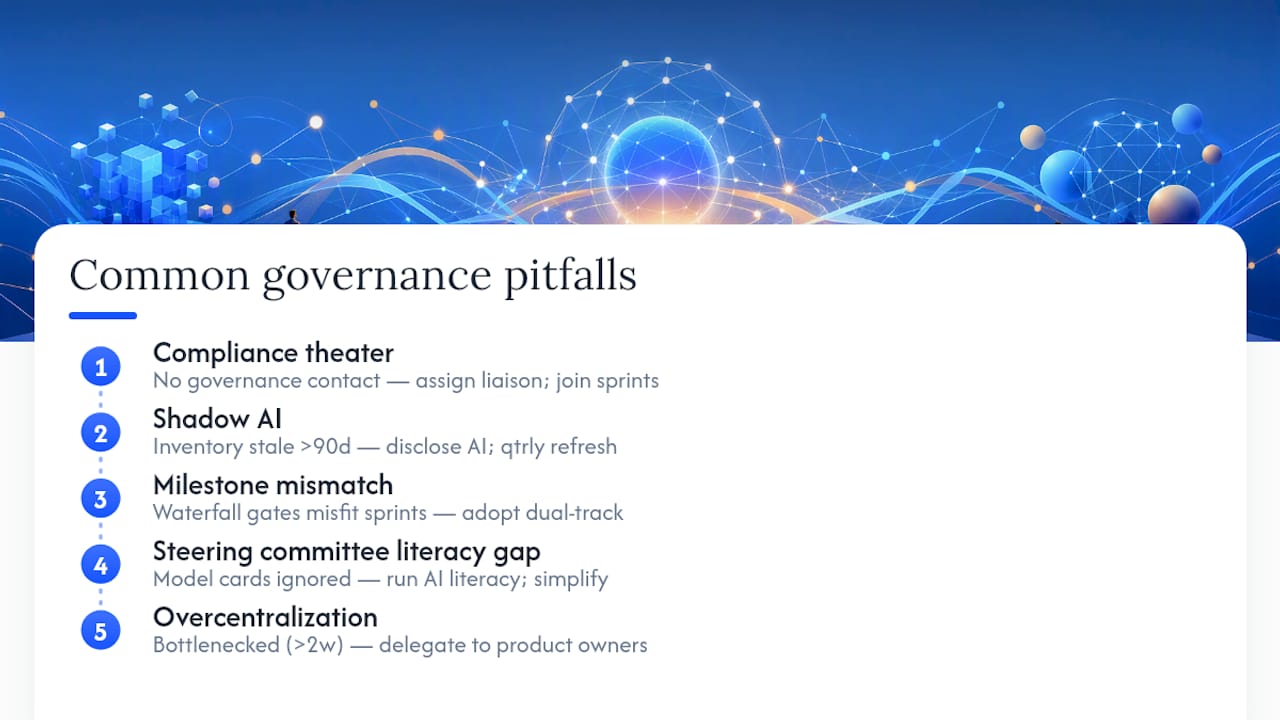
Compliance theater is the most common. Governance exists in policy documents and annual reviews but has no connection to how teams actually build and deploy AI. The red flag: no one on the delivery team can name the governance contact for their project. Remediation: assign a named governance liaison to each active AI workstream and make attendance at sprint reviews mandatory.
Shadow AI is the second most common. Teams use AI tools (often consumer-grade or vendor-embedded) that are not in the system inventory and have not been risk-tiered. The red flag: the inventory has not been updated in more than 90 days, or business units are procuring SaaS tools with embedded AI without notifying the CoE. Remediation: add an AI disclosure requirement to the procurement process and run a quarterly inventory refresh.
Milestone mismatch happens when the PMO applies phase-gate criteria designed for waterfall programs to agile AI workstreams. The result is either artificial delays (waiting for a gate that does not fit the sprint cycle) or gates that are bypassed entirely. Remediation: adopt the dual-track model, with performance-triggered checkpoints for AI workstreams alongside program-level phase gates.
Literacy gap at the steering committee means the people approving AI investments cannot evaluate the risk information they are receiving. The red flag: model cards are submitted to the committee but never discussed. Remediation: run a half-day AI literacy session for the steering committee and reformat model card summaries for a non-technical audience.
Overcentralization bottlenecks delivery when every governance decision routes through the CoE or a central committee. The red flag: average time from governance submission to decision exceeds two weeks for low-risk systems. Remediation: delegate routine approvals for minimal-risk systems to business unit product owners, reserving CoE review for high-risk and novel use cases.
How do you measure whether governance is actually working?
Governance effectiveness is measurable. These are the metrics that matter.
Deployment velocity versus defect rate is the primary signal. If governance is working, deployment velocity should increase over time as teams internalize standards, while defect rates (post-deployment incidents, compliance findings, model failures) should decrease. A rising defect rate alongside increasing velocity is a sign that governance is not keeping pace with deployment.
Percentage of AI assets inventoried tracks coverage.
Number of high-risk systems with active monitoring in place tracks whether the highest-stakes systems have the controls they require.
Incident response time measures operational readiness. From detection of an anomalous output to a documented response decision, the target for high-risk systems is under 24 hours.
Governance review cycle time measures whether the process is proportionate. If low-risk systems are waiting two weeks for a governance decision, the process is overcentralized. Target: under five business days for limited-risk systems, under two business days for minimal-risk.
Risk indicators to track alongside KPIs:
- Drift rate per model (how quickly performance degrades after deployment)
- Human override frequency (a rising override rate signals a model that is losing calibration)
- False-positive and false-negative rates for high-risk automated decision systems
For a broader view of how governance KPIs connect to corporate strategy, the AI in corporate strategy guide covers the strategic alignment dimension.
Why governance accelerates AI transformation, not slows it
The conventional view treats governance as friction. It is not. Governance is the mechanism that removes organizational drag.
Here is what actually happens without it: a pilot succeeds, the business unit wants to scale, and then six months pass while legal, IT security, data protection, and procurement each run their own review in sequence, with no shared framework and no pre-agreed standards. The pilot dies in the scaling phase, not because the technology failed, but because the organization had no repeatable path from pilot to production.
Governance builds that path in advance. When model cards are standard, when risk tiers are pre-defined, when the PMO knows how to run a dual-track review, and when the board has a reporting template it understands, the time from validated pilot to production deployment compresses. The AI governance framework overview covers how this plays out across different organizational structures.
The contrast is visible in practice. Organizations that treat governance as a post-hoc compliance step tend to have high pilot counts and low production counts. Organizations that embed governance from the first sprint tend to have fewer pilots but significantly higher conversion rates from pilot to production. The difference is not ambition or budget. It is whether governance is designed to enable delivery or to audit it after the fact.
Botiqueai’s governance-first AI transformation services
Scaling AI in a French organization means navigating the EU AI Act, CNIL expectations, and the internal challenge of turning pilots into production systems that the board can report on with confidence. That is exactly the work Botiqueai does.
Botiqueai designs and deploys governance-ready AI solutions: from CoE setup and PMO augmentation to model cards, monitoring dashboards, and production-ready conversational agents like Aria, built with compliance documentation from day one. The engagement model starts with a governance readiness assessment that produces your system inventory, risk tiering, and a prioritized roadmap in under four weeks. From there, Botiqueai’s team works alongside your delivery teams to embed governance checkpoints in your existing sprint cadence, not on top of it.
If your organization has pilots that are not reaching production, or a board that is asking for AI reporting it cannot yet receive, contact Botiqueai to schedule a governance assessment or a pilot governance workshop.
Sources
These are the primary documents decision-makers in France should read next.
This article is general information, not a substitute for advice from a qualified lawyer. Consult a qualified legal professional about your own circumstances before acting on anything here.