
Why AI Augments the Human Workforce, Not Replaces It
Why AI Augments the Human Workforce, Not Replaces It
AI augments the human workforce by raising output per worker, automating routine tasks, and freeing people to focus on judgment, creativity, and relationship-driven work that machines still cannot do well. That is the direct answer, and the data behind it is more specific than most executives realize.
A mid-2026 European study of large firms found that AI adoption lifts labor productivity by roughly 3.06% output per worker, while aggregate employment declines in that same sample stayed under 0.4%. The gains came from capital deepening and task augmentation, not from firms quietly cutting headcount. On the worker side, OECD survey data shows four in five workers say AI improved their performance, and three in five say it made their jobs more enjoyable, particularly when AI absorbed repetitive or physically risky tasks.
For leaders, the implication is blunt: treating AI as a one-for-one substitute for a job function usually undersells its value. The organizations getting the most out of AI are redesigning workflows around it, not just automating individual steps.
- AI adoption correlates with higher output per worker, not fewer workers, in the firms studied so far.
- Workers themselves report better performance and more enjoyment, especially on tasks they didn’t want to do anyway.
- The strategic payoff comes from workflow transformation, not task-by-task substitution.
Quick stat: Large firms adopting AI in 2026 project output per worker roughly 3% higher, with employment effects close to negligible in the same dataset.
Key Takeaways
AI augments the workforce most effectively when leaders redesign workflows around human judgment instead of substituting AI for entire job functions.
| Point | Details |
|---|---|
| Productivity gains are real | European firms adopting AI saw roughly 3% higher output per worker with minimal job loss. |
| Workers report genuine benefits | Four in five workers say AI improved their performance; three in five report more enjoyment. |
| Synergy requires design | Augmentation is common, but combined systems beating both human and AI alone takes deliberate task allocation. |
| Start with one pilot | Choose a low-risk, high-value process, involve workers early, and measure against a real baseline. |
| Botiqueai supports pilot design | Botiqueai builds augmentation-first tools like the Aria chatbot and custom workflow automations tailored to existing systems. |
Table of Contents
- How AI Augments Human Work: The Mechanisms Behind It
- What the Research Shows About Productivity and Worker Experience
- Where Augmentation Already Works: Sector Use-Cases
- How Jobs Will Evolve: Skills That Matter Most Now
- Risks Leaders Cannot Ignore, and How to Mitigate Them
- A Practical Playbook: From Strategy to Scaled Deployment
- How to Measure ROI and What Timeline to Expect
- Evidence Snapshot: What Leaders Should Take From the Research
- What Actually Works When You Implement This
- Get Help Designing Your First Augmentation Pilot
- Frequently Asked Questions
- Sources
How AI Augments Human Work: The Mechanisms Behind It
Augmentation isn’t a vague concept. It happens through specific mechanisms, and once you can name them, you can spot where they apply inside your own organization.
The first is task-level augmentation, where AI assists within a single task rather than replacing the person doing it. Code completion tools that suggest the next line without writing the whole function. Drafting assistants that produce a first pass of a contract clause a lawyer still edits. Triage systems that flag which support tickets or medical images need urgent human attention. In each case, a human remains the decision-maker; AI just removes friction from getting to the decision.
The second mechanism is workflow transformation, which operates at a higher level. Instead of assisting one task, AI coordinates handoffs across a multi-step process: pulling data from three systems, drafting a summary, routing it to the right person, and flagging exceptions. This is where the real productivity gains tend to concentrate, according to MIT Sloan research, which argues that leaders who use AI to grow revenue through augmented capability outperform those chasing pure cost reduction.
Why does this complementarity exist in the first place? It comes down to capability asymmetry. AI brings scale, speed, and pattern recognition across enormous datasets. Humans bring context, ethical judgment, and the ability to navigate ambiguity that no training set fully captures. Neither replaces the other’s strength; each covers the other’s blind spot.
That complementarity plays out through a few recognizable interaction patterns:
- Human-in-the-loop, where AI proposes and a human approves, common in fraud detection and medical imaging.
- Decision support, where AI surfaces options and evidence but the human owns the call, typical in underwriting or hiring.
- Mixed-initiative systems, where either party can take the lead depending on confidence levels, as seen in advanced writing and coding assistants.
- Agent-as-remote-collaborator, an emerging pattern where AI behaves less like a tool and more like a teammate coordinating its own subtasks, a shift documented in recent human-agent collaboration research.
Pro Tip: If a task has clear, stable rules and produces the same output every time, it’s a candidate for automation. If it requires weighing context, exceptions, or human relationships, it’s a candidate for augmentation. Sort your process map into those two buckets before you sort your budget.
What the Research Shows About Productivity and Worker Experience
The evidence for augmentation isn’t a single study. It’s a pattern across multiple independent sources, and the pattern holds up better than most AI headlines suggest.
Start with the European finding already mentioned: 3.06% higher output per worker at adopting firms, driven mainly by capital deepening rather than layoffs. That’s a meaningful number at scale, but it’s not the whole story. The OECD’s workplace survey adds a human dimension: four in five workers report improved performance, three in five report more enjoyment, and workers repeatedly cite better health and decision-making outcomes when AI takes over dangerous or monotonous work.
Then there’s the more cautious finding, and leaders should sit with this one. A meta-analysis published in Nature Human Behaviour reviewed experiments through mid-2023 and found consistent evidence of augmentation, meaning human-plus-AI beats human-alone, but it did not find consistent evidence of synergy, meaning the combined system beating both the human and the AI working separately. In practice, this means adding AI to a workflow usually helps. It does not automatically produce a system better than your best AI tool used on its own, unless the collaboration is deliberately designed.
That distinction matters for how leaders read vendor promises. “Augmentation” is a realistic, well-supported claim. “Our AI plus your team beats either alone” is a much higher bar, and the research says you have to earn it through careful task allocation, not assume it out of the box.
There’s also a distributional angle worth naming. IMF research using the Anthropic Economic Index estimated an annualized labor cost equivalent in the range of trillions of dollars from AI adoption, but the gains concentrate unevenly across occupations and countries. Augmentation isn’t a rising tide that lifts every boat at the same rate.
| Finding | Source | What It Measured |
|---|---|---|
| ~3.06% higher output per worker | European Commission publication | Firm-level productivity after AI adoption |
| a large majority of workers report better performance | OECD workplace survey | Self-reported worker experience |
| 3 in 5 workers report more enjoyment | OECD workplace survey | Self-reported job satisfaction |
| Augmentation found; consistent synergy not found on average | Nature Human Behaviour meta-analysis | Experimental human-AI team performance |
| A very large annualized labor cost equivalent, unevenly distributed | IMF working paper | Macroeconomic and distributional impact |
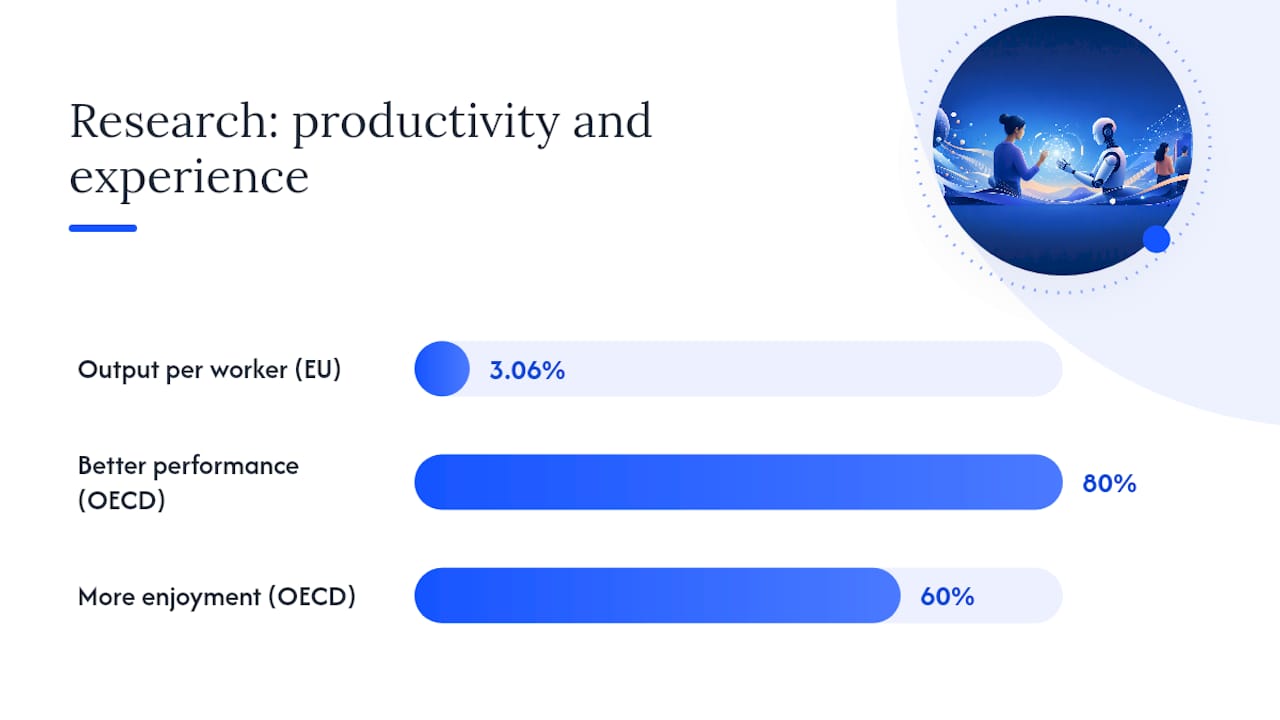
None of these studies claim AI eliminates the need for skilled workers. They measure output, sentiment, and cost equivalence, not job counts by title, and that distinction gets lost in a lot of the more breathless coverage of this research.
Where Augmentation Already Works: Sector Use-Cases
Abstract mechanisms are easier to trust once you see them applied. Here’s where augmentation is already delivering measurable results across major sectors.
Healthcare. Imaging triage tools flag likely abnormalities so radiologists spend their attention on cases that need it most, rather than scanning every image at the same pace. Administrative AI drafts clinical notes and handles scheduling, and MIT Technology Review reporting projects generative AI could reduce nursing administrative burden enough to be equivalent to adding substantial extra staff capacity over time, without replacing a single nurse’s clinical judgment.

Customer service. AI chatbots handle tier-one questions, password resets, order status, and basic troubleshooting, while human agents take over escalations, complaints, and anything requiring empathy or negotiation. Botiqueai has documented this pattern directly in a customer support automation case study, where routine volume gets absorbed by AI so human agents spend their time on the interactions that actually need a person.
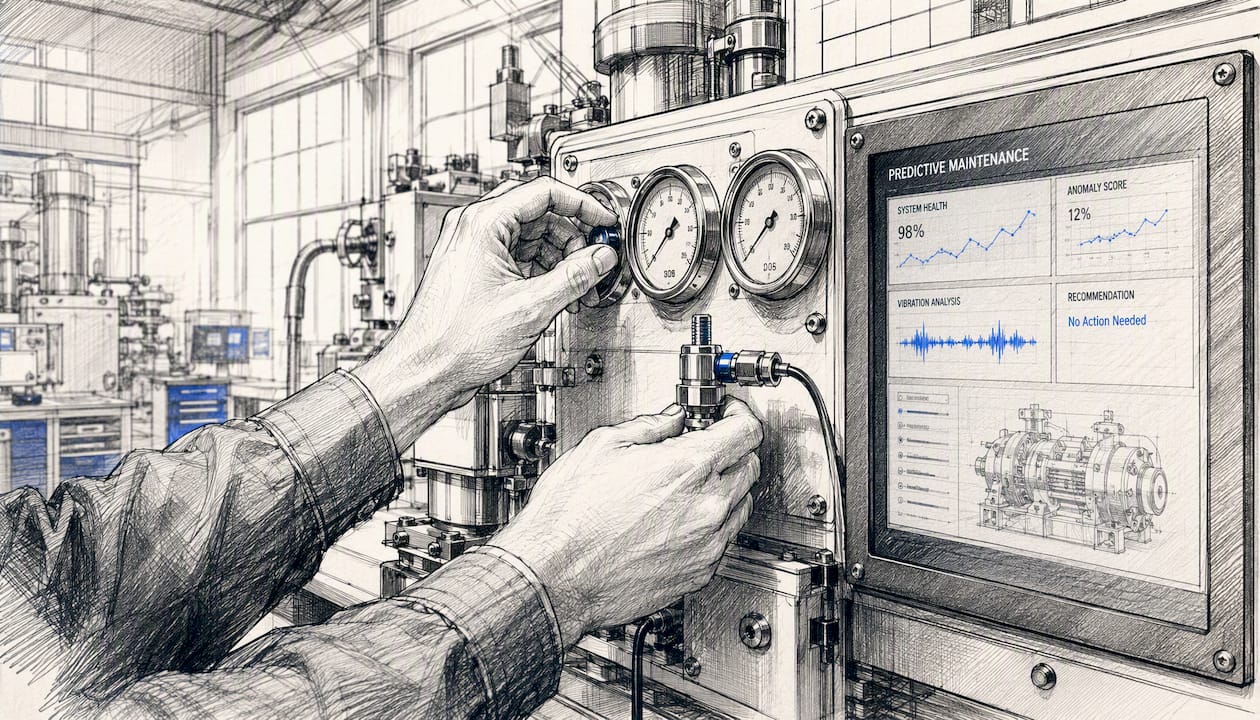
Manufacturing and logistics. Predictive maintenance systems monitor equipment vibration and temperature patterns, alerting technicians before a failure rather than after. Human operators and planners still make the call on scheduling downtime, but they’re making it with better information, not guessing based on a maintenance calendar.
Finance and legal. Document review tools that once took paralegals days now surface relevant clauses and flag compliance risks in minutes, though a human still signs off on interpretation. Fraud triage systems rank transactions by risk score, letting analysts focus their limited attention on the cases most likely to be real fraud.
HR and talent. Resume screening tools narrow a thousand applicants to a shortlist based on defined criteria, but hiring managers still make the final decision and conduct the interviews that actually predict fit. Learning platforms personalize training content to an employee’s skill gaps instead of running everyone through the same generic course.
A short pattern shows up across every one of these: identify the high-volume, low-judgment slice of the job, let AI absorb it, and let the human role shift toward the judgment-heavy remainder. That’s the augmentation loop in miniature, repeated across industries.
How Jobs Will Evolve: Skills That Matter Most Now
Job titles aren’t disappearing as fast as the automation panic of the early 2020s suggested. What’s actually happening is quieter and more interesting: routine components of jobs are shrinking, and new hybrid roles are emerging to manage the human-AI boundary itself.
Roles like AI trainers, prompt engineers, and workflow designers didn’t exist in most companies five years ago. Neither did the emerging “AI ethicist” function, which reviews AI-assisted decisions for fairness before they scale. These are orchestration roles: people whose job is making sure the human-AI handoff actually works.
Research on task allocation backs this up directly. A 2026 study on automation and augmentation found that whether a task should be automated or augmented depends on the type of complementarity involved. Within-task complementarity, where AI and human strengths interleave inside a single task, favors augmentation. Between-task complementarity, where AI can fully own a discrete step, favors automation. Most real jobs contain both, which is why blanket policies in either direction tend to underperform mixed approaches.
The human capabilities gaining the most value are the ones AI still handles poorly: contextual judgment, complex ethical reasoning, interpersonal negotiation, and creative problem-solving under ambiguity. Call it the EPOCH set, if you want a shorthand: empathy, presence, opinion, creativity, and holistic judgment.
Reskilling checklist for the next 12 months:
- Audit current roles for the routine-to-judgment ratio; prioritize training for people in roles shifting fastest toward judgment-heavy work.
- Build micro-credential programs around AI collaboration skills, not just AI literacy, focused on how to review, correct, and override AI output.
- Create internal mobility paths into orchestration roles for employees whose routine tasks are shrinking.
- Pair reskilling with real pilot exposure, not classroom-only training, so employees build trust calibration with actual tools.
- Track skill development against the specific tasks being automated in each department, not a generic company-wide curriculum.
Short-term priorities (six to twelve months) should focus on tool literacy and workflow redesign training for teams already touched by pilots. Medium-term priorities (one to three years) should build formal career paths into the new hybrid roles, backed by structured internal mobility programs rather than ad hoc reassignment.
Risks Leaders Cannot Ignore, and How to Mitigate Them
Augmentation done carelessly creates real harm, and pretending otherwise is how pilots turn into public relations problems.
Bias and discrimination top the list. AI systems trained on historical data can encode and amplify past discrimination in hiring, lending, or performance evaluation, often in ways that aren’t visible until an audit catches them. Privacy and surveillance concerns follow closely, particularly with algorithmic management tools that track keystrokes, movement, or communication patterns under the banner of “productivity insight.” Work intensification is a subtler risk: AI that removes downtime between tasks can quietly raise the pace of work beyond what’s sustainable, even while individual tasks get easier.
There’s also the risk of uneven access, where better-resourced teams or regions get AI tools first and pull ahead, widening internal inequality rather than closing it. And there’s a risk that cuts the opposite direction from what most people expect: overreliance, where workers stop questioning AI output even when it’s wrong, versus underreliance, where valid AI recommendations get ignored out of distrust or habit.
Mitigation isn’t complicated in principle, even if it takes discipline in practice:
- Consult workers before deploying AI into their workflow, not after. OECD research found that firms running these consultations made design adjustments that improved both productivity and worker outcomes compared to top-down rollouts.
- Run fairness testing on any AI system touching hiring, lending, or performance decisions, before and after deployment, not once at launch.
- Build privacy-by-design into monitoring tools, limiting data collection to what’s operationally necessary rather than everything technically possible.
- Assign clear accountability structures: someone specific owns the outcome of an AI-assisted decision, not “the algorithm.”
- Fund upskilling programs alongside deployment, not as an afterthought once workers start asking what happens to their role.
Pro Tip: Design your first pilot’s governance to surface problems early, not to prove the pilot works. Build in a mechanism for workers to flag issues anonymously during the pilot, and review those flags weekly. The pilots that fail quietly are the ones without a feedback channel.
A Practical Playbook: From Strategy to Scaled Deployment
Moving from “we should use AI” to a working augmentation program takes a sequence, not a single decision. Here’s the structure that tends to hold up.
Phase one: strategy. Define what success actually means before choosing a tool. Is the goal revenue growth, quality improvement, or employee experience? Pick the two or three processes where augmentation would matter most, and set governance ownership before you write a single line of code or sign a single contract.
Phase two: pilot design. Choose a high-value, genuinely low-risk use case first. Something where a failure costs you time, not customer trust. Define your metrics before launch, not after you see results you like. Include worker representatives in the design conversation, and keep the pilot period short enough to iterate, generally six to ten weeks.
Phase three: scale. Once a pilot proves out, operationalize the tooling into standard workflows rather than leaving it as a side project. Invest real budget in change management and training, and build a continuous measurement loop so you catch drift in performance or fairness before it compounds. BotiqueAI’s guide to running an AI pilot walks through this sequencing in more operational detail.
Tactical checklist by phase:
- Strategy: name the business outcome, name the process, name the owner.
- Pilot: pick the use case, set the metrics, staff the worker representatives, set the timeline.
- Scale: fund the training budget, integrate into existing tools, schedule quarterly measurement reviews.
| Metric Type | Example | What It Tells You |
|---|---|---|
| Leading indicator | Adoption rate among target users | Whether the tool is actually being used |
| Leading indicator | Time saved per completed task | Early efficiency signal before quality data matures |
| Lagging indicator | Error or rework rate | Whether speed came at the cost of quality |
| Lagging indicator | Employee satisfaction score | Whether the augmentation improved or hurt daily experience |
| Lagging indicator | Customer satisfaction change | Whether the end customer noticed a difference |
Before buying or building, ask vendors and internal teams a short list of hard questions: What happens when the AI is wrong, and who catches it? What data was this trained on, and does it reflect our actual user base? Can a worker override the system without a lengthy escalation process? A vendor who can’t answer these clearly is not ready for your production workflow, regardless of the demo.
How to Measure ROI and What Timeline to Expect
Measuring augmentation properly means comparing outcomes against a real baseline, not against a vendor’s projected benchmark.
The metrics that matter most: output per worker, time-to-completion on defined tasks, error rates, customer satisfaction scores, employee engagement, and, where you can calculate it, a labor cost equivalent estimate that translates time saved into dollar terms. Attribution requires discipline. Run pilots as genuine before/after comparisons, ideally with an A/B structure where one team uses the tool and a comparable team doesn’t, over the same period.
Quality-adjusted productivity matters more than raw speed. A support team that closes tickets twice as fast but generates twice the follow-up complaints hasn’t actually gained anything; it’s just moved the cost downstream.
Timelines vary predictably by the type of augmentation. Quick wins from automating clearly routine tasks, like document sorting or basic triage, tend to show up in weeks to a few months. Meaningful productivity returns from workflow transformation, the kind that touches how multiple roles interact, typically take six to eighteen months to materialize and measure reliably.
| Metric | How to Measure It | Typical Time to See Impact |
|---|---|---|
| Time-to-completion | Compare average task duration before and after tool adoption | 2 weeks |
| Error rate | Track defect or rework rate on AI-assisted vs. manual output | 4 to 12 weeks |
| Output per worker | Compare production volume per FTE across matched periods | 3 months |
| Employee engagement | Pulse survey before and after rollout | 3 months |
| Workflow-level productivity | Full process cycle time across all touched roles | 6 months |
Evidence Snapshot: What Leaders Should Take From the Research
Two data points anchor this entire discussion, and they’re worth holding side by side because they answer different questions.
The European Commission’s 2026 finding answers the firm-level question: does AI adoption pay off economically? The OECD’s survey answers the human-level question: do workers actually experience this as a benefit? Also yes, with four in five reporting better performance and three in five reporting more enjoyment.
Two different units of measurement, telling a consistent story.
Neither finding is a blank check. The productivity gain concentrated among firms that redesigned workflows, not just those that bought software. The worker sentiment gain concentrated in tasks that were repetitive or unpleasant to begin with. Distributional risk sits underneath both: the IMF’s analysis shows the trillions in aggregate value from AI adoption land unevenly, with some occupations and countries capturing far more than others. Reading these three sources together, augmentation-first strategy is well-supported, but only when paired with active training investment and attention to who’s being left out of the gains.
- Firm-level productivity gain: roughly 3% output per worker, with minimal aggregate employment loss.
- Worker sentiment: 4 in 5 report better performance, 3 in 5 report more enjoyment.
- Macro scale: trillions in labor cost equivalent value, unevenly distributed across occupations and countries.
- Design caveat: augmentation is common; true synergy requires deliberate task allocation, per the Nature Human Behaviour meta-analysis.
What Actually Works When You Implement This
Every AI rollout we’ve studied or supported follows one of two patterns: it starts small and earns trust, or it starts big and generates resistance. The organizations that get augmentation right almost always chose the first path, even when they had the budget for the second.
The most common trap isn’t technical. It’s treating AI as a drop-in automation for an existing role, then being surprised when adoption stalls because nobody asked the people doing the job what they’d actually find useful. A close second is ignoring data quality. An AI trained on messy, biased, or incomplete internal data will confidently produce messy, biased, or incomplete recommendations, and the confidence is what makes it dangerous. The third trap is skipping worker involvement entirely, treating the rollout as a technical deployment rather than a change management problem, which it always is.
What holds up better: start with one process, not five. Keep a human clearly in the loop on every consequential decision during the pilot phase, even if that feels slower. Measure the pilot against a real baseline, not a vendor’s promise. And invest in training before the tool goes live, not after employees start asking what it means for their job security.
Pro Tip: Trust erodes fastest when workers feel AI decisions happened to them rather than with them. Build a simple feedback loop where employees can flag a bad AI recommendation and see what changed as a result. That visibility, more than any policy document, is what keeps a rollout from turning adversarial.
Get Help Designing Your First Augmentation Pilot
The playbook above is straightforward on paper: pick a process, pilot it small, measure it honestly, scale what works. The harder part is building the actual chatbot, workflow automation, or decision-support tool that fits your specific systems instead of forcing your team to adapt to generic software. That’s the gap Botiqueai closes for companies that want augmentation without hiring an internal AI engineering team from scratch.
Botiqueai designs augmentation-first pilots built around your existing CRM, ERP, or support workflow rather than requiring you to rebuild around a new platform. For customer service specifically, the Aria chatbot handles tier-one web and e-commerce inquiries around the clock, giving your team back the hours currently spent on repetitive tickets so they can focus on the escalations that actually need a person. If your priority is internal process automation instead, Botiqueai’s team scopes the workflow, defines the pilot metrics, and builds the integration directly into the tools you already use.
The next step is a scoping conversation, not a sales pitch: bring one process you’re considering for augmentation, and Botiqueai will help you map whether it’s a fit for a pilot and what a realistic timeline looks like. Start that conversation through the Botiqueai team.
Frequently Asked Questions
Why does AI augment the human workforce instead of simply replacing it? AI augments the human workforce because most valuable work combines pattern recognition, which AI handles well, with contextual judgment and ethical reasoning, which humans still handle better. Research from the Nature Human Behaviour meta-analysis shows human-AI combinations consistently outperform humans working alone, even when they don’t outperform the AI system by itself.
What’s the difference between AI automation and AI augmentation? Automation replaces a task or process entirely, with AI performing the full sequence without human involvement. Augmentation keeps a human in the loop, using AI to handle the routine portion of a task while the person retains judgment and final decision authority. Most real workflows benefit from a mix of both, applied task by task.
How much productivity gain can companies expect from AI adoption? European firm data shows roughly 3% higher output per worker on average following AI adoption, with employment declines under 0.4% in that sample. Results vary significantly by sector and by how deeply the organization redesigns its workflows rather than simply bolting AI onto existing processes.
Which jobs are most likely to be augmented rather than automated? Jobs with high within-task complementarity, where human judgment and AI pattern recognition interleave inside the same task, tend to favor augmentation. This includes clinical diagnosis, legal review, complex customer negotiations, and strategic decision-making, according to research on automation and augmentation.
How should leaders start an AI augmentation pilot? Pick one high-value, low-risk process, define success metrics before launch, include worker representatives in the design, and run the pilot for six to ten weeks before scaling. Botiqueai’s pilot guide covers this sequencing step by step.
Sources
- European publication on AI adoption and productivity (2026)
- OECD: Using AI in the workplace (AI and work policy brief)
- MIT Sloan: Why AI-driven enterprises are future entrepreneurship
- When combinations of humans and AI are useful: A systematic review and meta-analysis | Nature Human Behaviour
- IMF working paper on AI aggregate and distributional impacts (2026)