
Why Build a Custom Chatbot Startup in 2026
Why Build a Custom Chatbot Startup in 2026
A custom chatbot startup is a business built around bespoke conversational AI systems designed to fit specific workflows, data environments, and customer needs. The core argument for building one is simple: off-the-shelf platforms give you speed, but they take away control. For founders asking why build a custom chatbot startup, the answer comes down to three forces: data sovereignty, integration depth, and long-term cost structure. Agencies like Botiqueai have made this their entire model, helping businesses replace generic AI tools with systems that actually match how they operate.
Why build a custom chatbot startup: the core business case
The primary reason to build a custom chatbot is full ownership of your data and your product behavior. When you use a SaaS chatbot platform, the vendor controls the model, the updates, and often the data pipeline. A custom build puts all of that under your roof.
Data sovereignty is not optional for startups in regulated industries. Healthcare founders must comply with HIPAA. Fintech founders face GDPR and financial data regulations. Any third-party vendor accessing that data creates legal exposure. Custom infrastructure eliminates that risk by keeping sensitive conversations inside your own private environment.

The economics also shift at scale. Above 5,000–8,000 monthly interactions, vendor SaaS fees can exceed the fixed cost of running custom infrastructure over a three-year period. That crossover point is where building stops being expensive and starts being cheaper than buying.
Custom-quality agents also resolve 70% of tickets without human escalation, compared to 35% for generic alternatives. That gap in resolution rate translates directly into support cost savings and faster customer response times.
- Full data ownership: No third party accesses or trains on your proprietary business data.
- Behavioral control: You define tone, escalation paths, and persona without vendor interference.
- Cost efficiency at scale: Fixed infrastructure beats per-interaction SaaS pricing above volume thresholds.
- Deep integration: Custom builds connect to legacy systems and proprietary APIs that SaaS connectors cannot reach.
Pro Tip: Before committing to a custom build, map your monthly interaction volume for the next 12 months. If you are consistently above 5,000 conversations per month, the financial case for building becomes hard to ignore.
When should a startup build versus buy a chatbot?
The build-versus-buy decision is not about preference. It follows clear criteria tied to volume, data sensitivity, and integration complexity.
Startups under 5,000 monthly interactions are almost always better served by a SaaS platform. The speed to market is faster, the engineering lift is lower, and the cost is predictable. Building at low volume is expensive and slow for no strategic gain.
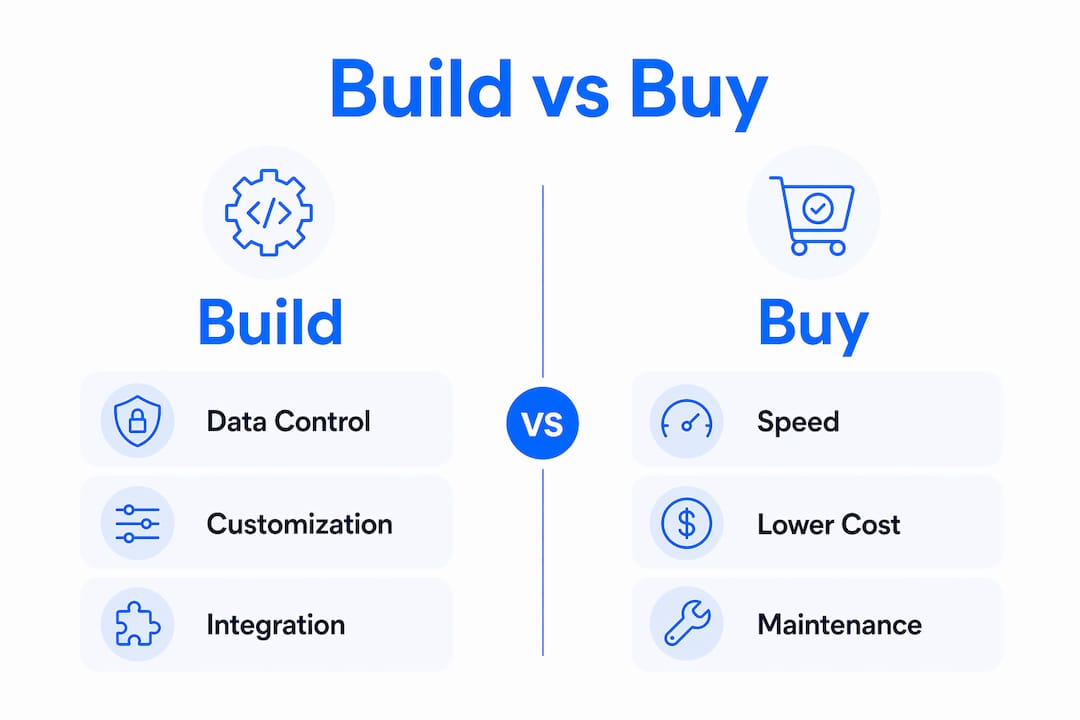
The calculus changes when three conditions appear together: high interaction volume, sensitive or regulated data, and the need to connect with internal systems that no standard connector supports. Proprietary business applications and legacy systems require custom engineering that SaaS platforms simply cannot provide safely.
One underused approach is the hybrid architecture. About 30–40% of conversations in most businesses require proprietary integration or regulatory architecture that only a custom layer can provide. A hybrid model uses an off-the-shelf platform for routine queries and routes complex or sensitive workflows to a custom-built layer. This approach cuts upfront cost while preserving control where it matters most.
For founders evaluating this decision, the chatbot vs. AI agent framework from Botiqueai offers a practical starting point for mapping use cases to the right architecture.
| Scenario | Recommended approach |
|---|---|
| Under 5,000 monthly interactions | SaaS platform for speed and low cost |
| Regulated data (HIPAA, GDPR, financial) | Custom build for full data control |
| Legacy or proprietary system integration | Custom engineering required |
| Mixed use cases at scale | Hybrid: SaaS for routine, custom for complex |
| Early-stage with standard use cases | Buy or integrate first, build later |
Pro Tip: Run a 90-day pilot on a SaaS platform before committing to a custom build. Real interaction data will tell you exactly where the platform breaks down and where custom engineering is actually needed.
How does a custom chatbot create a competitive advantage?
A custom chatbot becomes a defensible product asset. Off-the-shelf platforms give every competitor access to the same capabilities. Custom builds integrate proprietary data and tailored UX, creating a product experience that competitors cannot simply purchase and replicate.
Vendor lock-in is a real strategic risk that founders often overlook. Vendors can ship model updates that change chatbot behavior without offering rollback options. A startup that depends on a third-party AI roadmap has no control over how its product behaves after an update. Custom ownership eliminates that dependency entirely.
Speed of iteration is another advantage. A startup’s product evolves fast. A custom chatbot can be updated to match new features, new pricing logic, or new customer segments without waiting for a vendor’s release cycle. That agility compounds over time into a meaningfully better product.
The benefits of custom chatbots for customer engagement also extend to brand consistency. You control the persona, the tone, and the escalation logic. No vendor update can suddenly make your chatbot sound different or behave in ways that conflict with your brand standards.
- Defensible IP: Proprietary data and custom UX create a product moat competitors cannot buy.
- Roadmap independence: Your chatbot evolves on your schedule, not a vendor’s.
- Brand consistency: Tone, persona, and escalation logic stay under your control permanently.
- Feature integration: New product capabilities can be built directly into the chatbot without third-party approval.
What are the real challenges of building a custom chatbot?
Building a custom chatbot is a serious operational commitment. Founders consistently underestimate the ongoing maintenance burden once the initial build is complete. The chatbot needs monitoring, retraining, and on-call engineering support. That is not a one-time project cost. It is a recurring operational expense.
The time-to-market gap is also real. A SaaS platform can be live in days. A custom build typically takes weeks to months depending on integration complexity and team capacity. For early-stage startups racing to validate a product, that delay has a cost.
Upfront investment is higher with a custom build. You are paying for engineering time, infrastructure setup, and AI model integration before you see a single conversation. SaaS platforms spread that cost across a subscription, which feels lower risk even when it is more expensive over time.
The strategies that work best for managing these challenges include phased builds and external partnerships. Starting with a narrow, high-value use case reduces the initial engineering scope. Working with a specialized agency like Botiqueai compresses the timeline and transfers the maintenance burden to a team with existing infrastructure and expertise.
Pro Tip: Treat your first custom chatbot as a product, not a project. Assign an owner, set performance metrics, and budget for quarterly maintenance from day one. Startups that skip this step end up with chatbots that degrade quietly over time.
Key Takeaways
A custom chatbot startup delivers lasting competitive advantages when volume, data sensitivity, and integration needs justify the investment over a SaaS alternative.
| Point | Details |
|---|---|
| Volume threshold matters | Building pays off consistently above 5,000–8,000 monthly interactions. |
| Data sovereignty is non-negotiable | Regulated industries require custom infrastructure to meet HIPAA and GDPR obligations. |
| Hybrid architecture reduces risk | Use SaaS for routine queries and custom layers for complex or sensitive workflows. |
| Custom builds create defensible IP | Proprietary data and tailored UX cannot be replicated by competitors buying the same platform. |
| Maintenance is an ongoing cost | Budget for engineering support and monitoring from the start, not as an afterthought. |
The build decision is a strategy call, not a tech call
At Botiqueai, we have worked with enough startups to know where the real mistake happens. Founders treat the build-versus-buy question as a technology decision. It is not. It is a strategy decision about where you want control and where you are willing to accept dependency.
The most common misconception we see is that building a custom chatbot is always the premium, sophisticated choice. That is wrong. For a startup with 800 monthly conversations and a standard FAQ use case, building custom is wasteful. The right tool for that stage is a SaaS platform, full stop.
Where building becomes the right call is when your chatbot is the product, not a support feature. If the chatbot touches regulated data, connects to systems no vendor can access, or needs to evolve with your product at speed, then owning the architecture is not optional. It is the only path that keeps your options open.
The founders who get this right validate their use case on a SaaS platform first. They collect real data on conversation volume, failure points, and integration gaps. Then they build custom where the platform breaks down. That phased approach cuts risk and produces a much clearer engineering brief.
The long-term goal is a chatbot that becomes harder to replicate over time, not easier. Every month of proprietary data and custom tuning widens the gap between your product and what a competitor can buy off the shelf.
— Botiqueai
How Botiqueai builds custom chatbots for startups
Botiqueai specializes in building AI chatbots that give startups full control over data, behavior, and system integration from day one.
For web and e-commerce founders, the Aria Chatbot IA is built specifically for deep integration with product catalogs, order systems, and customer data. It handles complex queries that generic platforms cannot resolve without human escalation. Botiqueai’s approach starts with your actual use case, not a template, which means the chatbot fits your workflows rather than forcing your workflows to fit the chatbot. For startups ready to move beyond off-the-shelf limitations, Botiqueai’s AI solutions offer a practical path to building a chatbot that grows with your business.
FAQ
Why build a custom chatbot instead of using a SaaS platform?
Custom chatbots give startups full data ownership, deep system integration, and behavioral control that SaaS platforms cannot provide. The financial case strengthens above 5,000–8,000 monthly interactions, where fixed infrastructure costs undercut per-interaction SaaS fees.
What industries need a custom chatbot for compliance reasons?
Healthcare, finance, and any sector handling personal data under GDPR or HIPAA must use custom infrastructure. Third-party SaaS vendors accessing regulated data create legal exposure that custom builds eliminate by keeping data within private environments.
How long does it take to build a custom chatbot startup?
Build timelines vary by integration complexity, but most custom chatbot projects take weeks to months compared to days for a SaaS platform. Working with a specialized agency like Botiqueai compresses that timeline significantly.
What is a hybrid chatbot architecture?
A hybrid architecture uses a SaaS platform for routine, standard queries and routes complex or sensitive conversations to a custom-built layer. This approach covers roughly 30–40% of conversations that require proprietary integration or regulatory compliance that off-the-shelf tools cannot handle.
When does building a custom chatbot become cost-effective?
Building becomes cost-effective when monthly interaction volume exceeds 5,000–8,000 conversations. At that scale, fixed custom infrastructure costs over three years fall below the cumulative SaaS subscription fees for equivalent volume.