
Why Chatbots Reduce Support Costs for Business Owners
Why Chatbots Reduce Support Costs for Business Owners
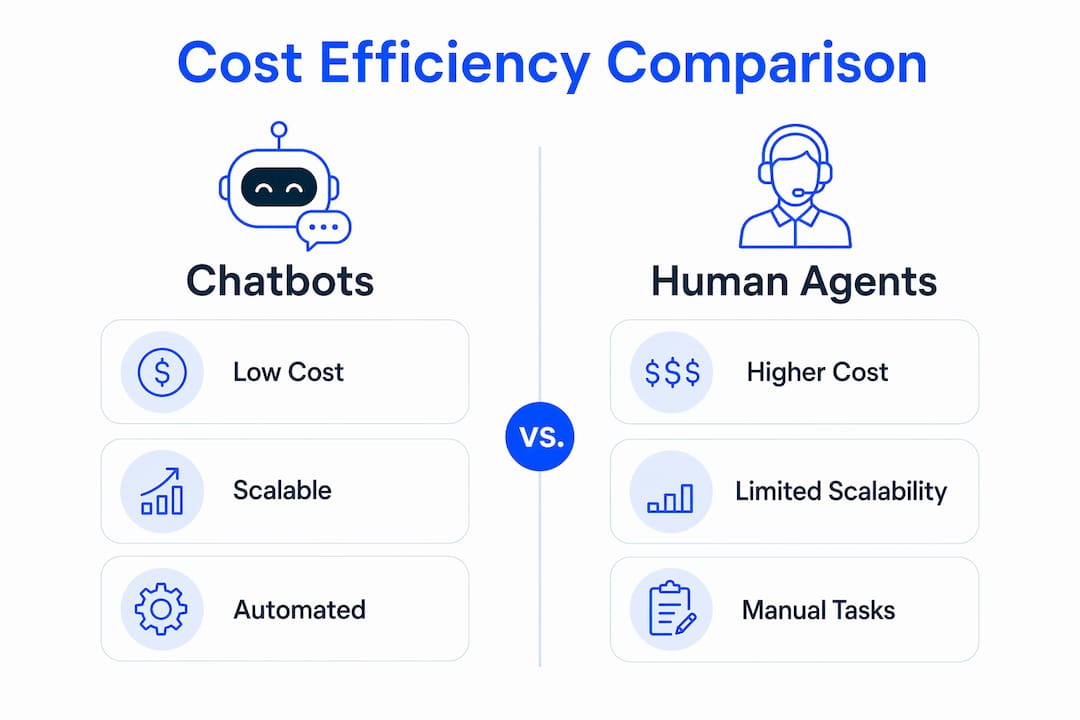
Chatbots reduce support costs by replacing human agents on routine, high-volume interactions at a fraction of the price. IBM reports an average 30% reduction in customer service costs when businesses deploy chatbot automation. The per-interaction cost difference is stark: a chatbot handles a query for $0.50–$0.70, while a human agent costs $4.13–$6.00 for the same interaction. That gap is why chatbots in customer service have moved from a nice-to-have to a core cost management tool. The real question is not whether chatbots save money, but how much, under what conditions, and what it takes to sustain those savings over time.
Why chatbots reduce support costs compared to human agents
The core mechanism is simple: chatbots automate the work that human agents repeat dozens of times per day. Password resets, order status checks, return policy questions, and basic account changes make up the majority of support volume in most businesses. A chatbot handles all of these without a salary, benefits, or shift scheduling.
The cost advantage compounds at scale. Businesses with over 100 daily support inquiries see the greatest savings because fixed chatbot costs spread across more interactions as volume grows. A human team, by contrast, requires proportional headcount increases as demand rises. That asymmetry is what makes chatbot cost efficiency so attractive for growing companies.
Three specific cost drivers explain the savings:
- Labor substitution: Chatbots handle routine queries without adding headcount, directly cutting payroll costs for tier-1 support.
- After-hours coverage: A chatbot operates 24 hours a day, 7 days a week with no overtime or shift premiums. Human agents covering nights and weekends carry a significant cost premium.
- Faster resolution: Instant responses reduce handle time per ticket, which lowers the cost per resolved issue even when human agents are involved downstream.
The scalability advantage is the most underappreciated factor. During peak seasons, a chatbot absorbs volume spikes without emergency hiring or contractor fees. That alone can justify deployment for businesses with seasonal demand patterns.
How does CRM integration affect chatbot ROI?

A standalone chatbot answers questions. An integrated chatbot takes action. That distinction defines the difference between modest savings and genuine ROI transformation.
When a chatbot connects to your CRM, marketing automation stack, or e-commerce platform, it can update customer records, trigger follow-up workflows, qualify leads, and process transactions without human involvement. These are called agentic capabilities, and they move the chatbot from a cost-reduction tool to a revenue-generating one. Integrated, agentic chatbots deliver 3 times higher conversion rates and 35% higher average order values compared to standalone conversational bots. That revenue lift changes the ROI calculation entirely.
Native CRM integration also eliminates the manual data entry that agents perform after every interaction. Each ticket a chatbot resolves and logs automatically saves several minutes of agent time. Across thousands of monthly interactions, that adds up to meaningful labor hours recovered.
The ROI gap between standalone and integrated solutions is significant. Standalone bots often reduce costs modestly through basic ticket deflection. Integrated solutions generate savings on labor, reduce errors from manual data handling, and add revenue through lead qualification and upsell prompts. Proper chatbot ROI analysis must include revenue lift, lead qualification, and data enrichment impact, not just ticket deflection numbers.
Pro Tip: Before selecting a chatbot platform, map every business system your support team touches during a typical interaction. Any system a chatbot can connect to is a potential source of additional ROI beyond basic cost savings.
What are the hidden costs of maintaining a chatbot?
Chatbots are not a set-and-forget investment. Without regular updates, chatbot performance degrades rapidly as products change, policies shift, and customer questions evolve. A chatbot trained on last year’s knowledge base will give wrong answers, frustrate customers, and push more tickets to human agents, which erases the savings it was deployed to create.
The ongoing maintenance burden includes several categories that decision-makers often underestimate:
- Knowledge base updates: Product changes, pricing updates, and policy revisions all require chatbot content to be refreshed. This takes dedicated staff time on a recurring basis.
- Flow and logic adjustments: As customer behavior changes, conversation flows need tuning to maintain high containment rates.
- Human oversight: Someone must review chatbot transcripts regularly to catch errors, identify gaps, and flag escalation failures.
- Policy and compliance updates: Regulated industries face additional requirements to keep chatbot responses current with legal standards.
Realistic ROI modeling must include bot containment rates, revenue effect, and maintenance costs. Overly optimistic assumptions produce disappointed returns. A chatbot that deflects 80% of tickets in month one may deflect only 55% by month twelve if no one maintains it.
Pro Tip: Budget a fixed monthly allocation for chatbot maintenance before you calculate your expected savings. Treat it like server costs: non-negotiable and always present.
How do chatbots improve efficiency and customer experience at the same time?
Reducing costs and improving service quality are not competing goals with chatbots. They reinforce each other. When a chatbot handles routine tickets, human agents spend their time on complex, high-value issues where judgment and empathy matter. That shift improves both the agent experience and the quality of service customers receive on difficult problems.
The numbers support this dual benefit. Chatbots handle up to 80% of routine support tickets in some organizations, which frees agents to focus on escalations, retention conversations, and technical troubleshooting. The result is a support team that operates at a higher level without adding headcount.
Four operational improvements follow directly from chatbot deployment:
- Instant response times: Customers receive answers in seconds rather than waiting in a queue. Reduced wait times lower frustration and abandonment rates.
- Consistent answers: Every customer receives the same accurate response to the same question. Human agents vary in knowledge and tone; chatbots do not.
- Abandoned cart recovery: E-commerce chatbots can proactively engage customers who leave without purchasing, recovering revenue that would otherwise be lost.
- Lead qualification: Chatbots can ask qualifying questions, score leads, and route high-value prospects to sales teams automatically.
“Customer satisfaction improves most with chatbots that efficiently solve problems and provide quality information. Survey research confirms that problem-solving capability and information quality drive satisfaction more than any other chatbot characteristic, including how human-like the bot appears.”
The loyalty benefit compounds the cost savings. Customers who get fast, accurate answers return more often and require less repeat contact. That reduces total support volume over time, which further lowers costs without any additional investment.
For a detailed look at how this plays out across industries, enterprise chatbot deployments show consistent patterns: high containment rates, measurable labor savings, and improved customer satisfaction scores when bots are well-maintained and properly integrated.
Key Takeaways
Chatbots reduce support costs most effectively when they are integrated with business systems, actively maintained, and deployed at sufficient volume to spread fixed costs across a high number of interactions.
| Point | Details |
|---|---|
| Cost per interaction gap | Chatbots cost $0.50–$0.70 per interaction versus $4.13–$6.00 for human agents, per IBM data. |
| Scale drives savings | Businesses handling over 100 daily inquiries see the strongest ROI as fixed chatbot costs spread across volume. |
| Integration multiplies ROI | Agentic chatbots connected to CRMs deliver 3x higher conversion rates than standalone bots. |
| Maintenance is non-negotiable | Without regular updates, containment rates fall and support burden shifts back to human agents. |
| Dual benefit | Chatbots handle up to 80% of routine tickets, freeing agents for complex work and improving overall service quality. |
What I have learned from real chatbot deployments
The businesses that get the most from chatbots share one trait: they treat the chatbot as a living system, not a one-time project. The ones that struggle deploy a bot, declare victory, and move on. Six months later, they wonder why their support costs are creeping back up.
The integration question is where I see the biggest gap between expectation and reality. A standalone chatbot that answers FAQs will save some money. But the businesses that see genuinely transformative results are the ones that connect their chatbot to their CRM, their order management system, and their marketing stack. That is when the bot stops being a cost center and starts generating revenue. The difference between a chatbot and an AI agent matters here: agentic systems that take multistep actions consistently outperform simple Q&A bots on every financial metric.
The other lesson is about containment rate honesty. Vendors will quote you their best-case numbers. Your actual containment rate depends on how well your knowledge base is maintained, how complex your product is, and how much your team invests in ongoing tuning. I recommend stress-testing your ROI model with a conservative containment rate before you commit to a platform. If the numbers still work at 50% containment, you have a real business case. If they only work at 85%, you are betting on a best-case scenario.
Avoiding common chatbot mistakes in the early stages of deployment saves significant time and money later. The patterns are predictable and preventable with the right planning.
— Botiqueai
How Botiqueai helps businesses cut support costs with integrated AI
Botiqueai builds custom AI chatbots and intelligent agents designed to connect directly with your existing CRM, e-commerce platform, and business workflows. The result is a chatbot that does more than answer questions: it qualifies leads, updates customer records, and triggers automated follow-up actions without human intervention.
The Aria chatbot from Botiqueai is built for businesses that want measurable cost savings from day one. Aria integrates with your existing systems, handles routine support volume at scale, and gives your team a no-code management interface for ongoing updates. Business owners who want to see what integrated chatbot automation looks like in practice can explore Botiqueai’s AI solutions to find the right fit for their operation.
FAQ
How much can chatbots reduce customer support costs?
IBM data shows chatbots reduce customer service costs by up to 30% on average. The savings come from lower cost per interaction ($0.50–$0.70 versus $4.13–$6.00 for human agents) and reduced headcount requirements for routine support volume.
What types of queries do chatbots handle best?
Chatbots handle repetitive, high-volume queries most effectively, including order status, password resets, return policies, and basic account changes. These categories make up the majority of support tickets in most businesses and require no human judgment to resolve.
Do chatbots improve customer satisfaction or just cut costs?
Chatbots improve satisfaction when they solve problems accurately and quickly. Research confirms that problem-solving capability and information quality drive customer satisfaction more than any other chatbot characteristic, including how conversational the bot sounds.
What is the biggest risk to chatbot ROI?
Neglecting maintenance is the primary risk. Without regular updates to knowledge bases and conversation flows, containment rates fall and more tickets escalate to human agents, which erodes the cost savings the chatbot was deployed to generate.
Are integrated chatbots worth the higher upfront cost?
Integrated, agentic chatbots consistently outperform standalone bots on ROI. They deliver 3 times higher conversion rates and 35% higher average order values by connecting to CRMs and automating multi-step business processes beyond basic ticket deflection.